


Monday, March 22, 2010

Baker Bighorns "Blinking Out," "Lords of Nature," plus Hillary Clinton on the "Jewish State"

[Edited, info added 3/23/10]
In This Issue:

- Baker Bighorns "Blinking Out"

- Bob Beschta & "Lords of Nature" in Baker City Tonight & Tomorrow

- Hillary Clinton Validates a "Jewish State" in Palestine (Hmmmmmmm)
_________________


Baker Bighorns "Blinking Out" - Payette National Forest Bighorn Plan

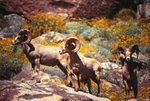
Bighorn Ram (photo from ODFW)

Our Hells Canyon bighorn sheep are suffering severe population declines from contact with domestic sheep that were, and are, presently allowed to be in the proximity of domestic sheep on public forest lands in the Payette National Forest across the river in Idaho.

According to "Bighorn Sheep in Hells Canyon: Historical Background and the Hells Canyon Bighorn Sheep Restoration Project,"Originally published in the summer 2002 issue of Wild Sheep Magazine, the official publication of the Foundation for North American Wild Sheep (Tim Schommer):

Rocky Mountain bighorn sheep were native in much of the mountain and canyon country, which currently comprises northeast Oregon and western Idaho. Historical accounts indicate that bighorns were numerous in and around Hells Canyon, main Salmon River, and the Wallowa Mountains. The Nez Perce Tribe has written that bighorns were the most plentiful large animal in the big river canyons of northeastern Oregon and west Idaho prior to European settlement.

The archeological records in Hells Canyon shows that the Nez Perce people had an extended and extensive history of using bighorn sheep. We know they constructed stone corrals for the capture and containment of bighorns and stone blinds for hunting. They used the animals for their meat, hides for warmth, and the horns for spoons (ewes) and bow making (rams). Most petroglyphs and pictographs in Hells Canyon depict scenes of hunters and bighorn sheep. Bighorn sheep were a significant ungulate food item as well as of great cultural value to the Nez Perce Tribe in Hells Canyon.

As European people settled the west, many of the activities either directly or indirectly had a negative impact on native bighorn sheep populations. In Hells Canyon, settlers quickly claimed every flat area with good soil, especially near the water. They brought with them flocks of cattle, horses, and domestic sheep. The flat areas were irrigated and turned into hay fields, while large gardens and orchards were adjacent to their homes.

Domestic herds grazed most of the year on adjacent “Unclaimed Lands” (now mostly public lands). The mild climate in Hells Canyon usually provided year-round grazing. Most homesteaders greatly increased the size of their flocks to take advantage of free grazing and increase revenue. Grazing soon became out of control and severely damaged soil, vegetation, and water quality. One settler wrote in 1901 that if he was not the first one to get to the grass after the snowmelt, they got none there the rest of the year (Langston, 1995). Range wars were common, especially between cattle and sheep producers. By the turn of the century, the situation demanded desperate measures. In 1905, Teddy Roosevelt convinced Congress to establish the National Forest Reserves. The main purpose of the reserves was to stop uncontrolled grazing and timber harvest, and improve and sustain quality soil and water conditions. Also in 1905, the Wallowa Cheifton reported there were over 300,000 domestic sheep in Wallowa County (northeast Oregon), most of which grazed on National Forest. . . . .

Unregulated hunting, competition for forage with domestic livestock, and parasites and diseases introduced by domestic livestock were all factors which lead to the elimination of bighorns in Hells Canyon. Today, research has shown that pneumonia caused by a biotype of bacteria called Pasteurella, which is transmitted from domestic sheep to bighorns, was the principal reason for the disappearance of bighorns in Hells Canyon and throughout most of the western United States (Martin et. al., 1996).
See this article's title link above for more. . .

Recently, a Baker City neighbor told me about the abundant bighorn population, as well as viewing and photography opportunities that existed down in Hells Canyon from below the Hells Canyon Dam to the Sheep Mountain area of Oxbow Reservoir and around Brownlee Dam. After a futile search recently for these bighorn, I spoke with the Oregon Department of Fish and Wildlife (ODFW) to see if I could improve my chances. That’s when I learned just how bad things had become since I’d seen my first Hells Canyon bighorn 8 or 9 years ago.

According to ODFW, the Sheep Mountain population is on the verge of “blinking out” and there were only six or so bighorn left in the Hells Canyon Dam area, which I believe is the “Upper Hells Canyon” population. ODFW had recently completed their winter bighorn minimum population census and found that there were only about nine sheep left in the Sheep Mountain herd, falling to this level from a high of 87 animals in 1999, after the initial transplant of 30 animals in 1991. ODFW indicated since disease issues related to domestic sheep allotments started in 1999, only 2 offspring have survived, with most dying within a month or two of birth.

According to a 2006 report by the Payette National Forest, Risk Analysis of Disease Transmission Between Domestic Sheep and Bighorn Sheep on the Payette National Forest, bighorn sheep are dying in the Hells Canyon area because of disease transmitted by domestic sheep, kept, and herded by, a few sheep allotment permittees on the Payette National Forest. The report states:

Perhaps the most important reason bighorn sheep populations have recovered poorly is that bighorn populations have been negatively affected by disease to a much greater extent than have populations of other wild ungulates such as mule deer and elk (Goodson 1982). Bighorn sheep is a New World species closely related to domestic sheep (Ovis aries). Domestic sheep, an Old World species, has likely evolved resistances to important diseases as a result of domestication
and intense artificial selection. Because they are so closely related, bighorn sheep are thought to be highly susceptible to diseases carried by domestic sheep.

An extensive body of scientific literature on the effects of disease on bighorn populations has accumulated. The literature indicates the following:

1) numerous examples of bighorn die-offs due to disease have been documented;
2) bighorn die-offs were documented as early as the mid 1800s and have been documented in every state in the western U.S.;
3) bighorn die-offs typically follow known or suspected contact with domestic sheep;
4) under experimental conditions, clinically healthy bighorn sheep have developed pneumonia and died within days to weeks following contact with clinically healthy domestic sheep;
5) a variety of diseases and pathogens have been implicated in die-offs, but most commonly the disease implicated in the die-off is bacterial pneumonia (Pasteurellosis) caused by Mannheimia haemolytica (formerly Pasteurella haemolytica) or other species of closely related Pasteurella bacteria;
6) there is consensus among wildlife biologists and veterinarians experienced in bighorn sheep management that
domestic sheep and bighorn sheep must be kept separated in order to maintain healthy bighorn populations (e.g., Foreyt and Jessup 1982; Goodson 1982; Onderka and Wishart 1988; Foreyt 1989; Desert Bighorn Council Technical Staff 1990; Callan et al. 1991; Cassirer et al. 1996; Martin et al. 1996; USDI Bureau of Land Management 1998; Bunch et al. 1999; Singer et al. 2000a, 2000b, 2000c, 2000d; Monello et al. 2001; Schommer and Woolever 2001; Singer et al. 2001; Dubay et al. 2002; Garde et al. 2005).


So, once again, the American people are sacrificing their wildlife heritage for the profit of a few public lands grazing permittees, their employees, and any taxes to be derived therefrom, minus the huge costs associated with managing the allotments.

Comments were due today on the updated Payette National Forest draft supplementary environmental impact statement on their plans for management of domestic sheep allotments in the area inhabited by bighorns.

You will have an opportunity in the future to comment on the final supplementary environmental impact statement. With regard to the draft, I sent them the following hurried comments, such as they are:

March 22, 2010

Christopher Christie
1985 15th Street
Baker City, OR 97814
refugee2000@gmail.com
541-523-2376

Suzanne C. Rainville
Forest Supervisor
Payette National Forest
Attn: Bighorn Sheep Comments
800 W. Lakeside Ave.
McCall, ID 83638
payettebighorn@fs.fed.us

Re: Draft Supplemental Environmental Impact Statement on Bighorn Sheep Viability—Comments

Dear Supervisor Rainville:

These are my comments on the Payette National Forest’s (“PNF”) Draft Supplemental Environmental Impact Statement on Bighorn Sheep Viability (“DSEIS”).

I cooperate with the Hells Canyon Preservation Council (HCPC), the Western Watersheds Project (WWP), and the Oregon Natural Desert Association (ONDA). I am aware of the views of HCPC and WWP and agree with their view that Alternative 7E should be selected. I have read the comments by Debra Ellers and the WWP. I agree with and support those comments.

Since my early youth, I have been fortunate to become acquainted with bighorn sheep through observation while traveling in the western U.S. and Canada. I have been concerned about their viability and ultimate survival since becoming aware of the struggles for survival of endangered Peninsular bighorn sheep during my years in California.

In 2001 or 2002, while on a jaunt to Hells Canyon from Prairie City, Oregon, I encountered a collared and bedraggled looking ewe on a trail along the rim in what was the Mc Graw herd area. While aware of disease transmission between domestic sheep, other livestock, and bighorns at the time, I had no idea of the tragedy that had been inflicted on the re-introduced Hells Canyon populations, including the McGraw herd, through contact with domestic sheep in the 1990’s and earlier parts of this decade.

After I moved to Baker City, my neighbor told me about the abundant bighorn population and opportunities viewing and photographing them down in Hells Canyon from below the Hells Canyon Dam to the Sheep Mountain area of Oxbow Reservoir and around Brownlee Dam. After a futile search recently for these bighorn, I spoke with the Oregon Department of Fish and Wildlife (ODFW) to see if I could improve my chances. That’s when I learned just how bad things had become since I’d seen my first Hells Canyon bighorn 8 or 9 years ago.

According to ODFW, the Sheep Mountain population is on the verge of “blinking out” and there were only 6 or so bighorn left in the Hells Canyon Dam area, which I believe is the “Upper Hells Canyon” population. ODFW had recently completed their winter bighorn minimum population census and found that there were only about nine sheep left in the Sheep Mountain herd, falling to this level from a high of 87 animals in 1999, after the initial transplant of 30 animals in 1991. ODFW indicated since disease issues started in 1999, only 2 offspring have survived, with most dying within a month or two of birth.

After reading the Risk Analysis of Disease Transmission Between Domestic Sheep and Bighorn Sheep on the Payette National Forest, (Payette National Forest, February 6, 2006), it appears that contact with domestic sheep on allotments or driveways within the Payette National Forest, is responsible for these unnecessary population declines.

According to the observational narrative in the report on pp. 7 and 8, some animals in the McGraw herd were crossing over to the Idaho side domestic sheep allotments and becoming sick from pneumonia. It also says that the McGraw herd began dying in the fall of 1999, and that two of them had also been observed mingling with Oregon’s Sheep Mountain herd that year, the year the Sheep Mountain herd die-off began. (The assumption being that the individuals from the McGraw herd could have transmitted the disease contracted originally from domestic sheep, to the Sheep Mountain herd.

Figure 3-6, Telemetry Data and Observations of Bighorn Sheep near the Payette National Forest, on p. 3-16 of the recent Update to the DSEIS (Update), confirms that two modes of transmission are possible: One of direct contact between bighorn and domestic sheep, and another of inter-herd re-transmission from bighorn to bighorn.

Evidence that inter-herd mixing of bighorns is fairly common and widespread between far-flung herds can be seen in the telemetry data represented in Figure 3-6. The data represented there, also suggests that the Upper Hells Canyon bighorns could have contracted disease by contact with domestic sheep on the sheep driveway that existed in previous years on the western slope of Cuddy Mountain in Idaho, after having crossed over at Brownlee Dam, with subsequent infection of the bighorns of the Sheep Mountain herd. The Update also states on p. 2-14, that” In addition, bighorn sheep foray in and out of domestic sheep allotments located on the Payette NF, often returning to the HCNRA.”

These things lead me to believe that the Payette National Forest (PNF) should choose Alternative 7E, which would not allow domestic sheep grazing or trailing routes within the PNF, because that alternative offers the best chance for maintaining bighorn viability and compliance with the National Forest Management Act (NFMA).

There is also other information in the Update that clearly points to Alternative 7E being the reasonable, rational, and legally supportable choice:

- It is the only alternative that prevents interspecies contact, thus preventing re-initiation of disease cycles from the original and major source for disease transmission. In discussing the Contact Model on p. 2-11, the Update states that “Alternative 7E is the only alternative that prevents interspecies contact,” which eliminates the original and recurring source of the disease problem. The preferred Alternative 7G does little to remedy the contact problem, as the Update admits on p. 2-11: “Alternatives 1B257, 346, 7G and 7L have moderate to high contact rates that involve four to seven of the populations.” Over half (56%) of the nine alternatives do a better job of preventing contact than the preferred Alternative 7G.

- 7E maximally reduces the probability of external domestic sheep initiated disease outbreaks in the affected herds. In discussing 7E in the Disease Model on p. 2-12, the Update states that “Alternative 7E (no allotments) was not included. The probability of a disease outbreak for all herds under this alternative is 0.” Under even moderate probability of contact assumptions, the preferred Alternative 7G results in a high probability of extirpation for four herds, including Upper Hells Canyon. (Update p 2-12: Under moderate assumptions for contact leading to a disease outbreak; Little Salmon, Main Salmon S. Fk. and Upper Hells Canyon have a high probability of extirpation under Alternatives 1B257, 346, 7G and 7L.)

- In the Update, on p. 2-13, under the heading “Summary and Determinations,” it states: “ Alternative [7]E provides the greatest protection to bighorn sheep habitats, the least likelihood of contact, and the highest probabilities of persistence for all bighorn sheep populations. For bighorn sheep, as a sensitive species, this alternative would have a Beneficial Impact.” This statement reiterates some of the conclusions above, and clearly shows that Alternative 7E provides the best chance for bighorn viability and survival. On the other hand, the preferred Alternative, 7G ranks 6th in “probability for bighorn sheep persistence,” and is one of the alternatives with “the highest risks of contact and protect the least amount of source habitats, [and] would likely not insure bighorn sheep populations on and adjacent to the Payette National Forest. . . .[and also] Will Impact Individuals or Habitat with a Consequence that the Action May Contribute to a Trend Towards Federal Listing or Cause a Loss of Viability to the Population or Species.” (Update p. 3-13)

- On p. 2-16 of the Update, it states that “Alternative 7G eliminates domestic sheep grazing from the Payette National Forest system lands within the boundary of the HCNRA. It also eliminates domestic sheep grazing at least 6 air miles from the boundary of the HCNRA. Only a small sliver of the core herd home range is within suitable area for domestic sheep grazing. Elimination of domestic sheep grazing in HCNRA and surrounding area is compatible with the HCNRA Act and its implementing regulations by providing for the protection, restoration, and maintenance of bighorn sheep and their habitat.” This last statement, as it applies to 7G, does not appear to be true because telemetry and other data in the Update shows that the bighorn in question travel much further on their forays than 6 miles, which would likely lead to further disease transmission. Even WAFA recommends a 9 mile buffer. Additional disease transmission hardly qualifies for protection of bighorn under the act. The Update also notes on p. 3-73 that: “Keeping an adequate spatial buffer between bighorn sheep and domestic sheep is the most reliable method of preventing contact between these species (Desert Bighorn Council Technical Staff 1990, Schommer and Woolever 2001, Singer et al. 2001), but spatial buffers are not always adequate given the distances bighorn sheep rams will travel (Wehausen et al., unpublished data). Clifford et al. (2009) recommended that if eliminating the risk of interspecies contact (thereby eliminating the probability of respiratory disease transmission to bighorn sheep from domestic sheep) is a management goal, at a minimum, domestic sheep grazing should not occur within the known population utility distribution of the bighorn sheep.”

- On p. 2-16 of the Update, it also states that “Alternative [7]G is in compliance with the HCNRA CMP by maintaining a separation between bighorn and domestic sheep that is likely to keep the two species apart at the current population levels. If the population levels of bighorn sheep increase, the likelihood of contact may increase and this evaluation may need to be revisited.” First, I found no evidence in the update that supports the first assertion, even at current population levels (please point it out if it is there). Additionally, keeping the populations at their current depauperate levels can hardly be seen as complying with the HCNRA Act or “its implementing regulations by providing for the protection, restoration, and maintenance of bighorn sheep and their habitat.” It is already clear that some populations, like the Sheep Mountain population are doomed to extirpation in the short term. Restoration implies an expansion of at least some populations, so dealing with the eventuality is best addressed by Alternative 7E, not by promising to revisit the subject at some future date.

- On p. 2-16 of the Update, with reference to 7G, it also states that “Monitoring should be conducted to assess future locations of bighorn sheep and assure no contact occurs with domestic sheep on permitted allotments.” Yes, on most livestock allotments, monitoring “should” be conducted, but it rarely is adequate because of USFS budgets. Clifford et.al. (2009) state: Husbandry practices such as removing domestic sheep well before the onset of rut, following vigilant herd management to reduce strays, and responding to wandering bighorn sheep, are other methods to separate the species and reduce risk, but extensive monitoring efforts are required and are not always effective (DSEIS IDT and Cooperators 2007, 2008).” I think everyone can agree that “monitoring efforts are required and are not always effective.”

- The economic analysis of portion of the Update on beginning on p. 3-89, particularly that under the heading “Income, from Sheep and Lamb Production in Idaho,” p. 3-92&94, while interesting, seems woefully inadequate, and/or irrelevant in many areas. The analysis needs to focus on the income (including income of the permittees), and taxes, derived from the use of the allotments in question, not on what comes from some counties or the whole state. It should also focus on actual use, not permitted use. It should compare the economic benefits of the sheep allotments to all the costs, including program administration cost, environmental rehabilitation costs, and to the loss of recreational tourist dollars in both Oregon and Idaho (among other costs), and show them clearly in a table, so that readers don’t become lost in pages of seemingly irrelevant statistics.

Having started very late on these comments, there is simply no time left for more of them. Again, I agree with HCPC and WWP that Alternative 7E should be implemented by the Payette National Forest to best provide for bighorn protection, viability, and restoration.

Thank you for consideration of these comments. Please keep me on your mailing list for any further communications, and particularly, the Final SEIS.

Sincerely,

Christopher Christie

Endangered Peninsular Bighorn Sheep, 1998
__________

Bob Beschta & "Lords of Nature" in Baker City Tonight & Tomorrow

Talks on March 24 in Baker City and in Enterprise

The Wallowa-Whitman National Forest is hosting a talk on "Carnivores and Sustainable Ecosystems", by Oregon State University Professor Emeritus, Dr. Bob Beschta, on Wednesday March 24 at two locations and times:

Baker City - 9:00 a.m., Whitman Ranger District, 3285 11th Street.

Enterprise - 3:00 p.m., Wallowa Mountains Office, 88401 Highway 82.

Dr. Beschta has taught and conducted research on a wide range of natural resource issues related to forest and rangeland ecosystems for over 36 years. Since 2001, his research has focused on the role of large predators and trophic cascades in western ecosystems. His presentation will summarize the results from six widely separated National Parks, including Yellowstone, where large predator removal/displacement occurred and the potential implications of these results to other public lands in the West.

Each talk will be 45 minutes to one hour long, followed by a 30-minute question and answer period. The public is invited to attend.

For additional information call Suzanne Fouty at 541-523-1944 (Baker City) or Trisha Johnson, at 541-426-5572 (Enterprise).


photo courtesy of Green Fire Productions


Lords of Nature Showings March 23rd and 24th
in Baker City and Enterprise.


The film by Green Fire Productions "Lords of Nature: Life in a Land of Great Predators" will be shown in:

Baker City on Tuesday March 23rd at the Eltrym Theatre (1809 1st Street) at 7 pm

Enterprise on Wednesday March 24th at the OK Theatre (208 W. Main St.) at 7 pm

Both showings will be followed by a panel discussion, with:
Dr. Bob Beschta, Oregon State University
Russ Morgan, Oregon Dept. of Fish & Wildlife (ODFW)
Jesse Timberlake, Defenders of Wildlife
Gary Miller, US Fish & Wildlife Service (USFWS)
Both screenings are free and open to the public.
photo courtesy of Green Fire Productions
__________


Israel's occupation of Palestine:
Hillary Clinton Quote While on Annual Pilgrimage to AIPAC (American Israeli Political Action Committee Conference on March 21, 2010


". . . we are determined to keep moving forward along a path that ensures Israel's future as a secure and democratic Jewish state living in peace with its Palestinian and Arab neighbors." -Hillary Clinton at AIPAC Conference, march 21, 2010"


Can you imagine what what the response would be from the mainstream media and others if a white gentile Christian leader had suggested to Americans that "we are determined to keep moving forward along a path that ensures America's future as a secure and democratic Christian state living in peace with its neighbors"?

Some articles showing basic responses to the subject of America as a Christian state or nation:

ADL Urges Sen. McCain to Withdraw Statements Describing U.S. as a 'Christian Nation'

New York, NY, October 1, 2007 … The Anti-Defamation League (ADL) today urged Senator John McCain to reconsider and withdraw his statements describing the United States as a "Christian nation" and a "nation founded on Christian principles." The remarks were made in an interview posted on Beliefnet.com.

"Senator McCain's statements were disappointing and disturbing to say the least," said Abraham H. Foxman, ADL National Director. "We would have thought that a senator as experienced and respected as John McCain would place himself above such divisive appeals to religious intolerance. His remarks were inaccurate and ill-advised for any candidate seeking to lead a nation as religiously diverse as ours."

In a letter to Senator McCain, ADL said that he was correct to note in the interview that the Founding Fathers unequivocally believed in the separation of church and state.

However, the letter went on to say, "Absolutely nothing in the Constitution establishes that the U.S. is a Christian nation, nor is it accurate to say that this nation was founded on Christian principles." The League called on McCain to reconsider and withdraw his statements to that effect.

"Appeals to voters based on religion are invariably divisive and contrary to the democratic ideals upon which our nation was truly founded," the letter said.

As a 501(c)(3) tax-exempt charitable organization, ADL is non-partisan and does not endorse or oppose any candidates for political office.

The Anti-Defamation League, founded in 1913, is the world's leading organization fighting anti-Semitism through programs and services that counteract hatred, prejudice and bigotry.
--
January 22, 2009, 6:38pm
Obama and the Christian-Muslim-Jewish Nation
By Nathan Guttman

One staple of any great speech is that everyone hears it in a different way. For some, President Obama’s inaugural address was all about hope and optimism; for others, it was about the nation’s resilience. For the Zionist Organization of America’s Morton Klein, it was all about one sentence: “We are a nation of Christians and Muslims, Jews and Hindus and non-believers.”
Turns out that it’s all about the sequence, and Klein, the ZOA president, feels that Jews were unfairly downgraded to third place. In a press release, Klein reads into Obama’s decision to put Muslims before Jews (and Hindus and non-believers) in his speech.

“Throughout its history, the United States has always been known as a nation based on Judeo-Christian values and heritages,” he argues, quoting former president Bush’s 2001 inaugural address in which he put “synagogue” before “mosque.”

According to Klein, it is not a matter of prestige but of numbers, and since Jews outnumber Muslims in the United States, they should rightly hold on to their second place. “This is not a Muslim-Christian-Jewish nation, it is a Judeo-Christian nation,” he told the Forward.

But if numbers and sequence do matter, here is a point Jewish observers who are worried about Islam beating Judaism for second place in the president’s eyes, should look at: A day after the inauguration, Obama attended the national prayer service, and guess what: There were three rabbis and only one Muslim representative.
--
Is America a Christian nation, as many conservatives claim it is? One American doesn't think so. In his press conference on April 6 in Turkey, President Obama explained: "One of the great strengths of the United States is … we have a very large Christian population -- we do not consider ourselves a Christian nation or a Jewish nation or a Muslim nation. We consider ourselves a nation of citizens who are bound by ideals and a set of values."
--
This next article distinguishes between a state and a nation:

The United States of America is not a Christian country or state. The writers of the Constitution said, very wisely, that "Congress shall make no law respecting an establishment of religion, prohibiting the free exercise thereof." In other words, there will be no state church (such as the Church of England), but the people may worship according to their wishes, anytime and anywhere. A "country" is a geographical area inhabited by a certain people under a particular political government.

However, the United States of America is a Christian nation. A nation is an aggregation of people bound together "by common ideals and a common purpose. A rich inheritance of memories and the desire to preserve those memories ... a nation is a spiritual entity brought into existence by complex historical conditions, by similar traditions and a similar imagination."
--
NPR: Debating America's Christian Character
by BARBARA BRADLEY HAGERTY
--
OP-ED CONTRIBUTOR
A Nation of Christians Is Not a Christian Nation

By JON MEACHAM
Published: October 7, 2007
Correction Appended

JOHN McCAIN was not on the campus of Jerry Falwell’s Liberty University last year for very long — the senator, who once referred to Mr. Falwell and Pat Robertson as “agents of intolerance,” was there to receive an honorary degree — but he seems to have picked up some theology along with his academic hood. In an interview with Beliefnet.com last weekend, Mr. McCain repeated what is an article of faith among many American evangelicals: “the Constitution established the United States of America as a Christian nation.”

___

The Last Resort
Don Henley
"The Eagles", from "Hell Freezes Over" album, 1994

Go to this link to View:
http://www.youtube.com/watch?v=qlszpoz6O-Y

Saturday, March 20, 2010

Protesting What America Has Become: Iraq--Seven Years After

In This Issue:

- Iraq--Seven Years After the Invasion
- Selling Corporate Welfare as Healthcare "reform"

Sirota
Nader
Angell
& Others
(Edited 3/21/10)
________________

Iraq--Seven Years After the Invasion

Rational & Reasonable Americans Protesting Lead-up to Iraq War in Winter of 2002

On the first day of Spring, I had wanted to do another blog on Baker Birds of the season, but another important commemoration is occurring. Today, all across the country, in places like Portland, OR, Los Angeles, Chicago, and Washington DC, Americans are protesting America's illegal wars and the aggressively homicidal nation we have become. The protests, which began on Thursday, were timed to coincide with Friday's seventh anniversary of the War on Iraq, but also include protests against Obama's war on Afghanistan, Israel's illegal occupation and abuse of Palestinians, and other US inspired military transgressions around the world. Signs carried by protestors reflected familiar popular themes like "Troops Home Now," "War is not the answer," "Healthcare--Not Warfare," "Books--Not Bombs," "End These Wars," "Justice for Palestine," "Jobs, Healthcare, Education--Not War & Occupation."

Ron Kovic (Photo from AnswerLA)
Wheel-chair bound Viet Nam Veteran Ron Kovic, urging people to attend today's protests, said:

“Like many Americans who served in Vietnam and those now serving in Iraq and Afghanistan, and countless human beings throughout history, I had been willing to give my life for my country with little knowledge or awareness of what that really meant. I trusted and believed and had no reason to doubt the sincerity or motives of my government.

“It would not be until many months later at the Veterans Hospital in New York that I would begin to question whether I and the others who had gone to that war had gone for nothing. Nearly 42 years have passed since then and the tragic lessons of Vietnam continue to go unheeded. The same old patterns of war, lies, aggression and brutality continue to repeat themselves. Another country, another occupation, another reason to hate and fear, but in the end it is the same crime being committed over and over again, the same innocent civilians being killed, the same young men and women returning home in caskets and body bags and wheelchairs.

“We can no longer remain silent. Too many have died already. How many more senseless wars, flag draped caskets, grieving mothers, paraplegics, amputees, stressed out sons and daughters, innocent civilians slaughtered, before we finally begin to break the silence of this shameful night?

“Many of us trusted and believed that change would come, that these wars would end, and that finally we would be listened to but that is not at all what has happened. We have been tragically misled. We have been deceived and betrayed. We had been promised peace and we have been given war. We had been told there would be change but nothing is changing. The same patterns repeat themselves. Rather than learning the lessons from the disastrous fiasco in Iraq our government continues down the path of destruction, brutality, aggression and war, dragging us into another senseless and unnecessary conflict in Afghanistan.

“America is headed in the wrong direction, and I want to encourage everyone to join with us on Saturday, March, 20th to once again proudly and passionately fill the streets of our country and raise your voices on behalf of peace and nonviolence and an end to the war in Afghanistan. War is not the answer. Violence is not the solution. A more peaceful world is possible.”

--Ron Kovic, Vietnam Veteran, author, "Born on the Fourth of July"


“Everything for the Rich—Nothing for the People.”

Answer LA, a Los Angeles peace group posted the following on their web page:

The March 20 action recognizes that only the people can end the wars and occupations being carried out by the U.S. or its proxies against the peoples of Afghanistan, Iraq, Palestine, the Philippines, Pakistan and elsewhere. Contrary to its “anti-war” image, the Obama administration has called for a major increase in the obscene, trillion-dollar military budget, and the escalation of the war on Afghanistan.

In the United States, millions of people have lost or will lose their homes, jobs and health care due to the economic crisis. Funding for schools, colleges, health care and other programs has been slashed. At the same time, the White House and Congress handed over trillions of dollars to the biggest banks, insurance companies and investors—the same ones who caused the crisis through their wild risk-taking in search of ever-greater profits. Another trillion will go to the military-industrial corporations.

The real motto of the government should be: “Everything for the Rich—Nothing for the People.”

___

Thousands march in D.C. war protest
Thousands are protesting in the nation's capital on the seventh anniversary of the invasion of Iraq, carrying signs reading “Indict Bush Now” and flag-draped cardboard coffins.

Protesters gathered at Lafayette Square across from the White House and planned to march through downtown. Stops on the route include military contractor Halliburton, the Mortgage Bankers Association and The Washington Post offices.

The protest, organized by military veterans and activists Ralph Nader and Cindy Sheehan, was expected to draw smaller crowds than the tens of thousands who marched in 2006 and 2007. But organizers say momentum is building as peace protesters have become disenchanted with President Obama's decision to send more troops into Afghanistan.

--Associated Press
___

Anti-war protests held near White House
Sat, 20 Mar 2010 18:38:38 GMT
Large crowds of anti-war demonstrators have gathered in the US and several other countries to mark the 7th anniversary of the invasion of Iraq.

In the Washington DC, thousands of people gathered near the White House in the largest demonstration against the extra deployment of US troops to Afghanistan.

The coalition of anti-war groups was led by military veterans as well as high-profile activists such as Ralph Nader and Cindy Sheehan.

Despite promising to withdraw troops from Iraq and Afghanistan during his campaign, US President Barack Obama recently approved the deployment of some 30,000 more troops in Afghanistan.

The move would increase US presence in Afghanistan to more than 100,000 troopers.

Similar rallies were also held in Japan, where around 600 protesters called for the complete withdrawal of US-led troops from Iraq and Afghanistan.

In the Philippines, protesters gathered outside the US embassy in Manila to demand an end to the American occupation of the two war-torn countries.
___
Thousands in U.S. protest against war; seek troop withdrawal:

On the seventh anniversary of the invasion of Iraq, thousands of people from across the United States today converged on Lafayette Square, opposite the White House in Washington DC. The rally then marched through downtown DC, halting en route at the premises of military contractor Halliburton, the Mortgage Bankers Association and The Washington Post offices.
Article was later removed from Website.
__________

Linking War to the Lack of Affordable Health Care

On Thursday, responding to a question from AMY Goodman on Democracy Now! about how the lack ofhealthcare was linked to war, Ralph Nader responded:

Well, just the cost of the war in Afghanistan, which is expanding rapidly, is more cost to the taxpayer than the supposed yearly cost of this health insurance bill that’s about to pass. So that’s just one country. That doesn’t even count Iraq. Joe Stiglitz, Nobel Prize-winning economist, whom you’ve had on the show, estimates the Iraq war to cost $3 trillion.

But how about the human costs? Two countries blown apart, millions of people dying, many millions refugees from their own country—such as Iraq, four million refugees out of 25 million people—more people displaced, more people sick, injured, our soldiers dying, coming back traumatized with illnesses, family split apart. This is madness! And the American people have got to really come together here. Nobody is going to do it for them. Dennis Kucinich is not going to do it for them. Nobody’s going to do it for them. They have got to start marching. And there’s going to be a big rally on Saturday—I hope Dennis will be there—in Washington, DC, in opposition, among other things, to Obama’s war in Afghanistan.

You know, Eisenhower was so prescient when he warned the American people in 1960 about the military-industrial complex. It’s devouring over half of our operating federal budget. The Pentagon budget, which is over half of the federal operating budget in Washington [Nader may have misspoke, but it is around half. - Chris], isn’t even auditable. The General Accounting Office of the Congress every year declares it’s not auditable. You know what that means. That means there’s no control on how the money is spent, and so they’re hiring private contractors, as the New York Times reported, to engage in homicidal activities and military activities, totally unaccountable, in the dark shadows of the war in Afghanistan.
From ProsperityAgenda.US

So the key question, Amy, is, how do we motivate the American people to start acting on what they already believe, that these are wars that are eating at the heart of America and damaging its status all over the world, and that we’ve got to bring those soldiers back home, and we’ve got to shut down these wars, because all they do is fuel the insurgencies, as General Casey and many others have said over the years? Our military occupation in Afghanistan is fuelling the insurgency. It’s producing huge sectarian revenge animosities and killings, and it’s propping up a very corrupt government that is loathed by most of the people in Afghanistan. And all this on the back of the taxpayer, while we don’t have any money to fix the Americans’ public works and all the things that Dennis has talked about. How do you get the American people angry? http://www.democracynow.org/2010/3/18/dennis_kucinich_and_ralph_nader_a


Iraqi Holocaust, Iraqi Genocide

Friday, marking the anniversary of the beginning of the War on Iraq, Dr Gideon Polya posted the following on Countercurrents.org:

In the period 1990-2010 Iraqi violent deaths totalled 1.6 million, non-violent excess deaths from deprivation totalled 2.8 million, under-5 infant deaths (90% avoidable and due to US Alliance war crimes in gross violation of the Geneva Convention) totalled 2.0 million and refugees totalled 5-6 million.

This is an Iraqi Holocaust and an Iraqi Genocide as per Article 2 of the UN Genocide Convention (cf WW2 Jewish Holocaust, 5-6 million killed, 1 in 6 dying from deprivation).


See Also: Iraqi Holocaust, Iraqi Genocide

Iraqi Refugees

Along these same lines, according to Juan Gonzales on Democracy Now!, "Iraq is suffering the worst refugee crisis in the world today. According to the United Nations, more than 4.2 million Iraqis have fled the country, many of them to neighboring Jordan and Syria. Another 1.9 million are internally displaced."

That's 6.1 MILLION people, over one and one half times the population of Oregon or the city of Los Angeles, almost one fourth of the population of Iraq living as refugees due to our illegal war.
___

Cost of War in Iraq & Afghanistan
$973,107,799,113
___

DN! On Anniversary of US Invasion, Iraq Is No Different Under Obama than Bush:

____________________

Selling Corporate Welfare for "Big Pharma" & Insurance Industry as Healthcare "reform"

The following articles and snippets help explain the hoax of Health Care "Reform," "the best we can get" from our corporate run "free enterprise" system.

Published on Friday, March 19, 2010 by Creators Syndicate
What's the Matter with Democrats?
by David Sirota


Ever since Thomas Frank published his book "What's the Matter With Kansas? " Democrats have sought a political strategy to match the GOP's. The health care bill proves they've found one.

Whereas Frank highlighted Republicans' sleight-of-hand success portraying millionaire tax cuts as gifts to the working class, Democrats are now preposterously selling giveaways to insurance and pharmaceutical executives as a middle-class agenda. Same formula, same fat cat beneficiaries, same bleating sheeple herded to the slaughterhouse. The only difference is the Rube Goldberg contraption that Democrats are using to tend the flock.

First, their leaders campaign on pledges to create a government insurer (a "public option") that will compete with private health corporations. Once elected, though, Democrats propose simply subsidizing those corporations, which are (not coincidentally) filling Democratic coffers. Justifying the reversal, Democrats claim the subsidies will at least help some citizens try to afford the private insurance they'll be forced to buy - all while insisting Congress suddenly lacks the votes for a public option.

Despite lawmakers' refusal to hold votes verifying that assertion, liberal groups obediently follow orders to back the bill, their obsequious leaders fearing scorn from Democratic insiders and moneymen. Specifically, MoveOn, unions and "progressive" non-profits threaten retribution against lawmakers who consider voting against the bill because it doesn't include a public option. The threats fly even though these congresspeople would be respecting their previous public-option ultimatums - ultimatums originally supported by many of the same groups now demanding retreat.

Soon it's on to false choices. Democrats tell their base that any bill is better than no bill, even one making things worse, and that if this particular legislation doesn't pass, Republicans will win the upcoming election - as if signing a blank check to insurance and drug companies couldn't seal that fate. They tell everyone else that "realistically" this is the "last chance" for reform, expecting We the Sheeple to forget that those spewing the do-or-die warnings control the legislative calendar and could immediately try again.

Predictably, the fear-mongering prompts left-leaning Establishment pundits to bless the bill, giving Democratic activists concise-yet-mindless conversation-enders for why everyone should shut up and fall in line ("Krugman supports it!").

Such bumper-sticker mottos are then demagogued by Democratic media bobbleheads and their sycophants, who dishonestly imply that the bill's progressive opponents 1) secretly aim to aid the far right and/or 2) actually hope more Americans die for lack of health care. In the process, the legislation's sellouts are lambasted as the exclusive fault of Republicans, not Democrats and their congressional majorities.

Earth sufficiently scorched, President Obama then barnstorms the country, calling the bill a victory for "ordinary working folks" over the same corporations he is privately promising to enrich. The insurance industry, of course, airs token ads to buttress Obama's "victory" charade - at the same time its lobbyists are, according to Politico, celebrating with chants of "we win!"

By design, pro-public-option outfits like Firedoglake and the Progressive Change Campaign Committee end up depicted as voices of the minority, even as they champion an initiative that polls show the majority of voters support. Meanwhile, telling questions hang: If this represents victory over special interests, why is Politico reporting that "drug industry lobbyists have huddled with Democratic staffers" to help pass the bill? How is the legislation a first step to reform, as proponents argue, if it financially and politically strengthens insurance and drug companies opposing true change? And what prevents those companies from continuing to increase prices?

These queries go unaddressed - and often unasked. Why? Because their answers threaten to expose the robbery in progress, circumvent the "What's the Matter with Kansas?" contemplation and raise the most uncomfortable question of all:

What's the matter with Democrats?

© 2010 Creators Syndicate
David Sirota is a bestselling author whose newest book is "The Uprising ." He is a fellow at the Campaign for America's Future and a board member of the Progressive States Network-both nonpartisan organizations. Sirota was once US Senator Bernie Sanders' spokesperson. His blog is at www.credoaction.com/sirota .

_____

From Ralph Nader: Basic Progressive Critique of the Dems Health Care "Reform" bill and of Poor Dennis Kucinich.

Summary:
- corporate Democrats crushing progressive forces both inside their party and against third parties
- doesn’t even kick in until 2014, except for one or two items
- 180,000 Americans who will die between now and 2014 before any coverage expands
- does not provide universal, comprehensive or affordable care to the American people
- It shovels hundreds and billions of dollars of taxpayer money into the worst corporations who’ve created this problem
- doesn’t require many contractual accountabilities and other accountabilities for people who are denied healthcare in this continuing pay-or-die system that is the disgrace of the Western world
- It doesn’t require Uncle Sam to negotiate volume discounts
- allows these new biologic drugs, under patent, to fight off generic competition—that’s a terrible provision
- it doesn’t allow reimportation from countries like Canada to keep prices down
- No real Public Option support
- so the American people have got to say, no, this isn’t it . . . . they really have to mobilize now, at the state level, try to get some of the state bills through and demonstrate the effectiveness of full Medicare for all with free choice of doctor and hospital
- There’s all kinds of exploitations that the health insurance companies and drug companies are going to be free to continue their ravenous ways over people who are at their most vulnerable situation
- the system costs twice as much per capita, about $7,600 per capita, than similar—than single-payer systems in Canada and Germany and France. They cover everybody for half the price per capita that we’re paying here, when 50 million people aren’t covered and thousands die every year. Eight hundred die every week, because they can’t afford health insurance to get treatment and diagnosis. And we’ve got hundreds of billions of dollars in Afghanistan and Iraq.
- And let’s say there are more people covered, right? Well, they’re being forced to buy junk insurance policies. There’s no regulation of insurance prices. There’s no regulation of the antitrust laws on this.
- and of course, while not explicitly stated, there's no Single Payer (which Obama did not campaign for)

AMY GOODMAN: We’re joined now by Congress member Dennis Kucinich of Ohio, who will be voting for the healthcare reform bill, and longtime consumer advocate Ralph Nader. Both of them, Ralph Nader and Dennis Kucinich, have run for president of the United States several times.

Ralph Nader, your response to the healthcare reform bill and Congress member Kucinich’s position?

RALPH NADER: Well, this is the latest chapter of corporate Democrats crushing progressive forces both inside their party and against third parties. There’s nothing new here. It’s being pointed out in my former running mate’s autobiography, the late Peter Camejo, which is coming out in a couple weeks from Chicago.

What we’re seeing here is a legislation that doesn’t even kick in until 2014, except for one or two items on staying with your parents’ insurance policy until you’re twenty-six. That means that there will be 180,000 Americans who will die between now and 2014 before any coverage expands, and hundreds of thousands of injuries and illnesses untreated. This bill does not provide universal, comprehensive or affordable care to the American people. It shovels hundreds and billions of dollars of taxpayer money into the worst corporations who’ve created this problem: the Aetnas, the CIGNAs, the health insurance companies. And it doesn’t require many contractual accountabilities and other accountabilities for people who are denied healthcare in this continuing pay-or-die system that is the disgrace of the Western world.

For the drug companies, it’s a bonanza. It doesn’t require Uncle Sam to negotiate volume discounts. It allows these new biologic drugs, under patent, to fight off generic competition—that’s a terrible provision. And it doesn’t allow reimportation from countries like Canada to keep prices down.

Congressman Kucinich’s points are not respected, either. There is no public choice or public option in order to keep prices down, so it’s an open sesame for these giant insurance companies that are concentrating more and more power, in violation of the antitrust laws, over the millions of American patients. And it doesn’t safeguard the states from the kind of litigation that’s heading toward Pennsylvania and California, that are now trying single payer.

So what we should recognize is nothing is really going to happen in this bill, if it’s passed, until 2014, because there’s a gap here, including a presidential campaign and the contest in 2012 and a congressional elections in 2010, for the single-payer supporters in this country. Majority of the American people, majority doctors and nurses, support single payer. They’ve supported Dennis Kucinich all over the country on this. They have supported singlepayeraction.org, which I hope a million people will visit in the next few days in their outrage over what’s happening here.

So I think what we have to do, Amy, is see this as a four-year gap before this bill kicks in and try to get the single payer as a major issue in the 2010 campaign and as a major issue in the 2012 campaign and try to save some of those 180,000 Americans that will die because they cannot afford health insurance to get diagnosed or treated. And that figure comes from Harvard Medical School researchers.

JUAN GONZALEZ: Ralph, I would like to ask you, though, what about the issue that Representative Kucinich raises, that at least if this bill is passed, there will continue to be debates and battles in Congress over reform of it, whereas if it was to be defeated, then the likelihood is that for years down the road there would not be another effort at healthcare reform?

RALPH NADER: I think both—you know, the Democrats are basically saying, if you don’t pass this bill, we won’t have a chance for another ten and fifteen years. And if the bill is passed, they’re going to say, “OK, that’s behind us. We now have to pay attention to all the other issues on our plate.” So the mindset of the Pelosis and the Hoyers, the people who run the House of Representatives, is that this is it for ten or fifteen years.

And the American people have got to say, no, this isn’t it. Now, Dennis is—you know, Dennis is subject to retaliation if he didn’t support this bill in the House of Representatives. And, you know, you have to have empathy with him on that. He’s got a subcommittee. He’s got to live with these corporate Democrats. But the American people are not subject to that kind of retaliation, and they really have to mobilize now, at the state level, try to get some of the state bills through and demonstrate the effectiveness of full Medicare for all with free choice of doctor and hospital. There’s no free choice of doctor and hospital under this. There’s all kinds of exploitations that the health insurance companies and drug companies are going to be free to continue their ravenous ways over people who are at their most vulnerable situation, when they’re sick and injured. So, you know, we really have to look at this—

RALPH NADER: Imagine, the system costs twice as much per capita, about $7,600 per capita, than similar—than single-payer systems in Canada and Germany and France. They cover everybody for half the price per capita that we’re paying here, when 50 million people aren’t covered and thousands die every year. Eight hundred die every week, because they can’t afford health insurance to get treatment and diagnosis. And we’ve got—

AMY GOODMAN: Ralph Nader, what about the fact that—

RALPH NADER: —hundreds of billions of dollars in Afghanistan and Iraq.

AMY GOODMAN: What about the—

RALPH NADER: Really, it’s time for the American people to get upset.

AMY GOODMAN: Ralph Nader, what about the fact that thirty more million people will be covered under this, no matter how much you feel it is lacking, under this healthcare reform bill?

RALPH NADER: First of all, that won’t even begin until 2014, 180,000 dead Americans later. Second, there’s no guarantee of that. The insurance companies can game this system. The 2,500 pages is full of opportunities and ambiguities for the insurance companies to game the system and to make it even worse.

And let’s say there are more people covered, right? Well, they’re being forced to buy junk insurance policies. There’s no regulation of insurance prices. There’s no regulation of the antitrust laws on this. Everything went down that Dennis was fighting for. There’s no regulation that prevents the insurance companies from taking this papier-mâché bill and lighting a fire to it and making a mockery of it. There’s no shift of power. There’s no facility to create a national consumer health organization, which we proposed and the Democrats ignored years ago, in order to give people a voice so they can have their own non-profit consumer lobby on Washington.


Best Kucinich Defense:

REP. DENNIS KUCINICH: If I can respond, what I’d like to say is this—if I may respond, you know, I think that with three years left in the Obama presidency, we have to continue to encourage him, but we’ve got to be careful that we don’t play into those who want to destroy his presidency and say—you know, the birthers and others who say that, you know, he should have never been president to begin with. This is—you know, there is a tension that exists, and I’ve—you know, I’ve been very critical of the administration on the war, on the so-called cap and trade, and on a whole range of other issues. But at the same time, we have to be just very careful about how much we attack this president, even as we disagree with him. We have to be careful about that, because we may play into those who just want to destroy his presidency.

And he’s—you know, like it or not, he’s the president, he’s what we have, and I’m going to continue whatever I can do, just as one person, to try to keep trying to influence a different direction. But, you know, it’s not easy. He’s made his position different than, you know, what many of us would go along with.

See DN! Video Above
__________

Moyers Talks to Dr. Marcia Angell About Health Care Reform

March 5, 2010
BILL MOYERS: Welcome to the Journal.
. . . .
BILL MOYERS: So, has President Obama been fighting as hard as you wished?

MARCIA ANGELL: Fighting for the wrong things and too little, too late. He gave away the store at the very beginning by compromising. Not just compromising, but caving in to the commercial insurance industry and the pharmaceutical industry. And then he stood back for months while the thing just fell apart. Now he's fighting, but he's fighting for something that shouldn't pass. Won't pass and shouldn't pass.

What this bill does is not only permit the commercial insurance industry to remain in place, but it actually expands and cements their position as the lynchpin of health care reform. And these companies they profit by denying health care, not providing health care. And they will be able to charge whatever they like. So if they're regulated in some way and it cuts into their profits, all they have to do is just raise their premiums. And they'll do that.

Not only does it keep them in place, but it pours about 500 billion dollars of public money into these companies over 10 years. And it mandates that people buy these companies' products for whatever they charge. Now that's a recipe for the growth in health care costs, not only to continue, but to skyrocket, to grow even faster.

BILL MOYERS: But given that, why have the insurance companies, health insurance companies been fighting reform so hard?

MARCIA ANGELL: Oh, they haven't fought it very hard, Bill. They really haven't fought it very hard. What they're fighting for is the individual mandate. And if they get that mandate, if everyone does have to buy their commercial products, then they're going to be extremely happy with it.

BILL MOYERS: But this is all about politics now. It's not about pure health care reform. So given that reality, what would you have the President do?

MARCIA ANGELL: Well, I think you really do have to separate the policy analysis from the political analysis and I'm looking at it as policy. And it fails as policy. Moreover, a lot of people say, "Let's hold our nose and pass it, because it's a step in the right direction." And I say it's a step in the wrong direction.

You're right. Politics is different and there are a lot of people who say, "Look, it's a terrible bill. Even a step in the wrong direction as policy goes. But we need to get Obama elected again and we need to continue with the Democratic majority in Congress. And so we need to give Obama and the Democrats a win. If we don't, the Republicans will come in and take over Congress in the fall, and then the White House in 2012. But the problem with a political analysis is sometimes you're right and sometimes you're wrong. And Democrats and particularly liberals have a history of outsmarting themselves.

And I'm not so sure that if this bill goes down, it's going to make it any harder for them politically. So I think it's difficult times for the President and for the Democrats. But if you look at it as a matter of policy, the President's absolutely right that the status quo is awful. If we do nothing, costs will continue to go up. People will continue to lose their coverage. Employers are dropping health benefits. Things will get very bad. The issue is will this bill make them better or worse? And I believe it will make it worse.
( See title link for rest of article)

From Wikipedia: Marcia Angell, M.D. (born 1939) is an American physician, author, and the first woman to serve as editor-in-chief of the New England Journal of Medicine (NEJM). She currently is a Senior Lecturer in the Department of Social Medicine at Harvard Medical School in Boston, Massachusetts.[1]. Dr. Angell is the author of The Truth About the Drug Companies: How They Deceive Us and What to Do About It
__________

Other Views:

Zero Public Option + One Mandate = Disaster
by Norman Solomon

Segment:
For many, the available coverage would be bottom-of-the-barrel quality -- and even then, given thin personal finances, would cause added strains to pay for premiums. In the absence of public-option health insurance run for purposes other than maximizing profits, the built-in unfairness of an individual mandate becomes magnified.

What's more, the very concept of healthcare as a human right will be fundamentally undermined by placing the health-insurance burden on individuals. Many who receive government subsidies will routinely struggle to make ends meet, while making do with shoddy health plans as part of a new configuration of healthcare apartheid. And, inevitably, the extent of government subsidies will be vulnerable to attacks from politicians eager to cut "entitlements."

On a political level, the mandate provision is a massive gift to the Republican Party, all set to keep on giving to the right wing for many years. With a highly intrusive requirement that personal funds and government subsidies be paid to private corporations, the law would further empower right-wing populists who want to pose as foes of government "elites" bent on enriching Wall Street.

With this turn of the "healthcare reform" screw, the Democratic Party will be cast -- with strong evidence -- as a powerful tool of corporate America. But the Democrats on Capitol Hill and the organizations eagerly whipping for passage are determined to celebrate the enactment of something called "healthcare reform."
*****

"When I use a word," Humpty Dumpty said, "it means just what I choose it to mean -- neither more nor less."

"The question is," Alice replied, "whether you can make words mean so many different things."

"The question is," Humpty Dumpty responded, "which is to be master -- that's all."

Many well-informed and insightful people are now hoping that the current healthcare bill will become law and then lead to something better. But few backers want to dwell on its requirement that everyone get health coverage from the private insurance industry -- a stunning, deeply structural transfer of humongous power and wealth that would greatly boost the leverage of an already autocratic corporate state.

___
NY Times Reporter Confirms Obama Made Deal to Kill Public Option
Miles Mogulescu
___
My Congressman, Bart Stupak, Has Neither a Uterus Nor a Brain
by Michael Moore
___

This one, by a gifted "salt of the earth" writer, challenged me, as I too, after giving meager sums to Ralph Nader in the last Presidential election, flip-flopped at the last minute to vote for Obama out of fear that McCain would win. Previously, I had been excoriated for voting for Ralph Nader in the contest that the conservative Supreme Court gave to George W. Bush over Al Gore, even though my vote in Oregon did not affect the outcome. (At this point, I do not know if militarist McCain would have been worse.) I only add this because as humans we are sometimes emotionally and intellectually frail, and Dennis Kucinich has demonstrated that even the most progressive among us are subject to choosing between the worst of choices. I cannot say what I would have done had I been in his position.

Everybody Knows The Deal Is Rotten
by Christopher Cooper
__________

Lest anyone think I support the Republicans or Tea Party folks on health care--I don't. Here is the Republican Plan:

Republican Back-up Health Care Plan: Die Quickly


Rational & Reasonable Americans Protesting Lead-up to Iraq War in Winter of 2002

Tuesday, March 9, 2010

Hells Canyon Early Spring Wildflowers (also, Brian Cole Case)

In This Issue:

- Hells Canyon (and Local) Early Spring Wildflowers

- Brian Cole Motion Hearing Date Set (Edited 3/10/10)
_________________

Early Spring Wildflowers

A brief post two days ago celebrated the fact that early spring wildflowers can be found blooming in Hells Canyon now. Photos of Dutchman's Breeches (Dicentra cucullaria) were included in that post, along with the hope that more photos would be posted soon. Here are photos of the Lomatium, Yellow Bells, Sagebrush Bluebells, and Sagebrush Buttercup.

Lomatium, also know as Biscuit Root or Desert Parsley (Lomatium species).

This early spring wildflower was growing on the rock face just a hundred yards or so downstream from Hells Canyon Dam. While they are not considered stunningly attractive by many, they have an interesting history of human use right up to the present. Some Native American tribes would cook, peel, cut-up and dry the roots of this perennial, which were later pounded to produce a flour that was used to make biscuits (thus the name biscuit root). They have been used medicinally by both Native and modern day Americans, and the Washoe Indians of Nevada were said to use the roots to treat influenza. They are common and easy to spot in most of the interior West in spring through summer.

Yellow Fritillary or Yellow Bells (Fritillaria pudica)

Yellow Bells are members of the Lily Family and are considered perennial herbs, because, while they dry up and appear dead by late summer or early fall, their small bulbs persist underground to produce above ground growth in future years. They can be found in the interior West from the sagebrush foothills to the openings of the conifer forests--from near the bottom of Hells Canyon to the Hells Canyon Rim--with the first blooms at the low elevations and the last along the rim. While they were cooked and eaten by Northwestern Native American groups, unless you know how to process them properly, Fritillaries should not be considered edible because they contain poisonous alkaloids.

Sagebrush Bluebells (Mertensia longiflora)

I find all the early spring wildflowers very attractive, but the Sagebrush Bluebells are especially so. The flowers at Hells Canyon were not quite open at the tips, so I'm using a photo of a plant taken near a satellite Sage Grouse lek in the south western portion of Baker County a year or two ago. I'm unaware of any Native American uses for this plant, but this little beauty brightens the sagebrush communities in most of the interior west.

Sagebrush Buttercup (Ranunculus glaberrimus)

The bright and cheery Sagebrush Buttercup is the harbinger of Spring for the locals in Baker County. I look forward to seeing them every March along Elk Creek Road, just as I did today. Ours had been blooming for only a few days and most had not opened, while those in Hells Canyon must have begun to open around a little over a week ago. They seem to be about a week early on Elk Creek, which isn't surprising, given the mild winter. Most things have their dark side, and the buttercups are no exception--they are toxic. Ingestion can cause vomiting or diarrhea and they can irritate the skin. Northwest tribes used them for both poison and as poultices.
__________________

Brian Cole Motion Hearing Date Set

[Edited 3/10/10]

According to the good folks at the County Court house, the first open court hearing in the Brian Cole case has been set for March 17th, 2010, at 2:00 PM, in Circuit Court. This could change up to near the last minute if a higher priority case comes along between now and then.

My original understanding was that the trial would begin on March 17th, but what will occur is a "Motion Hearing,", where it is thought that Mr. Cole's attorney, Mr. J. Robert Moon, will make a motion to compel discovery of evidence that has been gathered for the case by the prosecution. This would include any evidence uncovered that might tend to clear Mr. Cole of Blame in the matter (exculpatory evidence). Additionally, if it hasn't already occurred, he will make a motion to return property of Mr. Cole's that had been seized by the State during their investigation. Other open court motions will likely be made in the days, weeks or months leading to trial.

Mr. Cole has been charged by the State with two counts of Furnishing Liquor to a Minor and four counts of Sexual Abuse in the Third Degree.

If you have been down to the courthouse on any of the dates when a matter involving this case was to be addressed, you will have noted the many people of little means having to publicly appear in court, some in chains, for legal problems ranging from name changes and marijuana use, to kidnapping. People are free to sit in court and listen to the give and take. Interestingly, given the charges involved, Brian Cole, to the best of my knowledge, has not had to appear in person even once. Also, to the best of my knowledge, most or all of the proceedings, like Monday's hearing and pretrial conference, were not held in open court. The Grand Jury was conducted in secret as a "secret body." March 17th will theoretically be an opportunity for the public to view a proceeding in the case, but nothing would surprise me and many things are possible.
__________________

Monday, March 8, 2010

Western Watersheds Challenges the Legal & Political Purgatory for Sage Grouse.

Yesterday's post on the sage grouse (AKA greater sage-grouse or greater sage grouse), Centrocercus urophasianus, noted “ 'warranted but precluded' is sort of the endangered species Newspeak equivalent of an old folks nursing home or hospice, where endangered species lie around without care in a sort of political "purgatory." As the grouse and the many other species receiving that designation are accepted to be "endangered" or "threatened" by the "warranted" portion of the phrase, it is the "precluded" portion that creates the "catch-22" which actually places a species in legal and political purgatory. Today, Western Watersheds Project and Advocates For The West filed a court complaint in Idaho challenging the the US Fish & Wildlife Service's rational and legal basis for precluding the sage grouse, whose endangerment is now legally acknowledged, from being listed as such, and from being legally safeguarded under the protections offered by the Endangered Species Act. In their complaint they describe the legal and political purgatory: "This “precluded” determination relegates the sage-grouse to the long list of ESA “candidate” species – a black hole from which few species ever emerge, and under which they receive no ESA protection – and represents yet another non-scientific, politicized, and arbitrary determination that prevents the sage-grouse from obtaining the ESA protection that it urgently needs." (See larger portion of Complaint below)


WWP press Release:

Box 1770
Hailey, ID 83333
tel: (208) 788-2290
fax: (208) 788-2298
email: wwp@westernwatersheds.org
web site: www.westernwatersheds.org
Working to protect and restore Western Watersheds and Wildlife

Western Watersheds Project Files Legal Challenge To Denial of Endangered Species Act Protections for Greater Sage-Grouse
For immediate release - March 8, 2010

Contacts:
Jon Marvel, Executive Director Western Watersheds Project: 208-788-2290 ext. 11,
Laird Lucas, Executive Director, Advocates For The West: 208-342-7024 ext. 201

In response to the announcement on Friday March 5 by Secretary of the Interior Ken Salazar that the listing of greater sage-grouse and two of its distinct population segments (Mono Basin and Eastern Washington) under the protections of the Endangered Species Act is “warranted but precluded”, Western Watersheds Project has filed litigation in federal District Court in Boise, Idaho challenging the “precluded” portion of the finding.

The litigation charges that the U.S. Fish and Wildlife Service and the Department of the Interior violated the Administrative Procedure Act and the Endangered Species Act by finding that the listing of greater sage-grouse is “precluded”.

“The Obama administration rightfully concluded that the greater sage-grouse fully qualify for the protections of the Endangered Species Act,” said Jon Marvel, executive director of Western Watersheds Project. “Unfortunately, the administration has violated the law in not listing sage-grouse at the same time.”

The greater sage-grouse is a charismatic bird that lives in sagebrush steppe in eleven western states. First described by Lewis and Clark in 1805, nineteenth century travelers and settlers reported seeing huge flocks of sage-grouse that darkened the sky as they lifted from valley floors. However, westward expansion and development over the next 200 years has eliminated almost half of sagebrush habitat. The total sage-grouse population, estimated between 140,000-500,000 birds, has declined between 69-99 percent from historic levels.

Myriad human activities in the Sagebrush Sea have decimated sage-grouse habitat, including livestock grazing, oil and gas development, agricultural conversion, application of herbicides and pesticides, unnatural fire, urban sprawl, mining, off-road vehicle use, and the placement and construction of utility corridors, roads and fences.

The Fish and Wildlife Service’s finding indicates that current conservation efforts are failing to conserve sage-grouse.

“The ever growing effects of development of the sagebrush sea will doom sage-grouse without the mandatory protection provided by listing the species under the protections of the Endangered Species Act.” said Laird Lucas, executive director of Advocates For The West, the Boise-based legal advocacy firm representing Western Watersheds Project in the sage-grouse
litigation.

__

Here is the introduction to the Complaint:

Todd C. Tucci (ISB # 6526)
ADVOCATES FOR THE WEST
P.O. Box 1612
Boise, ID 83701
(208) 342-7024
(208) 342-8286 (fax)
ttucci@advocateswest.org

Laurence (“Laird”) J. Lucas (ISB # 4733)
P.O. Box 1342
Boise, Idaho 83701
(208) 424-1466 (phone and fax)
llucas@lairdlucas.org

Attorneys for Plaintiff Western Watersheds Project

UNITED STATES DISTRICT COURT
FOR THE DISTRICT OF IDAHO


WESTERN WATERSHEDS PROJECT,

Plaintiff,

vs.

U.S. FISH AND WILDLIFE SERVICE,

Defendant.

No. 06-cv-277-BLW
FIRST SUPPLEMENTAL
COMPLAINT

INTRODUCTION

1. In December 2007, the Court ruled in this case that Defendant U.S. Fish and Wildlife Service acted unlawfully in determining that Endangered Species Act listing of the greater sage-grouse was “not warranted,” due to improper political interference in the listing process and the Service’s arbitrary treatment of the best available science showing that sage grouse populations and habitats are deeply imperiled. See Docket No. 118. The Court remanded for the Service to make a new Endangered Species Act listing determination; and approved remand stipulations in which Plaintiff Western Watersheds Project agreed that the Service could delay the listing decision to take into account the latest sage-grouse science, as reported in a Studies for Avian Biology “Monograph” being prepared by leading sage-grouse researchers. See Docket Nos. 130, 137 & 183.

2. Based on that Monograph and other best available science, the Service announced on March 5, 2010 its new finding that ESA listing of greater sage-grouse is “warranted” under the ESA, because of the many threats facing sage-grouse populations and their sagebrush habitats – particularly habitat fragmentation from energy development, livestock grazing, infrastructure, fires, weed invasions, and climate change impacts. See U.S. Fish and Wildlife Service, “Endangered and Threatened Wildlife and Plants: 12-Month Findings for Petitions to List the Greater Sage-Grouse (Centrocercus urophasianus) As Threatened or Endangered,” available at http://www.fws.gov/mountain-prairie/species/birds/sagegrouse/FR03052010.pdf (hereafter, “March 2010 Finding”).

3. Yet despite these scientific findings acknowledging that the sage-grouse qualifies for listing as an endangered or threatened species, the Service is perpetuating its unlawful refusal to protect sage-grouse under the ESA. In the March 2010 Finding, the Service determined not to proceed with a proposed listing rule for the greater sage-grouse, asserting that its own
bureaucratic backlog and lack of resources supposedly preclude it from moving forward with an ESA listing rule for the sage-grouse this year.

4. This “precluded” determination relegates the sage-grouse to the long list of ESA “candidate” species – a black hole from which few species ever emerge, and under which they receive no ESA protection – and represents yet another non-scientific, politicized, and arbitrary determination that prevents the sage-grouse from obtaining the ESA protection that it urgently
needs.

4. [sic] As alleged below, the Court must reject the Service’s “precluded” finding as being arbitrary, capricious, and contrary to law. The Service cannot justify its refusal to proceed with a sage-grouse listing based on its own bureaucratic listing backlog and other grounds cited in the March 2010 Finding – particularly when the Service has already invested the bulk of the resources needed for a sage-grouse listing in rendering the March 2010 Finding; and when the Service has already been found by this Court (and many others) to have repeatedly violated the ESA in not proceeding to list sage-grouse and other species as directed by Congress. Moreover, the Service has abjectly failed to make expeditious progress in addressing the large backlog of species that warrant ESA protection; and it is relying on improper budgetary and other excuses to avoid proceeding with the greater sage-grouse listing, contrary to the ESA’s statutory requirements and without rational justification.

5. Plaintiff Western Watersheds Project thus brings this First Supplemental Complaint to challenge the “precluded” part of the Service’s March 1010 Finding that ESA listing of greater sage-grouse is “warranted, but precluded,” as being arbitrary, capricious, and contrary to law. WWP asks the Court to quickly review and reverse that “precluded” determination, and remand with instructions for the Service to promptly publish a proposed listing rule within a set deadline, so that greater sage-grouse can finally receive the ESA protections that science – and the Service’s own “warranted” determination – show are necessary
to prevent this icon of the sagebrush sea from declining further toward extinction.

____________________

Good AP Article:

Group challenges sage grouse finding

By MEAD GRUVER Associated Press Writer
Posted: 03/08/2010 03:07:51 PM PST
Updated: 03/08/2010 05:43:58 PM PST

CHEYENNE, Wyo.—An environmental group is challenging plans by the Interior Department to classify sage grouse as merely a candidate for protection under the Endangered Species Act and not list the bird as threatened or endangered.

The department announced Friday that federal protection as an endangered or threatened species is warranted but precluded by higher priorities—species deemed in more dire need of protection right now.

Western Watersheds questioned that finding in a supplemental complaint filed Monday in U.S. District Court in Boise, Idaho.

"The sage grouse is, in our judgment, as qualified as any species on the candidate list for the protections of the act," Jon Marvel, director of Western Watersheds, said Monday. "Of course they should be acting on all of these species, and why
aren't they?"

The new complaint calls the candidate species list "a black hole from which few species ever emerge, and under which they receive no ESA protection." The decision to put the sage grouse on the list was "arbitrary, capricious and contrary to law," the
group claims.

An Interior spokeswoman declined to comment because the matter is being litigated.

Western Watersheds sued in 2006 over a previous decision not to list sage grouse. U.S. District Judge B. Lynn Winmill found that the earlier decision was politically motivated and told the department to reevaluate, leading to Friday's announcement.

A supplemental complaint is filed to bring forth facts and claims that happen after an initial complaint in a case, said Laird Lucas, a Western Watersheds attorney.

The notion that sage grouse aren't a high priority for protection is implausible after the government spent considerable time and money studying whether they deserved protection, Lucas said
"They can't now claim they don't have the money to
move forward. It does not make sense," Lucas said.

"And that, to me, says really it is a political determination at the end." . . . .


To read entire article, See:
http://www.mercurynews.com/breaking-news/ci_14635602?nclick_check=1
___________________

SEE ALSO:

F&WS Notice of 12–month petition findings

SUNDAY, MARCH 7, 2010
Hells Canyon Springing & Purgatory for Sage Grouse
and,
THURSDAY, FEBRUARY 11, 2010
Environmental issues: Sage Grouse; Grazing Fee

Sunday, March 7, 2010

Hells Canyon Springing & Purgatory for Sage Grouse

In This Issue:

- Spring Has Sprung in Hells Canyon

- Obama Administration Sentences Sage Grouse to "Purgatory"

[Edited 3/8/10]
___________________

Hells Canyon:

A Hells Canyon Reflection

Dutchman's Breeches at Hells Canyon


I've been thinking more seriously about spring for the last week, culminating in a five day exploratory trip to the Hells Canyon country between between Oxbow and Hells Canyon Dam. The result is, that I am just now posting some info from environmental organizations and other sources on the "better than nothing. " near purgatory status given to the actually endangered Greater Sage Grouse this last Friday, March 5th. The links and other information about the sage grouse decision can be found immediately below the next photo of Dutchman's Breeches, which is a very early and immensely attractive perennial wildflower related to the native and ornamental Bleeding Hearts found in Baker City back yards. It can be found in the side canyons of the Snake River of Oregon and Idaho, and is also found in Washington state here in the North West. Elsewhere, it is very widely distributed from the mid-west, south to Georgia, but not in our other western states.

Other early spring wildflowers that can be found blooming in Hells Canyon right now are Lomatiums, Yellow Bells, Sagebrush Bluebells, Sagebrush Buttercup, and what I think might be Arabis crucisetosa, a comparatively small and delicate "rock cress." I'll try to post some photos of those plants in a later post.

Dutchman's Breeches at Hells Canyon
___________________

Obama/Salazar Send Sage Grouse to the Old Species Nursing Home, or is that Purgatory?

“warranted but precluded” is sort of the endangered species Newspeak equivalent of an old folks nursing home or hospice, where endangered species lie around without care in a sort of political purgatory. During this period, the powerful interests, like ranchers and energy companies, who have been the largest contributors to the species' decline, continue their destructive and sinful ways with half-hearted, often laughable, "mitigation," all the while praying alternately for the species' improbable survival on small reservations, or for their ultimate demise.

Greater Sage-grouse Warranted…but Precluded from ESA Protection
For immediate release - March 5, 2010


Contact:
Jon Marvel, Executive Director, Western Watersheds Project - 208-788-2290
 
Laird Lucas, Executive Director, Advocates for the West - 208-870-7621
 
Mark Salvo, Director, Sagebrush Sea Campaign - 503-757-4221
 
Katie Fite, Biodiversity Director, Western Watersheds Project - 208-429-1679

Seven years after conservationists petitioned to protect greater sage-grouse under the Endangered Species Act, Secretary of the Interior Ken Salazar announced today that the species is “warranted but precluded” from listing under the Act. The grouse will now join more than 270 imperiled species on the list of “candidate species” under the ESA. The decision marks the agency’s second attempt to assess the species for listing after the Bush Administration published an ecologically flawed, politically tainted decision not to list the grouse in 2005.

“We were right, the Bush Administration was wrong,” said Mark Salvo, Director of the Sagebrush Sea Campaign. “The sage-grouse is in trouble.”

The greater sage-grouse is a charismatic bird that lives in sagebrush steppe in eleven western states. First described by Lewis and Clark in 1805, nineteenth century travelers and settlers reported seeing huge flocks of sage-grouse that darkened the sky as they lifted from valley floors. However, westward expansion and development over the next 200 years eliminated almost half of sagebrush habitat. The total sage-grouse population, estimated between 140,000-500,000 birds, has declined between 69-99 percent from historic levels.

“The action by Secretary Salazar and the U.S. Fish and Wildlife Service comes years too late as hundreds of thousands of acres of sage-grouse habitat have been permanently altered or reduced in value for this charismatic native species since the initial petition for listing,” said Dr. Clait Braun, Director of Grouse, Inc. “Some populations are already at the brink of extirpation in each of the states where this species persists.” Dr. Braun, retired Avian Research Program Manager for the Colorado Division of Wildlife, has been involved with sage-grouse research and management since 1973.

Myriad human activities in the Sagebrush Sea have decimated sage-grouse habitat, including livestock grazing, oil and gas development, agricultural conversion, application of herbicides and pesticides, unnatural fire, urban sprawl, mining, off-road vehicle use, and the placement and construction of utility corridors, roads and fences.

The only way sage-grouse will survive is if large areas of the sagebrush sea are left undeveloped, and chronic disturbances like livestock grazing are removed from those areas,” said Katie Fite, Biodiversity Director for Western Watersheds Project. “This sad delay will make it much more difficult to effectively conserve this magnificent bird.”

The Fish and Wildlife Service’s finding indicates that current conservation efforts are failing to conserve sage-grouse. The grouse’s new status as a candidate species may require agencies such as the Bureau of Land Management to revise their land use plans on public land to improve habitat for sage-grouse and other sagebrush species.

“I look forward to making a careful review of the U.S. Fish and Wildlife Service’s reasons for this decision for sage grouse,” said Jon Marvel, Executive Director of Western Watersheds Project. “That review will determine if further litigation is needed to bring the agency into compliance with the law.”

The Sagebrush Sea Campaign, a program of WildEarth Guardians, was the lead petitioner to list the greater sage-grouse under the Endangered Species Act. Western Watersheds Project, a western conservation organization, successfully litigated a remand of the negative listing decision in 2007. Advocates for the West represented Western Watersheds Project in federal court. More than twenty conservation groups joined the petition to list sage-grouse under the ESA in 2003.
Resources

Video and images of sage-grouse, factsheets on sage-grouse and the Sagebrush Sea, and maps of sage-grouse range and land use in the West are posted at
www.sagebrushsea.org.
--

March 5, 2010
New York Times
No Endangered Status for Plains Bird
By JOHN M. BRODER
WASHINGTON — The Interior Department said Friday that the greater sage grouse, a dweller of the high plains of the American West, was facing extinction but would not be designated an endangered species for now.

Yet the decision in essence reverses a 2004 determination by the Bush administration that the sage grouse did not need protection, a decision that a federal court later ruled was tainted by political tampering with the Interior Department’s scientific conclusions.

Interior Secretary Ken Salazar, a conservative Democrat from a Colorado ranching family, sought to carve a middle course between conservationists who wanted ironclad protections for the ground-hugging bird and industry interests and landowners who sought the ability to locate mines, wells, windmills and power lines in areas where the grouse roam.

Mr. Salazar said that scientists at the United States Fish and Wildlife Service had concluded that the sage grouse deserved inclusion on the endangered species list but that other species were facing more imminent threats, leading the government to assign the bird a status known as “warranted but precluded.”

As a compromise measure, he said, the bird will be placed on the list of “candidate species” for future inclusion on the list and its status will be reviewed yearly.

The middle-ground decision is typical of Mr. Salazar’s stewardship at the Interior Department, where he has tried to mediate between competing energy and environmental interests. Like many previous decisions, including compromises on oil drilling in Utah and habitat protection for the polar bear in the Arctic, Mr. Salazar’s action left both sides somewhat disgruntled.

Residential building and energy development have shrunk the sage grouse habitat over the past several decades, causing its population in 11 Western states to dwindle from an estimated 16 million 100 years ago to 200,000 to 500,000 today.

“The sage grouse’s decline reflects the extent to which open land in the West has been developed in the last century,” Mr. Salazar said in a statement. “This development has provided important benefits, but we must find common-sense ways of protecting, restoring and reconnecting the Western lands that are most important to the species’ survival while responsibly developing much-needed energy resources.”

He said that state resource agencies would be instructed to take stronger steps to preserve the sagebrush where the birds live. Federal wildlife and lands agencies will oversee those efforts.

In 2004, the Bush administration Interior Department decided against listing the sage grouse as endangered or threatened, despite reports from agency scientists that the bird and its habitat were in jeopardy. Three years later, a federal judge ruled that a senior Interior Department political appointee, Julie MacDonald, had intimidated agency scientists and overruled their findings. She later resigned from the department over several similar incidents.

The judge ordered the department to review the sage grouse decision, which led to Friday’s announcement.

A group of lawmakers from Western states had strongly urged Mr. Salazar to keep the sage grouse off the endangered species list, saying that the states had made significant progress in protecting its habitat. They said adding the bird to the list would hurt ranchers and energy producers who need access to sagebrush-covered lands that would be off limits under the listing.

“Today’s unnecessary federal designation is one more on a growing list of examples that this administration places environmental special interests before job creation,” Representative Rob Bishop, Republican of Utah, said Friday.

“Not only is today’s announcement a direct attack on the hundreds of Western communities that depend on access to federal lands for ranching, livestock, mining and energy production, it also could potentially destroy opportunities for development of our renewable resources,” he said.

Representative Jason Chaffetz, another Utah Republican, has been more pungent in his opinion. “The only good place for a sage grouse to be listed is on the menu of a French bistro,” he said recently. “It does not deserve federal protection, period.”

Brian Rutledge, Rocky Mountain regional director for the Audubon Society, said he agreed with Mr. Salazar that other species were facing greater danger. But he said he hoped the decision to make the sage grouse a candidate for endangered species protection would mean that state and federal agencies would act much more aggressively to protect the bird’s threatened habitat.

“We’ve already achieved 50 percent total destruction of the sagebrush ecosystem and a large part of what’s left we’ve seriously compromised,” he said. “We have been told clearly that the science tells us this bird is in trouble. This is an absolute straightforward clarion call for us to pull together to save it.”

As for Mr. Chaffetz’s suggestion, Mr. Rutledge said: “All I can say is he never tasted a sage grouse; they taste horrible. It’s like eating sagebrush.”

Asked how he knew that, Mr. Rutledge responded, “Anecdotally.”

Monday, March 1, 2010

Hedges: Ralph Nader Was Right About Barack Obama

Ralph Nader Was Right About Barack Obama

http://www.informationclearinghouse.info/article24889.htm

Posted on Mar 1, 2010

By Chris Hedges

We owe Ralph Nader and Cynthia McKinney an apology. They were right about Barack Obama. They were right about the corporate state. They had the courage of their convictions and they stood fast despite wholesale defections and ridicule by liberals and progressives.

Obama lies as cravenly, if not as crudely, as George W. Bush. He promised us that the transfer of $12.8 trillion in taxpayer money to Wall Street would open up credit and lending to the average consumer. The Federal Deposit Insurance Corp. (FDIC), however, admitted last week that banks have reduced lending at the sharpest pace since 1942. As a senator, Obama promised he would filibuster amendments to the FISA Reform Act that retroactively made legal the wiretapping and monitoring of millions of American citizens without warrant; instead he supported passage of the loathsome legislation. He told us he would withdraw American troops from Iraq, close the detention facility at Guantánamo, end torture, restore civil liberties such as habeas corpus and create new jobs. None of this has happened.

He is shoving a health care bill down our throats that would give hundreds of billions of taxpayer dollars to the private health insurance industry in the form of subsidies, and force millions of uninsured Americans to buy insurers’ defective products. These policies would come with ever-rising co-pays, deductibles and premiums and see most of the seriously ill left bankrupt and unable to afford medical care. Obama did nothing to halt the collapse of the Copenhagen climate conference, after promising meaningful environmental reform, and has left us at the mercy of corporations such as ExxonMobil. He empowers Israel’s brutal apartheid state. He has expanded the war in Afghanistan and Pakistan, where hundreds of civilians, including entire families, have been slaughtered by sophisticated weapons systems such as the Hellfire missile, which sucks the air out of victims’ lungs. And he is delivering war and death to Yemen, Somalia and perhaps Iran.

Your "Hope and Change"

The illegal wars and occupations, the largest transference of wealth upward in American history and the egregious assault on civil liberties, all begun under George W. Bush, raise only a flicker of tepid protest from liberals when propagated by the Democrats. Liberals, unlike the right wing, are emotionally disabled. They appear not to feel. The tea-party protesters, the myopic supporters of Sarah Palin, the veterans signing up for Oath Keepers and the myriad of armed patriot groups have swept into their ranks legions of disenfranchised workers, angry libertarians, John Birchers and many who, until now, were never politically active. They articulate a legitimate rage. Yet liberals continue to speak in the bloodless language of issues and policies, and leave emotion and anger to the protofascists. Take a look at the 3,000-word suicide note left by Joe Stack, who flew his Piper Cherokee last month into an IRS office in Austin, Texas, murdering an IRS worker and injuring dozens. He was not alone in his rage.

“Why is it that a handful of thugs and plunderers can commit unthinkable atrocities (and in the case of the GM executives, for scores of years) and when it’s time for their gravy train to crash under the weight of their gluttony and overwhelming stupidity, the force of the full federal government has no difficulty coming to their aid within days if not hours?” Stack wrote. “Yet at the same time, the joke we call the American medical system, including the drug and insurance companies, are murdering tens of thousands of people a year and stealing from the corpses and victims they cripple, and this country’s leaders don’t see this as important as bailing out a few of their vile, rich cronies. Yet, the political ‘representatives’ (thieves, liars, and self-serving scumbags is far more accurate) have endless time to sit around for year after year and debate the state of the ‘terrible health care problem’. It’s clear they see no crisis as long as the dead people don’t get in the way of their corporate profits rolling in.”

The timidity of the left exposes its cowardice, lack of a moral compass and mounting political impotence. The left stands for nothing. The damage Obama and the Democrats have done is immense. But the damage liberals do the longer they beg Obama and the Democrats for a few scraps is worse. It is time to walk out on the Democrats. It is time to back alternative third-party candidates and grass-roots movements, no matter how marginal such support may be. If we do not take a stand soon we must prepare for the rise of a frightening protofascist movement, one that is already gaining huge ground among the permanently unemployed, a frightened middle class and frustrated low-wage workers. We are, even more than Glenn Beck or tea-party protesters, responsible for the gusts fanning the flames of right-wing revolt because we have failed to articulate a credible alternative.

A shift to the Green Party, McKinney and Nader, along with genuine grass-roots movements, will not be a quick fix. It will require years in the wilderness. We will again be told by the Democrats that the least-worse candidate they select for office is better than the Republican troll trotted out as an alternative. We will be bombarded with slick commercials about hope and change and spoken to in a cloying feel-your-pain language. We will be made afraid. But if we again acquiesce we will be reduced to sad and pathetic footnotes in our accelerating transformation from a democracy to a totalitarian corporate state. Isolation and ridicule—ask Nader or McKinney—is the cost of defying power, speaking truth and building movements. Anger at injustice, as Martin Luther King wrote, is the political expression of love. And it is vital that this anger become our own. We have historical precedents to fall back upon.

“Here in the United States, at the beginning of the twentieth century, before there was a Soviet Union to spoil it, you see, socialism had a good name,” the late historian and activist Howard Zinn said in a lecture a year ago at Binghamton University. “Millions of people in the United States read socialist newspapers. They elected socialist members of Congress and socialist members of state legislatures. You know, there were like fourteen socialist chapters in Oklahoma. Really. I mean, you know, socialism—who stood for socialism? Eugene Debs, Helen Keller, Emma Goldman, Clarence Darrow, Jack London, Upton Sinclair. Yeah, socialism had a good name. It needs to be restored.”

Social change does not come through voting. It is delivered through activism, organizing and mobilization that empower groups to confront the hegemony of the corporate state and the power elite. The longer socialism is identified with the corporatist policies of the Democratic Party, the longer we allow the right wing to tag Obama as a socialist, the more absurd and ineffectual we become. The right-wing mantra of “Obama the socialist,” repeated a few days ago to a room full of Georgia Republicans, by Newt Gingrich, the former U.S. speaker of the House, is discrediting socialism itself. Gingrich, who looks set to run for president, called Obama the “most radical president” the country had seen in decades. “By any standard of government control of the economy, he is a socialist,” Gingrich said. If only the critique were true.

The hypocrisy and ineptitude of the Democrats become, in the eyes of the wider public, the hypocrisy and ineptitude of the liberal class. We can continue to tie our own hands and bind our own feet or we can break free, endure the inevitable opprobrium, and fight back. This means refusing to support the Democrats. It means undertaking the laborious work of building a viable socialist movement. It is the only alternative left to save our embattled open society. We can begin by sending a message to the Green Party, McKinney and Nader. Let them know they are no longer alone.