This site may contain copyrighted material the use of which has not always been specifically authorized by the copyright owner. I am making such material available in an effort to advance understanding of environmental, political, human rights, economic, democracy, scientific, and social justice issues, etc. I believe this constitutes a ‘fair use’ of any such copyrighted material as provided for in section 107 of the US Copyright Law.
In accordance with Title 17 U.S.C. Section 107, the material on this site is distributed without profit.
"Fascism should rightly be called Corporatism as it is a merger of state and corporate power": Benito Mussolini
Voltaire on Freedom
"...So long as the people do not care to exercise their freedom, those who wish to tyrannize will do so; for tyrants are active and ardent, and will devote themselves in the name of any number of gods, religious and otherwise, to put shackles upon sleeping men." Voltaire, François Marie Arouet (1694-1778), Philosophical Dictionary, 1764
Darwin on Effect of Early Brainwashing
"It is worthy of remark that a belief constantly inculcated during the early years of life, whilst the brain is impressible, appears to acquire almost the nature of an instinct; and the very essence of an instinct is that it is followed independently of reason." - Charles Darwin, The Descent of Man, 1871
It was impossible to save the Great Republic
"But it was impossible to save the Great Republic. She was rotten to the heart. Lust of conquest had long ago done its work; trampling upon the helpless abroad had taught her, by a natural process, to endure with apathy the like at home; multitudes who had applauded the crushing of other people's liberties, lived to suffer for their mistake in their own persons. The government was irrevocably in the hands of the prodigiously rich and their hangers-on; the suffrage was become a mere machine, which they used as they chose. There was no principle but commercialism, no patriotism but of the pocket."
Mark Twain
E.O. Wilson on population growth and sustainability
"The raging monster upon the land is population growth. In its presence, sustainability is but a fragile theoretical construct." - E.O. Wilson
Jefferson on Corporations
“I hope we shall... crush in its birth the aristocracy of our moneyed corporations, which dare already to challenge our government to a trial of strength and to bid defiance to the laws of our country.”
~ Thomas Jefferson, letter to George Logan. November 12, 1816
How despicable and ignoble war is
Heroism at command, senseless brutality, deplorable love-of-country stance, how violently I hate all this, how despicable and ignoble war is; I would rather be torn to shreds than be a part of so base an action! - Albert Einstein
Do not despair due to hostility or exclusion
Do not despair due to hostility or exclusion by popular, small minded, or greedy men and women, simply because they reject or cannot understand your truths. Stand up and declare your reality, in defiance of their ignorance and self-serving falsehoods. -- Chris
Anger Looks to the Good of Justice
"He who is not angry when there is just cause for anger is immoral. Why? Because anger looks to the good of justice. And if you can live amid injustice without anger, you are immoral as well as unjust." -- St. Thomas Aquinas (1225-1274)
Aside from the fact that Thomas thought heretics should be put to death ;-) he really has hit on something here!
"In those wretched countries where a man cannot call his tongue his own, he can scarce call anything his own. Whoever would overthrow the liberty of a nation must begin by subduing the freeness of speech." -- Benjamin Franklin (1706-1790) US Founding Father - Source: Dogwood Papers
"There will be, in the next generation or so, a pharmacological method of making people love their servitude, and producing dictatorship without tears, so to speak, producing a kind of painless concentration camp for entire societies, so that people will in fact have their liberties taken away from them, but will rather enjoy it, because they will be distracted from any desire to rebel by propaganda or brainwashing, or brainwashing enhanced by pharmacological methods. And this seems to be the final revolution." - Aldous Huxley, Tavistock Group, California Medical School, 1961
The weak do what they must. . .
"The strong do what they will, and the weak do what they must." - Thucydides (c. 460 B.C. - c. 395 B.C.)
Sustainability and Population Growth
"A sincere concern for the future is certainly the factor that motivates many who make frequent use of the word, "sustainable." But there are cases where one suspects that the word is used carelessly, perhaps as though the belief exists that the frequent use of the adjective "sustainable" is all that is needed to create a sustainable society."
"Can you think of any problem in any area of human endeavor on any scale, from microscopic to global, whose long-term solution is in any demonstrable way aided, assisted, or advanced by further increases in population, locally, nationally, or globally?"
The Primary Political Question: "Who benefits? Who pays?"
To cut through the cant of "responsibility," we must ask the double question "Who benefits? Who pays?" This is the first question to ask when a politico-economic system of distribution is proposed. It focuses our attention on operations and their consequences rather than on words. The answer to this double question largely defines the properties of a system. We take it as axiomatic that every social action entails both gain (profit) and cost (loss). We can indicate the way profit and loss are distributed by three alternative verbs: privatize, commonize and socialize. -Garrett Hardin 1985
Thomas Paine on the Defense of Custom
Perhaps the sentiments contained in the following pages, are not yet sufficiently fashionable to procure them general favor; a long habit of not thinking a thing wrong, gives it a superficial appearance of being right, and raises at first a formidable outcry in defense of custom. But tumult soon subsides. Time makes more converts than reason.
From the Introduction to Common Sense, January 10, 1776
Taking A Position Because It Is Right
Cowardice asks the question - is it safe? Expediency asks the question - is it politic? Vanity asks the question - is it popular? But conscience asks the question - is it right? And there comes a time when one must take a position that is neither safe, nor politic, nor popular; but one must take it because it is right. Dr. Martin Luther King, Jr.
Galbraith on Respectability
“Political conservatism benefits from the deep desire of politicians, Democrats in particular, for respectability -their need to show that they are individuals of sound, confidence inspiring judgment. And what is the test of respectability? It is broadly whether speech and action are consistent with the comfort and well-being of the people of property and position. A radical is anyone who causes discomfort or otherwise offends such interests. Thus in our politics, we test even liberals by their conservatism.” - John Kenneth Galbraith
They love the liars and hate the truth, Mencken
"The men the American people admire most extravagantly are the greatest liars: the men they detest most violently are those who try to tell them the truth." - - H. L. Mencken - (1880-1956) American Journalist, Editor, Essayist
a lie so subtle
"Observance of customs and laws can very easily be a cloak for a lie so subtle that our fellow human beings are unable to detect it. It may help us to escape all criticism, we may even be able to deceive ourselves in the belief of our obvious righteousness. But deep down, below the surface of the average man's conscience, he hears a voice whispering, 'There is something not right,' no matter how much his rightness is supported by public opinion or by the moral code." - Carl Gustav Jung
Repression works only to strengthen and knit the repressed,
"And the great owners, who must lose their land in an upheaval, the great owners with access to history, with eyes to read history and to know the great fact: when property accumulates in too few hands it is taken away. And that companion fact: when a majority of the people are hungry and cold they will take by force what they need. And the little screaming fact that sounds through all history: repression works only to strengthen and knit the repressed." -John Steinbeck - Grapes of Wrath
Need to write an Oregon Public Records request?
Click on this link and they will write a request for you:
“Its hard to give, Its hard to get, But everybody needs a little forgiveness.” Patty Griffin - from "Forgiveness"
American “Democracy” and Responsibility
"we also have to be precise about the roadblocks that keep people from acting responsibly: A nominally democratic political system dominated by elites who serve primarily the wealthy in a predatory corporate capitalist system; which utilizes sophisticated propaganda techniques that have been effective in undermining real democracy; aided by mass-media industries dedicated to selling diversions to consumers more than to helping inform citizens in ways that encourage meaningful political action."
- Robert Jensen, Professor of journalism, University of Texas at Austin. From Op-Ed, July 8, 2008
OUR UNDISPUTED OVERLORDS
“Big money and big business, corporations and commerce, are again the undisputed overlords of politics and government. The White House, the Congress and, increasingly, the judiciary, reflect their interests. We appear to have a government run by remote control from the U.S. Chamber of Commerce, the National Association of Manufacturers and the American Petroleum Institute. To hell with everyone else.” - Bill Moyers - PBS Commentator
The Politics of Anti-Semitism
The Politics of Anti-Semitism, edited by Alexander Cockburn and Jeffrey St. Clair, confronts how the slur of "anti-semite" has been used to intimidate critics of Israel's abuse of Palestinians. It includes essays by Uri Avnery, Edward Said, Michael Neumann and Bill and Kathy Christison and more.
"If a nation values anything more than freedom, it will lose its freedom"
"If a nation values anything more than freedom, it will lose its freedom; and the irony of it is that if it is comfort or money that it values more, it will lose that too." -- Somerset Maugham
Human Insensitivity, Arrogance, Ignorance, Greed and Folly
There is perhaps no more certain sign of human insensitivity, arrogance, ignorance, greed and folly than the constant growth and destructive expansion of human populations across the globe—a self-worshiping, voracious cancer that continues to plunder and trash our planet and its creatures while almost imperceptibly picking away at the very support systems of life as we know it. - Me (and many others before)
I am a nature photographer specializing in wildflowers, birds, and other criters.
Some of my wildflower and other photos can be found at:
http://www.flickr.com/photos/christopherchristie/sets/
And
http://calphotos.berkeley.edu/cgi/img_query?where-photographer=Christopher+Christie
These photos can be downloaded without charge for personal use and are used for educational purposes in the publications of many organizations, most often for free.
My professional training is in microbiology (BS Microbiology, Honors / Distinction in) and medical technology. I have worked as a microbiologist, medical technologist and Greyhound bus driver. In the late 1980's I grew over 100 native species in a small nursery. Besides identifying, photographing and growing native plants, I enjoy birdwatching, gardening and hiking in the Great Basin and local mountains. In the fall and winter, I used to do raptor counts along the Burnt River in the Hereford area for the East Cascade Bird Conservancy.
“We are swimming with the snakes at the bottom of the well - So silent and peaceful in the darkness where we fell - But we are not snakes and what's more we never will be And if we stay swimming here forever we will never be free” Patty Griffin - from "Forgiveness"
Mysteries
Pictograph From San Rafael Swell, Utah
Endangered Peninsular Bighorn Sheep
Bighorns in Anza Borrego State Park, CA, 1998
Not One More Death, Not One More Dollar
Message On Main Street to End the War
Peace On Main Street
Need money For Schools?
Winnie Moves to New Meadows, Idaho
In 1944 Winnie's house at the logging camp was moved on the back of a truck. In those days, logger's homes were often moved from camp to camp on R.R.flatcars or trucks.
I received a call from someone affected by the Brian Cole sex abuse and providing liquor to a minor case today. They told me that Brian Cole had withdrawn his Motion to Set Aside Record of Arrest that had been filed on October 17, 2011. The source thought it may have something to do with the scathing letters against granting the motion that the Court had received.
The letter to the Baker County Circuit Court is dated January 31, 2012, a day after my post of January 30, concerning the Motion to Set Aside Arrest. I obtained a copy of the letter from the Court and it simply states:
RE: State v. Brian David Cole Case No. 09-725
To The Court:
This letter is to advise the Court that Brian Cole, defendant in the above-referenced case, hereby withdraws his Motion to Set Aside Record of Arrest in said case.
I heard back in mid-2011 that Brian Cole, a former Baker Economic Development Director, consultant, former County Commissioner, and former Nazarene Sunday school teacher, was being fingerprinted to fulfill one step in getting his arrest record, as it relates to four counts of sex abuse in the Third Degree (Class A Misdemeanor), and one of Providing Liquor to a Person Under 21 (Class A Misdemeanor), set aside in this case, which began on Halloween evening, October 31, 2009. He plead guilty to one count of Providing Liquor to a Person Under 21 (Class A Misdemeanor) on December 15, 2010.
The motion to set aside the arrest on the other counts was filed by Baker City attorney Bob Moon on October 17, 2011. It has been slow to develop, but there is reason to believe that a hearing on the motion may be set in the not to distant future. Former Umatilla County Chief Deputy prosecutor Dan Wendel, now Assistant Oregon Attorney General, is representing the state as a Special Deputy District Attorney for Baker County.
Interestingly, many of the principles in this case have worked in Umatilla County. Cole did development consulting there, Judge Garry Reynolds served there, and Wendel was a prosecutor there.
They say that after a year or so, people's memories begin to fade, certainly mine, so here are the links to my more informative posts on the subject, with the December 1, 2010 post being perhaps the most important (read down below the first two photos of County Courthouse damage issues in that post):
So now, over a year after now retired Judge Garry Reynolds issued his, in my opinion, infamous decisions in the case, we have Brian Cole and his attorney returning to court to have Cole's arrest record on the dismissed charges "set aside."
- "the victim to make a statement at the hearing." - "the court shall issue an order sealing the record of conviction and other official records in the case, including the records of arrest whether or not the arrest resulted in a further criminal proceeding." - "Upon entry of the order, the conviction, arrest or other proceeding shall be deemed not to have occurred, and the applicant may answer accordingly any questions relating to its occurrence."
- Notwithstanding the provisions of ORS 192.410 (Definitions for ORS 192.410 to 192.505) to 192.505 (Exempt and nonexempt public record to be separated) relating to public records the fingerprints, photographs, records and reports compiled under ORS 137.225 (Order setting aside conviction or record of arrest), 181.010 (Definitions for ORS 181.010 to 181.560 and 181.715 to 181.730), 181.511 (Fingerprints, identifying data, disposition report required upon arrest), 181.521 (Transmittal of disposition report), 181.555 (Establishment of procedures for access to criminal record information), 805.060 (Law enforcement undercover vehicles) and this section are confidential and exempt from public inspection except: . . . . So, despite the evidence produced in this case, if this motion is granted, the public record of what transpired, suppressed as it was by judge Garry Reynolds, and the arrest record for all but one charge, may disappear from the government record, and the "arrest or other proceeding shall be deemed not to have occurred, and the applicant may answer accordingly any questions relating to its occurrence." __
A Note from Senator Jeff Merkley on Social Security, Taxes, the Afghan War, and the Defense Budget
Tomorrow’s a special day. 72 years ago, Ida May Fuller was the nation's first recipient of a Social Security check.
Also, tomorrow, Republicans in Florida will vote in the GOP presidential primary. But, unfortunately for seniors in Florida and across the country, the candidates are humming an all-too-familiar tune.
Stop me if you’ve heard this one before: Leading Republican presidential candidates Mitt Romney and Newt Gingrich have pushed to privatize Social Security.
Surprised? I’m not. For years, Republican leaders have been saying that “reforming” Social Security is critical if we’re going to get our nation’s deficit and debt under control.
Here’s the truth: Social Security is fully solvent, and will be through 2038. So why all the bluster? It’s a giveaway to Wall Street, plain and simple.
Republicans like Romney and Gingrich claim that breaking our promise to seniors will reduce the debt. But I have a few other ideas that are more fair and make more sense: - End the Bush Administration’s tax cuts for the wealthiest Americans. - End tax subsidies to big oil companies. - End the war in Afghanistan and bring our troops home. - Reform our outdated tax code that lets ultra-wealthy individuals (like Romney) pay a lower tax rate than their secretaries. - Trim our nation’s bloated defense budget by cutting out unnecessary, sweetheart projects that the Pentagon doesn’t even want.
Starting with Ida May Fuller in 1940, our nation has a proud history of rewarding a lifetime of hard work with the promise of financial security in one’s golden years. It’s been the most effective anti-poverty program in the history of the world.
I’d love to hear your thoughts. Would you join me on Facebook and tell me: How is Social Security important to you and your family? Let’s have a conversation about our nation’s priorities.
Bentz Assembles Ace Team for 2012 Session SALEM--Representative Cliff Bentz (R-Ontario) has assembled an excellent staff for the 2012 Legislative Session, which convenes Wednesday, February 1.
Andrea Goodwin, originally from Claremore, Oklahoma, will join Rep. Bentz as Legislative Director. She holds a Juris Doctorate from the University of Tulsa--College of Law, and a Bachelor's degree in Environmental Science from the University of Kansas. Ms. Goodwin has previously worked as a Legal Intern for the U.S. Senate Environment & Public Works Committee, sat on the Executive Board for the Energy Law Journal, and served as the Student Editor-In-Chief for the American Bar Association's Year in Review: Section of Environment, Energy, and Resources publication.
Ms. Goodwin will be a full-time employee. One half of her salary will be paid from Rep. Bentz's campaign account (money donated by supporters of Rep. Bentz), and one half will be paid by the state. Ms. Goodwin will focus on legislative analysis, hearings, policy issues, and strategy.
Cheryl Williams of Dallas, Oregon, will manage the Salem Capitol office as Receptionist/Scheduler. Mrs. Williams holds a Bachelor's degree in Office Administration from Eastern Washington State University. She most recently worked as an Administrative Assistant for Home Aid Northern Virginia and the Northern Virginia Building Industry Association before retiring in 2008.
Although Mrs. Williams will be a full-time employee, all of her salary will be paid from campaign contributions received by Rep. Bentz. She will schedule meetings, email correspondence, and help manage mail and paper flow.
Andrea Dominguez, of Ontario, Oregon, will act as Rep. Bentz's Chief of Staff for the 2012 Session, and will continue to manage the day-to-day operations at the district office in Ontario. She has been a member of Rep. Bentz's staff since August 2009. Mrs. Dominguez holds a Bachelor's degree in Media Arts with a concentration in Journalism from Eastern Oregon University and an Associates' degree from Treasure Valley Community College.
Mrs. Dominguez is a full-time employee. Her entire salary is paid for by the state. She will continue to work on research projects, constituent concerns, and Eastern Oregon issues.
William Newell, a junior at Willamette University originally from Newton, Kansas, will join Rep. Bentz's staff as a volunteer Legislative Intern. He has previously worked for Rep. Vicki (R-Salem) Berger writing and researching legislation, and is currently attending Willamette University on an academic and debate scholarship.
Andres Oswill, a native of Pleasanton, California, and a freshman at Willamette University, will also be joining the Bentz staff as a volunteer Legislative Intern. He is a founding member of the Willamette College Republicans, and wrote Congressional panel simulations and case law for the "We the People-Unit 6" organization in California.
Mr. Newell and Mr. Oswill will both focus on bill research, policy analysis, the legislative process, and committee research.
Each legislator is allocated funds for 1.5 FTE positions during the one month Session. As indicated, Rep. Bentz will use contributions made to his re-election campaign to pay for additional staffing.
Rep. Bentz said, "Having these great employees working in both Eastern Oregon and Salem will provide District 60 with a significant advantage in the legislative arena. Not only will we be able to research and develop informed positions on issues during the 2012 Legislative Session. We will be able to get a head start on the 2013 Legislative Session. I truly appreciate the fact that money contributed to my campaign account can be used to better serve the constituents in my District and Eastern Oregon."
"I welcome you to stop by my offices in Salem or Ontario during the Session to say hello and witness our legislative team in action."
258 S. Oregon St., P.O. Box 1027, Ontario, OR 97914 900 Court St. NE, H-475, Salem, OR 97301 rep.cliffbentz@state.or.us
After having crumbled repeatedly to the desires of the morally bankrupt corporate Republican leadership (not the sme as the Republican rank and file), President Obama has apparently made the politically expedient choice to attack a softer target--members of his own party--particularly those in the Democratic Caucus of the House of Representatives. This is a dangerous and destructive version of Bill Clinton's run to the right and "triangulation" strategy during his two terms of "divided government." I would remind Obama that he still has a majority in Congress until the end of the year, but it looks like he has decided to ignore that. Obama even brought Clinton to the White House to help sell his tax cut deal. (People might want to remember that Clinton and his financial advisors, including current Obama advisor Larry Summers (a Clinton Secretary of the Treasury), helped set the stage for the economic collapse brought to fruition by George W. Bush.) In response to criticism about his having cut out Democratic input to his Republicanesque tax deal with the coldest stone in the Senate, Mitch McConnell, Obama has taken to implying his own party is irresponsible, and has called them "sanctimonious" "purists," and etc. Real Democrats, such as Oregon's Peter De Fazio, suggest that Obama has abandoned Democratic values. One wonders if the ever adaptable Obama's next move will be changing parties to run for the Republican Presidential nomination in 2010. ;-)
Some Democrats and progressives think letting the tax cuts expire would put the responsibility for not extending unemployment benefits back where it belongs--with the Republicans. The revenue could be used for a targeted stimulus to put people back to work and to protect the security of those who have been economically displaced through no fault of their own, as well as for cutting the deficit. Unfortunately, Obama had made that much less likely.
Representative De Fazio was on NPR's "Weekend Edition Saturday" this morning. When asked by Simon if the Democrats in opposition were acting responsibly, he replied
"Absolutely! We're trying to save tens of hundreds of billions of dollars for the American people. . .[because many of Obama's] measures will not put a single American back to work and are not targeted toward families in need."
He stated he thought the Republicans were bluffing and asked the rhetorical question of whether the Republicans are:
". . . prepared to go home as the Grinch--the people who took away unemployment benefits from people who want to work, who are struggling to make ends meet, keep food on the table for their kids--just before Christmas. [just] because they are holding out for millionaires and billionaires? I don't think so. I really think the President . . . got taken to the cleaners on this. . . . . When have we buckled down to this kind of fight? We haven't. I mean the President negotiated these things away without any fight at all. . . . . I mean when he says all these people who supported the public option--their just "purists" and these people who are opposed to the breaks for the wealthiest among us on borrowed money . . . are "sanctimonious"--Wow . . . ."
Financial investment types, as well as Obama apologists and advisors, have been busy reframing the issue and distorting who gets what and which ideas can fairly be called Democratic. Remember that an Obama deal that cuts out the input of most Congressional Democrats is not a Democratic proposal--it's a Barak Obama, Larry Summers, Joe "lets make a deal--any deal" Biden proposal.
Former Clinton Labor Secretary Robert Reich puts the deal in its proper context in a recent article where he writes:
Apart from its extraordinary cost and regressive tilt, the tax deal negotiated between the President and the Republicans has another fatal flaw.
It confirms the Republican worldview.
Americans want to know what happened to the economy and how to fix it. At least Republicans have a story – the same one they’ve been flogging for thirty years. The bad economy is big government’s fault and the solution is to shrink government.
Here’s the real story. For three decades, an increasing share of the benefits of economic growth have gone to the top 1 percent. Thirty years ago, the top got 9 percent of total income. Now they take in almost a quarter. Meanwhile, the earnings of the typical worker have barely budged.
"Mr. President, in 2007, the top one percent of all income earners in the United States made twenty-three and one half percent of all income. . . . . That is more than the bottom fifty percent . . . . . The percentage of income going to the top one percent nearly tripled since the 1970's. . . . . Eighty percent of all new income earned from 1980 to 5005 has gone to the top one percent. The top one percent now owns more wealth than the bottom ninety percent. . . . .
That is not the foundation for a democratic society, that's the foundation for an oligarchic society."
[Oligarchy: 1. a. Government by a few, especially by a small faction of persons or families. b. Those making up such a government. 2. A state governed by a few persons.]
James Kwak discusses various aspects of the deal on The Baseline Scenario in his article: More on the Tax Deal
Here is a small sample:
Obama has said for years that he wants to preserve the tax cuts for the “middle class,” but not for the rich. For the purposes of this post, “middle class” means a household with less than $250,000 in annual income. Of course, this is ridiculous, since $250,000 lands you easily in the top five percent of the population by income, according to Census figures. Why Obama chose to draw the line to separate the extremely rich from the very rich is something I’ve never understood. And besides, households above that line still benefit from the tax cuts as well, because they pay less taxes on their incomes up to $250,000, just like everyone else. In dollar terms, someone making $500,000 benefits just as much as someone making $250,000, and much more than someone making $50,000.
He also writes about how the issues are being distorted and mis-framed in another article, Who Wanted What?, where he reviews disingenuous analysis by Obama advisor Austan Goolsbee and others.
. . . . Cutting taxes for the very rich is an ineffective way to stimulate the economy in the short term (for a detailed discussion, see this post by my colleague James Kwak). On this there is widespread agreement, including from the pages of The Wall Street Journal, where Robert Frank, a careful student of the rich and famous (and editor of The Journal’s Wealth Report and author of “Richistan”), said: “When I ask wealthy business owners and entrepreneurs why they’re not hiring, they rarely mention taxes. They say consumer demand. And jobs.”
Three much more effective ways to support consumer demand and jobs would be: Really extend unemployment benefits. There is nothing in the proposal on the table that will help people who have already been unemployed for 99 weeks – see this explanation from Nevada.
Don’t lay off teachers anywhere in the country. The broader goal, of course, is to increase teacher quality, which is not easy and takes time (see the film“Waiting for Superman”). But firing teachers at any level of K-12 education makes no sense in the short or medium run.
Immediately hire more people to teach in community colleges. The unemployed – and those at risk of being fired – need new skills, particularly around information technology and the ability to run businesses. Give the long-term unemployed the opportunity and incentive to attend these classes. Help them get jobs – or start their own businesses. Even if those companies fail, the entrepreneurial experience will keep them in the labor force and enable them to enhance their skills – and become more productive employees when larger companies decide to start hiring in earnest again.
On December 2, 2010, Judge Garry Reynolds issued a Judgement in State of Oregon v. Brian Cole, Case No. 09-725 (Baker County). I posted the Judgement Friday on Scribd.com.
In the Judgement, Reynolds dissmissed the sex abuse charges "with prejudice."
"Under Oregon law, a dismissal with prejudice prevents the plaintiff from litigating his case again. See Joseph v. Cohen, 658 P.2d 544, 546 (Or.App.1983) (dismissal with prejudice is "terminal judgment on the merits"); see also Black's Law Dictionary 421 (West 5th ed. 1979) (dismissal with prejudice is 'An adjudication on the merits, and final disposition, barring the right to bring or maintain an action on the same claim or cause.')." Reference Citation: 101 F.3d 705
Apparently it is common practice in settlements like the Civil Compromise settlements as in this case, for the Judge to then dismiss the case "with predudice," which certainly benefits the defendant by protecting them from further litigation. But also, as best I understand it, dismissal with prejudice seems to be a dream come true for Judges. Conceivably, the presiding Judge could issue a dismissal with prejudice judgement so as to help insulate his own actions and decisions from further judicial review, at least any brought by the plaintiff. A friend just told me that it might not prevent the defendant from appealing some of the decisions made by the judge, although I am uncertain of that.
For information on this case see; WEDNESDAY, DECEMBER 1, 2010 Cole Case (18 months probation) & County Court House Damage http://bakercountyblog...
TUESDAY, NOVEMBER 23, 2010 Cole Case: Justice Delayed IS Justice Denied: Reynolds Dismisses Sex Abuse Charges Against Cole. http://bakercountyblog... __
Billy Bragg and Wilco-- "The Unwelcome Guest" By Woodie Guthrie
As the case of the influential, middle aged consultant and the poor school girl seemed to come to an end this morning, several of the Goddesses of Justice, including Justitia, Dike, and Maat, let out a collective cry of sadness and rage, followed by grief-filled moans and uncontrollable sobbing. Most could not hear them. Their discomfort came from the fact that Judge Garry Reynolds did exactly what some thought he would do: He dismissed all four counts of sex abuse against Brian Cole without giving due consideration to the motion or the evidence that had been collected in the case.
A relieved looking Brian Cole, right, and a more somber J. Robert Moon, prepare to leave the Circuit Court after Moon successfully defended the now 48 year old Cole against four counts of sex abuse involving a 17 year old high school girl.
The beginning of the hearing had sort of a slapstick quality, with the Special Prosecutor Riddell dialing the wrong number for the tele-conference, and the Judge stating that he had not read and was unaware of the Civil Compromise Agreement that he was supposed to rule on. After finding a copy so he could "read" it, and hearing pleas to Dismiss as a Civil Compromise from Attorney Moon and the victim's La Grande Attorney Brent Smith, a brief rebuttal from Chief Criminal Counsel Sean Riddell, and another short appeal from Moon, Judge Reynolds reversed ground and his previous practice of sitting on an opinion for almost a month or even more, by summarily dismissing the sex abuse charges.The whole discussion on the Civil Compromise motion probably didn't last longer than 15 to 20 minutes, and Judge Reynolds did not seriously address the objections of Riddell. Reynolds did not however dismiss the two charges of Providing Liquor to a person under 21, and those charges will be tried in Circuit Court at the County Court House on November 29th.
Again, Judge Reynolds did not seriously address this issue in today's hearing. I believe that Riddell's point was that sexual abuse by 47 year olds of 17 year olds is an issue that affects the public at large, and those cases are not protected by "Civil Compromise" with the victim when the public is possibly endangered by 47 year-olds who would engage in sexual acts with 17 year olds in the community.
Beyond That:
Given the long periods of time that Judge Reynolds has taken to decide the other motions offered by Moon in this case, which helped to prolong the case past the time the victim turned 18, and which provided the opportunity for the defense to cut the victim's parents out of a position of authority in the case, so as to deal directly with the victim, it is a bit surprising that he made a snap judgement on this particular motion, one that he only first read a few minutes earlier. In my mind, his actions in this case, from strangely suppressing the incriminating text messages from the day prior to the Halloween incident, to his long delays in issuing opinions, to his snap judgement on a motion he had no time to reflect on, raise many questions.
While the Grand Jury heard the evidence in secret, there are many public documents that have been made available in this case. In the interest of an informed public, the judgement of history, and in my opinion, in the interest of justice, I will be making some of those available in the near future.
More Later. . . . For other background on this case, see:
There is an old saying that justice delayed is justice denied. Delay is a primary tool of defense attorneys, and it may pay off big-time for Robert Moon and Brian Cole in the year old case of Brian Cole who was charged earlier this year with four counts of sexual abuse and two counts of providing alcohol to a minor. The charges relate to events that are alleged to have occurred between New Years Day and Halloween of 2009.
Brian Cole (right, and friend Bill Harvey, lower left) on way back from lunch during May 21, 2010 first motion to suppress hearing.
In our legal system, minors magically become adults when they turn 18 years of age, even if their minds are quite similar to what they were six months to a year prior. So if you are, say, a then 47 year-old trusted leader in the community, friend of the family, a former Nazarene Sunday school teacher, a valued economic-development consultant, a husband of a girls high school sports coach, a former County Commissioner, and an employer of the victim, and you have behaved in a manner that leads the State to charge you with the above mentioned crimes involving a 17 year old, your best defense is to delay justice until the victim turns 18, several months later. At that time, the victim can ignore the advice of parents and others, and being woefully inexperienced, seemingly ill-advised, and perhaps still smitten, you can make the victim an offer they won’t refuse.
Would defense attorneys do this? Of course they would, because some defense attorneys need to win at all cost. It guarantees their reputations as good defense attorneys, thus providing them a decent living, and questionable high status among their peers.
Last week, after several hail-Mary motions for reconsideration from defense attorney Bob Moon, he introduced a motion to dismiss, based on a “Civil Compromise” that had been forged with the victim, six months after she had reached “adulthood,” and was struggling to finance a well deserved university education in another state. According to the document, the victim “has received satisfaction for injuries incurred from the incidents” and gives up her rights to any further prosecution should she change her mind a year or two down the road when the fog clears. Forget any earlier statements to law enforcement from the victim to the contrary, or any quashed evidence—that means little now. The primary witness has apparently turned against the prosecution after becoming an “adult.”
In this case, the defense threw up smoke screen motion after smoke screen motion to delay the trial long enough for the victim to pass into the magical age of adulthood. Knowing that the victim was susceptible, and given the help of Judge Garry Reynolds, who threw out some of the most incriminating evidence against the accused, derailing the trial seems like a slam-dunk.
Judge Garry L. Reynolds, from Umatilla County (yes, the County where the District Attorney, Dean Gushwa, has been charged with “official misconduct” in a sex abuse case involving an employee, and where Brian Cole has worked recently as a consultant), is scheduled to hear two motions, on Tuesday, November 23, at 10:30 AM, in the Baker County Circuit Court. One motion for consideration is the previous second motion to suppress the evidence, and the other is the motion to dismiss as a civil compromise.
I am hearing that Sean Riddell, an ex-marine who now leads the Oregon Department of Justice’s Criminal Justice Division, would still like to pursue the case against Brian Cole, but given the civil compromise document signed by the newly adult “injured party,” and the previous quashing of important evidence by Judge Reynolds, I'm thinking that would be a formidable challenge.
Sean Riddell leaving County Courthouse on May 21, 2010.
I am also advised that Cole had previously offered a civil settlement when the victim was still a juvenile, but the money offered was not seen as satisfactory given the charges and related issues, and so was refused. Sources close to the case are wondering if the defense had approached the victim with a new offer after she became an adult who was legally responsible for her own affairs.
Brent Smith, who is a partner in the firm of Baum, Smith & Eyre, LLC in La Grande, Oregon, is listed in the “civil compromise” as representing the victim in this case, but he was not hired by the parents of the victim. This begs the question of who arranged for his representation, and, of course, who is paying for it. One of Brent Smith's most recent cases was serving as a defense attorney for Kevin Nice, who’s parents live in La Grande. Mr. Nice, a former high school teacher in Pilot Rock, was convicted and sentenced to six years in prison in October of this year. He was convicted of luring a minor, one count of third degree sexual abuse, and other charges involving minors. He will also be registered as a sex offender for the rest of his life, as Brian Cole would be if he were convicted of the charges against him. (see: Former teacher gets 6 years for sex crime
The issues may ultimately be decided by Judge Reynolds, either next Tuesday, or at a later date if he decides to take more time to issue his opinions. Faced with an apparently "turned," hostile witness, the victim, it is clear, at least to me, that any prosecution at this point will be fraught with difficulty.
Such is “Justice” in Baker County, Oregon.
__________
How long does it take to get a front License Plate?
In Oregon it is a Class D traffic violation if your vehicle was issued two plates and you do not display one in back and one in front. One of the reasons given by Sheriff's deputies for approaching Brian Cole's vehicle when he and the minor were sitting in his vehicle parked at the rural fire station on Halloween night of 2009, was that his vehicle had no front plate displayed. In court, it was made clear that Mr. Cole was not cited for the infraction, even though others are cited for it all the time.
While at the May 21st hearing in Circuit Court, I was told that Mr. Cole had parked his VW Passat on Third Street in front of the County Court House and that it still had no front plate. While Mr. Cole was at lunch with Bill Harvey, I photographed the front and back of his vehicle, which still had no front plate, almost seven months after the original stop. Back plate of Cole vehicle at court house, 5/21/10.
Still no front plate, 5/21/10.
On August 30, 2010, ten months after the original stop, I saw Mr. Cole's Passat parked between Bill Harvey's office space and the DMV on Tenth Street. Still No Plate. . . .
On 11/22/10, I observed Mr. Cole's Passat parked near Brian Harvey's office building on 10th street by the DMV. It still had no front license plate. __
- Cole Case Developments [Edited 4/22/10] - Some Baker County Birds (Spring Arrivals) ________________
COLE CASE-- Defense Attorney J. Robert Moon, Jr. Files MEMORANDUM IN SUPPORT OF DEFENDANT'S MOTION TO SUPPRESS [Evidence]
The sluggish legal process made a significant lurch forward this week in the Brian Cole sexual abuse case, when his attorney filed a motion to toss out essentially all the significant evidence. Cole, a former Economic Development Director, consultant, former County Commissioner, and former Nazarene Sunday school teacher, has been accused by the State of Oregon "of four counts of sexual abuse in the third degree (Class A misdemeanors) and two counts of providing liquor to a person under 21 (Class A misdemeanors)."
Wednesday, April 14, 2010, Bob Moon, a premier defense attorney here in Baker City, filed a motion with our Circuit Court to suppress (exclude) the most important and damaging evidence produced by the prosecution in the case--beginning with information gathered at the time of initial law enforcement contact at the Rural Fire Protection District property on Pocahontas Road. Alleging that the stop was illegal, Moon then claims that "all other evidence derived from" the evidence obtained during the stop, must be suppressed.
While attorney Moon's "facts" and and legal theories in support of Cole's defense have yet to be responded to by the prosecution, presented below is the text from pages 1 through 7 of his memorandum, which encompasses the "facts" from the defense perspective, and the text from pages 18 & 19, which offer the defense's conclusions. As I am not a lawyer, and as his arguments in pages 7 through 18, have not yet been responded to by the prosecution, it seemed to me less that helpful for the pursuit of justice, to include them here without rebuttal from the prosecution. I have removed the numerous references to the alleged victim and her family, by placing in brackets "[]" other references, such as [the 17 year-old minor].
It was surprising to me that while the press is properly admonished to protect the identity of alleged juvenile victims, the courts and defense attorneys have no such qualms. In fact, Attorney Moon's memorandum seems to go out of its way to reveal the victim's identity, not that many do not already know. In following up on this question, I have found the Oregon state agencies in Salem less than forthcoming. Generally, a minor is someone under the age of 21, and a juvenile is a person under the age of eighteen. [Corrected on my own edit 4/22/10] In this case, the alleged sex abuser, was 47 at the time of the incident. The alleged victim was 17 years old.
The most relevant portion of the defense's argument is that:
"The October 31,2009, contact between Deputy Maldonado and Brian Cole was a "stop" without legal justification and was thus illegal. From this illegal stop the state obtained evidence of furnishing alcohol to a minor. The state used this iIIegally obtained evidence to secure a November 3, 2009, warrant for [the minor's] messages from October 30, 2009, to November 1, 2009, even though that application only established probable cause to believe that evidence of "furnishing aicohol to a minor" would be found in a single phone call and text message that occurred on October 31,2009."
Following up, the defense then presents the "Fruit of the Poisonous Tree" argument that "Any and all evidence derived from an unreasonable search and/or seizure must be suppressed as "fruit of the poisonous tree."
Beyond that, basically, the defense contends that because in their view, the check on suspicious activity at an out of the way rural fire department was "illegal," then most of the evidence gained from statements made during the stop are inadmissible, and that because the defendant was not read his "Miranda" rights, even though no arrest took place, anything he said should also be inadmissible. They further contend that, in order to find incriminating evidence, the State Police used "coercive techniques" to gain information from the alleged victim, and used unjustified illegal searches to gain access to "sexually-suggestive" text messages between her and the defendant, Brian Cole. The evidence included what the state described as "sexually explicit text messaging." The state also contends that the alleged victim's father had no right to consent to the search of his juvenile daughter's computer, which revealed a "personal journal" with statements that led the state "to conclude that [the alleged victim] had a romantic relationship with Brian Cole."
Here is the text of the portions of the motion minus the laborious and legalistic arguments:
"MEMORANDUM IN SUPPORT OF DEFENDANT'S MOTION TO SUPPRESS
I. FACTS
On October 31, 2009, at approximately 8:15 p.m. Baker County Sheriffs Deputy Travis Ash drove past the Baker Rural Fire Department (BRFD) station located about two miles west of the Baker City limits on Pochahontas Road. He noticed a car parked underneath a light in the BRFD's parking lot. At that time, Ash was handling another matter of urgency, so he called Baker County Sheriffs Deputy Gabe Maldonado on his cell phone and asked Maldonado to check on this parked car. At the time, Maldonado was finishing a traffic stop on Hwy 30, but after finishing that stop he drove to the BRFD.
Maldonado arrived at BRFD at approximately 8:33 p.m. with his overhead lights on. According to his police report, he pulled into BRFD's parking lot where he saw a white four-door Volkswagen backed into the end of the gravel parking lot facing Pochahontas Road with it's lights off and he noticed the ·car had no front license plate. Maldonado saw that the car had two people in it. Maldonado reported that the man looked startled. Maldonado says he saw a younger-looking female and he thought the two of them were passing something between them because they were both looking down towards the center console. Maldonado parked in front of the Volkswagen and turned on his vehicle spotlight. He reported to dispatch that he was on a "traffic stop ... no front plate." Maldonado then says he saw the driver sit back in his seat, place his left elbow on the driver's door and lean his head on his left hand.
Maldonado approached the Volkswagen on the driver's side door and the driver identified himself as Brian Cole. Maldonado asked Cole for identification and Cole gave Maldonado his license. Maldonado then asked the passenger to identify herself and she said she was [. . . .]. She then told Maldonado her date of birth and he determined that she was 17 years old. During the conversation Maldonado could detect an odor of alcohol. Maldonado then asked Cole to step out of his car. At that time, Baker County Sheriffs Deputy Rich Kirby arrived at the fire station. When Cole got out of his car Maldonado reported that Cole said "I know this doesn't look good." Cole explained that the [17 year-old minor . . .] was unhappy with her performance and they were sitting there talking about it.
Maldonado told Cole that he could smell alcohol and Cole said, "I've had a few sips, but that's all." When asked whether [the 17 year-old minor] had been drinking Cole said, "I don't know. I don't think so." Cole said that he and [the 17 year-old minor] had not been doing anything else in the car and that a bottle of schnapps was in the car. Maldonado asked Cole if he would consent to the search of his car and Cole agreed. Maldonado then explained the situation to Kirby. They decided that Kirby would further question Cole, and Maldonado would talk to [the 17 year-old minor].
Kirby asked Cole what he was doing there with the 17 year-old minor. Cole explained that [the 17 year-old minor] . . . had a bad day that day, so they were at the fire siation talking. Kirby asked how the two of them had gotten together that night and Cole could not remember whether he called her or whether she called him. Cole told Kirby that he picked[ the 17 year-old minor] up near his office in downtown Baker City and that she was in the vehicle when he went into his office and grabbed the bottle of schnapps.
[The 17 year-old minor] explained to Maldonado that she was walking around Baker City when Cole called her. She looked at her cell phone and told Maldonado that Cole called her at 7:47 p.m. that evening. Maldonado asked her where she was going when Cole called her and she said she was just on a walk . . . . Maldonado asked [the 17 year-old minor] how she would describe her relationship with Cole and she said they were "friends, that's it."
[The 17 year-old minor] said Cole is ". . . ." The 17 year-old minor then admitted taking a "couple of sips" of the schnapps.
[The 17 year-old minor] told Maldonado that the schnapps were undemeath her seat. Maldonado then searched Cole's car and found the schnapps bottle.
Maldonado then asked Cole how he and [the 17 year-old minor] got together that evening and Cole said that he picked [the 17 year-old minor] up. Maldonado asked if Cole called [the 17 year-old minor] or if [the 17 year-old minor] called Cole and Cole said "I don't know," but he then thought about it further and said, "I texted her."
Cole was then issued a citation for furnishing alcohol to a minor and was told he was free to leave. [The 17 year-old minor] was transported to the Baker County Sheriffs office by Deputy Kirby where she was cited for minor in possession of alcohol. While at the Baker County Sheriff's office waiting for her parents to arrive, Kirby noticed that she was text messaging someone. Shortly afterwards, [the 17 year-old minor] was released to her mother . . . .
The police involved in this investigation were likely still very suspicious that some type of illicit relationship existed between Cole and [the 17 year-old minor], so the next day on November 1, 2009, Deputy Ash determined that [the 17 year-old minor]'s cell phone number was . . . . and Brian Cole's cell phone number was . . . . Ash then wrote letters to their respective cell phone companies requesting that those companies preserve all text and voice messages associated with these numbers. Ash indicated in these letters that "the incident date began on 10-31-09 and is still ongoing."
Also that day the Oregon State Police's major crime unit began investigating this case and OSP Sergeant Ty Duby asked OSP Detective Dave Aydelotte to work on this criminal investigation of Brian Cole. On November 2,2009, Aydelotte went to [the 17 year-old minor's] home in Baker City and met with her father . . . . Her Father told Aydelotte that he provides a cell phone to his daughter, . . . , through a family plan at U.S. Cellular and that he pays the bill on this account. [The father] told Aydelotte that he knew the [17 year-old minor's ] phone had been working on October 31, 2009, but on November 1 they were unable to get the phone to stay on.
A U.S. Cellular representative told [the father] that the phone had been water damaged. Aydelotte asked [the father] for consent to obtain the cell phone records from [the 17 year-old minor]s account, including text messages. [The father] agreed and signed a "consent to search" form. He also told Aydelotte that [the 17 year-old minor] had a Dell laptop computer that was paid for by both him and [the 17 year-old minor].
On November 3, 2009, Aydelotte applied to the Baker County Justice Court for a search warrant to obtain the cell phone records, including text messages, from [the 17 year-old minor] and Cole's cell phones. Aydelotte indicated in his search warrant affidavit to Justice of the Peace Lise Yervasi that he was investigating the crime of providing liquor to a person under 21. Aydelotte said in his affidavit that on Saturday, October 31, 2009, Brian Cole was cited for furnishing alcohol to a minor, 17-year-old [minor]. Aydelotte indicated that Cole admitted texting [the 17 year-old minor] to pick her up that evening and that [the 17 year-old minor] admitted that Brian Cole called her at 7:47 p.m. that evening. Aydelotte asserted that he had probable cause to search both Brian Cole's cell phone records and [the 17 year-old minor]'s records for the crime of furnishing alcohol to a minor and, based on that assertion, Judge Yervasi authorized the search of all of the cell phone records for both Brian Cole and [the 17 year-old minor] for the timeframe of between October 30, 2009, through November 1,2009. The warrants were served later that day. The records were provided to Aydelotte on November 5, 2009. The records from Brian Cole's cell phone contained no text messaging between Cole and [the 17 year-old minor]. However, Aydelotte reviewed the text message records captured on [the 17 year-old minor]'s phone and found sexually-suggestive texts that he thought were exchanged between [the 17 year-old minor] and Brian Coie on October 30, 2009.
On November 11, 2009, Sergeant Duby and Detective Aydelotte interviewed [the 17 year-old minor] at Baker City's Oregon State Police office. After what can only be described as a very coercive interview, [the 17 year-old minor] denied having any sexual contact with Brian Cole, but acknowledged that they exchanged text messages where they described sexual scenarios to each other.
On November 22, 2009, Aydelotte applied for another search warrant in the Baker County Justice Court. Aydelotte described what he thought was sexually-explicit text messaging that was exchanged between [the 17 year-old minor] and Brian Cole that he had obtained from [the 17 year-old minor]'s cell phone records. He acknowledged in this application that [the 17 year-old minor] was 17 years of age. He swore that probable cause existed to search Brian Cole's home, office and person for electronic equipment for the crime of "online sexual corruption of a child in the first degree" under ORS 163.433.
Aydelotte then asked for a warrant to search Brian Cole's home, office and person for electronic equipment for that crime. Then, without any grounds to believe that [the 17 year-old minor]'s computer would also contain evidence of online corruption of a child in the first degree, Aydelotte asked for a warrant to seize her computer as well. Despite online sexual corruption of a child in the first degree defining "child" as a person the defendant reasonably believes to be under 16 years of age (see ORS 163.431(1)) and having no grounds to believe that evidence of that crime would be on [ the 17 year-old minor]'s computer, Judge Yervasi signed a warrant authorizing the search of [the 17 year-old minor]r's computer.
[The 17 year-old minor]'s computer had her personal journal that Detectives Aydelotte and Duby were able to review. The journal had entries that led Duby and Aydelotte to conclude that [the 17 year-old minor] had a romantic relationship with Brian Cole. Duby and Aydelotte then re-interviewed [the 17 year-old minor] on December 3, 2009. Aydelotte and Duby confronted [the 17 year-old minor] with several journal entries. She first explained that these were short stories that she was making up. Then, in what can only be described as an incredibly coercive interview, [the 17 year-old minor] indicated that Brian Cole had touched her several times sexually.
Sometime thereafter, a Baker County grand jury convened to consider this case. [The 17 year-old minor] testified at this grand jury and likely testified that Brian Cole provided her alcohol on January 1, 2009. The grand jury did not deliberate in this case. Rather, on February 10, 2010, Special Baker County District Attorney Sean Riddell filed an Information accusing Brian Cole of four counts of sexual abuse in the third degree (Class A misdemeanors) and two counts of providing liquor to a person under 21 (Class A misdemeanors).
III. CONCLUSION The October 31,2009, contact between Deputy Maldonado and Brian Cole was a "stop" without legal justification and was thus illegal. From this illegal stop the state obtained evidence of furnishing alcohol to a minor. The state used this iIIegally obtained evidence to secure a November 3, 2009, warrant for [the 17 year-old minor]'s text messages from October 30, 2009, to November 1, 2009, even though that application only established probable cause to believe that evidence of "furnishing aicohol to a minor" would be found in a single phone call and text message that occurred on October 31,2009.
From these illegaily-obtained text messages, Troopers Duby and Aydelotte interviewed [the 17 year-old minor] on November 11, 2009. [the 17 year-old minor] disclosed no sexual contact between her and Brian Cole, but she gave Aydelotte additional information that he used to obtain a November 22, 2009, warrant to search [the 17 year-old minor]'s computer. Of course, in this November 22, 2009, application Aydelotte swore that he had probable cause to search for the crime of "Online Corruption of a Chiid" when he knew or should have known that a "child" was defined as a person reasonably believed by the defendant to be under 16 years of age when, in fact, [the 17 year-old minor] was 17.
This illegal search disclosed to the state [the 17 year-old minor]'s personal journal that they used as leverage, along with other coercive techniques, to eventually get [the 17 year-old minor] to declare that Cole had engaged in sexual contact with her. Under these facts, the state cannot prove that they would have obtained evidence of this sexual contact (or evidence of the January 1, 2009, furnishing alcohol to a minor) "independently" or "inevitably," so this court should declare that all evidence obtained by the state in this case was "fruit of the poisonous tree" and order it suppressed.
Brian Cole should have been given Miranda warnings on October 31, 2009, Also, statements made by Brian Cole to the police that day where made after an illegal stop. For those reasons, his statements should be suppressed and any consent he gave should be deemed invalid as involuntary. Finally, this court should rule that Cole has a privacy interest in his text messages, which could not be overcome by [the father]'s consent. So, evidence obtained from [the 17 year-old minor]'s cell phone records should aiso be suppressed by this court.
RESPECTFULLY SUBMITTED this 14th day of April, 2010. J. Robert Moon, Jr. OSB#81322 Attorney for Defendant"
Lots of Baker County birds have returned since February. Hard to know where to start. How about February? Only a few here, the rest for another blog.
Horned Larks
I began to see these sometime year-round residents in late February and early March. They were quite common in small groups or pairs by March 15th, in often windswept bare ground and sagebrush country, from Shetky Road north of Highway 203 and on to the east. It is said to be an early nester, with Gabrielson & Jewett (Birds of Oregon, 1940) putting the dates as between April 3, and June 20. Gabrielson & Jewett wrote that horned larks used to exist here in "great wintering flocks."although I have not seen them. The "streaked horned lark" of the west side of the state, much reduced in numbers, was recently featured on an edition of PBS's "Oregon Field Guide." Horned Lark, Eremophila alpestris, Schetky Road, May 11, 2008
Red-tailed Hawks (Buteo jamaicensis), the most numerous of our raptors, are nesting now in the larger trees in Baker County (as are the Great-horned and Barn Owls, except that the Barn Owls are more often found in small cliff caves, barns and manufactured owl boxes).
Red-tailed Hawk, Beaver Creek, 2/26/09
Adult Red-tail, Stall Road, 12/27/09
Red-tailed Hawk nesting on Sunny Slope Rd., April 26, 2010
Osprey
Another almost common raptor in Baker County is the Osprey--also known as the Fish Hawk. At the time "Birds of Oregon" was written in 1940, the Osprey had been in serious decline in Oregon. Today, due to various efforts, including the placement of nesting platforms near fish-bearing water, they are doing well. Platforms with nests can be found along Highway 7 at Hudspeth Road and a mile or two further west. There is another on Wingville Road near Highway 30, another on the east side of the "UPS/Freeway ponds," and another just south of Highway 86 where it crosses the Powder River before entering the lower Powder River canyon. Perhaps the favorite spot for leisurely viewing is Anthony Lakes, where they can be seen diving feet and head first into the lake, in an often successful effort to capture trout swimming near the surface. Osprey's first arrive in very late March or early April, and leave in October.
Osprey (Pandion haliatus), Snacking on fish, Sunnyslope Road, Baker County, OR, April 6, 2010
Osprey Family with small chick on left, Hwy 7 and Hudspeth Road, Baker County, OR, April 28, 2007
Osprey Family on nesting platform, Wingville Road about 1/8 mile west of Hwy 30, Baker County, OR, July 4, 2009 _____
[Edited 3/31/10, information added.] In This Edition:
Western Wildlife - Bighorn Sheep - Bald Eagle Cam - Tundra Swans - Sage Grouse
New Cole Hearing Set; Release Conditions Modified __________
Bighorn Sheep (Ovis canadensis)
In an earlier blog (MONDAY, MARCH 22, 2010--Baker Bighorns "Blinking Out", the threat to our Rocky Mountain Bighorn Sheep populations in Hells Canyon from disease transmitted by exposure to domestic sheep operations was discussed. The following is an assortment of other information about bighorn sheep, including sub-groups from Utah to Oregon and south to the Peninsular Ranges of California and the Trigo Mountains of Arizona. I will try to keep it brief with links to knowledgeable sources for the curious. The main point is that the several sub-populations of bighorn sheep are particularly sensitive to disease (the primary source being domestic sheep operations), hunting pressure, competition with both domestic animals and feral burros/horses, and habitat loss due to our ever expanding human activities.
Peninsular Bighorn Sheep The photo above of endangered Peninsular Bighorn Rams was taken near Borrego Springs, in the western edge of the Colorado desert of California, while I was on a wildflower trip back in the spring of 1998. Unlike our northern bighorns, they have evolved to exist in a very difficult and increasingly endangered habitat in a desert environment close to burgeoning populations in people smothered Southern California. The following account from the Center For Biological Diversity explains some of the pressures they face.
Peninsular bighorn sheep can get water from cacti, splitting the spiny barrel cactus with their horns and eating its watery insides. But thanks to sprawl and agribusiness, both sheep and succulent are increasingly rare: Up to 2 million bighorns roamed North America at the turn of the 20th century, but now only 70,000 remain. Peninsular bighorns, a so-called “distinct population segment” of these, number only in the hundreds. Still, their population has grown since they were federally protected, and thanks to the Center, they currently lay claim to nearly 850,000 acres of critical habitat. In 2007, we scored a big victory for part of that habitat when we won an injunction preventing development-associated grading in California’s Chino Canyon.
Unfortunately, the Peninsular bighorn’s critical habitat is in jeopardy. Responding to development pressure and a 2005 tribal lawsuit, the U.S. Fish and Wildlife Service proposed to dramatically reduce the area of land set aside for bighorn recovery, and its 2009 critical habitat proposal axed the original area by 55 percent — so the Center and four allies sued in October 2009.
But the Center won’t let this bighorn perish. Most recently, we joined the Sierra Club in suing the city of Palm Desert and California Fish and Game Department over a housing project that would affect the Bighorn Institute, a federally recognized recovery center for the sheep. In 2000, we won protections for the bighorn and more than 50 other endangered species in Southern California’s national forests; in 2001, we helped end off-road vehicle use of Dunn Road, illegally built in bighorn habitat — and we later challenged a plan to allow commercial vehicles on that road. We also advocate for protection of Peninsular bighorn in the central and southern parts of their range, including challenging off-road vehicle use in the Desert Cahuilla/Truckhaven area and fighting the expansion of a large gypsum mine, both in critical sheep habitat. We’re working to curb off-road vehicle impacts in the Yuha Desert and other border areas that provide a link to bighorns in Mexico.
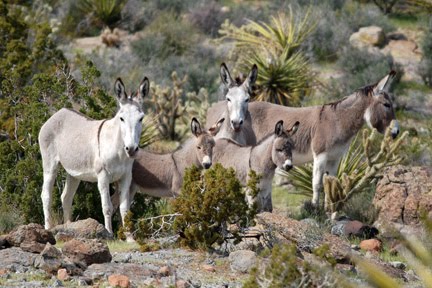
While populations of "Mexican bighorn" on the east side of the Colorado in the Trigo Mountains of Arizona are said to be fairing better, I will never forget encountering the carcass of a large ram, minus the ever sought after head and horns, alongside a jeep road there in the 1990's. I have a photo somewhere, but it would take some time to locate it in my old boxes of photos, where ever they are. A major threat there, besides hunting, is the competition with feral burro populations that resulted from the burro's abandonment by miners in the earlier portion of the 20th century. The burros drain the lifeline of the sheep's water supply by drinking from and fouling the seasonal small "tanks," or rock-lined reservoirs created by spring and summer rains, and they feed on many of the same plants needed by the bighorn. Burro or African wild ass--Cute, but Very Destructive to Native Ecosystems __
Rocky Mountain Bighorn with young ones at Flaming Gorge, Utah
Sheep Creek Bay on what is now Flaming Gorge Reservoir on the Green River in north east Utah is a pretty interesting place to visit. Besides the outsized geology and Kokanee spawning runs up Sheep Creek, it can be a good place to view transplanted Rocky Mountain bighorns. The following is a video with an old "Hi-8" Sony camera of some ewes and young ones from a visit there in July of 1994. Not spectacular footage, but somewhat enjoyable watching the lambs romp.
Again, Google Blog cuts off the right side of this wide screen video, so for the full view, go to: Baby BigHorns on a Romp.m4v
These Sheep Creek bighorns are currently threatened with possible pneumonia infection from a herd on Goslin Mountain, some 15 miles away. The following article about the eradication of the Goslin herd by the Utah Division of Wildlife Resources, indicates that there are not yet signs of infection in the Sheep Creek herd, however, Ken Cole's article on the WAFWA report (WAFWA report summarizes pneumonia outbreaks in bighorn sheep) indicates the herd may already be infected. Note also that the bighorn transplants on Goslin Mountain were acquired from herds in Montana, several of which have been infected with pneumonia due to proximity to domestic sheep activities or allotments. Given that disease transmission from domestic sheep to bighorns has been documented for well over a decade, one wonders why the state wildlife agencies have not been more alert to the possibility of transplants spreading disease to wild bighorn.
. . . . Wildlife biologists are shooting the entire bighorn sheep population on Goslin Mountain in the state's northeastern corner in an effort to stop a fatal and contagious disease from spreading to other nearby wild herds.
Twenty-five Rocky Mountain bighorn sheep from the Goslin Mountain herd have been shot by biologists in the steep canyon country north of the Green River and east of Dutch John in the past month. Many more have died from bacterial pneumonia, a malady that is striking a severe blow to bighorn herds in Montana, Nevada and Washington.
"Some states let the disease take its course when the herd is isolated, but we have documented cases of rams from the Goslin herd contacting other sheep and we don't want to risk infecting nearby herds and having a much larger die-off," said Leslie McFarlane, the wildlife disease specialist for the Utah Division of Wildlife Resources (DWR). . . . .
__
California Bighorn in Burnt River Canyon
Bighorn Ewe in Burnt River Canyon
The Baker City office of the Oregon Department of Fish and Wildlife (ODFW) tells me that the Burnt River population of introduced California bighorns is in pretty good shape, with high pregnancy rates and good lamb and young adult survival, and may be more resistant to disease than the Hells Canyon Rocky Mountain bighorns. The photos of the ewe, having just watered at the river, were taken last weekend. ODFW expects them to be lambing soon near the higher rocky and cliff areas that comprise their escape habitat above the river. Northern and north eastern populations of bighorn lamb in May and June, but this population finds April more suitable. They estimate the ewe in the photo to be "at least a few years old," with the typical, spring shedding, ratty coat.
One wonders how these magnificent animals can cling to the narrow perches and near vertical surfaces of cliffs, while seemingly appearing a bit too self-assured in their movements from one impossible perch to another. The answer appears to be in the "cork-like," "spongy," or "rubbery," hooves, with each half, or toe, being separately controllable. Ungulates like deer and elk, on the other hand, have harder hooves that would tend to slip on steeply angled surfaces. See the photo below of the hooves of the same bighorn shown above, the "dew claws" also being spongy.
Spongy hooves allow sure movement on steep and perilous terrain.
Check out the Bald Eagle Cam. Jan Taylor told me about this and it is now my home page on most days. This morning (Tuesday), the poor parent to be was pretty much completely covered with snow, protecting the developing new generation. I will try not to complain about the snow and cold again, but being a snow wimp, that scenario is unlikely. I just looked at the cam as I write on Tuesday night, and the nest is completely covered with snow, but the steadfast eagle is hunkered down, keeping the eggs warm as best he/she can. Frankly, I'm worried! Check it out. _____________
Tundra Swans (Cygnus columbianus)
The Baker City Herald had a delightful photograph of tundra swans in flight overhead a week or two ago, as they are migrating through the area on their way to their breeding grounds on coastal High Arctic Tundra. A few days previous, on March 14, I saw 750 - 800 Tundra Swans on Unity Reservoir while doing my raptor count for the East Cascades Bird Conservancy. Here is a photo of but a few of them in the north arm of the reservoir. A key feature for identification purposes is the yellow "spot" near the eye in most adult tundra swans, which is lacking in the trumpeter swans found more often to the east (eg. Yellowstone) or the the north west coastal regions of Oregon and Washington in winter.
Tundra Swans on Unity Reservoir
Here are a few more from Baker Valley back in March and April of 2008.
Tundra Swans on "UPS/Freeway Ponds" (Northern Shoveler duck on left)
The following were photographed on a small pond along Lindley Road: Pond along Lindley Road
Salt Lake Tribune Updated:03/31/2010 10:18:11 AM MDT
Everyone agrees the amazing mating ritual of the greater sage grouse is unique and entertaining. At issue is whether the bird is in need of federal oversight.
The U.S. Fish and Wildlife Service recently found greater sage grouse in North America a candidate for protection under the Endangered Species Act, but decided against pursing the listing because it deems other species to have higher priority. Now three environmental groups say they intend to sue the federal government, charging that the Interior Department isn't doing its job.
The Center for Biological Diversity, Desert Survivors and Western Watersheds Project made the joint announcement this week. There are about 250 species listed as candidates for protection, and some have had that status for decades. The Interior Department assigns priority rankings from 1 to 12 for species on the list and the sage grouse was given an 8 ranking. Environmentalists say protection is vital. Opponents, including Utah biologists, believe the state's management efforts are sound and that protection would unduly harm ranching, farming and energy interests.
"The only good place for a sage grouse to be listed is on the menu of a French bistro," Utah Congressman Jason Chaffetz said in a statement. "It does not deserve federal protection, period."
For Salt Lake City teacher Jim Carter, the birds provide an opportunity to watch a wonder of the wild close to home. "I have driven to the end of the earth to see birds, but I've never seen anything like it," Carter said after a recent pre-dawn trip to a lek -- the traditional mating grounds of the grouse. "They would stand and look eye-to-eye and puff up their chest and make a drumming sound. If one didn't back down they would bash each other until one ran off. The females didn't seem very impressed."
Whether you view them as a wonder or a main course, Utah's two species of sage grouse are currently strutting their stuff on leks across the state. . . . .
Three environmental groups announced Monday they intend to sue the Interior Department for not protecting sage grouse as an endangered or threatened species.
The Center for Biological Diversity, Desert Survivors and Western Watersheds Project said the department violated the Endangered Species Act by classifying sage grouse not as threatened or endangered but merely as candidates for such protection.
Some of the roughly 250 species considered candidates for protection have been on the candidate species list for decades. The groups pointed out in an intent-to-sue letter Monday to Interior Secretary Ken Salazar that relatively few species in recent years have been gaining protection under the Endangered Species Act.
The average during the Clinton administration was 65 a year, the groups wrote, while the average since 2005 has been just three a year.
At that rate, they wrote, sage grouse are unlikely to be protected any time soon.
"This is an agency dragging its feet," said Rob Mrowka, an ecologist in Las Vegas for the Center for Biological Diversity.
An Interior spokeswoman declined to comment, citing department policy for matters in litigation.
Sage grouse are a mottled brown, football-sized bird found in Wyoming, Montana, Idaho, Nevada, California, Colorado, Utah, Washington, Oregon, South Dakota, North Dakota and Canada.
Wyoming is believed to host about half of the birds but much of their sagebrush habitat in the state's vast basins also is prime country for oil and gas drilling. In Nevada, sage grouse are threatened by cheatgrass, an invasive species prone to wildfires that burn native sagebrush.
The Interior Department announced March 5 that protection for sage grouse is warranted but precluded by higher priorities - other species deemed in greater need of protection. The department announced the same finding for the distinct Mono Basin sage grouse population along the California-Nevada line.
The oil and gas, wind and ranching industries greatly feared an endangered or threatened listing, which would have restricted many activities on public land across the West.
The Fish and Wildlife Service assigns each candidate species a priority number between one and 12, with lower numbers being higher priorities for protection. The sage grouse across its 11-state range was assigned a number eight. The Mono Basin population got a three.
About half of all candidate species are ones and twos, meaning even the Mono Basin sage grouse are halfway down the priority list, said Noah Greenwald, endangered species program coordinator for the Center for Biological Diversity.
Sage grouse are in "a purgatory that could last literally decades," Greenwald said.
Sixty days' notice is required ahead of filing a lawsuit under the Endangered Species Act. Western Watersheds Project already has filed a complaint over sage grouse, a case in Boise, Idaho, that led to the candidate species finding.
Western Watersheds Project contested the candidate species finding three weeks ago by filing a supplemental complaint in its case. Executive Director Jon Marvel suggested the other groups could join Western Watersheds Project lawsuit or file elsewhere.
Mrowka said the groups haven't decided where they might sue.
New Cole Hearing Set to Hear Motions to Supress; Release Conditions Modified [3/31/10]
Yesterdays pretrial conference in the Brian Cole sex abuse case resulted in papers being filed with the Circuit Court that indicate a "motions to suppress" hearing is set for Circuit Court on May 21, 2010, from 9 AM to Noon, and from 1:30 PM to 5 PM. The clerk's office indicates that such hearings are public. While the one page notice doesn't explicitly state what is to be suppressed, normally a motion to suppress seeks to suppress evidence gathered by the prosecution during the investigation. A formal motion with more details is to be filed with the court by April 15th. Hopefully the hearing will actually take place and move this case towards a long delayed trial.
On March 24th, in papers filed the 26th, Circuit Court Judge Gary Reynolds modified Brian Cole's release conditions.
The new order requires Mr. Cole to first submit travel plans to the Attorney General's office before traveling out of state, and also requires he sign a "Waiver of Extradition" which he has done. It also allows Mr. Cole to have contact with his minor daughter, "but he shall not have contact minors [sic] or be in places where minors congregate such as schools, parks, churches, or shopping malls unless supervised by his wife. . . ."




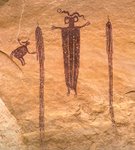
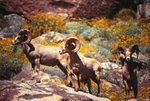






-sm.jpg)