This site may contain copyrighted material the use of which has not always been specifically authorized by the copyright owner. I am making such material available in an effort to advance understanding of environmental, political, human rights, economic, democracy, scientific, and social justice issues, etc. I believe this constitutes a ‘fair use’ of any such copyrighted material as provided for in section 107 of the US Copyright Law.
In accordance with Title 17 U.S.C. Section 107, the material on this site is distributed without profit.
"Fascism should rightly be called Corporatism as it is a merger of state and corporate power": Benito Mussolini
Voltaire on Freedom
"...So long as the people do not care to exercise their freedom, those who wish to tyrannize will do so; for tyrants are active and ardent, and will devote themselves in the name of any number of gods, religious and otherwise, to put shackles upon sleeping men." Voltaire, François Marie Arouet (1694-1778), Philosophical Dictionary, 1764
Darwin on Effect of Early Brainwashing
"It is worthy of remark that a belief constantly inculcated during the early years of life, whilst the brain is impressible, appears to acquire almost the nature of an instinct; and the very essence of an instinct is that it is followed independently of reason." - Charles Darwin, The Descent of Man, 1871
It was impossible to save the Great Republic
"But it was impossible to save the Great Republic. She was rotten to the heart. Lust of conquest had long ago done its work; trampling upon the helpless abroad had taught her, by a natural process, to endure with apathy the like at home; multitudes who had applauded the crushing of other people's liberties, lived to suffer for their mistake in their own persons. The government was irrevocably in the hands of the prodigiously rich and their hangers-on; the suffrage was become a mere machine, which they used as they chose. There was no principle but commercialism, no patriotism but of the pocket."
Mark Twain
E.O. Wilson on population growth and sustainability
"The raging monster upon the land is population growth. In its presence, sustainability is but a fragile theoretical construct." - E.O. Wilson
Jefferson on Corporations
“I hope we shall... crush in its birth the aristocracy of our moneyed corporations, which dare already to challenge our government to a trial of strength and to bid defiance to the laws of our country.”
~ Thomas Jefferson, letter to George Logan. November 12, 1816
How despicable and ignoble war is
Heroism at command, senseless brutality, deplorable love-of-country stance, how violently I hate all this, how despicable and ignoble war is; I would rather be torn to shreds than be a part of so base an action! - Albert Einstein
Do not despair due to hostility or exclusion
Do not despair due to hostility or exclusion by popular, small minded, or greedy men and women, simply because they reject or cannot understand your truths. Stand up and declare your reality, in defiance of their ignorance and self-serving falsehoods. -- Chris
Anger Looks to the Good of Justice
"He who is not angry when there is just cause for anger is immoral. Why? Because anger looks to the good of justice. And if you can live amid injustice without anger, you are immoral as well as unjust." -- St. Thomas Aquinas (1225-1274)
Aside from the fact that Thomas thought heretics should be put to death ;-) he really has hit on something here!
"In those wretched countries where a man cannot call his tongue his own, he can scarce call anything his own. Whoever would overthrow the liberty of a nation must begin by subduing the freeness of speech." -- Benjamin Franklin (1706-1790) US Founding Father - Source: Dogwood Papers
"There will be, in the next generation or so, a pharmacological method of making people love their servitude, and producing dictatorship without tears, so to speak, producing a kind of painless concentration camp for entire societies, so that people will in fact have their liberties taken away from them, but will rather enjoy it, because they will be distracted from any desire to rebel by propaganda or brainwashing, or brainwashing enhanced by pharmacological methods. And this seems to be the final revolution." - Aldous Huxley, Tavistock Group, California Medical School, 1961
The weak do what they must. . .
"The strong do what they will, and the weak do what they must." - Thucydides (c. 460 B.C. - c. 395 B.C.)
Sustainability and Population Growth
"A sincere concern for the future is certainly the factor that motivates many who make frequent use of the word, "sustainable." But there are cases where one suspects that the word is used carelessly, perhaps as though the belief exists that the frequent use of the adjective "sustainable" is all that is needed to create a sustainable society."
"Can you think of any problem in any area of human endeavor on any scale, from microscopic to global, whose long-term solution is in any demonstrable way aided, assisted, or advanced by further increases in population, locally, nationally, or globally?"
The Primary Political Question: "Who benefits? Who pays?"
To cut through the cant of "responsibility," we must ask the double question "Who benefits? Who pays?" This is the first question to ask when a politico-economic system of distribution is proposed. It focuses our attention on operations and their consequences rather than on words. The answer to this double question largely defines the properties of a system. We take it as axiomatic that every social action entails both gain (profit) and cost (loss). We can indicate the way profit and loss are distributed by three alternative verbs: privatize, commonize and socialize. -Garrett Hardin 1985
Thomas Paine on the Defense of Custom
Perhaps the sentiments contained in the following pages, are not yet sufficiently fashionable to procure them general favor; a long habit of not thinking a thing wrong, gives it a superficial appearance of being right, and raises at first a formidable outcry in defense of custom. But tumult soon subsides. Time makes more converts than reason.
From the Introduction to Common Sense, January 10, 1776
Taking A Position Because It Is Right
Cowardice asks the question - is it safe? Expediency asks the question - is it politic? Vanity asks the question - is it popular? But conscience asks the question - is it right? And there comes a time when one must take a position that is neither safe, nor politic, nor popular; but one must take it because it is right. Dr. Martin Luther King, Jr.
Galbraith on Respectability
“Political conservatism benefits from the deep desire of politicians, Democrats in particular, for respectability -their need to show that they are individuals of sound, confidence inspiring judgment. And what is the test of respectability? It is broadly whether speech and action are consistent with the comfort and well-being of the people of property and position. A radical is anyone who causes discomfort or otherwise offends such interests. Thus in our politics, we test even liberals by their conservatism.” - John Kenneth Galbraith
They love the liars and hate the truth, Mencken
"The men the American people admire most extravagantly are the greatest liars: the men they detest most violently are those who try to tell them the truth." - - H. L. Mencken - (1880-1956) American Journalist, Editor, Essayist
a lie so subtle
"Observance of customs and laws can very easily be a cloak for a lie so subtle that our fellow human beings are unable to detect it. It may help us to escape all criticism, we may even be able to deceive ourselves in the belief of our obvious righteousness. But deep down, below the surface of the average man's conscience, he hears a voice whispering, 'There is something not right,' no matter how much his rightness is supported by public opinion or by the moral code." - Carl Gustav Jung
Repression works only to strengthen and knit the repressed,
"And the great owners, who must lose their land in an upheaval, the great owners with access to history, with eyes to read history and to know the great fact: when property accumulates in too few hands it is taken away. And that companion fact: when a majority of the people are hungry and cold they will take by force what they need. And the little screaming fact that sounds through all history: repression works only to strengthen and knit the repressed." -John Steinbeck - Grapes of Wrath
Need to write an Oregon Public Records request?
Click on this link and they will write a request for you:
“Its hard to give, Its hard to get, But everybody needs a little forgiveness.” Patty Griffin - from "Forgiveness"
American “Democracy” and Responsibility
"we also have to be precise about the roadblocks that keep people from acting responsibly: A nominally democratic political system dominated by elites who serve primarily the wealthy in a predatory corporate capitalist system; which utilizes sophisticated propaganda techniques that have been effective in undermining real democracy; aided by mass-media industries dedicated to selling diversions to consumers more than to helping inform citizens in ways that encourage meaningful political action."
- Robert Jensen, Professor of journalism, University of Texas at Austin. From Op-Ed, July 8, 2008
OUR UNDISPUTED OVERLORDS
“Big money and big business, corporations and commerce, are again the undisputed overlords of politics and government. The White House, the Congress and, increasingly, the judiciary, reflect their interests. We appear to have a government run by remote control from the U.S. Chamber of Commerce, the National Association of Manufacturers and the American Petroleum Institute. To hell with everyone else.” - Bill Moyers - PBS Commentator
The Politics of Anti-Semitism
The Politics of Anti-Semitism, edited by Alexander Cockburn and Jeffrey St. Clair, confronts how the slur of "anti-semite" has been used to intimidate critics of Israel's abuse of Palestinians. It includes essays by Uri Avnery, Edward Said, Michael Neumann and Bill and Kathy Christison and more.
"If a nation values anything more than freedom, it will lose its freedom"
"If a nation values anything more than freedom, it will lose its freedom; and the irony of it is that if it is comfort or money that it values more, it will lose that too." -- Somerset Maugham
Human Insensitivity, Arrogance, Ignorance, Greed and Folly
There is perhaps no more certain sign of human insensitivity, arrogance, ignorance, greed and folly than the constant growth and destructive expansion of human populations across the globe—a self-worshiping, voracious cancer that continues to plunder and trash our planet and its creatures while almost imperceptibly picking away at the very support systems of life as we know it. - Me (and many others before)
I am a nature photographer specializing in wildflowers, birds, and other criters.
Some of my wildflower and other photos can be found at:
http://www.flickr.com/photos/christopherchristie/sets/
And
http://calphotos.berkeley.edu/cgi/img_query?where-photographer=Christopher+Christie
These photos can be downloaded without charge for personal use and are used for educational purposes in the publications of many organizations, most often for free.
My professional training is in microbiology (BS Microbiology, Honors / Distinction in) and medical technology. I have worked as a microbiologist, medical technologist and Greyhound bus driver. In the late 1980's I grew over 100 native species in a small nursery. Besides identifying, photographing and growing native plants, I enjoy birdwatching, gardening and hiking in the Great Basin and local mountains. In the fall and winter, I used to do raptor counts along the Burnt River in the Hereford area for the East Cascade Bird Conservancy.
“We are swimming with the snakes at the bottom of the well - So silent and peaceful in the darkness where we fell - But we are not snakes and what's more we never will be And if we stay swimming here forever we will never be free” Patty Griffin - from "Forgiveness"
Mysteries
Pictograph From San Rafael Swell, Utah
Endangered Peninsular Bighorn Sheep
Bighorns in Anza Borrego State Park, CA, 1998
Not One More Death, Not One More Dollar
Message On Main Street to End the War
Peace On Main Street
Need money For Schools?
Winnie Moves to New Meadows, Idaho
In 1944 Winnie's house at the logging camp was moved on the back of a truck. In those days, logger's homes were often moved from camp to camp on R.R.flatcars or trucks.
- Wolf News ----- Who Killed The Wenaha Wolf? (Video) ----- State & Congressional Legislators Attempting to Remove Protections for Wolves ----- Wolves In Umatilla County
- Oxbow Reservoir Eagles & Bighorn Sheep (Scroll through wolf articles for eagle and bighorn ewe photos) __________
The young male Wenaha Wolf lived in the Umatilla National Forest of the Blue Mountain Range, in the Wenaha-Tucannon Wilderness. He was fitted with a radio collar in early August, and shot dead by an unknown assailant in early October 2010. That person likely had a receiver tuned to his frequency who tracked him down and brutally shot him in his home territory.
The Wenaha wolf pack has never been associated with one single instance of depredation. The killing of this beautiful wolf was not only cruel and illegal, it was unjustified in every sense of the word. If you have any information that can lead to the arrest and conviction of the one who killed the Wenaha Wolf, we urge you to call the U.S. Fish & Wildlife Service at 503-682-6131.
PORTLAND, ORE Feb 03, 2011 On February 1, 2011, state Senator Ted Whitsett [District: 28, Klamath Falls, 541-883-4006, sen.dougwhitsett@state.or.us - Chris], introduced Senate Bill 583 which seeks to remove the gray wolf from protection under the state endangered species act. The bill is the first of many expected legislative efforts aimed at undermining the Oregon Wolf Conservation and Management Plan, adopted in 2005 after months of stakeholder meetings and negotiations. The following is the reaction of Rob Klavins of the conservation group Oregon Wild, a leading voice for wolves in Oregon:
“This wolf kill bill is a dangerous distraction from sincere efforts to recover and manage gray wolves in Oregon. It is sad that 60 years after wolves were eradicated in our state through poisoning and trapping some feel we should turn back the clock to those dark days. Wolves are native to Oregon and have a place on the landscape of our state. Just days after confirming 3 new wolves in Oregon, the state’s known population stands at 24 wolves and 2 breeding pairs. Now is not the time to repeat the mistakes of the past and send them back down the path to extermination.
This extreme bill takes wildlife management decisions out of the hands of professional biologists, and plays politics with what should be a scientifically-based process. In addition, we are fearful that this proposed legislation represents the tip of the iceberg of anti-wolf bills to be proposed during this legislative session. Oregon Wild will work to ensure we don’t take a step back in our efforts to recover gray wolves to the state and continue our efforts to educate Oregonians about the benefits of this once maligned animal returning to Oregon.”
Text of bill: Relating to wolves. Be It Enacted by the People of the State of Oregon: SECTION 1. Notwithstanding any provision of ORS 496.171 to 496.182, the State Fish and Wildlife Commission may not list the gray wolf on the list of wildlife species that are threatened species or endangered species adopted by rule of the commission pursuant to ORS 496.172.
New legislation would allow elimination of gray wolves, puts all America’s wildlife at risk Washington, DC (January 27, 2011) - Montana Rep. Denny Rehberg introduced two bills yesterday that would strip federal protections for gray wolves across the country. Together, these bills would allow states to eliminate all wolves in the Northern Rockies, Great Lakes and Southwest, including the 42 Mexican wolves struggling for survival in New Mexico and Arizona. If passed, this legislation would be the first to exempt a single species from the Endangered Species Act, setting a dangerous precedent for removing protections for other imperiled wildlife.
The following is a statement from Rodger Schlickeisen, president of Defenders of Wildlife:
“These bills are bad for wolves, bad for the Endangered Species Act, and bad for the future of all America’s wildlife. Some members of Congress are willing to sell out America’s wolves by looking for a quick legislative fix. In the process, they are undermining not only one of our greatest conservation successes, but also unraveling the Endangered Species Act, one of the world’s most far-sighted conservation laws.
“Most Americans care very deeply about our nation’s wildlife and want to see all animals protected from needless persecution. However, these bills would sacrifice wildlife belonging to all Americans just because a small minority of people don’t like wolves. Obviously, some folks still think all predators are bad, even though those animals are an essential part of this country’s wildlife heritage.
“These bills set a terrible precedent that will open the flood gates to legislation to strip protections for any other species that a politician finds inconvenient to protect. Grizzly bears, salmon, whales, polar bears and Florida panthers are just a few that could be at serious risk. If enacted, this legislation would constitute one of the worst assaults on the ESA since it became law in 1973. If we allow Congress to overrule the courts and usurp the authority of professional wildlife managers and expert biologists, there’s no telling where it will stop.
“For decades there has been a worldwide scientific consensus that human society is causing a rapid and accelerating loss of species, species that hold together the web of life that supports all life on earth, including human life. During President George H. W. Bush’s administration, his science advisory council identified this phenomenon as representing one of the most serious long-term threats to human welfare, and it has only become worse since then. The ESA is the single strongest law we have for combating this enormous threat to future generations, and it would be enormous human folly to mindlessly begin unraveling it based upon political whim. . . . .
Background: On August 5, 2010, federal protections were restored for wolves in the Northern Rockies under the Endangered Species Act. A U.S. District Court in Montana determined that wolves had been illegally delisted along state lines by removing protections in Idaho and Montana but not Wyoming.
Under current delisting plans, Idaho, Montana and Wyoming would have been allowed to manage wolves down to 100 to 150 wolves per states. Wyoming’s plan would allow wolves to be shot on sight in 90 percent of the state. Idaho’s official position, as adopted by the Idaho state legislature in 2002, is to remove all wolves by any means necessary. The 2002 Idaho state wolf management plan calls for no more than 150 wolves. Montana has so far committed to maintaining a minimum of 15 breeding pairs, but there is nothing to prevent the state legislature or future administrations from using this number as the maximum as well. There are currently an estimated 1,700 wolves in the region. More than 1,000 wolves could needlessly die because of this legislation.
At the last count in January 2010, biologists could find just 42 Mexican gray wolves and only two breeding pairs in Arizona and New Mexico – a dangerously low number that scientists say contributes to ongoing genetic inbreeding that is causing low birth and pup survival rates, creating a downward demographic spiral. The population dropped by 19 percent between 2009 and 2010. A new count is being conducted this month.
You may have already seen this in the news or heard it elsewhere… Track evidence found by ODFW and U.S. Forest Service biologists on Jan. 20 confirms that three wolves have been using the Walla Walla Unit and represent a potential new wolf pack. The wolves’ territory is not clear yet; they could be primarily using territory in Washington State. There is currently no evidence that these wolves reproduced in 2010.
Posted: Monday, January 31, 2011 2:39 pm | Updated: 3:16 pm, Mon Jan 31, 2011. By PHIL WRIGHT East Oregonian
Wolves are now living in northern Umatilla County, a state wildlife official confirmed today.
Mark Kirsch is the Umatilla District wildlife biologist with the Oregon Department of Fish and Wildlife. He said more than one Northern Rocky Mountain gray wolf has settled in the Walla Walla River/Mill Creek system.
"When we say more than one wolf, I think we're pretty confident we have no less than three," Kirsch said. But it's too early to say just what kind of "social formation" these wolves are in, he said.
"We know so little at this point," Kirsch said. "The source of our current efforts is to try and understand that."
Andrew Picken of Pendleton reported seeing a trio of wolves south of Milton-Freewater on Jan. 2. He even shot some video and took photos, but the animals were too far away to positively identify them as wolves.
[See link above for article.] __
Oxbow Reservoir Eagles & Bighorn Sheep
Bald Eagle Near Brownlee Dam, February 2, 2011 [Some sort of incompatibility between Google and Photoshop puts too much blue in this photo. I've tried to correct it to no avail!]
I took Joanne Britton's (our local bird historian and count organizer) advice and went out to enjoy the sunshine on Tuesday & Wednesday of last week. Saw 14 Bald Eagles on the Powder River arm of Brownlee Reservoir on Tuesday (Don't have a scope so there may have been more.) There were also 5 on a cow carcass in the lower Keating/Powder River Valley near Middle Bridge, and 4 golden eagles enroute to Brownlee. Couldn't find the Hooded Mergansers that Jim Lawrence had seen on an open pond near there a week or so earlier.
Quite a few Common Goldeneye have returned to the Powder, which is flowing with ice-melt. Common Goldeneye, Powder River, March, 2010
On Wednesday, February 2 (Groundhog Day), I went down to Oxbow on the Snake River and counted 52 BAEA between Oxbow dam and Brownlee dam, including 20 juveniles. Most were perched in the larger trees (with a few on the shoreline) on the Idaho side, but several were on the Oregon side. Both adults and juveniles were in flight around Brownlee Dam. Posted some of the eagles on Flickr.
Juvenile Bald Eagle, Brownlee Dam, February 2, 2011
Rocky Mountain Bighorn Ewe near Brownlee Dam, 2/2/11
Four Bighorn ewes were grazing on grasses just off the road on the Oregon side. One had a collar and a number 99 tag. Wish I knew more about her. The fur had been considerably shortened on her neck around the collar.
Rocky Mountain Bighorn Ewe with collar near Brownlee Dam, 2/2/11
- Wallowa Mountains Wildflowers, Part 1 - Hells Canyon/Payette N F Sheep Decision __________
Wallowa Mountains Wildflowers, Part 1
The closure of the Forest Service 39 Road, due to spring flooding, has left the 66 road via the 6625 road as the only “convenient” way for Baker County residents to get into the upper Hells Canyon country. This month I found some time to visit portions of that route to Fish Lake, Twin Lakes, and beyond. Along the way there were opportunities for photographing some of the common wildflowers along the route, and this is the first part of a long chronicle of common wildflowers that are easily found. Showy Milkweed (Asclepias speciosa)
As you travel along Highway 86, both east and west of Richland, patches of both light, and dark pink flowered “showy milkweed” (Asclepias speciosa) begin to crop up along the highway. As the name indicates, this particular milkweed flower is one of the prettiest and noticeable, with a strong, perfume-like fragrance.. It is also structured quite differently, as are the other milkweeds, than most of the flowers one encounters. As the second part of the common name indicates, it exudes a sticky milk-white sap from injured portions of the plant where the epidermis has been cracked or cut. Showy Milkweed (Asclepias speciosa)
One downside to this plant, from the perspective of stock raisers, is that all parts of the plant are poisonous, even when dry. It can cause sickness or death in cattle, sheep, and horses (and Humans) when ingested in large enough quantities.
At least one family of animals, the milkweed butterflies, of which the Monarch butterfly is one, depends upon milkweeds for their survival (bees nd other flying insects also utilize this plant). The larvae (caterpillars) feed on the milkweed plant and concentrate the various poisons in their bodies, thus becoming very distasteful to birds and other predators. This quality causes avoidance behavior in the would-be consumers, and allows the milkweed butterflies to go about their business un-harassed. Given the monarch’s long and difficult migration between Central Mexico or the coast of California and other areas in the U.S. and Canada, their adaptation to and relationship with milkweeds provides them with certain needed advantages unknown to many other butterflies. Some butterflies, like the Viceroy, mimic the color and pattern of the milkweed butterflies which helps to cause birds to leave them alone as well. Close-up of Showy Milkweed flower
Further east past Richland, around the crest of Halfway Hill (about 3500’), both “Lewis' mock orange” (Philadelphus lewisii), and “Venus Penstemon” (Penstemon venustus) can be found blooming from mid to late June and on into July. Mock orange is commonly used in residential planting throughout the North West, including Baker City. Venus Penstemon is seeing increasing use locally by native plant gardeners.
Lewis' Mock Orange (Philadelphus lewisii)
The scientific name for Mock Orange, lewisii, is for its first documented American discoverer (of European origins that is), Meriwether Lewis. It is one of many plants "discovered" during the Lewis and Clark expedition. The common name is in reference to its white flowers and sweet fragrance, which to some resemble the blossoms of the orange citrus tree.
Lewis' Mock Orange (Philadelphus lewisii)
Venus Penstemon (Penstemon venustus) belongs to a large, primarily North American genus of over 250 species, all of whom are very attractive, with many being useful to moths, bees and hummingbirds. Several are also useful horticulturally, although some can be short-lived (about 2-3 years, longer in suitable conditions, and some of the shrubby penstemons apparently live quite a long while.). Penstemons (apparently a reference to the five stamens), or beardtongues as they are also known (due to the presence of a fifth stamen, the staminode, which is hairy or bearded in many species, and the “bearded” lower lips of many Penstemons. They resemble the common garden snapdragon, and are just as easy to look at.
Venus Penstemon (Penstemon venustus)
Many more Venus Penstemons can be found in the canyon along North Pine Creek adjacent to the 39 Road, and on up the road to the Hells Canyon Rim. They are fairly common in the Wallowa Mountains.
Beginning in the ponderosa pine and mixed conifer forests not far out of Halfway, and continuing sporadically on up into the sub-alpine forest, are yet three more eye-catching wildflowers.
Tapertip or Hooker’s onion (Allium acuminatum)
The first to be encountered will likely be the Tapertip or Hooker’s onion (Allium acuminatum). This onion, with the characteristic odor of the genus, is fairly easy to distinguish from other local alliums due to its fuchia (rose-purple?) colored “petals” (tepals) with rather abruptly narrowed (acuminate) tips. Occasionally they are pink and rarely, white. Under the magnifying glass or dissecting scope, one can see the tiny teeth like projections which line the edges of the smaller inner tepals. The small onion bulbs were cooked and eaten by the Native Americans and no doubt by early settlers, as well as a few curious botanists and campers.
Tapertip or Hooker’s onion (Allium acuminatum)
The second wildflower might likely be one of the west’s all-star wildflowers, Scarlet Gilia (Ipomopsis aggregata). This tough and spectacular little biennial, graces much of the west, from the arid foothills of the Great Basin and North East Oregon to the more moist sub-alpine zones throughout the area. I have found this plant blooming even on dry exposed hillsides in conditions of drought, so it does well in the semi-dry garden situation.
Scarlet Gilia (Ipomopsis aggregata)
Beginning near the transition to primarily sub-alpine vegetation, the third plant, a beautiful and seemingly delicate Penstemon appears; Wilcox’s Penstemon (Penstemon wilcoxii).
Wilcox’s Penstemon (Penstemon wilcoxii)
To my knowledge, Wilcox’s Penstemon is only found in Oregon in the eastern Wallowa Mountains and along the Hells Canyon Rim, where it is quite common. It is closely related to Penstmon albertinus of central and eastern Idaho (for example, around the Sawtooth Mountains), and western Montana where the two species intergrade. It also appears to be related to Penstemon ovatus of western Washington and extreme north western Oregon.
Wilcox’s Penstemon
At about the same elevation, on southerly looking exposed slopes, will be found an early successional forest shrub that colonizes areas after forest fires and other major disturbances called Snowbrush Ceanothus (Ceanothus velutinus). After conifers, such as ponderosa pine, reestablish themselves, and shade out the Ceanothus, they pretty much disappear, but their seeds remain in the soil for long periods, to sprout again after the next disturbance. They are especially adapted to take advantage of fire.
Snowbrush Ceanothus (Ceanothus velutinus)
Further up on the 66 road to Fish Lake, at about 6300 feet, there is another common perennial wildflower that was in bloom on July 7th, Arrowleaf Balsamroot (Balsamorhiza sagittata).
Arrowleaf Balsamroot (Balsamorhiza sagittata)
Arrowleaf Balsamroot is one of the commonly viewed spring and early summer flowering perennials in Baker County. It can be found blooming earlier in the foothills over most of the County, including the Snake river Canyon, and the bloom persists into the summer in the higher elevations. Some still remain on the high ridges beyond Twin Lakes, but the lack of moisture after a wet spring is causing an early end to the bloom of this and other flowering species. Hopefully the recent summer thunderstorms will prolong the blooming period.
For more information on this common wildflower and others, see:
About a mile or so below Fish Lake, another most pleasing Penstemon appears; Globe Penstemon (Penstemon globosus).
Globe Penstemon (Penstemon globosus)
They begin along the 66 road at around 6300 feet and extend their range well up into the sub-alpine zone.
One of my favorite small to medium sized flowering Penstemons, they are quite adaptable to gardens where adequate sunshine, space (from weeds) and moisture is provided. They are primarily an Idaho species, but extend into Baker County and the south eastern reaches of Wallowa County from north of Halfway and east to the Hells Canyon Rim.
Globe Penstemon (Penstemon globosus)
That’s about all the time and space for Wallowa Mountains wildflowers I have for part one of this series. Hope to continue it in future blogs. _____
Hells Canyon/Payette N F Sheep Decision
The Payette National Forest has issued a decision, a four year transitional plan to cut back domestic sheep grazing in areas near Hells Canyon and the Salmon River of Idaho. There is no reduction the first year, and then three years of reductions beginning with the next grazing season. The Rocky Mountain bighorn sheep populations there and on the Oregon side of the Snake River have been decimated due to the transmission of disease from domestic sheep. The disease organisms involved—there are several—such as Mannheimia haemolytica, can cause chronic respiratory problems leading to fatal pneumonia in bighorn. The full plan will be implemented by the 2013 grazing season.
Rocky Mountain Bighorn Sheep (Idaho Dept. of Fish & Game)
Here is one announcement, from Western Watersheds Project, the Hailey, Idaho based environmental watchdog, led by Jon Marvel, who has been so instrumental in educating people about, and organizing effective legal resistance to, the environmental devastation wrought by livestock grazing on our western public lands.
“Western Watersheds Project Pressure Pays Off: The Payette National Forest Cuts Domestic Sheep Grazing By 65% to Protect Bighorn Sheep
Friends,
Western Watersheds Project has worked for several years now to protect bighorn sheep across the west. With excellent legal assistance from attorney Laurie Rule at the Boise office of Advocates for the West (http://www.advocateswest.org/), Western Watersheds Project’s efforts are now showing success through an unprecedented Payette National Forest decision released on July 26, 2010.
The decision is a direct consequence of litigation brought by WWP and our conservation partners at the Hells Canyon Preservation Council .
The Payette Forest decision closes hundreds of thousands of acres of public land to grazing by domestic sheep to protect Rocky Mountain bighorn sheep from fatal diseases transmitted to bighorns by domestic sheep. The total reduction in domestic sheep use on the Payette National Forest will be about 65% of currently permitted domestic sheep grazing, and the remaining use will probably become uneconomic for ranching.
This change in Forest Service management is a huge step in the right direction, and it will cause changes in domestic sheep grazing offices across the west as it becomes the gold-standard for protecting bighorn sheep.
Western Watersheds Project predicts that within five years all domestic sheep grazing taking place within 50 miles of bighorn sheep on public lands will be stopped!" Record of Decision.
[Edited 3/31/10, information added.] In This Edition:
Western Wildlife - Bighorn Sheep - Bald Eagle Cam - Tundra Swans - Sage Grouse
New Cole Hearing Set; Release Conditions Modified __________
Bighorn Sheep (Ovis canadensis)
In an earlier blog (MONDAY, MARCH 22, 2010--Baker Bighorns "Blinking Out", the threat to our Rocky Mountain Bighorn Sheep populations in Hells Canyon from disease transmitted by exposure to domestic sheep operations was discussed. The following is an assortment of other information about bighorn sheep, including sub-groups from Utah to Oregon and south to the Peninsular Ranges of California and the Trigo Mountains of Arizona. I will try to keep it brief with links to knowledgeable sources for the curious. The main point is that the several sub-populations of bighorn sheep are particularly sensitive to disease (the primary source being domestic sheep operations), hunting pressure, competition with both domestic animals and feral burros/horses, and habitat loss due to our ever expanding human activities.
Peninsular Bighorn Sheep The photo above of endangered Peninsular Bighorn Rams was taken near Borrego Springs, in the western edge of the Colorado desert of California, while I was on a wildflower trip back in the spring of 1998. Unlike our northern bighorns, they have evolved to exist in a very difficult and increasingly endangered habitat in a desert environment close to burgeoning populations in people smothered Southern California. The following account from the Center For Biological Diversity explains some of the pressures they face.
Peninsular bighorn sheep can get water from cacti, splitting the spiny barrel cactus with their horns and eating its watery insides. But thanks to sprawl and agribusiness, both sheep and succulent are increasingly rare: Up to 2 million bighorns roamed North America at the turn of the 20th century, but now only 70,000 remain. Peninsular bighorns, a so-called “distinct population segment” of these, number only in the hundreds. Still, their population has grown since they were federally protected, and thanks to the Center, they currently lay claim to nearly 850,000 acres of critical habitat. In 2007, we scored a big victory for part of that habitat when we won an injunction preventing development-associated grading in California’s Chino Canyon.
Unfortunately, the Peninsular bighorn’s critical habitat is in jeopardy. Responding to development pressure and a 2005 tribal lawsuit, the U.S. Fish and Wildlife Service proposed to dramatically reduce the area of land set aside for bighorn recovery, and its 2009 critical habitat proposal axed the original area by 55 percent — so the Center and four allies sued in October 2009.
But the Center won’t let this bighorn perish. Most recently, we joined the Sierra Club in suing the city of Palm Desert and California Fish and Game Department over a housing project that would affect the Bighorn Institute, a federally recognized recovery center for the sheep. In 2000, we won protections for the bighorn and more than 50 other endangered species in Southern California’s national forests; in 2001, we helped end off-road vehicle use of Dunn Road, illegally built in bighorn habitat — and we later challenged a plan to allow commercial vehicles on that road. We also advocate for protection of Peninsular bighorn in the central and southern parts of their range, including challenging off-road vehicle use in the Desert Cahuilla/Truckhaven area and fighting the expansion of a large gypsum mine, both in critical sheep habitat. We’re working to curb off-road vehicle impacts in the Yuha Desert and other border areas that provide a link to bighorns in Mexico.
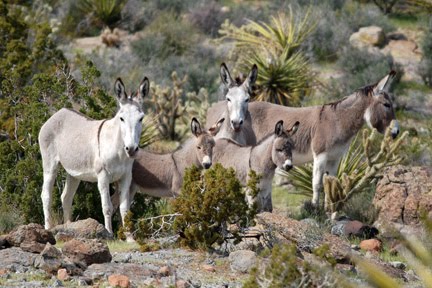
While populations of "Mexican bighorn" on the east side of the Colorado in the Trigo Mountains of Arizona are said to be fairing better, I will never forget encountering the carcass of a large ram, minus the ever sought after head and horns, alongside a jeep road there in the 1990's. I have a photo somewhere, but it would take some time to locate it in my old boxes of photos, where ever they are. A major threat there, besides hunting, is the competition with feral burro populations that resulted from the burro's abandonment by miners in the earlier portion of the 20th century. The burros drain the lifeline of the sheep's water supply by drinking from and fouling the seasonal small "tanks," or rock-lined reservoirs created by spring and summer rains, and they feed on many of the same plants needed by the bighorn. Burro or African wild ass--Cute, but Very Destructive to Native Ecosystems __
Rocky Mountain Bighorn with young ones at Flaming Gorge, Utah
Sheep Creek Bay on what is now Flaming Gorge Reservoir on the Green River in north east Utah is a pretty interesting place to visit. Besides the outsized geology and Kokanee spawning runs up Sheep Creek, it can be a good place to view transplanted Rocky Mountain bighorns. The following is a video with an old "Hi-8" Sony camera of some ewes and young ones from a visit there in July of 1994. Not spectacular footage, but somewhat enjoyable watching the lambs romp.
Again, Google Blog cuts off the right side of this wide screen video, so for the full view, go to: Baby BigHorns on a Romp.m4v
These Sheep Creek bighorns are currently threatened with possible pneumonia infection from a herd on Goslin Mountain, some 15 miles away. The following article about the eradication of the Goslin herd by the Utah Division of Wildlife Resources, indicates that there are not yet signs of infection in the Sheep Creek herd, however, Ken Cole's article on the WAFWA report (WAFWA report summarizes pneumonia outbreaks in bighorn sheep) indicates the herd may already be infected. Note also that the bighorn transplants on Goslin Mountain were acquired from herds in Montana, several of which have been infected with pneumonia due to proximity to domestic sheep activities or allotments. Given that disease transmission from domestic sheep to bighorns has been documented for well over a decade, one wonders why the state wildlife agencies have not been more alert to the possibility of transplants spreading disease to wild bighorn.
. . . . Wildlife biologists are shooting the entire bighorn sheep population on Goslin Mountain in the state's northeastern corner in an effort to stop a fatal and contagious disease from spreading to other nearby wild herds.
Twenty-five Rocky Mountain bighorn sheep from the Goslin Mountain herd have been shot by biologists in the steep canyon country north of the Green River and east of Dutch John in the past month. Many more have died from bacterial pneumonia, a malady that is striking a severe blow to bighorn herds in Montana, Nevada and Washington.
"Some states let the disease take its course when the herd is isolated, but we have documented cases of rams from the Goslin herd contacting other sheep and we don't want to risk infecting nearby herds and having a much larger die-off," said Leslie McFarlane, the wildlife disease specialist for the Utah Division of Wildlife Resources (DWR). . . . .
__
California Bighorn in Burnt River Canyon
Bighorn Ewe in Burnt River Canyon
The Baker City office of the Oregon Department of Fish and Wildlife (ODFW) tells me that the Burnt River population of introduced California bighorns is in pretty good shape, with high pregnancy rates and good lamb and young adult survival, and may be more resistant to disease than the Hells Canyon Rocky Mountain bighorns. The photos of the ewe, having just watered at the river, were taken last weekend. ODFW expects them to be lambing soon near the higher rocky and cliff areas that comprise their escape habitat above the river. Northern and north eastern populations of bighorn lamb in May and June, but this population finds April more suitable. They estimate the ewe in the photo to be "at least a few years old," with the typical, spring shedding, ratty coat.
One wonders how these magnificent animals can cling to the narrow perches and near vertical surfaces of cliffs, while seemingly appearing a bit too self-assured in their movements from one impossible perch to another. The answer appears to be in the "cork-like," "spongy," or "rubbery," hooves, with each half, or toe, being separately controllable. Ungulates like deer and elk, on the other hand, have harder hooves that would tend to slip on steeply angled surfaces. See the photo below of the hooves of the same bighorn shown above, the "dew claws" also being spongy.
Spongy hooves allow sure movement on steep and perilous terrain.
Check out the Bald Eagle Cam. Jan Taylor told me about this and it is now my home page on most days. This morning (Tuesday), the poor parent to be was pretty much completely covered with snow, protecting the developing new generation. I will try not to complain about the snow and cold again, but being a snow wimp, that scenario is unlikely. I just looked at the cam as I write on Tuesday night, and the nest is completely covered with snow, but the steadfast eagle is hunkered down, keeping the eggs warm as best he/she can. Frankly, I'm worried! Check it out. _____________
Tundra Swans (Cygnus columbianus)
The Baker City Herald had a delightful photograph of tundra swans in flight overhead a week or two ago, as they are migrating through the area on their way to their breeding grounds on coastal High Arctic Tundra. A few days previous, on March 14, I saw 750 - 800 Tundra Swans on Unity Reservoir while doing my raptor count for the East Cascades Bird Conservancy. Here is a photo of but a few of them in the north arm of the reservoir. A key feature for identification purposes is the yellow "spot" near the eye in most adult tundra swans, which is lacking in the trumpeter swans found more often to the east (eg. Yellowstone) or the the north west coastal regions of Oregon and Washington in winter.
Tundra Swans on Unity Reservoir
Here are a few more from Baker Valley back in March and April of 2008.
Tundra Swans on "UPS/Freeway Ponds" (Northern Shoveler duck on left)
The following were photographed on a small pond along Lindley Road: Pond along Lindley Road
Salt Lake Tribune Updated:03/31/2010 10:18:11 AM MDT
Everyone agrees the amazing mating ritual of the greater sage grouse is unique and entertaining. At issue is whether the bird is in need of federal oversight.
The U.S. Fish and Wildlife Service recently found greater sage grouse in North America a candidate for protection under the Endangered Species Act, but decided against pursing the listing because it deems other species to have higher priority. Now three environmental groups say they intend to sue the federal government, charging that the Interior Department isn't doing its job.
The Center for Biological Diversity, Desert Survivors and Western Watersheds Project made the joint announcement this week. There are about 250 species listed as candidates for protection, and some have had that status for decades. The Interior Department assigns priority rankings from 1 to 12 for species on the list and the sage grouse was given an 8 ranking. Environmentalists say protection is vital. Opponents, including Utah biologists, believe the state's management efforts are sound and that protection would unduly harm ranching, farming and energy interests.
"The only good place for a sage grouse to be listed is on the menu of a French bistro," Utah Congressman Jason Chaffetz said in a statement. "It does not deserve federal protection, period."
For Salt Lake City teacher Jim Carter, the birds provide an opportunity to watch a wonder of the wild close to home. "I have driven to the end of the earth to see birds, but I've never seen anything like it," Carter said after a recent pre-dawn trip to a lek -- the traditional mating grounds of the grouse. "They would stand and look eye-to-eye and puff up their chest and make a drumming sound. If one didn't back down they would bash each other until one ran off. The females didn't seem very impressed."
Whether you view them as a wonder or a main course, Utah's two species of sage grouse are currently strutting their stuff on leks across the state. . . . .
Three environmental groups announced Monday they intend to sue the Interior Department for not protecting sage grouse as an endangered or threatened species.
The Center for Biological Diversity, Desert Survivors and Western Watersheds Project said the department violated the Endangered Species Act by classifying sage grouse not as threatened or endangered but merely as candidates for such protection.
Some of the roughly 250 species considered candidates for protection have been on the candidate species list for decades. The groups pointed out in an intent-to-sue letter Monday to Interior Secretary Ken Salazar that relatively few species in recent years have been gaining protection under the Endangered Species Act.
The average during the Clinton administration was 65 a year, the groups wrote, while the average since 2005 has been just three a year.
At that rate, they wrote, sage grouse are unlikely to be protected any time soon.
"This is an agency dragging its feet," said Rob Mrowka, an ecologist in Las Vegas for the Center for Biological Diversity.
An Interior spokeswoman declined to comment, citing department policy for matters in litigation.
Sage grouse are a mottled brown, football-sized bird found in Wyoming, Montana, Idaho, Nevada, California, Colorado, Utah, Washington, Oregon, South Dakota, North Dakota and Canada.
Wyoming is believed to host about half of the birds but much of their sagebrush habitat in the state's vast basins also is prime country for oil and gas drilling. In Nevada, sage grouse are threatened by cheatgrass, an invasive species prone to wildfires that burn native sagebrush.
The Interior Department announced March 5 that protection for sage grouse is warranted but precluded by higher priorities - other species deemed in greater need of protection. The department announced the same finding for the distinct Mono Basin sage grouse population along the California-Nevada line.
The oil and gas, wind and ranching industries greatly feared an endangered or threatened listing, which would have restricted many activities on public land across the West.
The Fish and Wildlife Service assigns each candidate species a priority number between one and 12, with lower numbers being higher priorities for protection. The sage grouse across its 11-state range was assigned a number eight. The Mono Basin population got a three.
About half of all candidate species are ones and twos, meaning even the Mono Basin sage grouse are halfway down the priority list, said Noah Greenwald, endangered species program coordinator for the Center for Biological Diversity.
Sage grouse are in "a purgatory that could last literally decades," Greenwald said.
Sixty days' notice is required ahead of filing a lawsuit under the Endangered Species Act. Western Watersheds Project already has filed a complaint over sage grouse, a case in Boise, Idaho, that led to the candidate species finding.
Western Watersheds Project contested the candidate species finding three weeks ago by filing a supplemental complaint in its case. Executive Director Jon Marvel suggested the other groups could join Western Watersheds Project lawsuit or file elsewhere.
Mrowka said the groups haven't decided where they might sue.
New Cole Hearing Set to Hear Motions to Supress; Release Conditions Modified [3/31/10]
Yesterdays pretrial conference in the Brian Cole sex abuse case resulted in papers being filed with the Circuit Court that indicate a "motions to suppress" hearing is set for Circuit Court on May 21, 2010, from 9 AM to Noon, and from 1:30 PM to 5 PM. The clerk's office indicates that such hearings are public. While the one page notice doesn't explicitly state what is to be suppressed, normally a motion to suppress seeks to suppress evidence gathered by the prosecution during the investigation. A formal motion with more details is to be filed with the court by April 15th. Hopefully the hearing will actually take place and move this case towards a long delayed trial.
On March 24th, in papers filed the 26th, Circuit Court Judge Gary Reynolds modified Brian Cole's release conditions.
The new order requires Mr. Cole to first submit travel plans to the Attorney General's office before traveling out of state, and also requires he sign a "Waiver of Extradition" which he has done. It also allows Mr. Cole to have contact with his minor daughter, "but he shall not have contact minors [sic] or be in places where minors congregate such as schools, parks, churches, or shopping malls unless supervised by his wife. . . ."
- Bob Beschta & "Lords of Nature" in Baker City Tonight & Tomorrow
- Hillary Clinton Validates a "Jewish State" in Palestine (Hmmmmmmm) _________________
Baker Bighorns "Blinking Out" - Payette National Forest Bighorn Plan
Bighorn Ram (photo from ODFW)
Our Hells Canyon bighorn sheep are suffering severe population declines from contact with domestic sheep that were, and are, presently allowed to be in the proximity of domestic sheep on public forest lands in the Payette National Forest across the river in Idaho.
Rocky Mountain bighorn sheep were native in much of the mountain and canyon country, which currently comprises northeast Oregon and western Idaho. Historical accounts indicate that bighorns were numerous in and around Hells Canyon, main Salmon River, and the Wallowa Mountains. The Nez Perce Tribe has written that bighorns were the most plentiful large animal in the big river canyons of northeastern Oregon and west Idaho prior to European settlement.
The archeological records in Hells Canyon shows that the Nez Perce people had an extended and extensive history of using bighorn sheep. We know they constructed stone corrals for the capture and containment of bighorns and stone blinds for hunting. They used the animals for their meat, hides for warmth, and the horns for spoons (ewes) and bow making (rams). Most petroglyphs and pictographs in Hells Canyon depict scenes of hunters and bighorn sheep. Bighorn sheep were a significant ungulate food item as well as of great cultural value to the Nez Perce Tribe in Hells Canyon.
As European people settled the west, many of the activities either directly or indirectly had a negative impact on native bighorn sheep populations. In Hells Canyon, settlers quickly claimed every flat area with good soil, especially near the water. They brought with them flocks of cattle, horses, and domestic sheep. The flat areas were irrigated and turned into hay fields, while large gardens and orchards were adjacent to their homes.
Domestic herds grazed most of the year on adjacent “Unclaimed Lands” (now mostly public lands). The mild climate in Hells Canyon usually provided year-round grazing. Most homesteaders greatly increased the size of their flocks to take advantage of free grazing and increase revenue. Grazing soon became out of control and severely damaged soil, vegetation, and water quality. One settler wrote in 1901 that if he was not the first one to get to the grass after the snowmelt, they got none there the rest of the year (Langston, 1995). Range wars were common, especially between cattle and sheep producers. By the turn of the century, the situation demanded desperate measures. In 1905, Teddy Roosevelt convinced Congress to establish the National Forest Reserves. The main purpose of the reserves was to stop uncontrolled grazing and timber harvest, and improve and sustain quality soil and water conditions. Also in 1905, the Wallowa Cheifton reported there were over 300,000 domestic sheep in Wallowa County (northeast Oregon), most of which grazed on National Forest. . . . .
Unregulated hunting, competition for forage with domestic livestock, and parasites and diseases introduced by domestic livestock were all factors which lead to the elimination of bighorns in Hells Canyon. Today, research has shown that pneumonia caused by a biotype of bacteria called Pasteurella, which is transmitted from domestic sheep to bighorns, was the principal reason for the disappearance of bighorns in Hells Canyon and throughout most of the western United States (Martin et. al., 1996).
See this article's title link above for more. . .
Recently, a Baker City neighbor told me about the abundant bighorn population, as well as viewing and photography opportunities that existed down in Hells Canyon from below the Hells Canyon Dam to the Sheep Mountain area of Oxbow Reservoir and around Brownlee Dam. After a futile search recently for these bighorn, I spoke with the Oregon Department of Fish and Wildlife (ODFW) to see if I could improve my chances. That’s when I learned just how bad things had become since I’d seen my first Hells Canyon bighorn 8 or 9 years ago.
According to ODFW, the Sheep Mountain population is on the verge of “blinking out” and there were only six or so bighorn left in the Hells Canyon Dam area, which I believe is the “Upper Hells Canyon” population. ODFW had recently completed their winter bighorn minimum population census and found that there were only about nine sheep left in the Sheep Mountain herd, falling to this level from a high of 87 animals in 1999, after the initial transplant of 30 animals in 1991. ODFW indicated since disease issues related to domestic sheep allotments started in 1999, only 2 offspring have survived, with most dying within a month or two of birth.
Perhaps the most important reason bighorn sheep populations have recovered poorly is that bighorn populations have been negatively affected by disease to a much greater extent than have populations of other wild ungulates such as mule deer and elk (Goodson 1982). Bighorn sheep is a New World species closely related to domestic sheep (Ovis aries). Domestic sheep, an Old World species, has likely evolved resistances to important diseases as a result of domestication and intense artificial selection. Because they are so closely related, bighorn sheep are thought to be highly susceptible to diseases carried by domestic sheep.
An extensive body of scientific literature on the effects of disease on bighorn populations has accumulated. The literature indicates the following:
1) numerous examples of bighorn die-offs due to disease have been documented; 2) bighorn die-offs were documented as early as the mid 1800s and have been documented in every state in the western U.S.; 3) bighorn die-offs typically follow known or suspected contact with domestic sheep; 4) under experimental conditions, clinically healthy bighorn sheep have developed pneumonia and died within days to weeks following contact with clinically healthy domestic sheep; 5) a variety of diseases and pathogens have been implicated in die-offs, but most commonly the disease implicated in the die-off is bacterial pneumonia (Pasteurellosis) caused by Mannheimia haemolytica (formerly Pasteurella haemolytica) or other species of closely related Pasteurella bacteria; 6) there is consensus among wildlife biologists and veterinarians experienced in bighorn sheep management that domestic sheep and bighorn sheep must be kept separated in order to maintain healthy bighorn populations (e.g., Foreyt and Jessup 1982; Goodson 1982; Onderka and Wishart 1988; Foreyt 1989; Desert Bighorn Council Technical Staff 1990; Callan et al. 1991; Cassirer et al. 1996; Martin et al. 1996; USDI Bureau of Land Management 1998; Bunch et al. 1999; Singer et al. 2000a, 2000b, 2000c, 2000d; Monello et al. 2001; Schommer and Woolever 2001; Singer et al. 2001; Dubay et al. 2002; Garde et al. 2005).
So, once again, the American people are sacrificing their wildlife heritage for the profit of a few public lands grazing permittees, their employees, and any taxes to be derived therefrom, minus the huge costs associated with managing the allotments.
You will have an opportunity in the future to comment on the final supplementary environmental impact statement. With regard to the draft, I sent them the following hurried comments, such as they are:
March 22, 2010
Christopher Christie 1985 15th Street Baker City, OR 97814 refugee2000@gmail.com 541-523-2376
Suzanne C. Rainville Forest Supervisor Payette National Forest Attn: Bighorn Sheep Comments 800 W. Lakeside Ave. McCall, ID 83638 payettebighorn@fs.fed.us
Re: Draft Supplemental Environmental Impact Statement on Bighorn Sheep Viability—Comments
Dear Supervisor Rainville:
These are my comments on the Payette National Forest’s (“PNF”) Draft Supplemental Environmental Impact Statement on Bighorn Sheep Viability (“DSEIS”).
I cooperate with the Hells Canyon Preservation Council (HCPC), the Western Watersheds Project (WWP), and the Oregon Natural Desert Association (ONDA). I am aware of the views of HCPC and WWP and agree with their view that Alternative 7E should be selected. I have read the comments by Debra Ellers and the WWP. I agree with and support those comments.
Since my early youth, I have been fortunate to become acquainted with bighorn sheep through observation while traveling in the western U.S. and Canada. I have been concerned about their viability and ultimate survival since becoming aware of the struggles for survival of endangered Peninsular bighorn sheep during my years in California.
In 2001 or 2002, while on a jaunt to Hells Canyon from Prairie City, Oregon, I encountered a collared and bedraggled looking ewe on a trail along the rim in what was the Mc Graw herd area. While aware of disease transmission between domestic sheep, other livestock, and bighorns at the time, I had no idea of the tragedy that had been inflicted on the re-introduced Hells Canyon populations, including the McGraw herd, through contact with domestic sheep in the 1990’s and earlier parts of this decade.
After I moved to Baker City, my neighbor told me about the abundant bighorn population and opportunities viewing and photographing them down in Hells Canyon from below the Hells Canyon Dam to the Sheep Mountain area of Oxbow Reservoir and around Brownlee Dam. After a futile search recently for these bighorn, I spoke with the Oregon Department of Fish and Wildlife (ODFW) to see if I could improve my chances. That’s when I learned just how bad things had become since I’d seen my first Hells Canyon bighorn 8 or 9 years ago.
According to ODFW, the Sheep Mountain population is on the verge of “blinking out” and there were only 6 or so bighorn left in the Hells Canyon Dam area, which I believe is the “Upper Hells Canyon” population. ODFW had recently completed their winter bighorn minimum population census and found that there were only about nine sheep left in the Sheep Mountain herd, falling to this level from a high of 87 animals in 1999, after the initial transplant of 30 animals in 1991. ODFW indicated since disease issues started in 1999, only 2 offspring have survived, with most dying within a month or two of birth.
After reading the Risk Analysis of Disease Transmission Between Domestic Sheep and Bighorn Sheep on the Payette National Forest, (Payette National Forest, February 6, 2006), it appears that contact with domestic sheep on allotments or driveways within the Payette National Forest, is responsible for these unnecessary population declines.
According to the observational narrative in the report on pp. 7 and 8, some animals in the McGraw herd were crossing over to the Idaho side domestic sheep allotments and becoming sick from pneumonia. It also says that the McGraw herd began dying in the fall of 1999, and that two of them had also been observed mingling with Oregon’s Sheep Mountain herd that year, the year the Sheep Mountain herd die-off began. (The assumption being that the individuals from the McGraw herd could have transmitted the disease contracted originally from domestic sheep, to the Sheep Mountain herd.
Figure 3-6, Telemetry Data and Observations of Bighorn Sheep near the Payette National Forest, on p. 3-16 of the recent Update to the DSEIS (Update), confirms that two modes of transmission are possible: One of direct contact between bighorn and domestic sheep, and another of inter-herd re-transmission from bighorn to bighorn.
Evidence that inter-herd mixing of bighorns is fairly common and widespread between far-flung herds can be seen in the telemetry data represented in Figure 3-6. The data represented there, also suggests that the Upper Hells Canyon bighorns could have contracted disease by contact with domestic sheep on the sheep driveway that existed in previous years on the western slope of Cuddy Mountain in Idaho, after having crossed over at Brownlee Dam, with subsequent infection of the bighorns of the Sheep Mountain herd. The Update also states on p. 2-14, that” In addition, bighorn sheep foray in and out of domestic sheep allotments located on the Payette NF, often returning to the HCNRA.”
These things lead me to believe that the Payette National Forest (PNF) should choose Alternative 7E, which would not allow domestic sheep grazing or trailing routes within the PNF, because that alternative offers the best chance for maintaining bighorn viability and compliance with the National Forest Management Act (NFMA).
There is also other information in the Update that clearly points to Alternative 7E being the reasonable, rational, and legally supportable choice:
- It is the only alternative that prevents interspecies contact, thus preventing re-initiation of disease cycles from the original and major source for disease transmission. In discussing the Contact Model on p. 2-11, the Update states that “Alternative 7E is the only alternative that prevents interspecies contact,” which eliminates the original and recurring source of the disease problem. The preferred Alternative 7G does little to remedy the contact problem, as the Update admits on p. 2-11: “Alternatives 1B257, 346, 7G and 7L have moderate to high contact rates that involve four to seven of the populations.” Over half (56%) of the nine alternatives do a better job of preventing contact than the preferred Alternative 7G.
- 7E maximally reduces the probability of external domestic sheep initiated disease outbreaks in the affected herds. In discussing 7E in the Disease Model on p. 2-12, the Update states that “Alternative 7E (no allotments) was not included. The probability of a disease outbreak for all herds under this alternative is 0.” Under even moderate probability of contact assumptions, the preferred Alternative 7G results in a high probability of extirpation for four herds, including Upper Hells Canyon. (Update p 2-12: Under moderate assumptions for contact leading to a disease outbreak; Little Salmon, Main Salmon S. Fk. and Upper Hells Canyon have a high probability of extirpation under Alternatives 1B257, 346, 7G and 7L.)
- In the Update, on p. 2-13, under the heading “Summary and Determinations,” it states: “ Alternative [7]E provides the greatest protection to bighorn sheep habitats, the least likelihood of contact, and the highest probabilities of persistence for all bighorn sheep populations. For bighorn sheep, as a sensitive species, this alternative would have a Beneficial Impact.” This statement reiterates some of the conclusions above, and clearly shows that Alternative 7E provides the best chance for bighorn viability and survival. On the other hand, the preferred Alternative, 7G ranks 6th in “probability for bighorn sheep persistence,” and is one of the alternatives with “the highest risks of contact and protect the least amount of source habitats, [and] would likely not insure bighorn sheep populations on and adjacent to the Payette National Forest. . . .[and also] Will Impact Individuals or Habitat with a Consequence that the Action May Contribute to a Trend Towards Federal Listing or Cause a Loss of Viability to the Population or Species.” (Update p. 3-13)
- On p. 2-16 of the Update, it states that “Alternative 7G eliminates domestic sheep grazing from the Payette National Forest system lands within the boundary of the HCNRA. It also eliminates domestic sheep grazing at least 6 air miles from the boundary of the HCNRA. Only a small sliver of the core herd home range is within suitable area for domestic sheep grazing. Elimination of domestic sheep grazing in HCNRA and surrounding area is compatible with the HCNRA Act and its implementing regulations by providing for the protection, restoration, and maintenance of bighorn sheep and their habitat.” This last statement, as it applies to 7G, does not appear to be true because telemetry and other data in the Update shows that the bighorn in question travel much further on their forays than 6 miles, which would likely lead to further disease transmission. Even WAFA recommends a 9 mile buffer. Additional disease transmission hardly qualifies for protection of bighorn under the act. The Update also notes on p. 3-73 that: “Keeping an adequate spatial buffer between bighorn sheep and domestic sheep is the most reliable method of preventing contact between these species (Desert Bighorn Council Technical Staff 1990, Schommer and Woolever 2001, Singer et al. 2001), but spatial buffers are not always adequate given the distances bighorn sheep rams will travel (Wehausen et al., unpublished data). Clifford et al. (2009) recommended that if eliminating the risk of interspecies contact (thereby eliminating the probability of respiratory disease transmission to bighorn sheep from domestic sheep) is a management goal, at a minimum, domestic sheep grazing should not occur within the known population utility distribution of the bighorn sheep.”
- On p. 2-16 of the Update, it also states that “Alternative [7]G is in compliance with the HCNRA CMP by maintaining a separation between bighorn and domestic sheep that is likely to keep the two species apart at the current population levels. If the population levels of bighorn sheep increase, the likelihood of contact may increase and this evaluation may need to be revisited.” First, I found no evidence in the update that supports the first assertion, even at current population levels (please point it out if it is there). Additionally, keeping the populations at their current depauperate levels can hardly be seen as complying with the HCNRA Act or “its implementing regulations by providing for the protection, restoration, and maintenance of bighorn sheep and their habitat.” It is already clear that some populations, like the Sheep Mountain population are doomed to extirpation in the short term. Restoration implies an expansion of at least some populations, so dealing with the eventuality is best addressed by Alternative 7E, not by promising to revisit the subject at some future date.
- On p. 2-16 of the Update, with reference to 7G, it also states that “Monitoring should be conducted to assess future locations of bighorn sheep and assure no contact occurs with domestic sheep on permitted allotments.” Yes, on most livestock allotments, monitoring “should” be conducted, but it rarely is adequate because of USFS budgets. Clifford et.al. (2009) state: Husbandry practices such as removing domestic sheep well before the onset of rut, following vigilant herd management to reduce strays, and responding to wandering bighorn sheep, are other methods to separate the species and reduce risk, but extensive monitoring efforts are required and are not always effective (DSEIS IDT and Cooperators 2007, 2008).” I think everyone can agree that “monitoring efforts are required and are not always effective.”
- The economic analysis of portion of the Update on beginning on p. 3-89, particularly that under the heading “Income, from Sheep and Lamb Production in Idaho,” p. 3-92&94, while interesting, seems woefully inadequate, and/or irrelevant in many areas. The analysis needs to focus on the income (including income of the permittees), and taxes, derived from the use of the allotments in question, not on what comes from some counties or the whole state. It should also focus on actual use, not permitted use. It should compare the economic benefits of the sheep allotments to all the costs, including program administration cost, environmental rehabilitation costs, and to the loss of recreational tourist dollars in both Oregon and Idaho (among other costs), and show them clearly in a table, so that readers don’t become lost in pages of seemingly irrelevant statistics.
Having started very late on these comments, there is simply no time left for more of them. Again, I agree with HCPC and WWP that Alternative 7E should be implemented by the Payette National Forest to best provide for bighorn protection, viability, and restoration.
Thank you for consideration of these comments. Please keep me on your mailing list for any further communications, and particularly, the Final SEIS.
Bob Beschta & "Lords of Nature" in Baker City Tonight & Tomorrow
Talks on March 24 in Baker City and in Enterprise
The Wallowa-Whitman National Forest is hosting a talk on "Carnivores and Sustainable Ecosystems", by Oregon State University Professor Emeritus, Dr. Bob Beschta, on Wednesday March 24 at two locations and times:
Dr. Beschta has taught and conducted research on a wide range of natural resource issues related to forest and rangeland ecosystems for over 36 years. Since 2001, his research has focused on the role of large predators and trophic cascades in western ecosystems. His presentation will summarize the results from six widely separated National Parks, including Yellowstone, where large predator removal/displacement occurred and the potential implications of these results to other public lands in the West.
Each talk will be 45 minutes to one hour long, followed by a 30-minute question and answer period. The public is invited to attend.
For additional information call Suzanne Fouty at 541-523-1944 (Baker City) or Trisha Johnson, at 541-426-5572 (Enterprise).
photo courtesy of Green Fire Productions
Lords of Nature Showings March 23rd and 24th in Baker City and Enterprise.
The film by Green Fire Productions "Lords of Nature: Life in a Land of Great Predators" will be shown in:
Baker City on Tuesday March 23rd at the Eltrym Theatre (1809 1st Street) at 7 pm
Enterprise on Wednesday March 24th at the OK Theatre (208 W. Main St.) at 7 pm
Both showings will be followed by a panel discussion, with: Dr. Bob Beschta, Oregon State University Russ Morgan, Oregon Dept. of Fish & Wildlife (ODFW) Jesse Timberlake, Defenders of Wildlife Gary Miller, US Fish & Wildlife Service (USFWS) Both screenings are free and open to the public. photo courtesy of Green Fire Productions __________
Israel's occupation of Palestine: Hillary Clinton Quote While on Annual Pilgrimage to AIPAC (American Israeli Political Action Committee Conference on March 21, 2010
". . . we are determined to keep moving forward along a path that ensures Israel's future as a secure and democratic Jewish state living in peace with its Palestinian and Arab neighbors." -Hillary Clinton at AIPAC Conference, march 21, 2010"
Can you imagine what what the response would be from the mainstream media and others if a white gentile Christian leader had suggested to Americans that "we are determined to keep moving forward along a path that ensures America's future as a secure and democratic Christian state living in peace with its neighbors"?
Some articles showing basic responses to the subject of America as a Christian state or nation:
New York, NY, October 1, 2007 … The Anti-Defamation League (ADL) today urged Senator John McCain to reconsider and withdraw his statements describing the United States as a "Christian nation" and a "nation founded on Christian principles." The remarks were made in an interview posted on Beliefnet.com.
"Senator McCain's statements were disappointing and disturbing to say the least," said Abraham H. Foxman, ADL National Director. "We would have thought that a senator as experienced and respected as John McCain would place himself above such divisive appeals to religious intolerance. His remarks were inaccurate and ill-advised for any candidate seeking to lead a nation as religiously diverse as ours."
In a letter to Senator McCain, ADL said that he was correct to note in the interview that the Founding Fathers unequivocally believed in the separation of church and state.
However, the letter went on to say, "Absolutely nothing in the Constitution establishes that the U.S. is a Christian nation, nor is it accurate to say that this nation was founded on Christian principles." The League called on McCain to reconsider and withdraw his statements to that effect.
"Appeals to voters based on religion are invariably divisive and contrary to the democratic ideals upon which our nation was truly founded," the letter said.
As a 501(c)(3) tax-exempt charitable organization, ADL is non-partisan and does not endorse or oppose any candidates for political office.
The Anti-Defamation League, founded in 1913, is the world's leading organization fighting anti-Semitism through programs and services that counteract hatred, prejudice and bigotry. -- January 22, 2009, 6:38pm Obama and the Christian-Muslim-Jewish Nation By Nathan Guttman
One staple of any great speech is that everyone hears it in a different way. For some, President Obama’s inaugural address was all about hope and optimism; for others, it was about the nation’s resilience. For the Zionist Organization of America’s Morton Klein, it was all about one sentence: “We are a nation of Christians and Muslims, Jews and Hindus and non-believers.” Turns out that it’s all about the sequence, and Klein, the ZOA president, feels that Jews were unfairly downgraded to third place. In a press release, Klein reads into Obama’s decision to put Muslims before Jews (and Hindus and non-believers) in his speech.
“Throughout its history, the United States has always been known as a nation based on Judeo-Christian values and heritages,” he argues, quoting former president Bush’s 2001 inaugural address in which he put “synagogue” before “mosque.”
According to Klein, it is not a matter of prestige but of numbers, and since Jews outnumber Muslims in the United States, they should rightly hold on to their second place. “This is not a Muslim-Christian-Jewish nation, it is a Judeo-Christian nation,” he told the Forward.
But if numbers and sequence do matter, here is a point Jewish observers who are worried about Islam beating Judaism for second place in the president’s eyes, should look at: A day after the inauguration, Obama attended the national prayer service, and guess what: There were three rabbis and only one Muslim representative. -- Is America a Christian nation, as many conservatives claim it is? One American doesn't think so. In his press conference on April 6 in Turkey, President Obama explained: "One of the great strengths of the United States is … we have a very large Christian population -- we do not consider ourselves a Christian nation or a Jewish nation or a Muslim nation. We consider ourselves a nation of citizens who are bound by ideals and a set of values." -- This next article distinguishes between a state and a nation:
The United States of America is not a Christian country or state. The writers of the Constitution said, very wisely, that "Congress shall make no law respecting an establishment of religion, prohibiting the free exercise thereof." In other words, there will be no state church (such as the Church of England), but the people may worship according to their wishes, anytime and anywhere. A "country" is a geographical area inhabited by a certain people under a particular political government.
However, the United States of America is a Christian nation. A nation is an aggregation of people bound together "by common ideals and a common purpose. A rich inheritance of memories and the desire to preserve those memories ... a nation is a spiritual entity brought into existence by complex historical conditions, by similar traditions and a similar imagination." -- NPR: Debating America's Christian Character by BARBARA BRADLEY HAGERTY -- OP-ED CONTRIBUTOR A Nation of Christians Is Not a Christian Nation
By JON MEACHAM Published: October 7, 2007 Correction Appended
JOHN McCAIN was not on the campus of Jerry Falwell’s Liberty University last year for very long — the senator, who once referred to Mr. Falwell and Pat Robertson as “agents of intolerance,” was there to receive an honorary degree — but he seems to have picked up some theology along with his academic hood. In an interview with Beliefnet.com last weekend, Mr. McCain repeated what is an article of faith among many American evangelicals: “the Constitution established the United States of America as a Christian nation.”
___
The Last Resort Don Henley "The Eagles", from "Hell Freezes Over" album, 1994


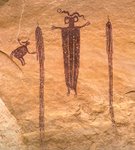
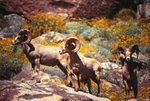



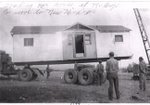

 Bald Eagle Near Brownlee Dam, February 2, 2011
 Common Goldeneye, Powder River, March, 2010
 Juvenile Bald Eagle, Brownlee Dam, February 2, 2011
 Rocky Mountain Bighorn Ewe near Brownlee Dam, 2/2/11
 Rocky Mountain Bighorn Ewe with collar near Brownlee Dam, 2/2/11