


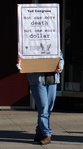



I thought this little rant from Information Clearing House might strike a chord with some.
Nice thoughts, but our society, from our corporate controlled media and govenment, to our two controlling and barely distinguishable political parties, to the majority of our unfortunately brainwashed consumer electorate, is corrupt to the core, so. . . forget it! There probably isn't the moral capacity and independent thinking ability left in the vast majority of them to even consider it, let alone follow through with it.
The sentiment and comments after the article are certainly interesting though. . . .
Another article on the criminal bailout, by Naomi Klein and her interview on DN! (below), may also be of interest.
Chris
The Election is Over; Time to Move On to the Recriminations
Let the Trials Begin!
By DOUGLAS VALENTINE
http://www.informationclearinghouse.info/article21225.htm
November 14, 2008 "Counterpunch" -- - Amid the euphoria and angst of the Obama apotheosis, the unreality of a mismanaged, two trillion dollar, taxpayer funded bailout of freewheeling capitalists, and the wars of limbo in Iraq and Afghanistan, one little thing is being overlooked.
George W Bush.
The Decider. The psychopath responsible for this appalling mess we're in. The architect of America's ignoble descent into moral darkness. The washed up and universally despised pseudo-despot who reveled in torture, kidnapping and assassination. The War-Monger.
"Bring 'em On!"
"Dead or Alive!"
The raving ignoramus whose words will haunt us forever.
The spoiled child of privilege playing with the lives of our sons and daughters, husbands and wives, mothers and fathers, friends and lovers, as if they were his personal toys.
The mass murderer who illegally invaded and occupied a foreign nation, killing hundreds of thousands of innocent people, utterly destroying their cities and bridges, power plants and schools, and scattering millions of them to the wind, as if he were GOD!
The Comic Book Madman obsessed with Death, reading CIA memos about Al Qaeda, sending kidnappers and hit teams and drones around the world, anywhere he wanted, to kill his imaginary enemies, while America burned.
The Super Traitor.
The elections are over, I say. The people have spoken. It's time to move on to the business at hand - hauling Bush's sorry ass before a war crimes tribunal of the sort he created. But not one staffed by his political cadre of complicit military officers. One composed of his victims.
Let the recriminations begin!
If there were any justice, the process would begin with his midnight arrest. Bush's beloved CIA drones and hitmen invariably kill their target's families in these little snatch operations, and if agreed upon by his inquisitors, I suggest this would be an appropriate touch.
Then the little fucker would be rendered to my basement and put on the waterboard. I'd ask that Joe Liebernut be made to put the wet towel on his face, but Joe would do it just for fun. Same with Limbaugh.
We'll find someone deserving of the job. Perhaps the boys from Gitmo? And I mean, the boys. The brothers and sisters of innocent Iraqis he killed? I think they'll be plenty of volunteers.
The whole point will be to make Bush confess. Not to the crimes he has committed. But to explain why he did it. Was it to show up Poppy? To win the love of Barbara?
I really want to know.
This interrogation should last seven years, and everyone Bush names as having followed his orders should be tried as well. That's Cheney, Rumsfeld, Rice and everyone in the CIA for starters.
Bush's kangaroo courtroom trial, presided over by Vincent Bugliosi, should be the highlight of the election campaign of 2016.
The supreme punishments to be broadcast live by Fox News.
Imagine.
Douglas Valentine is the author of four books which are available at his websites http://www.members.authorsguild.net/valentine/ and http://www.douglasvalentine.com/index.html His fifth book, The Strength of the Pack: The Politics, Personalities and Espionage Intrigues That Shaped The DEA, will be published in September 2009 by Trine Day.
To read the comments, go to the bottomof the page at:
http://www.informationclearinghouse.info/article21225.htm
-----------------------------------------
Wall Street's Bailout is a Trillion-Dollar Crime Scene
Why Aren't the Dems Doing Something About It?
By Naomi Klein
http://www.informationclearinghouse.info/article21226.htm
November 14, 2008 "The Nation" - -- The more details emerge, the clearer it becomes that Washington's handling of the Wall Street bailout is not merely incompetent. It is borderline criminal.
In a moment of high panic in late September, the U.S. Treasury unilaterally pushed through a radical change in how bank mergers are taxed -- a change long sought by the industry. Despite the fact that this move will deprive the government of as much as $140 billion in tax revenue, lawmakers found out only after the fact. According to the Washington Post, more than a dozen tax attorneys agree that "Treasury had no authority to issue the [tax change] notice."
Of equally dubious legality are the equity deals Treasury has negotiated with many of the country's banks. According to Congressman Barney Frank, one of the architects of the legislation that enables the deals, "Any use of these funds for any purpose other than lending -- for bonuses, for severance pay, for dividends, for acquisitions of other institutions, etc. -- is a violation of the act." Yet this is exactly how the funds are being used.
Then there is the nearly $2 trillion the Federal Reserve has handed out in emergency loans. Incredibly, the Fed will not reveal which corporations have received these loans or what it has accepted as collateral. Bloomberg News believes that this secrecy violates the law and has filed a federal suit demanding full disclosure.
Despite all of this potential lawlessness, the Democrats are either openly defending the administration or refusing to intervene. "There is only one president at a time," we hear from Barack Obama. That's true. But every sweetheart deal the lame-duck Bush administration makes threatens to hobble Obama's ability to make good on his promise of change. To cite just one example, that $140 billion in missing tax revenue is almost the same sum as Obama's renewable energy program. Obama owes it to the people who elected him to call this what it is: an attempt to undermine the electoral process by stealth.
Yes, there is only one president at a time, but that president needed the support of powerful Democrats, including Obama, to get the bailout passed. Now that it is clear that the Bush administration is violating the terms to which both parties agreed, the Democrats have not just the right but a grave responsibility to intervene forcefully.
I suspect that the real reason the Democrats are so far failing to act has less to do with presidential protocol than with fear: fear that the stock market, which has the temperament of an overindulged 2-year-old, will throw one of its world-shaking tantrums. Disclosing the truth about who is receiving federal loans, we are told, could cause the cranky market to bet against those banks. Question the legality of equity deals and the same thing will happen. Challenge the $140 billion tax giveaway and mergers could fall through. "None of us wants to be blamed for ruining these mergers and creating a new Great Depression," explained one unnamed Congressional aide.
More than that, the Democrats, including Obama, appear to believe that the need to soothe the market should govern all key economic decisions in the transition period. Which is why, just days after a euphoric victory for "change," the mantra abruptly shifted to "smooth transition" and "continuity."
Take Obama's pick for chief of staff. Despite the Republican braying about his partisanship, Rahm Emanuel, the House Democrat who received the most donations from the financial sector, sends an unmistakably reassuring message to Wall Street. When asked on This Week With George Stephanopoulos whether Obama would be moving quickly to increase taxes on the wealthy, as promised, Emanuel pointedly did not answer the question.
This same market-coddling logic should, we are told, guide Obama's selection of treasury secretary. Fox News's Stuart Varney explained that Larry Summers, who held the post under Clinton, and former Fed chair Paul Volcker would both "give great confidence to the market." We learned from MSNBC's Joe Scarborough that Summers is the man "the Street would like the most."
Let's be clear about why. "The Street" would cheer a Summers appointment for exactly the same reason the rest of us should fear it: because traders will assume that Summers, champion of financial deregulation under Clinton, will offer a transition from Henry Paulson so smooth we will barely know it happened. Someone like FDIC chair Sheila Bair, on the other hand, would spark fear on the Street -- for all the right reasons.
One thing we know for certain is that the market will react violently to any signal that there is a new sheriff in town who will impose serious regulation, invest in people and cut off the free money for corporations. In short, the markets can be relied on to vote in precisely the opposite way that Americans have just voted. (A recent USA Today/Gallup poll found that 60 percent of Americans strongly favor "stricter regulations on financial institutions," while just 21 percent support aid to financial companies.)
There is no way to reconcile the public's vote for change with the market's foot-stomping for more of the same. Any and all moves to change course will be met with short-term market shocks. The good news is that once it is clear that the new rules will be applied across the board and with fairness, the market will stabilize and adjust. Furthermore, the timing for this turbulence has never been better. Over the past three months, we've been shocked so frequently that market stability would come as more of a surprise. That gives Obama a window to disregard the calls for a seamless transition and do the hard stuff first. Few will be able to blame him for a crisis that clearly predates him, or fault him for honoring the clearly expressed wishes of the electorate. The longer he waits, however, the more memories fade.
When transferring power from a functional, trustworthy regime, everyone favors a smooth transition. When exiting an era marked by criminality and bankrupt ideology, a little rockiness at the start would be a very good sign.
See Also: http://www.democracynow.org/shows/2008/11/17
Showing posts with label taxpayer bailout. Show all posts
Showing posts with label taxpayer bailout. Show all posts
Tuesday, November 18, 2008


Sunday, September 21, 2008
Turn, Turn, Turn. . . A time to build up, a time to break down
I am in many ways a child of the 1960’s, although I’ve shed many of the illusions concerning “human nature” that I held dear then. My social and political outlook was formed in part by a few important forces of the time: my social circumstance (the “C” word—Class), the effects of the Viet Nam War, and the songs of Bob Dylan, Pete Seeger, Phil Ochs, and Joan Baez. From the latter two came a song that was to me perhaps the most compassionate and informative song of the decade: “There But For Fortune” (go you and I), long since buried, ever so deep, in the national consciousness. From the former came, among many, a song of hope and inspiration for the alienated and marginalized called “The Times They Are A Changin’.” (It was a few years before I discovered the likes of Johnny Cash, Waylon Jennings, Willie Nelson, Eddie Rabbitt, and Travis Tritt.) Before long, certainly by the time Reagan was elected in the early 80’s, it became pretty clear that, while the times were definitely a changin’, the direction wasn’t exactly what many of us had hoped for when it came to more egalitarian wealth distribution, improvements in worker rights, wages, and health care, not to mention real “democracy” in America. There are, however, other poem/songs, like “Masters of War” and “A Hard Rain’s a- Gonna Fall” that retain a forcefully relevant presence today. There were some simple truths too—like the line that “You don’t need a weatherman to know which way the wind blows.” Those words should be true for those checking on the political winds as well, but it is easier for some than others. In case you haven’t checked lately, today, and for the last few decades, we have been dominated by a chill, greedy, and toxic, corporate finance wind, emanating from Wall Street, the Pentagon, the halls of Congress, the White House, and the mansions of the political and financial elites.
As I think may have been implied earlier in these pages, the American people have been sold out by the political and economic system, and while it may not have been clear to some, the recent turn of events in the "system" (the casino economy), and our “democratic” government’s response to it, are making the sellout painfully obvious to even the semi-conscious. Yes, the times, they are a changin’—they’re getting far worse for the average American. Interestingly, these times are perhaps not quite so much worse for the poorest among us, because as Bob Dylan also wrote, “When you ain’t got nothin’, you got nothin’ to lose.” But if you have a home and still have enough to scrape by, or if you pay any taxes, that isn’t the case, because the aristocracy that makes up the Baker City and federal governments is getting ready to take whatever you had left to spare to pad their accounts, maintain their power, and keep the casino open.
The collapse that many of us saw coming for years is now upon us, despite whatever wishful thinking you may read in the papers about periodic Wall Street stock market rallies. Remember, in times like this, the market “rallies,” like vultures soaring on a temporary uplift, when the scamsters smell the rank odor of a taxpayer bailout, only to falter when they fear it might not be enough, which in this case, is probably true. While it is tempting to say simply that Bush fiddled while America degenerated into dust, the rot and decay has been hidden and nurtured over many years by both major political parties, and neither Presidential candidate will have a free hand to deal with it appropriately, as they are both beholden to, and advised by, the financial scamsters most responsible for the putrification.
"How many years can a mountain exist
Before it is washed to the sea?"
- Bob Dylan
IN THIS ISSUE:
- The End Of The American Dream--You've Been Sold out! (again)
- Note to All Patriotic Americans--Are You Clear About Your Role Yet?
- Turn, Turn, Turn
___________________________________________________
The End Of The American Dream--You've Been Sold out! (again)
Over the weekend, several good articles have appeared in the alternative press to explain what is actually happening, and several are included below, in case you haven’t yet found them.
The first is by Alexander Cockburn, formerly of “The Nation” and who founded and now runs “Counter Punch.” (http://www.counterpunch.org/ ) The article provides important historical context to explain how the crisis was created by deregulation demagogues (often with strong ties to Wall Street), within the “regulatory” agencies, Congress, and the executive branch, both Democrat and Republican, going as far back as the Clinton administration. A more complete biopsy would likely find roots as far back as the last years of the Carter administration just prior to the “Reagan Revolution.”
Is This the Stake Through Neoliberalism's Heart? It Should Be, But ...
By ALEXANDER COCKBURN
http://www.counterpunch.org/cockburn09202008.html
Hope walks arm in arm with fear, and so naturally enough Candidate Barack Obama is now reminding us, a la Roosevelt, that we have nothing to fear but fear itself and we must all pull together in a spirit of bipartisanship. Wrong. We have many identifiable things to be frightened of, starting with a bailout program designed to bail out the thieves running our financial system, and stick middle America with the pricetag – heftier than you can imagine. Why pull together with the licensed thug who just stole your money with the pledge that he would be doing it again to your kids? For the practicalities and implications of the thievery on Wall Street I highly recommend the pieces on our site this weekend by Michael Hudson, Pam Martens and our other writers. I also press upon our readers the reminder, which CounterPunchers surely don’t need, that when it comes to fingering the perpetrators this crisis is indeed truly bipartisan. What exploded last week was an economic credo that has been rolling along since the early 1970s: neoliberalism.
By all rights, this last crisis has brought us to the crossroads where neoliberalism should be buried with a stake through its heart. We’ve had thirty years worth of deregulation – the loosening of government supervision. This has been the neoliberal mantra preached by both major parties, the whole of the establishment press and almost every university economics department in the country. It is central to the current disasters. And if you want to identify symbolic figures in the legislated career of deregulation, there are no more resplendent culprits than the man at McCain’s elbow, Phil Gramm, and the man standing at Obama’s elbow at his press conference, Robert Rubin.
Take Gramm first.
In 1999 John McCain’s friend and now his closest economic counselor, then a senator from Texas, was the prime Republican force pushing through the Gramm-Leach-Bliley Act. It repealed the old Glass-Steagall Act, passed in the Great Depression, which prohibited a commercial bank from being in the investment and insurance business. President Bill Clinton cheerfully signed it into law.
A year later Gramm, chairman of the Senate Banking Committee, attached a 262-page amendment to an omnibus appropriations bill, voted on by Congress right before a recess. The amendment received no scrutiny and duly became the Commodity Futures Modernization Act which okayed deregulation of investment banks, exempting most over the counter derivatives, credit derivatives, credit defaults, and swaps from regulatory scrutiny. Thus were born the scams that produced the debacle of Enron, a company on whose board sat Gramm’s wife Wendy. She had served on the Commodity Futures Trading Commission from 1983 to 1993 and devised many of the rules coded into law by her husband in 2000.
Somewhat stained by the Enron debacle Gramm quit the senate in 2002 and began to enjoy the fruits of his own deregulatory efforts. He became a vice chairman of the giant Swiss bank UBS’ new investment arm in the US, lobbying Congress, the Federal Reserve and the Treasury Department about banking and mortgage issues in 2005 and 2006, urging Congress to roll back strong state rules trying to crimp the predatory tactics of the subprime mortgage industry. UBS took a bath of about $20 billion in write offs from bad real estate loans this year. . . . .
Gramm is a prime exhibit in any list of the architects of the current economic mess. At the behest of the banking industry he wrote the laws that enabled the huge balloons of funny money debt that exploded this year. The deregulatory statutes bearing his name prompted Wall Street’s looting orgy in the subprime thievery.
But is he Exhibit A? No. That honor should surely go to Robert Rubin and to the economic course he set for his boss, the eagerly complicit Bill Clinton. Gramm has been the hireling of the banking industry. Rubin is at the beating heart of Wall Street finance, and he and Lawrence Summers at Clinton’s Treasury, were the guiding forces for financial deregulation.
Obviously the Republicans hoped that the roof wouldn’t fall in on their watch, and the crisis could be deferred to 2008 and then blamed on the Democrats. But their insurance policy was that if the roof did cave, as it has now, the rescue policy would be identical in both cases. That’s why Obama has collected more money than McCain from the big Wall Street houses.
The gang that successfully got out of Dodge in time was the Clinton-Rubin-Summers gang, just before the last bubble -–the stock market bubble -- burst in March of 2001. They knew what was coming.
I urge CounterPunchers to pull off the shelf Robert Pollin’s invaluable economic history of the Clinton years, Contours of Descent.
"The second major component of Clinton administration policy in this area was supporting the successful repeal of the Depression-era Glass-Steagall framework of financial regulation through the 1999 Financial Services Modernization Act, otherwise known as Gramm-Leach-Bliley Dismantlement of Glass-Steagall, de facto and de jure, had been long in the making. Innovative financial market players were easily circumventing this old regulatory apparatus, with its focus on creating firewalls between segments of the financial services industry, and preventing commercial banks from operating in more than one state. But the point is that an alternative to both Glass-Steagall and complete deregulation could have been devised, through some combination of policies such as taxing speculative financial transactions and establishing lower reserve requirements for loans that finance productive, as against speculative, investments. But the Clinton administration never considered such an approach. Quite the contrary. The 2001 Economic Report of the President, the last one written under Clinton, was unequivocal in dismissing Glass-Steagall and touting the virtues of financial deregulation: “‘Given the massive financial instability of the 1930s, narrowing the range of banks' activities was arguably important for that day and age. But those rules are not needed today, and the easing of interstate banking rules, along with the passage of the Financial Services Modernization Act of 1999 have removed them, while maintaining appropriate safeguards. These steps allow consolidation in the financial sector that will result in efficiency gains and provide new services for consumers.’
“Moreover, Robert Rubin, a major Clinton administration force behind Glass-Steagall repeal, was also among the first to benefit personally from it, in moving from his Treasury position to co-direct the newly merged investment/commercial banking conglomerate Citigroup. Under any reasonable interpretation of Glass-Steagall, the former commercial bank Citicorp and the former investment banking firm Travelers would not have been permitted to merge."
Amid the embers of last weekend’s meltdown on Wall Street -- one of the most devastating in the nation’s history as Lehman went broke, Merrill Lynch was swallowed up by Bank of America and AIG tottered to the Fed, begging bowl in hand -- John McCain insisted that "the fundamentals of our economy are strong."
This was eerily reminiscent of the House of Morgan’s Thomas Lamont and his famous understatement to journalists including my father, standing on Wall Street on Black Thursday, October 24, 1929. As my father describes it in his memoirs:
It was like the manner of the man who comes on the stage of a burning theater and urges everyone to keep perfectly cool, stating there is no cause for alarm. Lamont made soft, soothing gesticulations with his pince-nez as softly, gently, almost stammeringly, he deprecated anything in the nature of sensationalism. His first sentence has been aptly described as one of the most remarkable understatements of all time.
‘There has been a little distress selling on the stock exchange,’ he said, ‘and we have held a meeting of the heads of several financial institutions to discuss the situation. We have found that there are no houses in difficulty and the reports from brokers indicate that margins are being maintained satisfactorily.’
The Rest: http://www.counterpunch.org/cockburn09202008.html
The second is by William Greider, a level-headed populist oracle, who has spent much of his life trying to explain to Americans how they are getting fleeced by “banksters” and Wall Street, and how our “freedom” and “democracy” have been betrayed by the corporate takeover. He has written many books on the subject, including the classic “Who Will Tell The People: The Betrayal Of American Democracy.” A new book, “Come Home, America: The Rise and Fall (and Redeeming Promise) of Our Country” will be released in 2009. He currently is a columnist for “The Nation.”
( http://www.thenation.com/ )
Paulson Bailout Plan a Historic Swindle
By William Greider
http://www.informationclearinghouse.info/article20823.htm
Excerpt:
19/09/08 "The Nation" -- - Financial-market wise guys, who had been seized with fear, are suddenly drunk with hope. They are rallying explosively because they think they have successfully stampeded Washington into accepting the Wall Street Journal solution to the crisis: dump it all on the taxpayers. That is the meaning of the massive bailout Treasury Secretary Henry Paulson has shopped around Congress. It would relieve the major banks and investment firms of their mountainous rotten assets and make the public swallow their losses--many hundreds of billions, maybe much more. What's not to like if you are a financial titan threatened with extinction?
If Wall Street gets away with this, it will represent an historic swindle of the American public--all sugar for the villains, lasting pain and damage for the victims. My advice to Washington politicians: Stop, take a deep breath and examine what you are being told to do by so-called "responsible opinion." If this deal succeeds, I predict it will become a transforming event in American politics--exposing the deep deformities in our democracy and launching a tidal wave of righteous anger and popular rebellion. As I have been saying for several months, this crisis has the potential to bring down one or both political parties, take your choice.
Christopher Whalen of Institutional Risk Analytics, a brave conservative critic, put it plainly: "The joyous reception from Congressional Democrats to Paulson's latest massive bailout proposal smells an awful lot like yet another corporatist lovefest between Washington's one-party government and the Sell Side investment banks."
A kindred critic, Josh Rosner of Graham Fisher in New York, defined the sponsors of this stampede to action: "Let us be clear, it is not citizen groups, private investors, equity investors or institutional investors broadly who are calling for this government purchase fund. It is almost exclusively being lobbied for by precisely those institutions that believed they were 'smarter than the rest of us,' institutions who need to get those assets off their balance sheet at an inflated value lest they be at risk of large losses or worse."
Let me be clear. The scandal is not that government is acting. The scandal is that government is not acting forcefully enough--using its ultimate emergency powers to take full control of the financial system and impose order on banks, firms and markets. Stop the music, so to speak, instead of allowing individual financiers and traders to take opportunistic moves to save themselves at the expense of the system. The step-by-step rescues that the Federal Reserve and Treasury have executed to date have failed utterly to reverse the flight of investors and banks worldwide from lending or buying in doubtful times. There is no obvious reason to assume this bailout proposal will change their minds, though it will certainly feel good to the financial houses that get to dump their bad paper on the government. ….
More important, if the taxpayers are compelled to refinance the villains in this drama, then Americans at large are entitled to equivalent treatment in their crisis. That means the suspension of home foreclosures and personal bankruptcies for debt-soaked families during the duration of this crisis. The debtors will not escape injury and loss--their situation is too dire--but they deserve equal protection from government, the chance to work out things gradually over some years on reasonable terms.
See: http://www.informationclearinghouse.info/article20823.htm
Here are excerpts/links to several other articles that are well worth reading:
Comrades Bush, Paulson and Bernanke Welcome You to the USSRA (United Socialist State Republic of America)
Nouriel Roubini | Sep 9, 2008
http://www.rgemonitor.com/roubini-monitor/253529/comrades_bush_paulson_and_bernanke_welcome_you_to_the_ussra_united_socialist_state_republic_of_america
So now Comrades Bush, Paulson and Bernanke (as originally nicknamed by Willem Buiter) have now turned the USA into the USSRA (the United Socialist State Republic of America). Socialism is indeed alive and well in America; but this is socialism for the rich, the well connected and Wall Street. A socialism where profits are privatized and losses are socialized with the US tax-payer being charged the bill. . . .
Financial Bailout:
America's Kleptocracy
The largest transformation of America's Financial System since the Great Depression
http://www.informationclearinghouse.info/article20822.htm
By Michael Hudson
20/09/08 "Global Research"
. . . .
What a two weeks! On Sunday, September 7, the Treasury took on the $5.3 trillion mortgage exposure of Fannie Mae and Freddie Mac, whose heads already had been removed for accounting fraud. On Monday, September 15, Lehman Brothers went bankrupt, when prospective Wall Street buyers couldn't gain any sense of reality from its financial books. On Wednesday the Federal Reserve agreed to make good for at least $85 billion in the just-pretend "insured" winnings owed to financial gamblers who bet on computer-driven trades in junk mortgages and bought counter-party coverage from the A.I.G. (the American International Group, whose head Maurice Greenberg already had been removed a few years back for accounting fraud). But it is Friday, September 19, that will go down as a turning point in American history. The White House committed at least half a trillion dollars more to re-inflate real estate prices in an attempt to support the market value junk mortgages - mortgages issued far beyond the ability of debtors to pay and far above the going market price of the collateral being pledged.
These billions of dollars were devoted to keeping a dream alive - the accounting fictions written down by companies that had entered an unreal world based on false accounting that nearly everyone in the financial sector knew to be fake. But they played along with buying and selling packaged mortgage junk because that was where the money was. As Charles Prince of Citibank put it, "As long as they're playing music, you have to get up and dance." Even after markets collapsed, fund managers who steered clear were blamed for not playing the game while it was going. I have friends on Wall Street who were fired for not matching the returns that their compatriots were making. And the biggest returns were to be made in trading in the economy's largest financial asset - mortgage debt. The mortgages packaged, owned or guaranteed by Fannie and Freddie alone exceeded the entire U.S. national debt - the cumulative deficits run up by the American Government since the nation won the Revolutionary War!
This gives an idea of just how large the bailout has been - and where the government's (or at least the Republicans') priorities lie! Instead of waking up the economy to reality, the government has thrown all its resources to promote the unreal dream that debts can be paid - if not by the debtors themselves, then by the government - "taxpayers," as the euphemism goes.
Overnight, the U.S. Treasury and Federal Reserve have radically changed the character of American capitalism. It is nothing less than a coup d'Etat for the class that FDR called "banksters." What has happened in the past two weeks threatens to change the coming century - irreversibly, if they can get away with it. This is the largest and most inequitable transfer of wealth since the land giveaways to the railroad barons during the Civil War era.
Even so, there seems little sign that it even may end the free-market patter talk by financial insiders who have managed to avert public oversight by appointing non-regulators to the major regulatory agencies - and thus created the mess that Treasury Secretary Henry Paulson now says threatens the bank deposits and jobs of all Americans. What he really means, of course, are simply the largest Republican campaign contributors (and to be fair, also the largest contributors to Democratic candidates on key financial committees).
A kleptocratic class has taken over the economy to replace industrial capitalism. Franklin Roosevelt's term "banksters" says it all in a nutshell. The economy has been captured - by an alien power, but not the usual suspects. Not socialism, workers or "big government," nor by industrial monopolists or even by the great banking families.
. . . .
So why has the Treasury found it necessary to enter this picture at all? Why should these gamblers be bailed out, if they had enough to lose without having to become public wards by going on welfare? Hedge fund trading was limited to the very rich, for investment banks and other institutional investors. But it became one of the easiest ways to make money, loaning funds at interest for people to pay out of their computer-driven cross-trades. And almost as fast as it was made, this revenue was paid out in commissions, salaries and annual bonuses reminiscent of America's Gilded Age in the years prior to World War I - years before the income tax was introduced in 1913. The remarkable thing about all this money was that its recipients didn't even have to pay normal income tax on it. The government let them call it "capital gains," which meant that the money was taxed at only a fraction of the rate that incomes were taxed.
The pretense, of course, is that all this frenetic trading creates real "capital." It certainly does not do so in the classical 19th-century concept of capital. The term has been decoupled from producing goods and services, hiring wage labor or from financing innovation. It is as much "capital" as the right to conduct a lottery and collect the winnings from the hopes of the losers. But then, casinos from Las Vegas to riverboats have become a major "growth industry," muddying the language of capital, growth and wealth itself. . . . .
Hardly by surprise, this giveaway of public money is being handled by the same group that warned the country so piously about weapons of mass destruction in Iraq. Pres. Bush and Treasury Secretary Paulson have piously announced that this is no time for partisan disagreements over this shift of public policy to favor creditors rather than debtors. There is no time to make the biggest bailout in election history an election issue. Not an appropriate time to debate whether it is a good thing to re-inflate housing prices to a level that will continue to oblige new home buyers to go so deeply into debt that they must pay some 40 percent of their take-home pay on housing.
Remember when President Bush and Alan Greenspan informed the American people that there was no money left to pay Social Security (not to mention Medicare) because at some future date (a decade from now? 20 years? 40 years?) the system might run a deficit of what now seems to be merely a trivial trillion dollars spread over many, many years. The moral was that if we can't figure out how to pay, let's plow the program under right now.
Mr. Bush and Greenspan did have a helpful solution, of course. The Treasury could turn Social Security and medical insurance money over to Bear Stearns, Lehman Brothers and their brethren to invest at the "magic of compound interest."
What would have happened to U.S. Social Security had this been done? Perhaps we should view the past two weeks' events as having assigned to Wall Street gamblers all the money that has been set aside since the Greenspan Commission in 1983 shifted the tax burden onto FICA wage withholding. It is not retirees who are being rescued, but the Wall Street investors who signed papers saying that they could afford to lose their money. The Republican slogan this November should be "Gambling insurance, not health insurance."
More: http://www.informationclearinghouse.info/article20822.htm
Grasping at Straws
By Mike Whitney
http://www.informationclearinghouse.info/article20828.htm
21/09/08 "ICH" -- -
. . . . On Friday morning, Senator Christopher Paulson's plan is a band-aid approach to a sucking chest wound. The debts are enormous and the pain will be substantial, but the problem cannot be resolved by crushing the middle class or destroying the currency. The malfunctioning of the markets and the freeze-over in the banking system are the outcome of a massive credit unwind instigated by trillions of dollars of low interest credit from the Federal Reserve which was magnified many times over via complex derivatives contracts and extreme leveraging by speculative investment bankers. This has generated the biggest equity bubble in history. That bubble is now set for a "hard-landing" which is the predictable result of an unsupervised marketplace where individual players are allowed to create as much credit as they choose. If Paulson is not removed and his rescue plan scrapped altogether; the dollar will lose its position as the world's reserve currency and the US government will face a historic funding crisis as foreign sources of capital dry up. That will thrust the country into a hyper-inflationary depression.
What's Really Bankrupt
The Wall Street Model: Unintelligent Design
By PAM MARTENS
http://www.counterpunch.org/martens09202008.html
21/09/08 "Counterpunch" -- Wall Street is collapsing not because of bad mortgage debt or lack of capital or over-leverage. Those are merely symptoms. Wall Street is collapsing because it deserves to collapse; it needs to collapse in order for America to survive. The economist Joseph Schumpeter called it creative destruction, a system where outdated models collapse to make room for new innovation.
Wall Street of the past decade never really had a business model as much as it had a business creed: greed is good; leveraged greed is even better.
The fact that Wall Street is collapsing is a given. How it survived as long as it did under its corrupted model is the question that will be debated in history books for the next generation.
THIS JUST IN (9/22/08):
Cash for Trash
By PAUL KRUGMAN
http://www.nytimes.com/2008/09/22/opinion/22krugman.html?_r=1&oref=slogin&pagewanted=print
. . . .
But Mr. Paulson insists that he wants a “clean” plan. “Clean,” in this context, means a taxpayer-financed bailout with no strings attached — no quid pro quo on the part of those being bailed out. Why is that a good thing? Add to this the fact that Mr. Paulson is also demanding dictatorial authority, plus immunity from review “by any court of law or any administrative agency,” and this adds up to an unacceptable proposal.
I’m aware that Congress is under enormous pressure to agree to the Paulson plan in the next few days, with at most a few modifications that make it slightly less bad. Basically, after having spent a year and a half telling everyone that things were under control, the Bush administration says that the sky is falling, and that to save the world we have to do exactly what it says now now now.
But I’d urge Congress to pause for a minute, take a deep breath, and try to seriously rework the structure of the plan, making it a plan that addresses the real problem. Don’t let yourself be railroaded — if this plan goes through in anything like its current form, we’ll all be very sorry in the not-too-distant future.
________________
Note to All Patriotic Americans
Dear American, True Believing Patriot, and Poor Free Market Ideologue—
Are You Clear About Your Role Yet?
Yours is to give your Children—
Their Souls, or Limbs or Lives
Yours is to defend the Rich Man’s Ways—
Their Privilege, Casinos and Lies
Yours is to give your health and security to—
Their Excess, Debts and Sighs
Are You Clear About Your Role Yet?
Chris
________________
Turn, Turn, Turn
Words-adapted from the bible, book of ecclesiastes
Music by Pete Seeger
To everything (turn, turn, turn)
There is a season (turn, turn, turn)
And a time for every purpose, under heaven
A time to be born, a time to die
A time to plant, a time to reap
A time to kill, a time to heal
A time to laugh, a time to weep
To everything (turn, turn, turn)
There is a season (turn, turn, turn)
And a time for every purpose, under heaven
A time to build up, a time to break down
A time to dance, a time to mourn
A time to cast away stones, a time to gather stones together
To everything (turn, turn, turn)
There is a season (turn, turn, turn)
And a time for every purpose, under heaven
A time of love, a time of hate
A time of war, a time of peace
A time you may embrace, a time to refrain from embracing
To everything (turn, turn, turn)
There is a season (turn, turn, turn)
And a time for every purpose, under heaven
A time to gain, a time to lose
A time to rend, a time to sew
A time to love, a time to hate
A time for peace, I swear its not too late
P. S.
There But For Fortune
Written by Phil Ochs
Sung by Joan Baez
Show me the prison, show me the jail
Show me the prisoner, whose life has gone stale
And I'll show you a young man
With so many reasons why
And there but for fortune, go you or I
Show me the alley, show me the train
Show me the hobo, who sleeps out in the rain
And I'll show you a young man
With so many reasons why
And there but for fortune, go you or I
Show me the whiskey, stains on the floor
Show me the drunkard, as he stumbles out the door
And I'll show you a young man
with so many reasons why
And there but for fortune go you or I
Show me the country, where the bombs had to fall
Show me the ruins of the buildings, once so tall
And I'll show you a young land
with so many reasons why
And there but for fortune go you and I, you and I.
Masters Of War
- Bob Dylan
Come you masters of war
You that build the big guns
You that build the death planes
You that build all the bombs
You that hide behind walls
You that hide behind desks
I just want you to know
I can see through your masks
You that never done nothin'
But build to destroy
You play with my world
Like it's your little toy
You put a gun in my hand
And you hide from my eyes
And you turn and run farther
When the fast bullets fly
Like Judas of old
You lie and deceive
A world war can be won
You want me to believe
But I see through your eyes
And I see through your brain
Like I see through the water
That runs down my drain
You fasten all the triggers
For the others to fire
Then you set back and watch
While the death count gets higher
Then you hide in your mansion
While the young people's blood
Flows out of their bodies
And is buried in the mud
You've thrown the worst fear
That can ever be hurled
Fear to bring children
Into the world
For threatening my baby
Unborn and unnamed
You ain't worth the blood
That runs in your veins
How much do I know
To talk out of turn
You might say that I'm young
You might say I'm unlearned
But there's one thing I know
Though I'm younger than you
Even Jesus would never
Forgive what you do
Let me ask you one question
Is your money that good
Will it buy you forgiveness
Do you think that it could
I think you will find
When your death takes its toll
All the money you made
Will never buy back your soul
And I hope that you die
And your death'll come soon
I will follow your casket
In the pale afternoon
And I'll watch while you're lowered
Down to your deathbed
And I'll stand o'er your grave
'Til I'm sure that you're dead
A Hard Rain's A-Gonna Fall
- Bob Dylan
Oh, where have you been, my blue-eyed son?
Oh, where have you been, my darling young one?
I've stumbled on the side of twelve misty mountains,
I've walked and I've crawled on six crooked highways,
I've stepped in the middle of seven sad forests,
I've been out in front of a dozen dead oceans,
I've been ten thousand miles in the mouth of a graveyard,
And it's a hard, and it's a hard, it's a hard, and it's a hard,
And it's a hard rain's a-gonna fall.
Oh, what did you see, my blue-eyed son?
Oh, what did you see, my darling young one?
I saw a newborn baby with wild wolves all around it
I saw a highway of diamonds with nobody on it,
I saw a black branch with blood that kept drippin',
I saw a room full of men with their hammers a-bleedin',
I saw a white ladder all covered with water,
I saw ten thousand talkers whose tongues were all broken,
I saw guns and sharp swords in the hands of young children,
And it's a hard, and it's a hard, it's a hard, it's a hard,
And it's a hard rain's a-gonna fall.
And what did you hear, my blue-eyed son?
And what did you hear, my darling young one?
I heard the sound of a thunder, it roared out a warnin',
Heard the roar of a wave that could drown the whole world,
Heard one hundred drummers whose hands were a-blazin',
Heard ten thousand whisperin' and nobody listenin',
Heard one person starve, I heard many people laughin',
Heard the song of a poet who died in the gutter,
Heard the sound of a clown who cried in the alley,
And it's a hard, and it's a hard, it's a hard, it's a hard,
And it's a hard rain's a-gonna fall.
Oh, who did you meet, my blue-eyed son?
Who did you meet, my darling young one?
I met a young child beside a dead pony,
I met a white man who walked a black dog,
I met a young woman whose body was burning,
I met a young girl, she gave me a rainbow,
I met one man who was wounded in love,
I met another man who was wounded with hatred,
And it's a hard, it's a hard, it's a hard, it's a hard,
It's a hard rain's a-gonna fall.
Oh, what'll you do now, my blue-eyed son?
Oh, what'll you do now, my darling young one?
I'm a-goin' back out 'fore the rain starts a-fallin',
I'll walk to the depths of the deepest black forest,
Where the people are many and their hands are all empty,
Where the pellets of poison are flooding their waters,
Where the home in the valley meets the damp dirty prison,
Where the executioner's face is always well hidden,
Where hunger is ugly, where souls are forgotten,
Where black is the color, where none is the number,
And I'll tell it and think it and speak it and breathe it,
And reflect it from the mountain so all souls can see it,
Then I'll stand on the ocean until I start sinkin',
But I'll know my song well before I start singin',
And it's a hard, it's a hard, it's a hard, it's a hard,
It's a hard rain's a-gonna fall.
As I think may have been implied earlier in these pages, the American people have been sold out by the political and economic system, and while it may not have been clear to some, the recent turn of events in the "system" (the casino economy), and our “democratic” government’s response to it, are making the sellout painfully obvious to even the semi-conscious. Yes, the times, they are a changin’—they’re getting far worse for the average American. Interestingly, these times are perhaps not quite so much worse for the poorest among us, because as Bob Dylan also wrote, “When you ain’t got nothin’, you got nothin’ to lose.” But if you have a home and still have enough to scrape by, or if you pay any taxes, that isn’t the case, because the aristocracy that makes up the Baker City and federal governments is getting ready to take whatever you had left to spare to pad their accounts, maintain their power, and keep the casino open.
The collapse that many of us saw coming for years is now upon us, despite whatever wishful thinking you may read in the papers about periodic Wall Street stock market rallies. Remember, in times like this, the market “rallies,” like vultures soaring on a temporary uplift, when the scamsters smell the rank odor of a taxpayer bailout, only to falter when they fear it might not be enough, which in this case, is probably true. While it is tempting to say simply that Bush fiddled while America degenerated into dust, the rot and decay has been hidden and nurtured over many years by both major political parties, and neither Presidential candidate will have a free hand to deal with it appropriately, as they are both beholden to, and advised by, the financial scamsters most responsible for the putrification.
"How many years can a mountain exist
Before it is washed to the sea?"
- Bob Dylan
IN THIS ISSUE:
- The End Of The American Dream--You've Been Sold out! (again)
- Note to All Patriotic Americans--Are You Clear About Your Role Yet?
- Turn, Turn, Turn
___________________________________________________
The End Of The American Dream--You've Been Sold out! (again)
Over the weekend, several good articles have appeared in the alternative press to explain what is actually happening, and several are included below, in case you haven’t yet found them.
The first is by Alexander Cockburn, formerly of “The Nation” and who founded and now runs “Counter Punch.” (http://www.counterpunch.org/ ) The article provides important historical context to explain how the crisis was created by deregulation demagogues (often with strong ties to Wall Street), within the “regulatory” agencies, Congress, and the executive branch, both Democrat and Republican, going as far back as the Clinton administration. A more complete biopsy would likely find roots as far back as the last years of the Carter administration just prior to the “Reagan Revolution.”
Is This the Stake Through Neoliberalism's Heart? It Should Be, But ...
By ALEXANDER COCKBURN
http://www.counterpunch.org/cockburn09202008.html
Hope walks arm in arm with fear, and so naturally enough Candidate Barack Obama is now reminding us, a la Roosevelt, that we have nothing to fear but fear itself and we must all pull together in a spirit of bipartisanship. Wrong. We have many identifiable things to be frightened of, starting with a bailout program designed to bail out the thieves running our financial system, and stick middle America with the pricetag – heftier than you can imagine. Why pull together with the licensed thug who just stole your money with the pledge that he would be doing it again to your kids? For the practicalities and implications of the thievery on Wall Street I highly recommend the pieces on our site this weekend by Michael Hudson, Pam Martens and our other writers. I also press upon our readers the reminder, which CounterPunchers surely don’t need, that when it comes to fingering the perpetrators this crisis is indeed truly bipartisan. What exploded last week was an economic credo that has been rolling along since the early 1970s: neoliberalism.
By all rights, this last crisis has brought us to the crossroads where neoliberalism should be buried with a stake through its heart. We’ve had thirty years worth of deregulation – the loosening of government supervision. This has been the neoliberal mantra preached by both major parties, the whole of the establishment press and almost every university economics department in the country. It is central to the current disasters. And if you want to identify symbolic figures in the legislated career of deregulation, there are no more resplendent culprits than the man at McCain’s elbow, Phil Gramm, and the man standing at Obama’s elbow at his press conference, Robert Rubin.
Take Gramm first.
In 1999 John McCain’s friend and now his closest economic counselor, then a senator from Texas, was the prime Republican force pushing through the Gramm-Leach-Bliley Act. It repealed the old Glass-Steagall Act, passed in the Great Depression, which prohibited a commercial bank from being in the investment and insurance business. President Bill Clinton cheerfully signed it into law.
A year later Gramm, chairman of the Senate Banking Committee, attached a 262-page amendment to an omnibus appropriations bill, voted on by Congress right before a recess. The amendment received no scrutiny and duly became the Commodity Futures Modernization Act which okayed deregulation of investment banks, exempting most over the counter derivatives, credit derivatives, credit defaults, and swaps from regulatory scrutiny. Thus were born the scams that produced the debacle of Enron, a company on whose board sat Gramm’s wife Wendy. She had served on the Commodity Futures Trading Commission from 1983 to 1993 and devised many of the rules coded into law by her husband in 2000.
Somewhat stained by the Enron debacle Gramm quit the senate in 2002 and began to enjoy the fruits of his own deregulatory efforts. He became a vice chairman of the giant Swiss bank UBS’ new investment arm in the US, lobbying Congress, the Federal Reserve and the Treasury Department about banking and mortgage issues in 2005 and 2006, urging Congress to roll back strong state rules trying to crimp the predatory tactics of the subprime mortgage industry. UBS took a bath of about $20 billion in write offs from bad real estate loans this year. . . . .
Gramm is a prime exhibit in any list of the architects of the current economic mess. At the behest of the banking industry he wrote the laws that enabled the huge balloons of funny money debt that exploded this year. The deregulatory statutes bearing his name prompted Wall Street’s looting orgy in the subprime thievery.
But is he Exhibit A? No. That honor should surely go to Robert Rubin and to the economic course he set for his boss, the eagerly complicit Bill Clinton. Gramm has been the hireling of the banking industry. Rubin is at the beating heart of Wall Street finance, and he and Lawrence Summers at Clinton’s Treasury, were the guiding forces for financial deregulation.
Obviously the Republicans hoped that the roof wouldn’t fall in on their watch, and the crisis could be deferred to 2008 and then blamed on the Democrats. But their insurance policy was that if the roof did cave, as it has now, the rescue policy would be identical in both cases. That’s why Obama has collected more money than McCain from the big Wall Street houses.
The gang that successfully got out of Dodge in time was the Clinton-Rubin-Summers gang, just before the last bubble -–the stock market bubble -- burst in March of 2001. They knew what was coming.
I urge CounterPunchers to pull off the shelf Robert Pollin’s invaluable economic history of the Clinton years, Contours of Descent.
"The second major component of Clinton administration policy in this area was supporting the successful repeal of the Depression-era Glass-Steagall framework of financial regulation through the 1999 Financial Services Modernization Act, otherwise known as Gramm-Leach-Bliley Dismantlement of Glass-Steagall, de facto and de jure, had been long in the making. Innovative financial market players were easily circumventing this old regulatory apparatus, with its focus on creating firewalls between segments of the financial services industry, and preventing commercial banks from operating in more than one state. But the point is that an alternative to both Glass-Steagall and complete deregulation could have been devised, through some combination of policies such as taxing speculative financial transactions and establishing lower reserve requirements for loans that finance productive, as against speculative, investments. But the Clinton administration never considered such an approach. Quite the contrary. The 2001 Economic Report of the President, the last one written under Clinton, was unequivocal in dismissing Glass-Steagall and touting the virtues of financial deregulation: “‘Given the massive financial instability of the 1930s, narrowing the range of banks' activities was arguably important for that day and age. But those rules are not needed today, and the easing of interstate banking rules, along with the passage of the Financial Services Modernization Act of 1999 have removed them, while maintaining appropriate safeguards. These steps allow consolidation in the financial sector that will result in efficiency gains and provide new services for consumers.’
“Moreover, Robert Rubin, a major Clinton administration force behind Glass-Steagall repeal, was also among the first to benefit personally from it, in moving from his Treasury position to co-direct the newly merged investment/commercial banking conglomerate Citigroup. Under any reasonable interpretation of Glass-Steagall, the former commercial bank Citicorp and the former investment banking firm Travelers would not have been permitted to merge."
Amid the embers of last weekend’s meltdown on Wall Street -- one of the most devastating in the nation’s history as Lehman went broke, Merrill Lynch was swallowed up by Bank of America and AIG tottered to the Fed, begging bowl in hand -- John McCain insisted that "the fundamentals of our economy are strong."
This was eerily reminiscent of the House of Morgan’s Thomas Lamont and his famous understatement to journalists including my father, standing on Wall Street on Black Thursday, October 24, 1929. As my father describes it in his memoirs:
It was like the manner of the man who comes on the stage of a burning theater and urges everyone to keep perfectly cool, stating there is no cause for alarm. Lamont made soft, soothing gesticulations with his pince-nez as softly, gently, almost stammeringly, he deprecated anything in the nature of sensationalism. His first sentence has been aptly described as one of the most remarkable understatements of all time.
‘There has been a little distress selling on the stock exchange,’ he said, ‘and we have held a meeting of the heads of several financial institutions to discuss the situation. We have found that there are no houses in difficulty and the reports from brokers indicate that margins are being maintained satisfactorily.’
The Rest: http://www.counterpunch.org/cockburn09202008.html
The second is by William Greider, a level-headed populist oracle, who has spent much of his life trying to explain to Americans how they are getting fleeced by “banksters” and Wall Street, and how our “freedom” and “democracy” have been betrayed by the corporate takeover. He has written many books on the subject, including the classic “Who Will Tell The People: The Betrayal Of American Democracy.” A new book, “Come Home, America: The Rise and Fall (and Redeeming Promise) of Our Country” will be released in 2009. He currently is a columnist for “The Nation.”
( http://www.thenation.com/ )
Paulson Bailout Plan a Historic Swindle
By William Greider
http://www.informationclearinghouse.info/article20823.htm
Excerpt:
19/09/08 "The Nation" -- - Financial-market wise guys, who had been seized with fear, are suddenly drunk with hope. They are rallying explosively because they think they have successfully stampeded Washington into accepting the Wall Street Journal solution to the crisis: dump it all on the taxpayers. That is the meaning of the massive bailout Treasury Secretary Henry Paulson has shopped around Congress. It would relieve the major banks and investment firms of their mountainous rotten assets and make the public swallow their losses--many hundreds of billions, maybe much more. What's not to like if you are a financial titan threatened with extinction?
If Wall Street gets away with this, it will represent an historic swindle of the American public--all sugar for the villains, lasting pain and damage for the victims. My advice to Washington politicians: Stop, take a deep breath and examine what you are being told to do by so-called "responsible opinion." If this deal succeeds, I predict it will become a transforming event in American politics--exposing the deep deformities in our democracy and launching a tidal wave of righteous anger and popular rebellion. As I have been saying for several months, this crisis has the potential to bring down one or both political parties, take your choice.
Christopher Whalen of Institutional Risk Analytics, a brave conservative critic, put it plainly: "The joyous reception from Congressional Democrats to Paulson's latest massive bailout proposal smells an awful lot like yet another corporatist lovefest between Washington's one-party government and the Sell Side investment banks."
A kindred critic, Josh Rosner of Graham Fisher in New York, defined the sponsors of this stampede to action: "Let us be clear, it is not citizen groups, private investors, equity investors or institutional investors broadly who are calling for this government purchase fund. It is almost exclusively being lobbied for by precisely those institutions that believed they were 'smarter than the rest of us,' institutions who need to get those assets off their balance sheet at an inflated value lest they be at risk of large losses or worse."
Let me be clear. The scandal is not that government is acting. The scandal is that government is not acting forcefully enough--using its ultimate emergency powers to take full control of the financial system and impose order on banks, firms and markets. Stop the music, so to speak, instead of allowing individual financiers and traders to take opportunistic moves to save themselves at the expense of the system. The step-by-step rescues that the Federal Reserve and Treasury have executed to date have failed utterly to reverse the flight of investors and banks worldwide from lending or buying in doubtful times. There is no obvious reason to assume this bailout proposal will change their minds, though it will certainly feel good to the financial houses that get to dump their bad paper on the government. ….
More important, if the taxpayers are compelled to refinance the villains in this drama, then Americans at large are entitled to equivalent treatment in their crisis. That means the suspension of home foreclosures and personal bankruptcies for debt-soaked families during the duration of this crisis. The debtors will not escape injury and loss--their situation is too dire--but they deserve equal protection from government, the chance to work out things gradually over some years on reasonable terms.
See: http://www.informationclearinghouse.info/article20823.htm
Here are excerpts/links to several other articles that are well worth reading:
Comrades Bush, Paulson and Bernanke Welcome You to the USSRA (United Socialist State Republic of America)
Nouriel Roubini | Sep 9, 2008
http://www.rgemonitor.com/roubini-monitor/253529/comrades_bush_paulson_and_bernanke_welcome_you_to_the_ussra_united_socialist_state_republic_of_america
So now Comrades Bush, Paulson and Bernanke (as originally nicknamed by Willem Buiter) have now turned the USA into the USSRA (the United Socialist State Republic of America). Socialism is indeed alive and well in America; but this is socialism for the rich, the well connected and Wall Street. A socialism where profits are privatized and losses are socialized with the US tax-payer being charged the bill. . . .
Financial Bailout:
America's Kleptocracy
The largest transformation of America's Financial System since the Great Depression
http://www.informationclearinghouse.info/article20822.htm
By Michael Hudson
20/09/08 "Global Research"
. . . .
What a two weeks! On Sunday, September 7, the Treasury took on the $5.3 trillion mortgage exposure of Fannie Mae and Freddie Mac, whose heads already had been removed for accounting fraud. On Monday, September 15, Lehman Brothers went bankrupt, when prospective Wall Street buyers couldn't gain any sense of reality from its financial books. On Wednesday the Federal Reserve agreed to make good for at least $85 billion in the just-pretend "insured" winnings owed to financial gamblers who bet on computer-driven trades in junk mortgages and bought counter-party coverage from the A.I.G. (the American International Group, whose head Maurice Greenberg already had been removed a few years back for accounting fraud). But it is Friday, September 19, that will go down as a turning point in American history. The White House committed at least half a trillion dollars more to re-inflate real estate prices in an attempt to support the market value junk mortgages - mortgages issued far beyond the ability of debtors to pay and far above the going market price of the collateral being pledged.
These billions of dollars were devoted to keeping a dream alive - the accounting fictions written down by companies that had entered an unreal world based on false accounting that nearly everyone in the financial sector knew to be fake. But they played along with buying and selling packaged mortgage junk because that was where the money was. As Charles Prince of Citibank put it, "As long as they're playing music, you have to get up and dance." Even after markets collapsed, fund managers who steered clear were blamed for not playing the game while it was going. I have friends on Wall Street who were fired for not matching the returns that their compatriots were making. And the biggest returns were to be made in trading in the economy's largest financial asset - mortgage debt. The mortgages packaged, owned or guaranteed by Fannie and Freddie alone exceeded the entire U.S. national debt - the cumulative deficits run up by the American Government since the nation won the Revolutionary War!
This gives an idea of just how large the bailout has been - and where the government's (or at least the Republicans') priorities lie! Instead of waking up the economy to reality, the government has thrown all its resources to promote the unreal dream that debts can be paid - if not by the debtors themselves, then by the government - "taxpayers," as the euphemism goes.
Overnight, the U.S. Treasury and Federal Reserve have radically changed the character of American capitalism. It is nothing less than a coup d'Etat for the class that FDR called "banksters." What has happened in the past two weeks threatens to change the coming century - irreversibly, if they can get away with it. This is the largest and most inequitable transfer of wealth since the land giveaways to the railroad barons during the Civil War era.
Even so, there seems little sign that it even may end the free-market patter talk by financial insiders who have managed to avert public oversight by appointing non-regulators to the major regulatory agencies - and thus created the mess that Treasury Secretary Henry Paulson now says threatens the bank deposits and jobs of all Americans. What he really means, of course, are simply the largest Republican campaign contributors (and to be fair, also the largest contributors to Democratic candidates on key financial committees).
A kleptocratic class has taken over the economy to replace industrial capitalism. Franklin Roosevelt's term "banksters" says it all in a nutshell. The economy has been captured - by an alien power, but not the usual suspects. Not socialism, workers or "big government," nor by industrial monopolists or even by the great banking families.
. . . .
So why has the Treasury found it necessary to enter this picture at all? Why should these gamblers be bailed out, if they had enough to lose without having to become public wards by going on welfare? Hedge fund trading was limited to the very rich, for investment banks and other institutional investors. But it became one of the easiest ways to make money, loaning funds at interest for people to pay out of their computer-driven cross-trades. And almost as fast as it was made, this revenue was paid out in commissions, salaries and annual bonuses reminiscent of America's Gilded Age in the years prior to World War I - years before the income tax was introduced in 1913. The remarkable thing about all this money was that its recipients didn't even have to pay normal income tax on it. The government let them call it "capital gains," which meant that the money was taxed at only a fraction of the rate that incomes were taxed.
The pretense, of course, is that all this frenetic trading creates real "capital." It certainly does not do so in the classical 19th-century concept of capital. The term has been decoupled from producing goods and services, hiring wage labor or from financing innovation. It is as much "capital" as the right to conduct a lottery and collect the winnings from the hopes of the losers. But then, casinos from Las Vegas to riverboats have become a major "growth industry," muddying the language of capital, growth and wealth itself. . . . .
Hardly by surprise, this giveaway of public money is being handled by the same group that warned the country so piously about weapons of mass destruction in Iraq. Pres. Bush and Treasury Secretary Paulson have piously announced that this is no time for partisan disagreements over this shift of public policy to favor creditors rather than debtors. There is no time to make the biggest bailout in election history an election issue. Not an appropriate time to debate whether it is a good thing to re-inflate housing prices to a level that will continue to oblige new home buyers to go so deeply into debt that they must pay some 40 percent of their take-home pay on housing.
Remember when President Bush and Alan Greenspan informed the American people that there was no money left to pay Social Security (not to mention Medicare) because at some future date (a decade from now? 20 years? 40 years?) the system might run a deficit of what now seems to be merely a trivial trillion dollars spread over many, many years. The moral was that if we can't figure out how to pay, let's plow the program under right now.
Mr. Bush and Greenspan did have a helpful solution, of course. The Treasury could turn Social Security and medical insurance money over to Bear Stearns, Lehman Brothers and their brethren to invest at the "magic of compound interest."
What would have happened to U.S. Social Security had this been done? Perhaps we should view the past two weeks' events as having assigned to Wall Street gamblers all the money that has been set aside since the Greenspan Commission in 1983 shifted the tax burden onto FICA wage withholding. It is not retirees who are being rescued, but the Wall Street investors who signed papers saying that they could afford to lose their money. The Republican slogan this November should be "Gambling insurance, not health insurance."
More: http://www.informationclearinghouse.info/article20822.htm
Grasping at Straws
By Mike Whitney
http://www.informationclearinghouse.info/article20828.htm
21/09/08 "ICH" -- -
. . . . On Friday morning, Senator Christopher Paulson's plan is a band-aid approach to a sucking chest wound. The debts are enormous and the pain will be substantial, but the problem cannot be resolved by crushing the middle class or destroying the currency. The malfunctioning of the markets and the freeze-over in the banking system are the outcome of a massive credit unwind instigated by trillions of dollars of low interest credit from the Federal Reserve which was magnified many times over via complex derivatives contracts and extreme leveraging by speculative investment bankers. This has generated the biggest equity bubble in history. That bubble is now set for a "hard-landing" which is the predictable result of an unsupervised marketplace where individual players are allowed to create as much credit as they choose. If Paulson is not removed and his rescue plan scrapped altogether; the dollar will lose its position as the world's reserve currency and the US government will face a historic funding crisis as foreign sources of capital dry up. That will thrust the country into a hyper-inflationary depression.
What's Really Bankrupt
The Wall Street Model: Unintelligent Design
By PAM MARTENS
http://www.counterpunch.org/martens09202008.html
21/09/08 "Counterpunch" -- Wall Street is collapsing not because of bad mortgage debt or lack of capital or over-leverage. Those are merely symptoms. Wall Street is collapsing because it deserves to collapse; it needs to collapse in order for America to survive. The economist Joseph Schumpeter called it creative destruction, a system where outdated models collapse to make room for new innovation.
Wall Street of the past decade never really had a business model as much as it had a business creed: greed is good; leveraged greed is even better.
The fact that Wall Street is collapsing is a given. How it survived as long as it did under its corrupted model is the question that will be debated in history books for the next generation.
THIS JUST IN (9/22/08):
Cash for Trash
By PAUL KRUGMAN
http://www.nytimes.com/2008/09/22/opinion/22krugman.html?_r=1&oref=slogin&pagewanted=print
. . . .
But Mr. Paulson insists that he wants a “clean” plan. “Clean,” in this context, means a taxpayer-financed bailout with no strings attached — no quid pro quo on the part of those being bailed out. Why is that a good thing? Add to this the fact that Mr. Paulson is also demanding dictatorial authority, plus immunity from review “by any court of law or any administrative agency,” and this adds up to an unacceptable proposal.
I’m aware that Congress is under enormous pressure to agree to the Paulson plan in the next few days, with at most a few modifications that make it slightly less bad. Basically, after having spent a year and a half telling everyone that things were under control, the Bush administration says that the sky is falling, and that to save the world we have to do exactly what it says now now now.
But I’d urge Congress to pause for a minute, take a deep breath, and try to seriously rework the structure of the plan, making it a plan that addresses the real problem. Don’t let yourself be railroaded — if this plan goes through in anything like its current form, we’ll all be very sorry in the not-too-distant future.
________________
Note to All Patriotic Americans
Dear American, True Believing Patriot, and Poor Free Market Ideologue—
Are You Clear About Your Role Yet?
Yours is to give your Children—
Their Souls, or Limbs or Lives
Yours is to defend the Rich Man’s Ways—
Their Privilege, Casinos and Lies
Yours is to give your health and security to—
Their Excess, Debts and Sighs
Are You Clear About Your Role Yet?
Chris
________________
Turn, Turn, Turn
Words-adapted from the bible, book of ecclesiastes
Music by Pete Seeger
To everything (turn, turn, turn)
There is a season (turn, turn, turn)
And a time for every purpose, under heaven
A time to be born, a time to die
A time to plant, a time to reap
A time to kill, a time to heal
A time to laugh, a time to weep
To everything (turn, turn, turn)
There is a season (turn, turn, turn)
And a time for every purpose, under heaven
A time to build up, a time to break down
A time to dance, a time to mourn
A time to cast away stones, a time to gather stones together
To everything (turn, turn, turn)
There is a season (turn, turn, turn)
And a time for every purpose, under heaven
A time of love, a time of hate
A time of war, a time of peace
A time you may embrace, a time to refrain from embracing
To everything (turn, turn, turn)
There is a season (turn, turn, turn)
And a time for every purpose, under heaven
A time to gain, a time to lose
A time to rend, a time to sew
A time to love, a time to hate
A time for peace, I swear its not too late
P. S.
There But For Fortune
Written by Phil Ochs
Sung by Joan Baez
Show me the prison, show me the jail
Show me the prisoner, whose life has gone stale
And I'll show you a young man
With so many reasons why
And there but for fortune, go you or I
Show me the alley, show me the train
Show me the hobo, who sleeps out in the rain
And I'll show you a young man
With so many reasons why
And there but for fortune, go you or I
Show me the whiskey, stains on the floor
Show me the drunkard, as he stumbles out the door
And I'll show you a young man
with so many reasons why
And there but for fortune go you or I
Show me the country, where the bombs had to fall
Show me the ruins of the buildings, once so tall
And I'll show you a young land
with so many reasons why
And there but for fortune go you and I, you and I.
Masters Of War
- Bob Dylan
Come you masters of war
You that build the big guns
You that build the death planes
You that build all the bombs
You that hide behind walls
You that hide behind desks
I just want you to know
I can see through your masks
You that never done nothin'
But build to destroy
You play with my world
Like it's your little toy
You put a gun in my hand
And you hide from my eyes
And you turn and run farther
When the fast bullets fly
Like Judas of old
You lie and deceive
A world war can be won
You want me to believe
But I see through your eyes
And I see through your brain
Like I see through the water
That runs down my drain
You fasten all the triggers
For the others to fire
Then you set back and watch
While the death count gets higher
Then you hide in your mansion
While the young people's blood
Flows out of their bodies
And is buried in the mud
You've thrown the worst fear
That can ever be hurled
Fear to bring children
Into the world
For threatening my baby
Unborn and unnamed
You ain't worth the blood
That runs in your veins
How much do I know
To talk out of turn
You might say that I'm young
You might say I'm unlearned
But there's one thing I know
Though I'm younger than you
Even Jesus would never
Forgive what you do
Let me ask you one question
Is your money that good
Will it buy you forgiveness
Do you think that it could
I think you will find
When your death takes its toll
All the money you made
Will never buy back your soul
And I hope that you die
And your death'll come soon
I will follow your casket
In the pale afternoon
And I'll watch while you're lowered
Down to your deathbed
And I'll stand o'er your grave
'Til I'm sure that you're dead
A Hard Rain's A-Gonna Fall
- Bob Dylan
Oh, where have you been, my blue-eyed son?
Oh, where have you been, my darling young one?
I've stumbled on the side of twelve misty mountains,
I've walked and I've crawled on six crooked highways,
I've stepped in the middle of seven sad forests,
I've been out in front of a dozen dead oceans,
I've been ten thousand miles in the mouth of a graveyard,
And it's a hard, and it's a hard, it's a hard, and it's a hard,
And it's a hard rain's a-gonna fall.
Oh, what did you see, my blue-eyed son?
Oh, what did you see, my darling young one?
I saw a newborn baby with wild wolves all around it
I saw a highway of diamonds with nobody on it,
I saw a black branch with blood that kept drippin',
I saw a room full of men with their hammers a-bleedin',
I saw a white ladder all covered with water,
I saw ten thousand talkers whose tongues were all broken,
I saw guns and sharp swords in the hands of young children,
And it's a hard, and it's a hard, it's a hard, it's a hard,
And it's a hard rain's a-gonna fall.
And what did you hear, my blue-eyed son?
And what did you hear, my darling young one?
I heard the sound of a thunder, it roared out a warnin',
Heard the roar of a wave that could drown the whole world,
Heard one hundred drummers whose hands were a-blazin',
Heard ten thousand whisperin' and nobody listenin',
Heard one person starve, I heard many people laughin',
Heard the song of a poet who died in the gutter,
Heard the sound of a clown who cried in the alley,
And it's a hard, and it's a hard, it's a hard, it's a hard,
And it's a hard rain's a-gonna fall.
Oh, who did you meet, my blue-eyed son?
Who did you meet, my darling young one?
I met a young child beside a dead pony,
I met a white man who walked a black dog,
I met a young woman whose body was burning,
I met a young girl, she gave me a rainbow,
I met one man who was wounded in love,
I met another man who was wounded with hatred,
And it's a hard, it's a hard, it's a hard, it's a hard,
It's a hard rain's a-gonna fall.
Oh, what'll you do now, my blue-eyed son?
Oh, what'll you do now, my darling young one?
I'm a-goin' back out 'fore the rain starts a-fallin',
I'll walk to the depths of the deepest black forest,
Where the people are many and their hands are all empty,
Where the pellets of poison are flooding their waters,
Where the home in the valley meets the damp dirty prison,
Where the executioner's face is always well hidden,
Where hunger is ugly, where souls are forgotten,
Where black is the color, where none is the number,
And I'll tell it and think it and speak it and breathe it,
And reflect it from the mountain so all souls can see it,
Then I'll stand on the ocean until I start sinkin',
But I'll know my song well before I start singin',
And it's a hard, it's a hard, it's a hard, it's a hard,
It's a hard rain's a-gonna fall.
Monday, September 8, 2008
The Incredible Scam Continues As A Corrupt System Teeters Toward Collapse
The main-stream media, mouth-piece of the financial, largely corporate, elite, has been feeding a constant stream of the usual BS to the people coerced into supporting their increasingly untenable pyramid scheme of greed and speculation, and the volume has increased dramatically since Sunday’s announcement by the administration that it has begun the biggest bailout of private interests in American history. The transfer of our declining wealth to the rich is being promoted as the only thing they can do to help alleviate the problems of affected home owners and to save your financial choices and well being, but it will ultimately only help save a scandalous and failed system that serves the interests of “capital markets” and the wealthy around the world. That’s why the stock market rallied today. A “capital market” is a euphemism for the the interests of wealthy elites who control our “democracy,” who exploit you at every opportunity, and their financial stability and survival is what our government is now all about. (A similar, though hopefully less draconian, situation exists in Baker City) While they pick your poor pocket, the media asks you “How lucky can you get?” and pretends that the monstrously mendacious McCain, one of the infamous “Keating 5” is a war hero and a true reformer.
If you don’t read any of these blogs, please read the first article below in its entirety, if you can tear yourself away from "Public" Broadcasting, Rush Limbaugh, Fox News pundits, and the other popular propagandists. Two of the articles are by academics, and a third is by a journalist and financial consultant. Your time spent on it may just help you in your search for the truth.
In This Issue:
- Modern Debt Peonage
- US Waves Goodbye to Prosperity and Democracy
- Why The Fannie-Freddie Bailout Will Fail
- Jon Stewart on Sarah Palin Choice ( Humorous VIDEO)
- George W. Bush’s Early Promises - He was smirking because the joke was on us
------------------------------------------------------------------------------
“Modern Debt Peonage”? Economic Democracy Is Turning Into a Financial Oligarchy
An interview with Michael Hudson, former Wall Street economist specializing in the balance of payments and real estate at the Chase Manhattan Bank (now JP Morgan Chase & Co.), Arthur Anderson, and later at the Hudson Institute (no relation).
By Mike Whitney
http://www.informationclearinghouse.info/article20709.htm
08/09/08 "ICH"
<”On Friday afternoon the government announced plans to place the two mortgage giants, Fannie Mae and Freddie Mac, under “conservatorship.” Shareholders will be virtually wiped out (their stock already had plunged by over 90 per cent) but the US Treasury will step in to protect the companies’ debt. To some extent it also will protect their preferred shares, which Morgan-Chase have marked down only by half.
This seems to be the most sweeping government intervention into the financial markets in American history. If these two companies are nationalized, it will add $5.3 trillion dollars to the nation's balance sheet. So my first question is, why is the Treasury bailing out bondholders and other investors in their mortgage IOUs? What is the public interest in all this?
Hudson: The Treasury emphasized that it was under a Sunday afternoon deadline to finalize the takeover details before the Asian markets opened for trading. This concern reflects the balance-of-payments and hence military dimension to the bailout. The central banks of China, Japan and Korea are major holders of these securities, precisely because of the large size of Fannie Mae and Freddie Mac – their $5.3 trillion in mortgage-backed debt that you mention, and the $11 trillion overall U.S. mortgage market.
When you look at the balance sheet of U.S. assets available for foreign central banks to buy with the $2.5 to $3.5 trillion of surplus dollars they hold, real estate is the only asset category large enough to absorb the balance-of-payments outflows that U.S. military spending, foreign trade and investment-capital flight are throwing off. When the U.S. military spends money abroad to fight the New Cold War, these dollars are recycled increasingly into U.S. mortgage-backed securities, because there is no other market large enough to absorb the sums involved. Remember, we do not permit foreigners – especially Asians – to buy high-tech, “national security” or key infrastructure. The government would prefer to see them buy harmless real estate trophies such as Rockefeller Center, or minority shares in banks with negative equity such as Citibank shares sold to the Saudis and Bahrainis.
But there is a limit on how nakedly the U.S. Government can exploit foreign central banks. It does need to keep dollar recycling going, in order to prevent a sharp dollar depreciation. The Treasury therefore has given informal assurances to foreign governments that they will guarantee at least the dollar value of the money their central banks are recycling. (These governments still will lose as the dollar plunges against hard currencies – just about every currency except the dollar these days.) A failure to provide investment guarantees to foreigners would thwart the continuation of U.S. overseas military spending! And once foreigners are bailed out, the Treasury has to bail out domestic American investors as well, simply for political reasons.
Fannie and Freddie have been loading up on risky mortgages for ages, under-stating the risks largely to increase their stock price so that their CEOs can pay themselves tens of millions of dollars in salary and stock options. Now they are essentially insolvent, as the principal itself is in question. There was widespread criticism of this year after year after year. Why was nothing done?
Hudson: Fannie and Freddie were notorious for their heavy Washington lobbying. They bought the support of Congressmen and Senators who managed to get onto the financial oversight committees so that they would be in a position to collect campaign financing from Wall Street that wanted to make sure that no real regulation would take place.
On the broadest level, Treasury Secretary Paulson has said that these companies are being taken over in order to reflate the real estate market. Fannie and Freddie were almost single-handedly supporting the junk mortgage market that was making Wall Street rich.
The CEOs claimed to pay themselves for “innovation.” In today’s Orwellian vocabulary financial “innovation” means the creation of special rent-extracting privilege. The privilege was being able to get the proverbial “free ride” (that is, economic rent) by borrowing at low-interest government rates to buy and repackage mortgages to sell at a high-interest markup. Their “innovation” lies in the ambiguity that enabled them to pose as public-sector borrowers when they wanted to borrow at low rates, and private-sector arbitrageurs when they wanted to get a rake-off from higher margins.
The government’s auditors are now finding out that their other innovation was to cook the accounting books, Enron-style. As mortgage arrears and defaults mounted up, Fannie and Freddie did not mark down their mortgage holdings to realistic prices. They said they would do this in a year or so – by 2009, after the Bush Administration’s deregulators have left office. The idea was to blame it all on Obama when they finally failed.
But at the deepest level of all, the “innovation” that created a rent-extracting loophole was the deception that making more and more bad-mortgage loans could continue for a prolonged period of time. The reality is that no exponential rise in debt ever has been able to be paid for more than a few years, because no economy ever has been able to produce a surplus fast enough to keep pace with the “magic of compound interest.” That phrase is itself a synonym for the exponential growth of debt.
The Road to Debt Peonage
In an earlier interview you said: “The economy has reached its debt limit and is entering its insolvency phase. We are not in a cycle but the end of an era. The old world of debt pyramiding to a fraudulent degree cannot be restored.” Would you expand on this in view of today’s developments?
Hudson: How long can more and more money can be pumped into the real estate market, while disposable personal income is not growing by enough to pay these debts? How can people pay mortgages in excess of the rental value of their property? Where is the “market demand” to come from? Speculators already withdrew from the real estate market by late 2006 – and in that year they represented about a sixth of all purchases.
The best that this weekend’s bailout can do is to postpone the losses on bad mortgage debts. But this is a far cry from actually restoring the ability of debtors to pay. Mr. Paulson talks about more lending to support real estate prices. But this will prevent housing from falling to levels that people can afford without running deeper and deeper into mortgage debt. Housing prices are still way, way above the traditional definition of equilibrium – prices whose carrying charges are just about equal to what it would cost to rent over time.
The Treasury’s aim is to revive Fannie and Freddie as lenders – and hence as vehicles for the U.S. economy to borrow from the foreign central banks and large institutional investors that I mentioned above. More lending is supposed to support real estate prices from falling quite so far as they otherwise would – and in fact, the aim is to keep the debt pyramid growing. The only way to do this is to lend mortgage debtors enough to pay the interest and amortization charges on the existing volume of debt they have been loaded down with. And since most people aren’t really earning any more – and in fact are finding their budgets squeezed – the only basis for borrowing more is to inflate the price of real estate that is being pledged as collateral for mortgage refinancing.
It is pure hypocrisy for Wall Street’s Hank Paulson to claim that all this is being done to “help home owners.” They are vehicles off whom to make money, not the beneficiaries. They are at the bottom of an increasingly carnivorous and extractive financial food chain.
Nearly all real estate experts are in agreement that for the next year or two, many of today’s homeowners will find themselves locked into where they are now living. Their situation is much like medieval serfs were tied to their land. They can’t sell, because the market price won’t cover the mortgage they owe, and they don’t have the savings to pay the difference.
Matters are aggravated by the fact that interest rates are scheduled to reset at higher non-teaser rates for the rest of this next year and 2010, increasing the financial burden. You may remember that Alan Greenspan recommended that homebuyers take out adjustable-rate mortgages (ARMs) because the average American moves every three years. By the time the mortgage interest rate jumped, he explained, they could sell to a new buyer in this game of musical chairs – presumably with more and more chairs being added all the times, and plusher ones to boot.
But homeowners can’t move today, so they find themselves stuck with rising interest charges on top of their rising fuel and heating and electricity charges, transportation charges, food costs, health insurance and even property taxes as these begin to catch up with the rise in Bubble Prices.
The government has carefully avoided nationalizing the companies and thereby taking them onto its own balance sheet. It has created a “conservatorship” (a word that my spellchecker does not recognize). So the bailout of Fannie and Freddie looks like the Republicans are trying to play the financial just-pretend game simply until they leave office in February, after which time they can blame the failure of the “miracle of compound debt interest” on the incoming Democratic Congress.
So it’s politics as usual: play for the short run. In the long run – even next year – the real estate market will continue to drift down.
The economic news keeps getting grimmer and grimmer, but you’d never know it by listening to the politicians at the Republican Convention. The only time the economy was brought up at all was in the context of praise for free markets and globalization. The housing crash and credit market meltdown were not mentioned. Could you tell us what you think the rising unemployment numbers, falling consumer demand, skyrocketing foreclosures and ongoing troubles in the credit markets mean for America’s future? Is this just a blip on the radar or are we in the middle of a major retrenchment that will result in falling living standards and a deep, protracted recession?
Hudson: The Republicans prefer to distract attention from how the Bush regime has failed over the past eight years. If attention can be focused on Iraq and terrorism, on personalities and style, serious discussion of such matters may be crowded out. That’s what the news media are for.
When politicians do talk about the economy, the basic strategy is to fight the November election over who has the nicest dream for what people would like to believe. Amazing as it seems, a large number of Americans actually expect to have a good chance of becoming millionaires. They’re simply not looking at the debt side of the balance sheet.
The most striking economic dynamic today is polarization between those who live off the returns to wealth (finance and property extracting interest and rent, plus capital gains as asset prices are inflated) and those who live off what they can earn, struggling to pay the taxes and debts they are taking on. The national income and product accounts – GNP and national income – don’t say anything about the polarization of property, and doesn’t include capital gains, which are how most wealth is being achieved these days, not by actual direct investment to increase the means of production as lobbyists for trickle-down economic theory claim.
Here’s how things look today: The richest 1 per cent of the population receive 57.5 per cent of all the income generated by wealth – that is, payment for privilege, most of it inherited. These returns – interest, rent and capital gains – are not primarily a return for enterprise. They are pure inertia, weighing down markets. They do not “free” markets, except by providing a free lunch to the wealthiest families. The richest 20 per cent of the population receives some 86 per cent of all this income – that is what actually is increasing household balance sheets.
What people still view as an economic democracy is turning into a financial oligarchy. Politicians are looking for campaign support mainly from this oligarchy because that is where the money is. So they talk about a happy-face economy to appeal to American optimism, while being quite pragmatic in knowing who to serve if they want to get ahead and not be blackballed.
During the 1990s the bottom 90 per cent of the population tried to catch up by going into debt to buy homes and other property. What they didn’t see was that an insatiable growth in debt is needed to keep a real estate and finance bubble expanding. All this credit imposes financial charges, which have been largely responsible for polarizing wealth ownership so sharply in recent decades.
These debt charges have grown so heavy that debtors are able to pay only by borrowing the interest that is falling due. They have been able to borrow for the past few years by pledging real estate or other collateral whose prices are being inflated by Federal Reserve policy. The Treasury also contributes by giving tax favoritism, un-taxing property and finance. This forces labor and tangible industrial capital to pick up the fiscal slack, even as they are being forced to carry a heavier debt burden.
Homeowners do not gain by this higher market “equilibrium” price for housing. Higher prices simply mean more debt overhead. Rising price/rent and price/earnings ratios for debt-financed properties, stocks and bonds oblige wage earners to go deeper and deeper into debt, devoting more and more years of their working life to pay for housing and to buy income-yielding stocks and bonds for their retirement.
Debt expansion to buy property seems self-justifying as long as asset prices are rising. This asset-price inflation is euphemized as “wealth creation” by focusing on real estate, stock and bond prices – even as disposable personal income and living and working conditions are eroded.
So to come back to your broad question. . .”>
For rest of article see:
http://www.informationclearinghouse.info/article20709
-------------------------------------------------------------------------------
US Waves Goodbye to Prosperity and Democracy
By David Hirst
http://www.informationclearinghouse.info/article20708.htm
08/09/08 "The Age" -- - THE events of the weekend begin the greatest intervention in the US economy by the Federal Government since the Great Depression, with the Bear Stearns rescue but a splutter on this road we must now travel.
If you were wondering what all the flag-waving at the Republican convention has been about, it is now clear. Americans are waving goodbye to the prosperity the nation has enjoyed since the Great Depression and a final goodbye to democracy. But while preparation for the most important decision made in the nation's post-depression financial history towered above the conventions, I don't think the fate of Freddie and Fannie and the remaining government-sponsored enterprises (GSEs) was mentioned during either convention.
And the politicians. President Bush has long authorised the Treasury to open its purse strings and, naturally, Treasury Secretary Henry Paulson said he did not expect the line of endless taxpayer credit to be used. This is like signing an authority to go to war and saying we don't expect to go to war. Once the authority is given, it will happen. It was always laughable to expect otherwise. Paulson "briefed" John McCain and Barack Obama on the "plan". The fact is that while America, and the world, wait to see who will govern, Mr Paulson has decided to take matters out of the politicians' hands.
They willingly agreed. The ultimate political power, to spend taxpayers' money, has been tossed away. Obviously the economy is too important to be left to the politicians. Instead it is to be put into "conservatorship". It has come to this.
. . . .
For rest of article see:
http://www.informationclearinghouse.info/article20708.htm
David Hirst is a journalist, documentary maker, financial consultant and investor. His column, Planet Wall Street, is syndicated by News Bites, a Melbourne-based sharemarket and business news publisher.
---------------------------------------------------
Why The Fannie-Freddie Bailout Will Fail By Martin D. Weiss, Ph.D.
http://www.informationclearinghouse.info/article20707.htm
08/09/08 "ICH" - -- With yesterday's announcement of the most massive federal bailout of all time, it's now official: Fannie Mae and Freddie Mac, the two largest mortgage lenders on Earth, are bankrupt.
Some Washington bigwigs and bureaucrats will inevitably try to spin it. They'll avoid the "b" word with vengeance. They'll push the "c" word (conservatorship) with passion. And in the newspeak of 21st century bailouts, they'll tell you "it all depends on what the definition of solvency is."
The truth: Without their accounting smoke and mirrors, Fannie and Freddie have no capital. The government is seizing control of their operations. Their chief executives are getting fired. Common shareholders will be virtually wiped out. Preferred shareholders will get pennies. If that's not wholesale bankruptcy, what is?
Some Wall Street pundits and pros will also try to twist the facts to their own liking. They'll treat the bailout like long-awaited manna from heaven. They'll declare that the "credit crisis is now behind us." They may even jump in to buy select financial stocks. And then they'll try to persuade you to do the same.
The reality: This was the same pitch we heard in August of last year when the world's central banks made a coordinated attempt to rescue credit markets with massive injections of fresh cash. It was also the same pitch we heard in March when the Fed bailed out Bear Stearns. But each time, the crisis got progressively worse. Each time, investors lost fortunes.
Together, both Washington and Wall Street are trying to persuade you that, "no matter what, the government will save us from financial disaster." But the real lessons already learned from these events are another matter entirely:
Lesson #1. Each successive round of the credit crisis is far deeper and broader than the previous.
In 2007, the big news was big losses; in 2008, it's big bankruptcies.
In March, the failure of Bear Stearns shattered $395 billion in assets. Now, just six months later, the failure of Fannie Mae and Freddie Mac is impacting $1.7 trillion in combined assets, or over four times more. And considering the $5.3 trillion in mortgages that Fannie-Freddie own or guarantee, the impact is actually thirteen times greater than the Bear Stearns failure.
Lesson #2. Despite unprecedented countermeasures, Washington has been unable to stem the tide.
Yes, the Fed can inject hundreds of billions into the banking system. But if banks don't lend, the money goes nowhere.
Sure, the Treasury can inject up to $200 billion of capital into Fannie and Freddie. But if their mortgage portfolio is full of holes, all that new capital goes down the drain.
And of course, the U.S. government has vast resources. But if the $49 trillion mountain of U.S. debts and the $180 trillion pile-up of U.S. derivatives are beginning to crumble, all those resources don't amount to more than a band-aid and a prayer.
Lesson #3. Shareholders are the first victims.
Bear Stearns shareholders got wiped out. Fannie and Freddie Mac shareholders are getting wiped out. Ditto for shareholders in any of Detroit's Big Three that go belly-up, any bank taken over by the FDIC or any insurer taken over by state insurance commissioners.
The Next Lesson: The Primary Mission of the Fannie-Freddie Bailout Will Ultimately End in Failure
Most people assume that when the government steps in, that's it. The story dies and investors shift their attention to other concerns. In smaller bailouts, perhaps. But not in this Mother of All Bailouts.
The taxpayer cost for just these two companies — up to $200 billion — is more than the total cost of bailing out thousands of S&Ls in the 1970s. But it's still just a fraction of the liability the government is now assuming.
Why?
First, because the number of home foreclosures and mortgage delinquencies has now surged to a shocking four million — and a substantial portion of the massive losses stemming from this calamity have yet to appear on Fannie's and Freddie's books.
Second, because the U.S. recession is still in an early stage, with surging unemployment just beginning to cause still another surge in foreclosures and mortgage delinquencies.
Third, even before Fannie and Freddie begin to feel the full brunt of the mortgage and recession calamity, their capital had already been grossly overstated.
Indeed, right at this moment, while Wall Street analysts are trying to evaluate the details of a bailout plan that's supposed to save them, regulators and their advisers are poring over the Freddie-Fannie accounting mess they're supposed to inherit. According to Gretchen Morgenson and Charles Duhigg's column in yesterday's New York Times, "Mortgage Giant Overstated the Size of Its Capital Base" ...
Freddie Mac's portfolio contains many securities backed by subprime and Alt-A loans. But the company has not written down the value of many of those loans to reflect current market prices.
For years, both Freddie and Fannie have effectively recognized losses whenever payments on a loan are 90 days past due. But in recent months, the companies saidthey would wait until payments were TWO YEARS late. As a result, tens of thousands of other loans have also not been marked down in value.
Both companies have grossly inflated their capital by relying on accumulated tax credits that can supposedly be used to offset future profits. Fannie says it gets a $36 billion capital boost from tax credits, while Freddie claims a $28 billion benefit. But unless these companies can generate profits, which now seems highly unlikely, all of the tax credits are useless. Not one penny of these so-called "assets" could ever be sold. And every single penny will now vanish as the company goes into receivership.
In short, the federal government is buying a pig in a poke — a bottomless pit that will suck up many times more capital than they're revealing.
My forecast:
Just to keep Fannie and Freddie solvent will take so much capital, there will be no funds available to pursue the primary mission of this bailout — to pump money into the mortgage market and save it from collapse. That mission will ultimately end in failure.
The Most Important Lesson of All: As the U.S. Treasury Assumes Responsibility for $5.3 Trillion in Mortgages, It Places Its Own Borrowing Ability at Risk
The immediate reason the government decided not to wait any longer to bail out Freddie and Fannie was very simple: All over the world, investors were beginning to reject their bonds, refusing to lend them any more money. So the price of Fannie and Freddie bonds plunged, and the yields on those bonds went through the roof.
As a result, to borrow money, Fannie-Freddie had to pay higher and higher interest rates, far above the rates paid by the U.S. Treasury Department. And they had to pass those higher rates on to any homeowner taking out a new home loan, driving 30-year fixed-rate mortgages sharply higher as well.
Now, with the U.S. Treasury itself stepping in to directly guarantee Fannie-Freddie debts, Washington and Wall Street are hoping this rapidly deteriorating scenario will be reversed.
They hope investors will flock back to Fannie and Freddie bonds.
They hope investors will resume lending them money at a rate that's much closer to the Treasury rates.
And they hope Fannie and Freddie will again be able to feed that low-cost money into the mortgage market just like they used to.
In other words, they hope the U.S. Treasury will lift up the credit of Fannie and Freddie.
There's just one not-so-small hitch in this rosy scenario: Fannie's and Freddie's mortgage obligations are just as big as the total amount of Treasury debt outstanding.So rather than the Treasury lifting up Fannie and Freddie, what about a scenario in which Fannie and Freddie drag down the U.S. Treasury?
To understand the magnitude of this dilemma, just look at the numbers ...
Mortgages owned or guaranteed by Fannie and Freddie: $5.3 trillion.
Treasury securities outstanding as of March 31, according to the Fed's Flow of Funds (report page 87, pdf page 95): Also $5.3 trillion.
If Fannie's and Freddie's obligations were equivalent to 10% or even 20% of the U.S. Treasury debts, the idea that they could fit under the Treasury's "full faith and credit" umbrella might make sense. But that's not the situation we have here — Fannie's and Freddie's obligations are the equivalent of 100% of the Treasury's debts.
And it's actually worse than that:
See: http://www.informationclearinghouse.info/article20707.htm
Short Video from Jon Stewart Show:
Jon Stewart : On Sarah Palin Hypocrisy
http://www.informationclearinghouse.info/article20704.htm
-----------------------------------------------------
Bush’s Early Promises
The following is one of the few good tidbits from tonight’s Lehrer “Propaganda Hour” on PBS. One should think about it before deciding how to vote in this year’s election for one, or none, one of the elite’s two chosen candidates.
When asked at the first presidential debate prior to his election about what he would do with the $230 BILLION surplus he inherited from the Democrats, which had been projected to become a $4.5 TRILLION surplus over the next decade, Bush noted that he was a Governor from West Texas with executive experience (sound familiar), and responded, with the usual don’t believe this nonsense smirk on his face, that:
“I want to take one half of the surplus and dedicate it social security, one quarter of the surplus for important projects, and I want to send one quarter of the surplus back to the people who pay the bills.”
I realize this was before he started the wars his neocon friends and choice for VP had planned for us before he became president, but. . . .
If you don’t read any of these blogs, please read the first article below in its entirety, if you can tear yourself away from "Public" Broadcasting, Rush Limbaugh, Fox News pundits, and the other popular propagandists. Two of the articles are by academics, and a third is by a journalist and financial consultant. Your time spent on it may just help you in your search for the truth.
In This Issue:
- Modern Debt Peonage
- US Waves Goodbye to Prosperity and Democracy
- Why The Fannie-Freddie Bailout Will Fail
- Jon Stewart on Sarah Palin Choice ( Humorous VIDEO)
- George W. Bush’s Early Promises - He was smirking because the joke was on us
------------------------------------------------------------------------------
“Modern Debt Peonage”? Economic Democracy Is Turning Into a Financial Oligarchy
An interview with Michael Hudson, former Wall Street economist specializing in the balance of payments and real estate at the Chase Manhattan Bank (now JP Morgan Chase & Co.), Arthur Anderson, and later at the Hudson Institute (no relation).
By Mike Whitney
http://www.informationclearinghouse.info/article20709.htm
08/09/08 "ICH"
<”On Friday afternoon the government announced plans to place the two mortgage giants, Fannie Mae and Freddie Mac, under “conservatorship.” Shareholders will be virtually wiped out (their stock already had plunged by over 90 per cent) but the US Treasury will step in to protect the companies’ debt. To some extent it also will protect their preferred shares, which Morgan-Chase have marked down only by half.
This seems to be the most sweeping government intervention into the financial markets in American history. If these two companies are nationalized, it will add $5.3 trillion dollars to the nation's balance sheet. So my first question is, why is the Treasury bailing out bondholders and other investors in their mortgage IOUs? What is the public interest in all this?
Hudson: The Treasury emphasized that it was under a Sunday afternoon deadline to finalize the takeover details before the Asian markets opened for trading. This concern reflects the balance-of-payments and hence military dimension to the bailout. The central banks of China, Japan and Korea are major holders of these securities, precisely because of the large size of Fannie Mae and Freddie Mac – their $5.3 trillion in mortgage-backed debt that you mention, and the $11 trillion overall U.S. mortgage market.
When you look at the balance sheet of U.S. assets available for foreign central banks to buy with the $2.5 to $3.5 trillion of surplus dollars they hold, real estate is the only asset category large enough to absorb the balance-of-payments outflows that U.S. military spending, foreign trade and investment-capital flight are throwing off. When the U.S. military spends money abroad to fight the New Cold War, these dollars are recycled increasingly into U.S. mortgage-backed securities, because there is no other market large enough to absorb the sums involved. Remember, we do not permit foreigners – especially Asians – to buy high-tech, “national security” or key infrastructure. The government would prefer to see them buy harmless real estate trophies such as Rockefeller Center, or minority shares in banks with negative equity such as Citibank shares sold to the Saudis and Bahrainis.
But there is a limit on how nakedly the U.S. Government can exploit foreign central banks. It does need to keep dollar recycling going, in order to prevent a sharp dollar depreciation. The Treasury therefore has given informal assurances to foreign governments that they will guarantee at least the dollar value of the money their central banks are recycling. (These governments still will lose as the dollar plunges against hard currencies – just about every currency except the dollar these days.) A failure to provide investment guarantees to foreigners would thwart the continuation of U.S. overseas military spending! And once foreigners are bailed out, the Treasury has to bail out domestic American investors as well, simply for political reasons.
Fannie and Freddie have been loading up on risky mortgages for ages, under-stating the risks largely to increase their stock price so that their CEOs can pay themselves tens of millions of dollars in salary and stock options. Now they are essentially insolvent, as the principal itself is in question. There was widespread criticism of this year after year after year. Why was nothing done?
Hudson: Fannie and Freddie were notorious for their heavy Washington lobbying. They bought the support of Congressmen and Senators who managed to get onto the financial oversight committees so that they would be in a position to collect campaign financing from Wall Street that wanted to make sure that no real regulation would take place.
On the broadest level, Treasury Secretary Paulson has said that these companies are being taken over in order to reflate the real estate market. Fannie and Freddie were almost single-handedly supporting the junk mortgage market that was making Wall Street rich.
The CEOs claimed to pay themselves for “innovation.” In today’s Orwellian vocabulary financial “innovation” means the creation of special rent-extracting privilege. The privilege was being able to get the proverbial “free ride” (that is, economic rent) by borrowing at low-interest government rates to buy and repackage mortgages to sell at a high-interest markup. Their “innovation” lies in the ambiguity that enabled them to pose as public-sector borrowers when they wanted to borrow at low rates, and private-sector arbitrageurs when they wanted to get a rake-off from higher margins.
The government’s auditors are now finding out that their other innovation was to cook the accounting books, Enron-style. As mortgage arrears and defaults mounted up, Fannie and Freddie did not mark down their mortgage holdings to realistic prices. They said they would do this in a year or so – by 2009, after the Bush Administration’s deregulators have left office. The idea was to blame it all on Obama when they finally failed.
But at the deepest level of all, the “innovation” that created a rent-extracting loophole was the deception that making more and more bad-mortgage loans could continue for a prolonged period of time. The reality is that no exponential rise in debt ever has been able to be paid for more than a few years, because no economy ever has been able to produce a surplus fast enough to keep pace with the “magic of compound interest.” That phrase is itself a synonym for the exponential growth of debt.
The Road to Debt Peonage
In an earlier interview you said: “The economy has reached its debt limit and is entering its insolvency phase. We are not in a cycle but the end of an era. The old world of debt pyramiding to a fraudulent degree cannot be restored.” Would you expand on this in view of today’s developments?
Hudson: How long can more and more money can be pumped into the real estate market, while disposable personal income is not growing by enough to pay these debts? How can people pay mortgages in excess of the rental value of their property? Where is the “market demand” to come from? Speculators already withdrew from the real estate market by late 2006 – and in that year they represented about a sixth of all purchases.
The best that this weekend’s bailout can do is to postpone the losses on bad mortgage debts. But this is a far cry from actually restoring the ability of debtors to pay. Mr. Paulson talks about more lending to support real estate prices. But this will prevent housing from falling to levels that people can afford without running deeper and deeper into mortgage debt. Housing prices are still way, way above the traditional definition of equilibrium – prices whose carrying charges are just about equal to what it would cost to rent over time.
The Treasury’s aim is to revive Fannie and Freddie as lenders – and hence as vehicles for the U.S. economy to borrow from the foreign central banks and large institutional investors that I mentioned above. More lending is supposed to support real estate prices from falling quite so far as they otherwise would – and in fact, the aim is to keep the debt pyramid growing. The only way to do this is to lend mortgage debtors enough to pay the interest and amortization charges on the existing volume of debt they have been loaded down with. And since most people aren’t really earning any more – and in fact are finding their budgets squeezed – the only basis for borrowing more is to inflate the price of real estate that is being pledged as collateral for mortgage refinancing.
It is pure hypocrisy for Wall Street’s Hank Paulson to claim that all this is being done to “help home owners.” They are vehicles off whom to make money, not the beneficiaries. They are at the bottom of an increasingly carnivorous and extractive financial food chain.
Nearly all real estate experts are in agreement that for the next year or two, many of today’s homeowners will find themselves locked into where they are now living. Their situation is much like medieval serfs were tied to their land. They can’t sell, because the market price won’t cover the mortgage they owe, and they don’t have the savings to pay the difference.
Matters are aggravated by the fact that interest rates are scheduled to reset at higher non-teaser rates for the rest of this next year and 2010, increasing the financial burden. You may remember that Alan Greenspan recommended that homebuyers take out adjustable-rate mortgages (ARMs) because the average American moves every three years. By the time the mortgage interest rate jumped, he explained, they could sell to a new buyer in this game of musical chairs – presumably with more and more chairs being added all the times, and plusher ones to boot.
But homeowners can’t move today, so they find themselves stuck with rising interest charges on top of their rising fuel and heating and electricity charges, transportation charges, food costs, health insurance and even property taxes as these begin to catch up with the rise in Bubble Prices.
The government has carefully avoided nationalizing the companies and thereby taking them onto its own balance sheet. It has created a “conservatorship” (a word that my spellchecker does not recognize). So the bailout of Fannie and Freddie looks like the Republicans are trying to play the financial just-pretend game simply until they leave office in February, after which time they can blame the failure of the “miracle of compound debt interest” on the incoming Democratic Congress.
So it’s politics as usual: play for the short run. In the long run – even next year – the real estate market will continue to drift down.
The economic news keeps getting grimmer and grimmer, but you’d never know it by listening to the politicians at the Republican Convention. The only time the economy was brought up at all was in the context of praise for free markets and globalization. The housing crash and credit market meltdown were not mentioned. Could you tell us what you think the rising unemployment numbers, falling consumer demand, skyrocketing foreclosures and ongoing troubles in the credit markets mean for America’s future? Is this just a blip on the radar or are we in the middle of a major retrenchment that will result in falling living standards and a deep, protracted recession?
Hudson: The Republicans prefer to distract attention from how the Bush regime has failed over the past eight years. If attention can be focused on Iraq and terrorism, on personalities and style, serious discussion of such matters may be crowded out. That’s what the news media are for.
When politicians do talk about the economy, the basic strategy is to fight the November election over who has the nicest dream for what people would like to believe. Amazing as it seems, a large number of Americans actually expect to have a good chance of becoming millionaires. They’re simply not looking at the debt side of the balance sheet.
The most striking economic dynamic today is polarization between those who live off the returns to wealth (finance and property extracting interest and rent, plus capital gains as asset prices are inflated) and those who live off what they can earn, struggling to pay the taxes and debts they are taking on. The national income and product accounts – GNP and national income – don’t say anything about the polarization of property, and doesn’t include capital gains, which are how most wealth is being achieved these days, not by actual direct investment to increase the means of production as lobbyists for trickle-down economic theory claim.
Here’s how things look today: The richest 1 per cent of the population receive 57.5 per cent of all the income generated by wealth – that is, payment for privilege, most of it inherited. These returns – interest, rent and capital gains – are not primarily a return for enterprise. They are pure inertia, weighing down markets. They do not “free” markets, except by providing a free lunch to the wealthiest families. The richest 20 per cent of the population receives some 86 per cent of all this income – that is what actually is increasing household balance sheets.
What people still view as an economic democracy is turning into a financial oligarchy. Politicians are looking for campaign support mainly from this oligarchy because that is where the money is. So they talk about a happy-face economy to appeal to American optimism, while being quite pragmatic in knowing who to serve if they want to get ahead and not be blackballed.
During the 1990s the bottom 90 per cent of the population tried to catch up by going into debt to buy homes and other property. What they didn’t see was that an insatiable growth in debt is needed to keep a real estate and finance bubble expanding. All this credit imposes financial charges, which have been largely responsible for polarizing wealth ownership so sharply in recent decades.
These debt charges have grown so heavy that debtors are able to pay only by borrowing the interest that is falling due. They have been able to borrow for the past few years by pledging real estate or other collateral whose prices are being inflated by Federal Reserve policy. The Treasury also contributes by giving tax favoritism, un-taxing property and finance. This forces labor and tangible industrial capital to pick up the fiscal slack, even as they are being forced to carry a heavier debt burden.
Homeowners do not gain by this higher market “equilibrium” price for housing. Higher prices simply mean more debt overhead. Rising price/rent and price/earnings ratios for debt-financed properties, stocks and bonds oblige wage earners to go deeper and deeper into debt, devoting more and more years of their working life to pay for housing and to buy income-yielding stocks and bonds for their retirement.
Debt expansion to buy property seems self-justifying as long as asset prices are rising. This asset-price inflation is euphemized as “wealth creation” by focusing on real estate, stock and bond prices – even as disposable personal income and living and working conditions are eroded.
So to come back to your broad question. . .”>
For rest of article see:
http://www.informationclearinghouse.info/article20709
-------------------------------------------------------------------------------
US Waves Goodbye to Prosperity and Democracy
By David Hirst
http://www.informationclearinghouse.info/article20708.htm
08/09/08 "The Age" -- - THE events of the weekend begin the greatest intervention in the US economy by the Federal Government since the Great Depression, with the Bear Stearns rescue but a splutter on this road we must now travel.
If you were wondering what all the flag-waving at the Republican convention has been about, it is now clear. Americans are waving goodbye to the prosperity the nation has enjoyed since the Great Depression and a final goodbye to democracy. But while preparation for the most important decision made in the nation's post-depression financial history towered above the conventions, I don't think the fate of Freddie and Fannie and the remaining government-sponsored enterprises (GSEs) was mentioned during either convention.
And the politicians. President Bush has long authorised the Treasury to open its purse strings and, naturally, Treasury Secretary Henry Paulson said he did not expect the line of endless taxpayer credit to be used. This is like signing an authority to go to war and saying we don't expect to go to war. Once the authority is given, it will happen. It was always laughable to expect otherwise. Paulson "briefed" John McCain and Barack Obama on the "plan". The fact is that while America, and the world, wait to see who will govern, Mr Paulson has decided to take matters out of the politicians' hands.
They willingly agreed. The ultimate political power, to spend taxpayers' money, has been tossed away. Obviously the economy is too important to be left to the politicians. Instead it is to be put into "conservatorship". It has come to this.
. . . .
For rest of article see:
http://www.informationclearinghouse.info/article20708.htm
David Hirst is a journalist, documentary maker, financial consultant and investor. His column, Planet Wall Street, is syndicated by News Bites, a Melbourne-based sharemarket and business news publisher.
---------------------------------------------------
Why The Fannie-Freddie Bailout Will Fail By Martin D. Weiss, Ph.D.
http://www.informationclearinghouse.info/article20707.htm
08/09/08 "ICH" - -- With yesterday's announcement of the most massive federal bailout of all time, it's now official: Fannie Mae and Freddie Mac, the two largest mortgage lenders on Earth, are bankrupt.
Some Washington bigwigs and bureaucrats will inevitably try to spin it. They'll avoid the "b" word with vengeance. They'll push the "c" word (conservatorship) with passion. And in the newspeak of 21st century bailouts, they'll tell you "it all depends on what the definition of solvency is."
The truth: Without their accounting smoke and mirrors, Fannie and Freddie have no capital. The government is seizing control of their operations. Their chief executives are getting fired. Common shareholders will be virtually wiped out. Preferred shareholders will get pennies. If that's not wholesale bankruptcy, what is?
Some Wall Street pundits and pros will also try to twist the facts to their own liking. They'll treat the bailout like long-awaited manna from heaven. They'll declare that the "credit crisis is now behind us." They may even jump in to buy select financial stocks. And then they'll try to persuade you to do the same.
The reality: This was the same pitch we heard in August of last year when the world's central banks made a coordinated attempt to rescue credit markets with massive injections of fresh cash. It was also the same pitch we heard in March when the Fed bailed out Bear Stearns. But each time, the crisis got progressively worse. Each time, investors lost fortunes.
Together, both Washington and Wall Street are trying to persuade you that, "no matter what, the government will save us from financial disaster." But the real lessons already learned from these events are another matter entirely:
Lesson #1. Each successive round of the credit crisis is far deeper and broader than the previous.
In 2007, the big news was big losses; in 2008, it's big bankruptcies.
In March, the failure of Bear Stearns shattered $395 billion in assets. Now, just six months later, the failure of Fannie Mae and Freddie Mac is impacting $1.7 trillion in combined assets, or over four times more. And considering the $5.3 trillion in mortgages that Fannie-Freddie own or guarantee, the impact is actually thirteen times greater than the Bear Stearns failure.
Lesson #2. Despite unprecedented countermeasures, Washington has been unable to stem the tide.
Yes, the Fed can inject hundreds of billions into the banking system. But if banks don't lend, the money goes nowhere.
Sure, the Treasury can inject up to $200 billion of capital into Fannie and Freddie. But if their mortgage portfolio is full of holes, all that new capital goes down the drain.
And of course, the U.S. government has vast resources. But if the $49 trillion mountain of U.S. debts and the $180 trillion pile-up of U.S. derivatives are beginning to crumble, all those resources don't amount to more than a band-aid and a prayer.
Lesson #3. Shareholders are the first victims.
Bear Stearns shareholders got wiped out. Fannie and Freddie Mac shareholders are getting wiped out. Ditto for shareholders in any of Detroit's Big Three that go belly-up, any bank taken over by the FDIC or any insurer taken over by state insurance commissioners.
The Next Lesson: The Primary Mission of the Fannie-Freddie Bailout Will Ultimately End in Failure
Most people assume that when the government steps in, that's it. The story dies and investors shift their attention to other concerns. In smaller bailouts, perhaps. But not in this Mother of All Bailouts.
The taxpayer cost for just these two companies — up to $200 billion — is more than the total cost of bailing out thousands of S&Ls in the 1970s. But it's still just a fraction of the liability the government is now assuming.
Why?
First, because the number of home foreclosures and mortgage delinquencies has now surged to a shocking four million — and a substantial portion of the massive losses stemming from this calamity have yet to appear on Fannie's and Freddie's books.
Second, because the U.S. recession is still in an early stage, with surging unemployment just beginning to cause still another surge in foreclosures and mortgage delinquencies.
Third, even before Fannie and Freddie begin to feel the full brunt of the mortgage and recession calamity, their capital had already been grossly overstated.
Indeed, right at this moment, while Wall Street analysts are trying to evaluate the details of a bailout plan that's supposed to save them, regulators and their advisers are poring over the Freddie-Fannie accounting mess they're supposed to inherit. According to Gretchen Morgenson and Charles Duhigg's column in yesterday's New York Times, "Mortgage Giant Overstated the Size of Its Capital Base" ...
Freddie Mac's portfolio contains many securities backed by subprime and Alt-A loans. But the company has not written down the value of many of those loans to reflect current market prices.
For years, both Freddie and Fannie have effectively recognized losses whenever payments on a loan are 90 days past due. But in recent months, the companies saidthey would wait until payments were TWO YEARS late. As a result, tens of thousands of other loans have also not been marked down in value.
Both companies have grossly inflated their capital by relying on accumulated tax credits that can supposedly be used to offset future profits. Fannie says it gets a $36 billion capital boost from tax credits, while Freddie claims a $28 billion benefit. But unless these companies can generate profits, which now seems highly unlikely, all of the tax credits are useless. Not one penny of these so-called "assets" could ever be sold. And every single penny will now vanish as the company goes into receivership.
In short, the federal government is buying a pig in a poke — a bottomless pit that will suck up many times more capital than they're revealing.
My forecast:
Just to keep Fannie and Freddie solvent will take so much capital, there will be no funds available to pursue the primary mission of this bailout — to pump money into the mortgage market and save it from collapse. That mission will ultimately end in failure.
The Most Important Lesson of All: As the U.S. Treasury Assumes Responsibility for $5.3 Trillion in Mortgages, It Places Its Own Borrowing Ability at Risk
The immediate reason the government decided not to wait any longer to bail out Freddie and Fannie was very simple: All over the world, investors were beginning to reject their bonds, refusing to lend them any more money. So the price of Fannie and Freddie bonds plunged, and the yields on those bonds went through the roof.
As a result, to borrow money, Fannie-Freddie had to pay higher and higher interest rates, far above the rates paid by the U.S. Treasury Department. And they had to pass those higher rates on to any homeowner taking out a new home loan, driving 30-year fixed-rate mortgages sharply higher as well.
Now, with the U.S. Treasury itself stepping in to directly guarantee Fannie-Freddie debts, Washington and Wall Street are hoping this rapidly deteriorating scenario will be reversed.
They hope investors will flock back to Fannie and Freddie bonds.
They hope investors will resume lending them money at a rate that's much closer to the Treasury rates.
And they hope Fannie and Freddie will again be able to feed that low-cost money into the mortgage market just like they used to.
In other words, they hope the U.S. Treasury will lift up the credit of Fannie and Freddie.
There's just one not-so-small hitch in this rosy scenario: Fannie's and Freddie's mortgage obligations are just as big as the total amount of Treasury debt outstanding.So rather than the Treasury lifting up Fannie and Freddie, what about a scenario in which Fannie and Freddie drag down the U.S. Treasury?
To understand the magnitude of this dilemma, just look at the numbers ...
Mortgages owned or guaranteed by Fannie and Freddie: $5.3 trillion.
Treasury securities outstanding as of March 31, according to the Fed's Flow of Funds (report page 87, pdf page 95): Also $5.3 trillion.
If Fannie's and Freddie's obligations were equivalent to 10% or even 20% of the U.S. Treasury debts, the idea that they could fit under the Treasury's "full faith and credit" umbrella might make sense. But that's not the situation we have here — Fannie's and Freddie's obligations are the equivalent of 100% of the Treasury's debts.
And it's actually worse than that:
See: http://www.informationclearinghouse.info/article20707.htm
Short Video from Jon Stewart Show:
Jon Stewart : On Sarah Palin Hypocrisy
http://www.informationclearinghouse.info/article20704.htm
-----------------------------------------------------
Bush’s Early Promises
The following is one of the few good tidbits from tonight’s Lehrer “Propaganda Hour” on PBS. One should think about it before deciding how to vote in this year’s election for one, or none, one of the elite’s two chosen candidates.
When asked at the first presidential debate prior to his election about what he would do with the $230 BILLION surplus he inherited from the Democrats, which had been projected to become a $4.5 TRILLION surplus over the next decade, Bush noted that he was a Governor from West Texas with executive experience (sound familiar), and responded, with the usual don’t believe this nonsense smirk on his face, that:
“I want to take one half of the surplus and dedicate it social security, one quarter of the surplus for important projects, and I want to send one quarter of the surplus back to the people who pay the bills.”
I realize this was before he started the wars his neocon friends and choice for VP had planned for us before he became president, but. . . .
Monday, March 17, 2008
BEAR STEARNS BAILOUT—Whatever happened to Laissez-faire and “The Free Market?”
Bailouts for Wall Street, Bankruptcy for the little guy.
As we witness the bailout of billionaires and the economy sinking into recession, or worse, Robert Kuttner’s comments on the effects of deregulation in his 2007 book, The Squandering of America, seem even more prescient:
“But if some technical entrepreneurs arguably deserve large earnings, the Wall Street billionaires are a whole different story. There is a very good case that their windfall profits are actually making the economy worse off. The gains to hedge fund operators and merger-and-acquisition specialists in the newly deregulated environment are often not a case of inventing something new and valuable, but rather taking advantage of an insider position to capitalize on information that will move markets before it becomes widely known, or manipulating those markets for personal gain, or rearranging assets for the value that can be extracted from the transaction. While some Wall Street insiders do add value, spillover costs of the windfall economy frequently exceed the benefits.”
Ah, yes—the spillover costs. The fed is doing its best to shield those primarily responsible for the problem from those spillover costs. Those costs will be paid for by the taxpayer, as they often are in American special interest capitalism for the rich.
As the denial continues in some quarters, the 5 articles and the blog comments below help put the Fed’s actions in proper perspective. -Chris
- - - - -
"Bernankerupted"
Bear Stearns Fire-sale sends Global Markets Plunging; Dollar Routed
By Mike Whitney
Bear's travails are just the beginning of Wall Street's woes. Now there's talk of Lehman Brothers going under. According to the Wall Street Journal:
http://www.informationclearinghouse.info/article19552.htm
===
Too Big to Bail
The Fed's Wall Street Dilemma
By Pam Martens
Americans learned two new truths last week from the Bush Administration's version of Life's Little Instruction Book: if you're a Wall Street miscreant you're thrown a lifeline; if you're a Wall Street crime fighter you're thrown a land mine.
http://www.informationclearinghouse.info/article19555.htm
See also: http://www.alternet.org/story/74510/?page=entire
- - - - -
The $200 billion bail-out for predator banks and Spitzer charges are intimately linked
By Greg Palast
Reporting for Air America Radio’s Clout
Listen to Palast on Clout at http://www.GregPalast.com
While New York Governor Eliot Spitzer was paying an ‘escort’ $4,300 in a hotel room in Washington, just down the road, George Bush’s new Federal Reserve Board Chairman, Ben Bernanke, was secretly handing over $200 billion in a tryst with mortgage bank industry speculators.
Both acts were wanton, wicked and lewd. But there’s a BIG difference. The Governor was using his own checkbook. Bush’s man Bernanke was using ours.
This week, Bernanke’s Fed, for the first time in its history, loaned a selected coterie of banks one-fifth of a trillion dollars to guarantee these banks’ mortgage-backed junk bonds. The deluge of public loot was an eye-popping windfall to the very banking predators who have brought two million families to the brink of foreclosure.
Up until Wednesday, there was one single, lonely politician who stood in the way of this creepy little assignation at the bankers’ bordello: Eliot Spitzer.
Who are they kidding? Spitzer’s lynching and the bankers’ enriching are intimately tied.
How? Follow the money.
The press has swallowed Wall Street’s line that millions of US families are about to lose their homes because they bought homes they couldn’t afford or took loans too big for their wallets. Ba-LON-ey. That’s blaming the victim.
Here’s what happened. Since the Bush regime came to power, a new species of loan became the norm, the ‘sub-prime’ mortgage and it’s variants including loans with teeny “introductory” interest rates. From out of nowhere, a company called ‘Countrywide’ became America’s top mortgage lender, accounting for one in five home loans, a large chuck of these ‘sub-prime.’
Here’s how it worked: The Grinning Family, with US average household income, gets a $200,000 mortgage at 4% for two years. Their $955 a month payment is 25% of their income. No problem. Their banker promises them a new mortgage, again at the cheap rate, in two years. But in two years, the promise ain’t worth a can of spam and the Grinnings are told to scram - because their house is now worth less than the mortgage. Now, the mortgage hits 9% or $1,609 plus fees to recover the “discount” they had for two years. Suddenly, payments equal 42% to 50% of pre-tax income. Grinnings move into their Toyota.
Now, what kind of American is ‘sub-prime.’ Guess. No peeking. Here’s a hint: 73% of HIGH INCOME Black and Hispanic borrowers were given sub-prime loans versus 17% of similar-income Whites. Dark-skinned borrowers aren’t stupid – they had no choice. They were ‘steered’ as it’s called in the mortgage sharking business.
‘Steering,’ sub-prime loans with usurious kickers, fake inducements to over-borrow, called ‘fraudulent conveyance’ or ‘predatory lending’ under US law, were almost completely forbidden in the olden days (Clinton Administration and earlier) by federal regulators and state laws as nothing more than fancy loan-sharking.
But when the Bush regime took over, Countrywide and its banking brethren were told to party hardy – it was OK now to steer’m, fake’m, charge’m and take’m.
But there was this annoying party-pooper. The Attorney General of New York, Eliot Spitzer, who sued these guys to a fare-thee-well. Or tried to.
Instead of regulating the banks that had run amok, Bush’s regulators went on the warpath against Spitzer and states attempting to stop predatory practices. Making an unprecedented use of the legal power of “federal pre-emption,” Bush-bots ordered the states to NOT enforce their consumer protection laws.
Indeed, the feds actually filed a lawsuit to block Spitzer’s investigation of ugly racial mortgage steering. Bush’s banking buddies were especially steamed that Spitzer hammered bank practices across the nation using New York State laws.
Spitzer not only took on Countrywide, he took on their predatory enablers in the investment banking community. Behind Countrywide was the Mother Shark, its funder and now owner, Bank of America. Others joined the sharkfest: Goldman Sachs, Merrill Lynch and Citigroup’s Citibank made mortgage usury their major profit centers. They did this through a bit of financial legerdemain called “securitization.”
What that means is that they took a bunch of junk mortgages, like the Grinnings, loans about to go down the toilet and re-packaged them into “tranches” of bonds which were stamped “AAA” - top grade - by bond rating agencies. These gold-painted turds were sold as sparkling safe investments to US school district pension funds and town governments in Finland (really).
When the housing bubble burst and the paint flaked off, investors were left with the poop and the bankers were left with bonuses. Countrywide’s top man, Angelo Mozilo, will ‘earn’ a $77 million buy-out bonus this year on top of the $656 million - over half a billion dollars – he pulled in from 1998 through 2007.
But there were rumblings that the party would soon be over. Angry regulators, burned investors and the weight of millions of homes about to be boarded up were causing the sharks to sink. Countrywide’s stock was down 50%, and Citigroup was off 38%, not pleasing to the Gulf sheiks who now control its biggest share blocks.
Then, on Wednesday of this week, the unthinkable happened. Carlyle Capital went bankrupt. Who? That’s Carlyle as in Carlyle Group. James Baker, Senior Counsel. Notable partners, former and past: George Bush, the Bin Laden family and more dictators, potentates, pirates and presidents than you can count.
The Fed had to act. Bernanke opened the vault and dumped $200 billion on the poor little suffering bankers. They got the public treasure – and got to keep the Grinning’s house. There was no ‘quid’ of a foreclosure moratorium for the ‘pro quo’ of public bail-out. Not one family was saved – but not one banker was left behind.
Every mortgage sharking operation shot up in value. Mozilo’s Countrywide stock rose 17% in one day. The Citi sheiks saw their company’s stock rise $10 billion in an afternoon.
And that very same day the bail-out was decided – what a coinkydink! – the man called, ‘The Sheriff of Wall Street’ was cuffed. Spitzer was silenced.
Do I believe the banks called Justice and said, “Take him down today!” Naw, that’s not how the system works. But the big players knew that unless Spitzer was taken out, he would create enough ruckus to spoil the party. Headlines in the financial press – one was “Wall Street Declares War on Spitzer” - made clear to Bush’s enforcers at Justice who their number one target should be. And it wasn’t Bin Laden.
It was the night of February 13 when Spitzer made the bone-headed choice to order take-out in his Washington Hotel room. He had just finished signing these words for the Washington Post about predatory loans:
“Not only did the Bush administration do nothing to protect consumers, it embarked on an aggressive and unprecedented campaign to prevent states from protecting their residents from the very problems to which the federal government was turning a blind eye.”
Bush, said Spitzer right in the headline, was the “Predator Lenders’ Partner in Crime.” The President, said Spitzer, was a fugitive from justice. And Spitzer was in Washington to launch a campaign to take on the Bush regime and the biggest financial powers on the planet.
Spitzer wrote, “When history tells the story of the subprime lending crisis and recounts its devastating effects on the lives of so many innocent homeowners the Bush administration will not be judged favorably.”
But now, the Administration can rest assured that this love story – of Bush and his bankers - will not be told by history at all – now that the Sheriff of Wall Street has fallen on his own gun.
A note on “Prosecutorial Indiscretion.”
Back in the day when I was an investigator of racketeers for government, the federal prosecutor I was assisting was deciding whether to launch a case based on his negotiations for airtime with 60 Minutes. I’m not allowed to tell you the prosecutor’s name, but I want to mention he was recently seen shouting, “Florida is Rudi country! Florida is Rudi country!”
Not all crimes lead to federal bust or even public exposure. It’s up to something called “prosecutorial discretion.”
Funny thing, this ‘discretion.’ For example, Senator David Vitter, Republican of Louisiana, paid Washington DC prostitutes to put him in diapers (ewww!), yet the Senator was not exposed by the US prosecutors busting the pimp-ring that pampered him.
Naming and shaming and ruining Spitzer – rarely done in these cases - was made at the ‘discretion’ of Bush’s Justice Department.
Or maybe we should say, 'indiscretion.'
- - - - -
March 17, 2008
Bailing Out Billionaires
Ward Sloane is a CBS News producer based in Washington.
http://www.cbsnews.com/blogs/2008/03/17/couricandco/printable3944450.shtml
“. . . . Over the weekend, the Federal Reserve Board's Ben Bernanke announced another billionaire bail-out. This time he has decided the American people should take on $30 billion in potentially and likely bad mortgage debt so that JP Morgan could then assume the other assets of the formerly venerable Bear Stearns investment house. We get $30 billion in bad debt; JP Morgan gets Bear Sterns at two dollars per share.
. . . .
What seems to be happening before our eyes is the evolution of a national economic policy that puts the full faith and credit of the United States government behind Wall Street at the expense of the United States taxpayer.
. . . .
Here's what the Federal Reserve and the economic gurus of the administration think about the average homeowner facing sky-rocketing mortgage increases or worse, foreclosure: Too bad. Those folks made bad decisions and now should have to live with them.
. . . .
The current economic crisis can be boiled down to this – the big bad boys and girls on Wall Street sold to a willing public the idea that it's possible to get something for nothing.
. . . .
I generally don't have much sympathy for people who buy into this, but let's be real. Everyone bought into it and the economic boom times rolled merrily along.
The only difference, it seems, is that when Wall Street billionaires live beyond their means, they never have to pay the consequences when the house of cards comes tumbling down. The have the full faith and credit of the United States Government to back them. For everyone else it's just tough noogies.
And here is the endgame. The fat cats are reaping their rewards for the millions and millions of dollars they've pumped into the political system. Money talks, everybody else walks."
Read the entire article: http://www.cbsnews.com/blogs/2008/03/17/couricandco/printable3944450.shtml
- - - - -
Bear Stearns in Bankruptcy: Can You Feel Their Pain?
By Dean Baker http://www.truthout.org/docs_2006/031708J.shtml
Monday 17 March 2008
According to the current plans being crafted in Washington, you will. Bear Stearns, one of the longstanding giants of Wall Street investment banking, is now on life support, the victim of its own excessive greed and bad judgment. Apparently, the wizards who run the show at Bear Stearns (I will resist the temptation to use initials) somehow couldn't see an $8 trillion housing bubble in the US economy. They made highly leveraged bets on assets backed by mortgages.
These bets have turned bad in a big way. Bear Stearns would now have less value than a corner lemonade stand, if not for the generosity of the Federal Reserve Board. The Fed lent money to Bear Stearns under terms no private lender would have agreed to. The risk it will end up with a substantial loss on its loans to Bear Stearns is quite large, with no prospect for any real return on its investment.
This raises the obvious question: Why is the Fed, an agency of the government, using our tax dollars to keep Bear Stearns and its rich managers and shareholders above water? After all, the government supposedly doesn't have enough money to provide kids with health care and childcare, to guarantee families decent housing or to meet a long list of other needs. Why do we have the money to lend tens of billions of dollars to Bear Stearns at below market interest rates?
There are two points about this bailout that should be clear. First, this is a bailout - we are handing money to Bear Stearns. Second, we don't have to hand tens of billions of dollars to the country's richest people to save the financial system.
The politicians will try to do their best to obscure the first point. They say, "we aren't giving them money - we're lending money and we're getting interest, so the government can make a profit."
This is what politicians tell people who they think are stupid. No private bank would lend money to Bear Stearns at the same interest rate and under the same terms as the Fed. (We know this for certain; otherwise, Bear Stearns would not have run to the Fed.) When the government makes a loan at below market interest rates, it is giving away money. People on Wall Street know this very well, that is how they got to be fabulously rich: They borrow money at a lower interest rate than they lend it out.
If they can't get away with the "no bailout" nonsense, the Wall Street welfare boys will then try the route of claiming we have to bail them out in order to prevent the whole financial system from collapsing. Such a collapse could turn the recession into a depression leaving millions unemployed for years.
This is also nonsense. We know how to keep banks operating even as they go into bankruptcy. England just did this with Northern Rock, a major bank that managed to get itself into huge trouble because of its holding of bad mortgage debt. After it was clear the bank was insolvent, the Bank of England stepped in and essentially took over the bank. It replaced the incompetent managers who had ruined the bank and brought in a new team to straighten out the books. The plan is to resell the bank to the private sector once the books are in order.
In the meantime, the bank keeps operating. The depositors can continue to make deposits and withdrawals just as before. This prevents any chain reaction from bringing down the financial system.
The difference between the Northern Rock route and what happened with Bear Stearns last week is that in the Northern Rock, the highly paid managers that ruined the bank are sent packing. Similarly, the shareholders will get little or nothing. They own a bankrupt company; why should the government give them money?
As the financial crisis deepens, it is important the public realize the distinction between what the Bank of England did with Northern Rock and the handout from the Fed to Bear Stearns. There are other banks in serious trouble that are also looking to the Fed for help.
The best thing the Fed can do is to go the Northern Rock route. Instead of giving more money to troubled banks, it should give less. It should end the Term Auction Facility and other special mechanisms for injecting money into banks. The economy will recover quickest if we let the banks and the bankers get the full benefit of their own bad judgment. When they have written down their bad debts and are taken over by new management, the banks will again be able to play a productive role in financing growth.
- - - - -
Robert Rubin Still Doesn't Know
Dean Baker and others have been alerting people to the housing bubble and the enormity of the problems associated with it for some time. Robert Rubin, who was head of the Treasury Department in the Clinton Administration and who even today is a Democratic policy advisor, is still pretending otherwise.
March 14, 2008
Robert Rubin Still Doesn't Know that People Warned About the Bubble
"Former Treasury Secretary Robert Rubin was at a session at the Brookings Institution this morning at which said that "few, if any" people anticipated the sort of meltdown that we are seeing in the credit markets at present.
This should be newsworthy. Mr. Rubin is not only a former Treasury Secretary, he is in the top management at Citigroup and he is one of the top Democratic policy advisers. The failure to recognize the housing bubble and the danger it posed was an act of extraordinary negligence that would get people fired in most lines of work. The fact that he still doesn't recognize the enormity of this oversight even after the fact (economists did recognize the housing bubble and the dangers its collapse would pose to the financial system) is remarkable.
There were several reporters from major media outlets at this event. It would have been appropriate to note that Mr. Rubin is apparently still does not recognize that the collapse of the bubble and the resulting financial chaos was both predictable and predicted by economists who did understand the financial crisis that it would create."
--Dean Baker
The NYT Hides the Bailout of Bear Stearns From Readers
"The NYT told readers why the Fed had to use tens of billion of taxpayer dollars to kep Bear Stearns in business. It explained that letting the bank go under would lead to a chain reaction of collapses throughout the financial system.
This is not true. The Fed could have followed the example of the Bank of England in its takeover of Northern Rock. Northern Rock continues to function paying off depositors and honoring other commitments. The major difference is that the incompetent managers who drove Northern Rock into bankruptcy were thrown out on the street. At Bear Stearns they are still collecting multi-million dollar salaries.
The other big difference is that Northern Rock's shareholders essentially lost all their money. That's what happens when you buy stock in a company that goes bankrupt. (It is possible that when the company is resold to the public there will be some money from the sales to kick back to shareholders.) By contrast, stockholders in Bear Stearns still have $4 billion in equity, courtesy of U.S. taxpayers."
--Dean Baker
See all of Dean Baker’s Blog at:
http://www.prospect.org/csnc/blogs/beat_the_press
As we witness the bailout of billionaires and the economy sinking into recession, or worse, Robert Kuttner’s comments on the effects of deregulation in his 2007 book, The Squandering of America, seem even more prescient:
“But if some technical entrepreneurs arguably deserve large earnings, the Wall Street billionaires are a whole different story. There is a very good case that their windfall profits are actually making the economy worse off. The gains to hedge fund operators and merger-and-acquisition specialists in the newly deregulated environment are often not a case of inventing something new and valuable, but rather taking advantage of an insider position to capitalize on information that will move markets before it becomes widely known, or manipulating those markets for personal gain, or rearranging assets for the value that can be extracted from the transaction. While some Wall Street insiders do add value, spillover costs of the windfall economy frequently exceed the benefits.”
Ah, yes—the spillover costs. The fed is doing its best to shield those primarily responsible for the problem from those spillover costs. Those costs will be paid for by the taxpayer, as they often are in American special interest capitalism for the rich.
As the denial continues in some quarters, the 5 articles and the blog comments below help put the Fed’s actions in proper perspective. -Chris
- - - - -
"Bernankerupted"
Bear Stearns Fire-sale sends Global Markets Plunging; Dollar Routed
By Mike Whitney
Bear's travails are just the beginning of Wall Street's woes. Now there's talk of Lehman Brothers going under. According to the Wall Street Journal:
http://www.informationclearinghouse.info/article19552.htm
===
Too Big to Bail
The Fed's Wall Street Dilemma
By Pam Martens
Americans learned two new truths last week from the Bush Administration's version of Life's Little Instruction Book: if you're a Wall Street miscreant you're thrown a lifeline; if you're a Wall Street crime fighter you're thrown a land mine.
http://www.informationclearinghouse.info/article19555.htm
See also: http://www.alternet.org/story/74510/?page=entire
- - - - -
The $200 billion bail-out for predator banks and Spitzer charges are intimately linked
By Greg Palast
Reporting for Air America Radio’s Clout
Listen to Palast on Clout at http://www.GregPalast.com
While New York Governor Eliot Spitzer was paying an ‘escort’ $4,300 in a hotel room in Washington, just down the road, George Bush’s new Federal Reserve Board Chairman, Ben Bernanke, was secretly handing over $200 billion in a tryst with mortgage bank industry speculators.
Both acts were wanton, wicked and lewd. But there’s a BIG difference. The Governor was using his own checkbook. Bush’s man Bernanke was using ours.
This week, Bernanke’s Fed, for the first time in its history, loaned a selected coterie of banks one-fifth of a trillion dollars to guarantee these banks’ mortgage-backed junk bonds. The deluge of public loot was an eye-popping windfall to the very banking predators who have brought two million families to the brink of foreclosure.
Up until Wednesday, there was one single, lonely politician who stood in the way of this creepy little assignation at the bankers’ bordello: Eliot Spitzer.
Who are they kidding? Spitzer’s lynching and the bankers’ enriching are intimately tied.
How? Follow the money.
The press has swallowed Wall Street’s line that millions of US families are about to lose their homes because they bought homes they couldn’t afford or took loans too big for their wallets. Ba-LON-ey. That’s blaming the victim.
Here’s what happened. Since the Bush regime came to power, a new species of loan became the norm, the ‘sub-prime’ mortgage and it’s variants including loans with teeny “introductory” interest rates. From out of nowhere, a company called ‘Countrywide’ became America’s top mortgage lender, accounting for one in five home loans, a large chuck of these ‘sub-prime.’
Here’s how it worked: The Grinning Family, with US average household income, gets a $200,000 mortgage at 4% for two years. Their $955 a month payment is 25% of their income. No problem. Their banker promises them a new mortgage, again at the cheap rate, in two years. But in two years, the promise ain’t worth a can of spam and the Grinnings are told to scram - because their house is now worth less than the mortgage. Now, the mortgage hits 9% or $1,609 plus fees to recover the “discount” they had for two years. Suddenly, payments equal 42% to 50% of pre-tax income. Grinnings move into their Toyota.
Now, what kind of American is ‘sub-prime.’ Guess. No peeking. Here’s a hint: 73% of HIGH INCOME Black and Hispanic borrowers were given sub-prime loans versus 17% of similar-income Whites. Dark-skinned borrowers aren’t stupid – they had no choice. They were ‘steered’ as it’s called in the mortgage sharking business.
‘Steering,’ sub-prime loans with usurious kickers, fake inducements to over-borrow, called ‘fraudulent conveyance’ or ‘predatory lending’ under US law, were almost completely forbidden in the olden days (Clinton Administration and earlier) by federal regulators and state laws as nothing more than fancy loan-sharking.
But when the Bush regime took over, Countrywide and its banking brethren were told to party hardy – it was OK now to steer’m, fake’m, charge’m and take’m.
But there was this annoying party-pooper. The Attorney General of New York, Eliot Spitzer, who sued these guys to a fare-thee-well. Or tried to.
Instead of regulating the banks that had run amok, Bush’s regulators went on the warpath against Spitzer and states attempting to stop predatory practices. Making an unprecedented use of the legal power of “federal pre-emption,” Bush-bots ordered the states to NOT enforce their consumer protection laws.
Indeed, the feds actually filed a lawsuit to block Spitzer’s investigation of ugly racial mortgage steering. Bush’s banking buddies were especially steamed that Spitzer hammered bank practices across the nation using New York State laws.
Spitzer not only took on Countrywide, he took on their predatory enablers in the investment banking community. Behind Countrywide was the Mother Shark, its funder and now owner, Bank of America. Others joined the sharkfest: Goldman Sachs, Merrill Lynch and Citigroup’s Citibank made mortgage usury their major profit centers. They did this through a bit of financial legerdemain called “securitization.”
What that means is that they took a bunch of junk mortgages, like the Grinnings, loans about to go down the toilet and re-packaged them into “tranches” of bonds which were stamped “AAA” - top grade - by bond rating agencies. These gold-painted turds were sold as sparkling safe investments to US school district pension funds and town governments in Finland (really).
When the housing bubble burst and the paint flaked off, investors were left with the poop and the bankers were left with bonuses. Countrywide’s top man, Angelo Mozilo, will ‘earn’ a $77 million buy-out bonus this year on top of the $656 million - over half a billion dollars – he pulled in from 1998 through 2007.
But there were rumblings that the party would soon be over. Angry regulators, burned investors and the weight of millions of homes about to be boarded up were causing the sharks to sink. Countrywide’s stock was down 50%, and Citigroup was off 38%, not pleasing to the Gulf sheiks who now control its biggest share blocks.
Then, on Wednesday of this week, the unthinkable happened. Carlyle Capital went bankrupt. Who? That’s Carlyle as in Carlyle Group. James Baker, Senior Counsel. Notable partners, former and past: George Bush, the Bin Laden family and more dictators, potentates, pirates and presidents than you can count.
The Fed had to act. Bernanke opened the vault and dumped $200 billion on the poor little suffering bankers. They got the public treasure – and got to keep the Grinning’s house. There was no ‘quid’ of a foreclosure moratorium for the ‘pro quo’ of public bail-out. Not one family was saved – but not one banker was left behind.
Every mortgage sharking operation shot up in value. Mozilo’s Countrywide stock rose 17% in one day. The Citi sheiks saw their company’s stock rise $10 billion in an afternoon.
And that very same day the bail-out was decided – what a coinkydink! – the man called, ‘The Sheriff of Wall Street’ was cuffed. Spitzer was silenced.
Do I believe the banks called Justice and said, “Take him down today!” Naw, that’s not how the system works. But the big players knew that unless Spitzer was taken out, he would create enough ruckus to spoil the party. Headlines in the financial press – one was “Wall Street Declares War on Spitzer” - made clear to Bush’s enforcers at Justice who their number one target should be. And it wasn’t Bin Laden.
It was the night of February 13 when Spitzer made the bone-headed choice to order take-out in his Washington Hotel room. He had just finished signing these words for the Washington Post about predatory loans:
“Not only did the Bush administration do nothing to protect consumers, it embarked on an aggressive and unprecedented campaign to prevent states from protecting their residents from the very problems to which the federal government was turning a blind eye.”
Bush, said Spitzer right in the headline, was the “Predator Lenders’ Partner in Crime.” The President, said Spitzer, was a fugitive from justice. And Spitzer was in Washington to launch a campaign to take on the Bush regime and the biggest financial powers on the planet.
Spitzer wrote, “When history tells the story of the subprime lending crisis and recounts its devastating effects on the lives of so many innocent homeowners the Bush administration will not be judged favorably.”
But now, the Administration can rest assured that this love story – of Bush and his bankers - will not be told by history at all – now that the Sheriff of Wall Street has fallen on his own gun.
A note on “Prosecutorial Indiscretion.”
Back in the day when I was an investigator of racketeers for government, the federal prosecutor I was assisting was deciding whether to launch a case based on his negotiations for airtime with 60 Minutes. I’m not allowed to tell you the prosecutor’s name, but I want to mention he was recently seen shouting, “Florida is Rudi country! Florida is Rudi country!”
Not all crimes lead to federal bust or even public exposure. It’s up to something called “prosecutorial discretion.”
Funny thing, this ‘discretion.’ For example, Senator David Vitter, Republican of Louisiana, paid Washington DC prostitutes to put him in diapers (ewww!), yet the Senator was not exposed by the US prosecutors busting the pimp-ring that pampered him.
Naming and shaming and ruining Spitzer – rarely done in these cases - was made at the ‘discretion’ of Bush’s Justice Department.
Or maybe we should say, 'indiscretion.'
- - - - -
March 17, 2008
Bailing Out Billionaires
Ward Sloane is a CBS News producer based in Washington.
http://www.cbsnews.com/blogs/2008/03/17/couricandco/printable3944450.shtml
“. . . . Over the weekend, the Federal Reserve Board's Ben Bernanke announced another billionaire bail-out. This time he has decided the American people should take on $30 billion in potentially and likely bad mortgage debt so that JP Morgan could then assume the other assets of the formerly venerable Bear Stearns investment house. We get $30 billion in bad debt; JP Morgan gets Bear Sterns at two dollars per share.
. . . .
What seems to be happening before our eyes is the evolution of a national economic policy that puts the full faith and credit of the United States government behind Wall Street at the expense of the United States taxpayer.
. . . .
Here's what the Federal Reserve and the economic gurus of the administration think about the average homeowner facing sky-rocketing mortgage increases or worse, foreclosure: Too bad. Those folks made bad decisions and now should have to live with them.
. . . .
The current economic crisis can be boiled down to this – the big bad boys and girls on Wall Street sold to a willing public the idea that it's possible to get something for nothing.
. . . .
I generally don't have much sympathy for people who buy into this, but let's be real. Everyone bought into it and the economic boom times rolled merrily along.
The only difference, it seems, is that when Wall Street billionaires live beyond their means, they never have to pay the consequences when the house of cards comes tumbling down. The have the full faith and credit of the United States Government to back them. For everyone else it's just tough noogies.
And here is the endgame. The fat cats are reaping their rewards for the millions and millions of dollars they've pumped into the political system. Money talks, everybody else walks."
Read the entire article: http://www.cbsnews.com/blogs/2008/03/17/couricandco/printable3944450.shtml
- - - - -
Bear Stearns in Bankruptcy: Can You Feel Their Pain?
By Dean Baker http://www.truthout.org/docs_2006/031708J.shtml
Monday 17 March 2008
According to the current plans being crafted in Washington, you will. Bear Stearns, one of the longstanding giants of Wall Street investment banking, is now on life support, the victim of its own excessive greed and bad judgment. Apparently, the wizards who run the show at Bear Stearns (I will resist the temptation to use initials) somehow couldn't see an $8 trillion housing bubble in the US economy. They made highly leveraged bets on assets backed by mortgages.
These bets have turned bad in a big way. Bear Stearns would now have less value than a corner lemonade stand, if not for the generosity of the Federal Reserve Board. The Fed lent money to Bear Stearns under terms no private lender would have agreed to. The risk it will end up with a substantial loss on its loans to Bear Stearns is quite large, with no prospect for any real return on its investment.
This raises the obvious question: Why is the Fed, an agency of the government, using our tax dollars to keep Bear Stearns and its rich managers and shareholders above water? After all, the government supposedly doesn't have enough money to provide kids with health care and childcare, to guarantee families decent housing or to meet a long list of other needs. Why do we have the money to lend tens of billions of dollars to Bear Stearns at below market interest rates?
There are two points about this bailout that should be clear. First, this is a bailout - we are handing money to Bear Stearns. Second, we don't have to hand tens of billions of dollars to the country's richest people to save the financial system.
The politicians will try to do their best to obscure the first point. They say, "we aren't giving them money - we're lending money and we're getting interest, so the government can make a profit."
This is what politicians tell people who they think are stupid. No private bank would lend money to Bear Stearns at the same interest rate and under the same terms as the Fed. (We know this for certain; otherwise, Bear Stearns would not have run to the Fed.) When the government makes a loan at below market interest rates, it is giving away money. People on Wall Street know this very well, that is how they got to be fabulously rich: They borrow money at a lower interest rate than they lend it out.
If they can't get away with the "no bailout" nonsense, the Wall Street welfare boys will then try the route of claiming we have to bail them out in order to prevent the whole financial system from collapsing. Such a collapse could turn the recession into a depression leaving millions unemployed for years.
This is also nonsense. We know how to keep banks operating even as they go into bankruptcy. England just did this with Northern Rock, a major bank that managed to get itself into huge trouble because of its holding of bad mortgage debt. After it was clear the bank was insolvent, the Bank of England stepped in and essentially took over the bank. It replaced the incompetent managers who had ruined the bank and brought in a new team to straighten out the books. The plan is to resell the bank to the private sector once the books are in order.
In the meantime, the bank keeps operating. The depositors can continue to make deposits and withdrawals just as before. This prevents any chain reaction from bringing down the financial system.
The difference between the Northern Rock route and what happened with Bear Stearns last week is that in the Northern Rock, the highly paid managers that ruined the bank are sent packing. Similarly, the shareholders will get little or nothing. They own a bankrupt company; why should the government give them money?
As the financial crisis deepens, it is important the public realize the distinction between what the Bank of England did with Northern Rock and the handout from the Fed to Bear Stearns. There are other banks in serious trouble that are also looking to the Fed for help.
The best thing the Fed can do is to go the Northern Rock route. Instead of giving more money to troubled banks, it should give less. It should end the Term Auction Facility and other special mechanisms for injecting money into banks. The economy will recover quickest if we let the banks and the bankers get the full benefit of their own bad judgment. When they have written down their bad debts and are taken over by new management, the banks will again be able to play a productive role in financing growth.
- - - - -
Robert Rubin Still Doesn't Know
Dean Baker and others have been alerting people to the housing bubble and the enormity of the problems associated with it for some time. Robert Rubin, who was head of the Treasury Department in the Clinton Administration and who even today is a Democratic policy advisor, is still pretending otherwise.
March 14, 2008
Robert Rubin Still Doesn't Know that People Warned About the Bubble
"Former Treasury Secretary Robert Rubin was at a session at the Brookings Institution this morning at which said that "few, if any" people anticipated the sort of meltdown that we are seeing in the credit markets at present.
This should be newsworthy. Mr. Rubin is not only a former Treasury Secretary, he is in the top management at Citigroup and he is one of the top Democratic policy advisers. The failure to recognize the housing bubble and the danger it posed was an act of extraordinary negligence that would get people fired in most lines of work. The fact that he still doesn't recognize the enormity of this oversight even after the fact (economists did recognize the housing bubble and the dangers its collapse would pose to the financial system) is remarkable.
There were several reporters from major media outlets at this event. It would have been appropriate to note that Mr. Rubin is apparently still does not recognize that the collapse of the bubble and the resulting financial chaos was both predictable and predicted by economists who did understand the financial crisis that it would create."
--Dean Baker
The NYT Hides the Bailout of Bear Stearns From Readers
"The NYT told readers why the Fed had to use tens of billion of taxpayer dollars to kep Bear Stearns in business. It explained that letting the bank go under would lead to a chain reaction of collapses throughout the financial system.
This is not true. The Fed could have followed the example of the Bank of England in its takeover of Northern Rock. Northern Rock continues to function paying off depositors and honoring other commitments. The major difference is that the incompetent managers who drove Northern Rock into bankruptcy were thrown out on the street. At Bear Stearns they are still collecting multi-million dollar salaries.
The other big difference is that Northern Rock's shareholders essentially lost all their money. That's what happens when you buy stock in a company that goes bankrupt. (It is possible that when the company is resold to the public there will be some money from the sales to kick back to shareholders.) By contrast, stockholders in Bear Stearns still have $4 billion in equity, courtesy of U.S. taxpayers."
--Dean Baker
See all of Dean Baker’s Blog at:
http://www.prospect.org/csnc/blogs/beat_the_press
Subscribe to:
Posts (Atom)