



In This Issue:
- Obama's Decision: What About Afghanistan?
- Bolivia Re-invents Democratic Socialism
- Too Fearful to Publicise Peak Oil Reality
- Roots of Terrorism
_____________________
Obama's Decision: What About Afghanistan?
Monday 16 November 2009
by: William Rivers Pitt, t r u t h o u t | Columnist
http://www.truthout.org/1116094
When you're wounded and left on Afghanistan's plains, and the women come out to cut up what remains, jest roll to your rifle and blow out your brains and go to your gawd like a soldier. - Rudyard Kipling
All the presidents in my lifetime share one common characteristic: each one aged rapidly, visibly and dramatically over the course of their administrations. Nixon appeared to be melting by the time he boarded that last helicopter. Ford's stay was brief, but it left its stamp on his face. Carter quickly came to resemble the peanuts he was associated with. Reagan already looked like the eagle from "The Muppet Show" when he took office, but was positively wizened when he left. Bush Sr. became an old man before our very eyes, and Clinton ballooned at first before hardening, wrinkling and whitening. Even George W. Bush, who left a lot of the heavy lifting to the gremlins who staffed his administration, looked like a hickory stick before mercifully departing for the motivational-speaker circuit.
The trend is no different for President Obama. Seeing how they gray has overtaken his hair in less than a year has been like watching time-lapse photography of autumn leaves changing color. The lines have deepened around his eyes and mouth, and the furrows in his brow have deepened and spread. He is still a young and vital man, especially compared to the opponent he vanquished to become president, but there is no doubt that, as usual, the job is taking its toll.
There's no mystery behind the phenomenon, of course. It's the decisions a president has to make, the risk-versus-reward calculations, the body count considerations, the political geometry involved, and all too often, the Hobson's Choices where any decision is going to be wrong and dangerous and potentially calamitous. Every president gets their fair share, and Obama has already endured two full terms worth in ten months, thanks in no small part to the aged men who came before him. The Middle East, national security, civil liberties, international relations, economic catastrophe, environmental peril: These are but a few of the lines on Obama's daily crisis sheet.
The decision looming largest over president Obama at present does not concern health care reform or the economy. He has a call to make soon regarding our present and future role in Afghanistan. What to do about an eight-year war that has accomplished little? This is the largest, and worst, Hobson's Choice Obama has faced, for there are no bloodless and peril-free decisions in this one, no matter how many generals and advisers and pundits pitch in with their opinions.
It is going to be an anguished, agonizing and costly choice no matter what he decides. A family in Massachusetts mourning their son, who died in Afghanistan trying to save another soldier is the distilled essence of this truth. The mother of this fallen soldier, quoted by a local Boston news station, said, "It's time we do something. This has gone on too long. They either need to come home or we need to end it."
There it is. Come home or end it, period. Those are the choices, and either will come with a cost.
Some very pressing points in recent history, along with a number of present day concerns, illuminate the dangers involved in coming home. Beginning in 1978, the US invested itself into making Afghanistan into the USSR's own version of Vietnam by arming, funding and training Afghan "freedom fighters" to attack the Afghan government, which, at the time, was a puppet of the Soviet government. The idea was to trick the Soviets into invading Afghanistan in order to protect their satellite regime there, and it worked when the Soviets invaded in 1979.
Zbignew Brzezinski, President Carter's national security adviser and author of the plan, said in a 1998 interview, "That secret operation was an excellent idea. It had the effect of drawing the Soviets into the Afghan trap. The day that the Soviets officially crossed the border, I wrote to President Carter: We now have the opportunity of giving to the Soviet Union its Vietnam war."
He has since come to regret the sentiment, as well as the operation, for the ones he helped to arm and train became the Taliban, and became al-Qaeda. After the Soviets withdrew in defeat from Afghanistan in 1989, the US did the same, having achieved our geo-strategic goal of undermining the USSR. Afghanistan collapsed into a state of civil war until 1996, after which the Taliban emerged as the dominant force, and the rest is, unfortunately, history. Our involvement and subsequent withdrawal precipitated the creation of the very opponent we face there today, and if we withdraw before having ended what we caused, Afghanistan could easily become a full-fledged narco-state fueled by heroin profits and hatred for the West.
This lesson from the past stands in combination with a serious concern for the present: Pakistan. Afghanistan's closest neighbor is in a state of turmoil, with mass murders and suicide bombings taking place on a daily basis. The government is barely hanging on to power, which puts the state of command and control over their nuclear weapons very much in play. If the US and NATO withdraw, and the chaos in Afghanistan finally overwhelms and topples the regime in Pakistan, we will be faced with the potential of loose nukes in a region that shares borders with nuclear-armed India and China, and the doomsday scenarios that spin off from this are too numerous and ghastly to contemplate.
In saying "end it," that mourning, Massachusetts mother meant "win it." The decision to stay and try to fight the war to some reasonable or meaningful conclusion is, however, fraught with peril. The region is already exploding with violence, which has been bleeding across the border into an unstable, nuclear-armed Pakistan for some time. The Taliban has been making strong inroads in both countries, winning over large swaths of the populace, who have grown weary and furious with the occupying NATO/US forces that have been there for most of a decade now. This has been the bloodiest year for coalition troops in Afghanistan - 288 American soldiers killed out of 468 NATO soldiers killed, with more than 1,800 Americans wounded - a trend that will only continue and increase with the introduction of thousands of more troops.
Finally, there is little actual evidence to suggest an increase in troop presence will make any appreciable difference. We have been there for eight years, and matters have remained the same only in the areas where they have not gotten appreciably worse. Afghanistan is, and has always been, the eater of armies. No amount of technology or troop superiority can overcome the natural advantages held by those who know the ground, and who already know how to defeat a superpower, something many of those fighting us there have already done in their lifetime. We could stay there for another eight years and find ourselves in exactly the same position, or even worse off than before.
These are but a few of the issues the Obama administration must wrestle with in coming to a decision on Afghanistan. It is no wonder the president is aging before our eyes.
____
Cost of War in Iraq
$700,690,174,401
Cost of War in Afghanistan
$231,718,938,280
Number Of International Occupation Force Troops Slaughtered In Afghanistan : 1,519
__________________________
Bolivia Re-invents Democratic Socialism
[Democratic Socialism is a political form that is perhaps most developed in Europe, but the systems vary in the degree of social benefit. This is the form now chosen by the developing country of Bolivia. It will not come without environmental costs, a problematic increase in population, and much oppositional pressure from the powers that be in the United States... Chris]
By Judy Rebick
http://www.informationclearinghouse.info/article23986.htm
November 16, 2009 "Rabble" -- On December 6, Bolivia will hold a general election where Evo Morales, the first Indigenous President in South America will no doubt be re-elected. His party, the MAS, has recently released an election programme that Susan Harvie has kindly summarized and translated. Bolivia is reinventing democractic socialism. They are in the process of creating a plurinational state with equal rights for all nations and people, redistributing land, providing free health and education for everyone, creating what they call a pluri-economy that includes public, private, co-operative and communitarian. In four years of power they have eliminated illiteracy, reduced extreme poverty by 6%, insituted a senior's pension for the first time, nationalized hydrocarbons and achieved a 6.5% economic growth. They are showing that a government that acts in the interests of the majority really can succeed and that an alternative is truly possible. The full list of achievements and election platform for the next four years is below:
http://www.informationclearinghouse.info/article23986.htm
_________________________
Too Fearful to Publicise Peak Oil Reality
The economic establishment accepts the world soon won't be able to meet energy demands, but wants to keep quiet about it
[The "Peak Oil" warning has been heralded for many years now, and thanks to the Guardian of London (and Information Clearing House) for publishing a piece that asks serious questions about why mainstream media and government have avoided the issue.] - Chris
By Madeleine Bunting
http://www.informationclearinghouse.info/article23982.htm
November 16, 2009 "The Guardian" --- It is very hard for the average person in the street to come to a sensible conclusion on peak oil. It's a subject that prompts a passionate polarisation of views. The peak oilists sometimes sound like those extraordinary Christians with sandwich boards proclaiming that the end of the world is nigh. In contrast, the the international economic establishment – including the International Energy Agency (IEA) – has one very clear purpose in mind at all times: don't panic. Their mission seems to be focused on keeping jittery markets calm.
Faced with these options the majority of people shrug their shoulders in confusion and ignore the trickle of whistleblowers, industry insiders and careful analysts who have been warning of the imminent decline in oil for over a decade now.
Remember the Queen's question – that uncannily accurate and strikingly obvious question she put to economists at the London School of Economics a year ago after the financial crisis: did no one see it coming? Apply that question to peak oil and the answer is that many people did see it coming but they were marginalised, bullied into silence and the evidence was buried in the small print.
Take the 2008 edition of World Energy Outlook, the annual report on which the entire energy industry and governments depend. It included the table also published by the Guardian today, and the version I saw had shorter intervals on the horizontal axis. What it made blindingly clear was that peak oil was somewhere in 2008/9 and that production from currently producing fields was about to drop off a cliff. Fields yet to be developed and yet to be found enabled a plateau of production and it was only "non-conventional oil" which enabled a small rise. Think tar sands of Canada, think some of the most climate polluting oil extraction methods available. Think catastrophe.
What made this little graph so devastating was that it estimated energy resources by 2030 that were woefully inadequate for the energy-hungry economies of India and China. Business as usual in oil production threatens massive conflict over sharing it.
Now, this all seemed pretty gigantic news to me but guess where the World Energy Outlook chose to put this graph? Was it in the front, was it prominently discussed in the foreword? Did it cause headlines around the world. No, no, no. It was buried deep into the report and no reference was made to it in the press conference a year ago.
The fear is that panicky markets can cause enormous damage – panic-buying that prompts fights over resources, which in turn could lead to power cuts in some places and other such mayhem. But so far in facing this huge challenge, our political/economic system seems unable to cope with reality. We are forced to carry on living in an illusion that we have so much time to adapt to post-oil that we don't even need to be talking or thinking much about what a world without plentiful oil would look like. Reality has become too dangerous.
So in reply to the Queen's question of a few years hence, we did see it coming but we chose to ignore it.
_________________________
Shining a Light on the Roots of Terrorism
http://www.informationclearinghouse.info/article23979.htm
or
http://www.consortiumnews.com/2009/111509a.html
By Ray McGovern
Retired CIA Officer, Political Activist See: http://www.americanswhotellthetruth.org/pgs/portraits/ray_mcgovern.php
. . . .
Creative Editing
[FCM = Fawning Corporate Media]
If you’ve read down this far, you will not be surprised that the FCM ignored the Defense Science Board findings for two months. On Nov. 24, 2004, the New York Times, erstwhile "newspaper of record," finally published a story on the report – but only after some highly instructive surgery.
Thom Shanker of the Times quoted the paragraph beginning with “Muslims do not ‘hate our freedom’” (see above), but he or his editors deliberately cut out the following sentence about what Muslims do object to, i.e., “what they see as one-sided support in favor of Israel and against Palestinian rights” and support for tyrannical regimes.
The Times did include the sentence that immediately followed the omitted one. In other words, it was not simply a matter of shortening the paragraph. Rather, the offending middle sentence fell victim to the "delete" key.
Similarly creative editing showed through the Times’ reporting in late October 2004 on a videotaped speech by Osama bin Laden. Almost six paragraphs of the story made it onto page one, but the Times saw to it that the key point bin Laden made at the beginning of his speech was relegated to paragraphs 23 to 25 at the very bottom of page nine.
Buried there was bin Laden’s assertion that the idea for 9/11 first germinated after “we witnessed the oppression and tyranny of the American-Israeli coalition against our people in Palestine and Lebanon.”
There is other evidence regarding the Israeli-Palestinian motive behind 9/11.
Though Khalid Sheikh Mohammed was not allowed to talk to the attorneys in the 2006 trial of 9/11 co-conspirator Zacarias Moussaoui, the judge did allow into the official record a statement by Mohammed on the "Purpose of the 9/11 Attacks," which was drawn from "numerous written summaries of Sheikh Mohammed’s oral statements in response to extensive questioning."
The following statement from Sheikh Mohammed appears on page 11 of Defense Trial Exhibit 941 from United States v. Zacarias Moussaoui, Criminal No. 01-455-A:
"Sheikh Mohammed said that the purpose of the attack on the Twin Towers was to ‘wake the American people up.’ Sheikh Mohammed said that if the target would have been strictly military or government, the American people would not focus on the atrocities that America is committing by supporting Israel against the Palestinian people and America’s self-serving foreign policy that corrupts Arab governments and leads to further exploitation of the Arab/Muslim peoples." . . . .
___________________________
Showing posts with label social arrangements. Show all posts
Showing posts with label social arrangements. Show all posts
Monday, November 16, 2009


Saturday, March 10, 2007
Democracy and Social Arrangements in Baker City (part1)

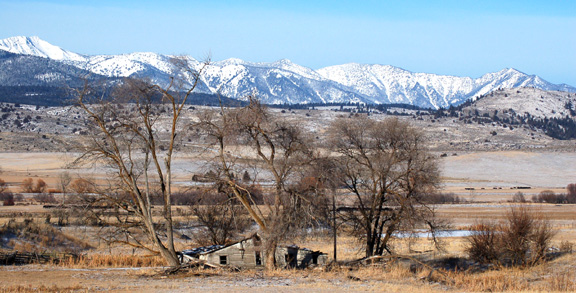
One Face of Baker City
Those of you who are interested in participatory democracy, and how it functions here in Baker City and Baker County, might also be interested in my own experience as a concerned citizen trying to participate and give input to local government. But first a little background.
When we think of the democratic ideal, we often think of Thomas Jefferson and the Declaration of Independence and its notions of equality. Others might think of the “general Welfare” as found in the preamble to the Constitution. When I think of the reality of democracy in America though, I think of a phrase used by Michael Parenti in the title of one of his books, i.e.: “Democracy For The Few.”
The social structure here in Baker City and Baker County is similar to what will be found throughout America. Put in its simplest form, to paraphrase Bill Moyers, “[business people and the wealthy are our] undisputed overlords of politics and government.” If you are a business person (like all but one of our City Councilors), one involved with the Historic District or the culture industry, a member of the Chamber of Commerce or tourist bureaucracy, a large land owner farmer/rancher, a member of a long established family or a part of a good-old-boys & girls network, a health professional or City/County/State department head, a member of the law enforcement community, a leader in one of the many churches, or simply someone deemed “respectable” by the aforementioned, you stand a chance of receiving fair and equal treatment by local leaders and media. The late, great economist John Kenneth Galbraith defined “respectable” as those who are thought by some to be “individuals of sound, confidence inspiring judgment.” In answering his own question; “And what is the test of [that] respectability?” he replied: “It is broadly whether speech and action are consistent with the comfort and well-being of the people of property and position. A radical is anyone who causes discomfort or otherwise offends such interests.” And so it is in Baker County.

Another Face of Baker City
But what if you are a mere commoner, a member of the subclass mired in what some have referred to as the “culture of rural poverty,” or worse yet, a person whose speech and action are not consistent with the comfort and well-being of the people of property and position? Well, then, you need a good lawyer, but you probably can’t afford one. Your ideas may well be quite logical and sensible, or represent the legitimate attitudes of a significant portion of the American population, but unless they are shared by those in the local governing bodies, good-old boy networks, and media, those ideas become irrelevant and may not see the light of day.
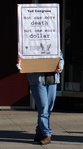
One Flag Is Good
If you are a truly poor member of the “culture of rural poverty,” then your participation is reduced to remembering your place and adorning your property with symbols of acquiescence to the status quo. One of the most popular of these symbols here in Baker City is the American flag, the bigger the better, draped visibly in a front window or prominently displayed on a pole. Other than actually offering up the blood sacrifice of one’s children in our imperial wars (which is also popular), this is the one tried and true method for the poor to attempt to redeem themselves and their self-esteem--to earn some piddling amount of social currency. But the poor learned long ago that they don’t matter and know very well that participation in self-interested political battles is a wasted effort from their position of isolation and resourcelessness, so offering up their children and parading the colors and yellow ribbons largely defines the extent of their participation.
Two Flags Must Be Better
For example:
To be continued . . .
Birds:
On Monday, March 5, Baker Valley presented many pintails, common goldeneye, mallards, 50-60 common mergansers on "Beautiful Lake Bob," buffleheads, 2 gadwall, and the usual large flock of Canada geese. Also heard my first killdeer in the east valley at Shetky Road.
This morning I heard my first of the season meadowlarks west of Bowen Valley on Elk Creek Road. Two bald eagles have been supervising the calving operation nearby for at least the last two days.
As predicted here last week, the Sandhill Cranes have appeared at Ladd Marsh. Craig Bennet of La Grande reported that 6 pairs were seen west of the freeway yesterday morning. 10 were just below the viewpoint on Foothill Road.
Straight Talk:
In addition to the following item from earlier in the week, NPR carried a story yesterday about the second largest provider of sub-prime home loans being in serious financial trouble. Excess has its consequences (believe me, I know!).
Dean Baker | The Housing Bubble Starts to Burst
http://www.truthout.org/docs_2006/030607J.shtml
Dean Baker writes: "While the collapse of the housing bubble was both predictable and inevitable, it is not pretty. Tens of millions of people will be hurt as they see much of the equity in their homes - money that most had counted on to support their retirement - disappear. Millions more will be forced out of their homes as they find that they are unable to meet the payments on adjustable rate mortgages that reset at higher rates. People who had worked hard and saved in order to become homeowners will see their dream disappear."
More on Honoring Our Veterans:
Valor and Squalor
By Paul Krugman
The New York Times
Monday 05 March 2007
http://www.truthout.org/docs_2006/printer_030507C.shtml
Krugman says: ". . . the administration has broken longstanding promises of lifetime health care to those who defend our nation. Two months before the invasion of Iraq the V.H.A., which previously offered care to all veterans, introduced severe new restrictions on who is entitled to enroll in its health care system. As the agency's Web site helpfully explains, veterans whose income exceeds as little as $27,790 a year, and who lack "special eligibilities such as a compensable service connected condition or recent combat service," will be turned away.
So when you hear stories of veterans who spend months or years fighting to get the care they deserve, trying to prove that their injuries are service-related, remember this: all this red tape was created not by the inherent inefficiency of government bureaucracy, but by the Bush administration's penny-pinching."
See also:
Committee Subpoenas Former Walter Reed Chief
By Kelly Kennedy
The Army Times
Saturday 03 March 2007
http://www.armytimes.com/news/2007/03/Weightmansubpoena/
Subscribe to:
Posts (Atom)