






This site may contain copyrighted material the use of which has not always been specifically authorized by the copyright owner. I am making such material available in an effort to advance understanding of environmental, political, human rights, economic, democracy, scientific, and social justice issues, etc. I believe this constitutes a ‘fair use’ of any such copyrighted material as provided for in section 107 of the US Copyright Law.
In accordance with Title 17 U.S.C. Section 107, the material on this site is distributed without profit.
"Fascism should rightly be called Corporatism as it is a merger of state and corporate power": Benito Mussolini
Voltaire on Freedom
"...So long as the people do not care to exercise their freedom, those who wish to tyrannize will do so; for tyrants are active and ardent, and will devote themselves in the name of any number of gods, religious and otherwise, to put shackles upon sleeping men." Voltaire, François Marie Arouet (1694-1778), Philosophical Dictionary, 1764
Darwin on Effect of Early Brainwashing
"It is worthy of remark that a belief constantly inculcated during the early years of life, whilst the brain is impressible, appears to acquire almost the nature of an instinct; and the very essence of an instinct is that it is followed independently of reason." - Charles Darwin, The Descent of Man, 1871
It was impossible to save the Great Republic
"But it was impossible to save the Great Republic. She was rotten to the heart. Lust of conquest had long ago done its work; trampling upon the helpless abroad had taught her, by a natural process, to endure with apathy the like at home; multitudes who had applauded the crushing of other people's liberties, lived to suffer for their mistake in their own persons. The government was irrevocably in the hands of the prodigiously rich and their hangers-on; the suffrage was become a mere machine, which they used as they chose. There was no principle but commercialism, no patriotism but of the pocket."
Mark Twain
E.O. Wilson on population growth and sustainability
"The raging monster upon the land is population growth. In its presence, sustainability is but a fragile theoretical construct." - E.O. Wilson
Jefferson on Corporations
“I hope we shall... crush in its birth the aristocracy of our moneyed corporations, which dare already to challenge our government to a trial of strength and to bid defiance to the laws of our country.”
~ Thomas Jefferson, letter to George Logan. November 12, 1816
How despicable and ignoble war is
Heroism at command, senseless brutality, deplorable love-of-country stance, how violently I hate all this, how despicable and ignoble war is; I would rather be torn to shreds than be a part of so base an action! - Albert Einstein
Do not despair due to hostility or exclusion
Do not despair due to hostility or exclusion by popular, small minded, or greedy men and women, simply because they reject or cannot understand your truths. Stand up and declare your reality, in defiance of their ignorance and self-serving falsehoods. -- Chris
Anger Looks to the Good of Justice
"He who is not angry when there is just cause for anger is immoral. Why? Because anger looks to the good of justice. And if you can live amid injustice without anger, you are immoral as well as unjust." -- St. Thomas Aquinas (1225-1274)
Aside from the fact that Thomas thought heretics should be put to death ;-) he really has hit on something here!
"In those wretched countries where a man cannot call his tongue his own, he can scarce call anything his own. Whoever would overthrow the liberty of a nation must begin by subduing the freeness of speech." -- Benjamin Franklin (1706-1790) US Founding Father - Source: Dogwood Papers
"There will be, in the next generation or so, a pharmacological method of making people love their servitude, and producing dictatorship without tears, so to speak, producing a kind of painless concentration camp for entire societies, so that people will in fact have their liberties taken away from them, but will rather enjoy it, because they will be distracted from any desire to rebel by propaganda or brainwashing, or brainwashing enhanced by pharmacological methods. And this seems to be the final revolution." - Aldous Huxley, Tavistock Group, California Medical School, 1961
The weak do what they must. . .
"The strong do what they will, and the weak do what they must." - Thucydides (c. 460 B.C. - c. 395 B.C.)
Sustainability and Population Growth
"A sincere concern for the future is certainly the factor that motivates many who make frequent use of the word, "sustainable." But there are cases where one suspects that the word is used carelessly, perhaps as though the belief exists that the frequent use of the adjective "sustainable" is all that is needed to create a sustainable society."
"Can you think of any problem in any area of human endeavor on any scale, from microscopic to global, whose long-term solution is in any demonstrable way aided, assisted, or advanced by further increases in population, locally, nationally, or globally?"
The Primary Political Question: "Who benefits? Who pays?"
To cut through the cant of "responsibility," we must ask the double question "Who benefits? Who pays?" This is the first question to ask when a politico-economic system of distribution is proposed. It focuses our attention on operations and their consequences rather than on words. The answer to this double question largely defines the properties of a system. We take it as axiomatic that every social action entails both gain (profit) and cost (loss). We can indicate the way profit and loss are distributed by three alternative verbs: privatize, commonize and socialize. -Garrett Hardin 1985
Thomas Paine on the Defense of Custom
Perhaps the sentiments contained in the following pages, are not yet sufficiently fashionable to procure them general favor; a long habit of not thinking a thing wrong, gives it a superficial appearance of being right, and raises at first a formidable outcry in defense of custom. But tumult soon subsides. Time makes more converts than reason.
From the Introduction to Common Sense, January 10, 1776
Taking A Position Because It Is Right
Cowardice asks the question - is it safe? Expediency asks the question - is it politic? Vanity asks the question - is it popular? But conscience asks the question - is it right? And there comes a time when one must take a position that is neither safe, nor politic, nor popular; but one must take it because it is right. Dr. Martin Luther King, Jr.
Galbraith on Respectability
“Political conservatism benefits from the deep desire of politicians, Democrats in particular, for respectability -their need to show that they are individuals of sound, confidence inspiring judgment. And what is the test of respectability? It is broadly whether speech and action are consistent with the comfort and well-being of the people of property and position. A radical is anyone who causes discomfort or otherwise offends such interests. Thus in our politics, we test even liberals by their conservatism.” - John Kenneth Galbraith
They love the liars and hate the truth, Mencken
"The men the American people admire most extravagantly are the greatest liars: the men they detest most violently are those who try to tell them the truth." - - H. L. Mencken - (1880-1956) American Journalist, Editor, Essayist
a lie so subtle
"Observance of customs and laws can very easily be a cloak for a lie so subtle that our fellow human beings are unable to detect it. It may help us to escape all criticism, we may even be able to deceive ourselves in the belief of our obvious righteousness. But deep down, below the surface of the average man's conscience, he hears a voice whispering, 'There is something not right,' no matter how much his rightness is supported by public opinion or by the moral code." - Carl Gustav Jung
Repression works only to strengthen and knit the repressed,
"And the great owners, who must lose their land in an upheaval, the great owners with access to history, with eyes to read history and to know the great fact: when property accumulates in too few hands it is taken away. And that companion fact: when a majority of the people are hungry and cold they will take by force what they need. And the little screaming fact that sounds through all history: repression works only to strengthen and knit the repressed." -John Steinbeck - Grapes of Wrath
Need to write an Oregon Public Records request?
Click on this link and they will write a request for you:
“Its hard to give, Its hard to get, But everybody needs a little forgiveness.” Patty Griffin - from "Forgiveness"
American “Democracy” and Responsibility
"we also have to be precise about the roadblocks that keep people from acting responsibly: A nominally democratic political system dominated by elites who serve primarily the wealthy in a predatory corporate capitalist system; which utilizes sophisticated propaganda techniques that have been effective in undermining real democracy; aided by mass-media industries dedicated to selling diversions to consumers more than to helping inform citizens in ways that encourage meaningful political action."
- Robert Jensen, Professor of journalism, University of Texas at Austin. From Op-Ed, July 8, 2008
OUR UNDISPUTED OVERLORDS
“Big money and big business, corporations and commerce, are again the undisputed overlords of politics and government. The White House, the Congress and, increasingly, the judiciary, reflect their interests. We appear to have a government run by remote control from the U.S. Chamber of Commerce, the National Association of Manufacturers and the American Petroleum Institute. To hell with everyone else.” - Bill Moyers - PBS Commentator
The Politics of Anti-Semitism
The Politics of Anti-Semitism, edited by Alexander Cockburn and Jeffrey St. Clair, confronts how the slur of "anti-semite" has been used to intimidate critics of Israel's abuse of Palestinians. It includes essays by Uri Avnery, Edward Said, Michael Neumann and Bill and Kathy Christison and more.
"If a nation values anything more than freedom, it will lose its freedom"
"If a nation values anything more than freedom, it will lose its freedom; and the irony of it is that if it is comfort or money that it values more, it will lose that too." -- Somerset Maugham
Human Insensitivity, Arrogance, Ignorance, Greed and Folly
There is perhaps no more certain sign of human insensitivity, arrogance, ignorance, greed and folly than the constant growth and destructive expansion of human populations across the globe—a self-worshiping, voracious cancer that continues to plunder and trash our planet and its creatures while almost imperceptibly picking away at the very support systems of life as we know it. - Me (and many others before)
I am a nature photographer specializing in wildflowers, birds, and other criters.
Some of my wildflower and other photos can be found at:
http://www.flickr.com/photos/christopherchristie/sets/
And
http://calphotos.berkeley.edu/cgi/img_query?where-photographer=Christopher+Christie
These photos can be downloaded without charge for personal use and are used for educational purposes in the publications of many organizations, most often for free.
My professional training is in microbiology (BS Microbiology, Honors / Distinction in) and medical technology. I have worked as a microbiologist, medical technologist and Greyhound bus driver. In the late 1980's I grew over 100 native species in a small nursery. Besides identifying, photographing and growing native plants, I enjoy birdwatching, gardening and hiking in the Great Basin and local mountains. In the fall and winter, I used to do raptor counts along the Burnt River in the Hereford area for the East Cascade Bird Conservancy.
“We are swimming with the snakes at the bottom of the well - So silent and peaceful in the darkness where we fell - But we are not snakes and what's more we never will be And if we stay swimming here forever we will never be free” Patty Griffin - from "Forgiveness"
Mysteries
Pictograph From San Rafael Swell, Utah
Endangered Peninsular Bighorn Sheep
Bighorns in Anza Borrego State Park, CA, 1998
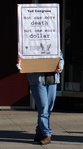
Not One More Death, Not One More Dollar
Message On Main Street to End the War
Peace On Main Street
Need money For Schools?
Winnie Moves to New Meadows, Idaho
In 1944 Winnie's house at the logging camp was moved on the back of a truck. In those days, logger's homes were often moved from camp to camp on R.R.flatcars or trucks.
GLENNGREENWALD: I think this is really the critical point that has to be understood. The reason that Edward Snowden came forward, the reason that we’re reporting on this so aggressively, is because—and this is not hyperbole in any way; it’s a purely accurate description—the NSA is in the process, in total secrecy, with no accountability, of constructing a global, ubiquitous surveillance system that has as its goal the elimination of privacy worldwide, so that there can be no electronic communications—by telephone, Internet, email, chat—that is beyond the reach of the United States government. They are attempting to collect and store and monitor all of it, and that they can invade it at any time they want, no matter who you are or where you are on the planet. This has very profound implications for the kind of world in which we live, for the kind of relationship the United States has to the rest of the world, the way in which individuals feel free to communicate with one another, use the Internet. And that, I think, is why the story is resonating as much as it is.
AMYGOODMAN: Timesreporting, "In more than a dozen classified rulings, the nation’s surveillance court has created a secret body of law giving the National Security Agency the power to amass vast collections of data on Americans while pursuing not only terrorism suspects, but also people possibly involved in nuclear proliferation, espionage and cyberattacks, officials say." Your response to that revelation this weekend in The New York Times? GLENNGREENWALD: Well, it shows what a complete joke the argument has been from NSA defenders in the Democratic Party that there is robust oversight on this surveillance. What you actually have is a completely warped and undemocratic institution, this court that meets in complete secrecy, where only the government is allowed to attend. And unlike previously, when it really was confined to just issuing individual warrants about particular targets of terrorism, it is now issuing sweeping, broad opinions defining the contours of our constitutional liberties, of the Fourth Amendment, of the government’s power to spy on us—and it’s all being done in secret. What kind of a country has a court that defines the Constitution in total secrecy and forces us to live under truly secret law in which the government can do all sorts of things to us that we’re not even aware of, that it’s claiming the right to do and being given the power to do it? So I think the New York Times article highlighted what has long been known about the joke called the FISA court, but it’s good to seeThe New York Times doing some reporting on these stories and hopefully bringing some more attention to this.
AMYGOODMAN: Did he talk about his preference for where he wants to go? GLENNGREENWALD: He didn’t. I didn’t really speak very much with him about his quest for asylum. I think that he has always been fairly consistent about the fact—and there’s a fantastic article, an op-ed by Daniel Ellsberg in The Washington Post today making the same point—that the crucial objective that Snowden has, just like Ellsberg had, was to make sure that he’s able to participate in the ongoing debate that he triggered. And that means staying out of the custody of the United States government, which will not only put him in prison, but render him incommunicado. And so I think wherever he ends up, as long as it’s somewhere that he can be heard and his voice can be heard, I think he’ll be happy and fine. AMYGOODMAN: What, Glenn, is Edward Snowden most encouraged by as he follows the debates and the continued revelations online? GLENNGREENWALD: The very first conversation I ever had with him, Amy, online, he said that his only fear—he only had one fear, and that was that he would sacrifice his life and take these enormous personal risks in order to make these disclosures possible, and then have the world react with indifference and apathy, a kind of fear that they would just simply say, "OK, well, I assumed this was happening, and I don’t really mind." None of that has happened. There’s been an incredibly intense debate inside the United States over these disclosures, all kinds of movements of reform, movements against the United States government, and in many, many other countries around the world, as we previously discussed. So he feels like what he set out to do is exactly what has happened. He said he didn’t set out to destroy these systems—that’s not his place; he set out to make people around the world realize what the United States’s government is doing to them, to enable them to decide whether that’s the kind of thing they are willing to tolerate. And he sees those debates happening, and he’s extremely enthused and satisfied that his objective has been fulfilled. . . . .
AMYGOODMAN: And finally, Glenn, it’s not only the revelations that you have put out in The Guardian and that have come out other places, but they’re sparking even others, I think, to go down this track. The latest NSA spying issue, another headline today, U.S. Postal Service now under scrutiny for a surveillance program of its own, The New York Times revealing the postal service has been carrying out a Mail Isolation Control and Tracking program [link update 7/9/13), which photographs every piece of mail in its system—around 160 billion envelopes, packages, postcards documented last year. The contents never read without a warrant, but they allow investigators to learn key information including names, addresses, return addresses, postmark locations. The information reportedly used to nab the suspect recently accused of mailing ricin-laced letters to Obama and New York Mayor Bloomberg. Leslie James Pickering, the former activist with the Earth Liberation Front who now owns a small bookstore in Buffalo, recently learned his mail was being monitored after a surveillance order was accidentally delivered to his door. Can you respond to this? GLENNGREENWALD: There’s a fantastic article by the journalism professor at NYU, Jay Rosen, who has written a article entitled "The Snowden Effect." And what he argues is that the revelations about the surveillance state go far beyond the specific revelations enabled by the documents that he disclosed to us, that we’re now disclosing to the world in our reporting, that instead he completely refocused—Snowden did—worldwide global attention on the abuses of the surveillance state. And so, not just that article about the postal service monitoring, but the one you mentioned earlier about theFISA court—there’s articles in Le Monde last week about how the French are mass surveilling their own citizens’ electronic communications. All sorts of revelations coming forward, one in The Washington Post today about how the Pentagon is engaged in domestic propaganda, monitoring websites for what they consider to be extremist political activity—this tidal wave of revelations that clearly have come from the sea change that has resulted in how we think about surveillance as a result of Mr. Snowden’s whistleblowing and the reporting of ours that it enabled then. And I think that that’s really ultimately going to be the most profound effect. People are thinking differently about how their government spies on them, the nature of government secrecy, whether they want to trust their government, why journalism has failed to uncover these sorts of things, why we needed someone like Mr. Snowden to risk his life and throw away his liberty in order to come forward and bring it to our attention. I think this is all going to have very profound repercussions for a long time to come.
One week ago I left Hong Kong after it became clear that my freedom and safety were under threat for revealing the truth. My continued liberty has been owed to the efforts of friends new and old, family, and others who I have never met and probably never will. I trusted them with my life and they returned that trust with a faith in me for which I will always be thankful.
On Thursday, President Obama declared before the world that he would not permit any diplomatic "wheeling and dealing" over my case. Yet now it is being reported that after promising not to do so, the President ordered his Vice President to pressure the leaders of nations from which I have requested protection to deny my asylum petitions.
This kind of deception from a world leader is not justice, and neither is the extralegal penalty of exile. These are the old, bad tools of political aggression. Their purpose is to frighten, not me, but those who would come after me. [i.e., other whistle blowers]
For decades the United States of America has been one of the strongest defenders of the human right to seek asylum. Sadly, this right, laid out and voted for by the U.S. in Article 14 of the Universal Declaration of Human Rights, is now being rejected by the current government of my country. The Obama administration has now adopted the strategy of using citizenship as a weapon. Although I am convicted of nothing, it has unilaterally revoked my passport, leaving me a stateless person. Without any judicial order, the administration now seeks to stop me exercising a basic right. A right that belongs to everybody. The right to seek asylum.
In the end the Obama administration is not afraid of whistleblowers like me, Bradley Manning or Thomas Drake. We are stateless, imprisoned, or powerless. No, the Obama administration is afraid of you. It is afraid of an informed, angry public demanding the constitutional government it was promised — and it should be.
I am unbowed in my convictions and impressed at the efforts taken by so many. Edward Joseph Snowden Monday 1st July 2013
_____
The Original Fascist Defines Fascism
"Fascism should rightly be called Corporatism as it is a merger of state and corporate power": Benito Mussolini
CAIRO (Reuters) - Army concern about the way President Mohamed Mursi was governing Egypt reached tipping point when the head of state attended a rally packed with hardline fellow Islamists calling for holy war in Syria, military sources said.At the June 15 rally, Sunni Muslim clerics used the word "infidels" to denounce both the Shi'ites fighting to protect Syrian President Bashar al-Assad and the non-Islamists that oppose Mursi at home.Mursi himself called for foreign intervention in Syria against Assad, leading to a veiled rebuke from the army, which issued an apparently bland but sharp-edged statement the next day stressing that its only role was guarding Egypt's borders."The armed forces were very alarmed by the Syrian conference at a time the state was going through a major political crisis," said one officer, whose comments reflected remarks made privately by other army staff. He was speaking on condition of anonymity because he was not permitted to talk to the media.The controversy surrounding the Syria conference pointed to a crippling flaw in the Mursi presidency: though the constitution names Mursi as supreme commander of the armed forces, the military remains master of its own destiny and a rival source of authority to the country's first freely elected head of state.The army's dramatic ultimatum demanding Mursi and other politicians settle their differences by Wednesday afternoon caught the presidency completely off guard. Triggered by mass protests against Mursi's rule, it amounted to a soft coup by a military that has been a major recipient of U.S. aid since the 1970s, when Egypt made peace with neighboring Israel.
[Added link to Repulsive Progressive Hypocrisy, by Glenn Greenwald, with quote, 2/10/12]
Back on January 23rd, 2012, a Herald editorial made what I could only take as a snide and senseless remark about bloggers. The editorial thought that the rhetoric against the SOPA and PIPA internet censorship acts included both "slight exaggerations" and "hysterical claims." They went on to set up a hypothetical example, an example that is unhinged from the realities of the the two bills, between two bloggers expressing their opinions. They conclude with a dig at bloggers by incorrectly suggesting they would still be able to post their "opinion, ad nauseum" (sic), and suggesting that the opinions posted by bloggers everywhere which opposed SOPA and PIPA were "Conspiracy theories." I guess we can be glad that we still live in a country where small newspapers too, can issue their deriding, error prone editorials, ad nauseam.
Oh damn, here I go again with another blogger "ad nauseam" post questioning the behavior of our President and Congress when they violate our basic Constitutional rights. Thankfully the somnolent, apathetic and hypocritical herd can choose instead to read the fluff in the local papers about the Cattlemen's Association, the Super Bowl, or the "Art of the Spud."
Back in 2011, in one of those moments of ad nauseam conspiracy ferver, I had mentioned that killing American citizens by drone strike without formal charge and trial was a grave violation of our Constitutional protections and our long held right of Habeas Corpus and Due Process in courts of law as stated in the Bill of Rights, I.E. the Fourth, Fifth and 14th Amendments to the Constitution.
Now we have leaders from both political parties questioning the Obama administration's authority to order killings of American citizens without due process and asking for the Obama administration's secret interpretations of law that support these killings.
When it comes to national security, Michael V. Hayden is no shrinking violet. As CIA director, he ran the Bush administration's program of warrantless wiretaps against suspected terrorists.
But the retired air force general admits to being a little squeamish about the Obama administration's expanding use of pilotless drones to kill suspected terrorists around the world — including, occasionally, U.S. citizens.
"Right now, there isn't a government on the planet that agrees with our legal rationale for these operations, except for Afghanistan and maybe Israel," Hayden told me recently.
As an example of the problem, he cites the example of Anwar Awlaki, the New Mexico-born member of Al Qaeda who was killed by a U.S. drone in Yemen last September. "We needed a court order to eavesdrop on him," Hayden notes, "but we didn't need a court order to kill him. Isn't that something?"
Washington, D.C. In a letter to Attorney General Eric Holder, U.S. Senator Ron Wyden called the Administration’s refusal to share legal opinions pertaining to the executive branch’s understanding of its authority to kill Americans “an indefensible assertion of executive authority.” Wyden has been pressing the Justice Department and other administration officials to share its legal interpretations of the government’s authority in this area for more than a year but, as the Senator writes, “it is increasingly clear that [the Justice Department] has no intention of doing so.”
“To be clear, I am not suggesting that the President has no authority to act in this area. If American citizens choose to take up arms against the United States during times of war, there can undoubtedly be some circumstances under which the President has the authority to use lethal force against those Americans,” wrote Wyden. “However, when the United States is engaged in a military conflict with a terrorist group, whose members do not wear uniforms but instead attempt to blend in with civilian populations in a variety of countries around the world, questions about when the President may use lethal force against Americans whom he believes are part of this enemy force become significantly more complicated.
“Members of Congress need to understand how (or whether) the executive branch has attempted to answer these questions so that they can decide for themselves whether this authority has been properly defined. But it is impossible for elected legislators to understand how the executive branch interprets its own authority if the secret legal opinions that outline the Justice Department’s understanding of this authority are withheld from Congress by the Administration.”
Wyden has long asserted that it is inappropriate for the Administration to rely on what he refers to as “secret law” or classified legal interpretations that grant the government authorities without the knowledge and consent of the American people.
“I understand that government officials who choose to rely on secret law almost invariably believe that their decision to do so is justified, and that their secret interpretations of the law would stand up to public scrutiny. But the only way to find out whether this is true is to ensure that this public scrutiny actually takes place,” wrote Wyden, “Intelligence agencies may sometimes need to conduct secret operations, but they should never be in the position of relying on secret law.”
February 4th, 2012 | by Chris Woods and Christina Lamb
The CIA’s drone campaign in Pakistan has killed dozens of civilians who had gone to help rescue victims or were attending funerals, an investigation by the Bureau for the Sunday Times has revealed.
The findings are published just days after President Obama claimed that the drone campaign in Pakistan was a ‘targeted, focused effort’ that ‘has not caused a huge number of civilian casualties.’
Speaking publicly for the first time on the controversial CIA drone strikes, Obama claimed last week they are used strictly to target terrorists, rejecting what he called ‘this perception we’re just sending in a whole bunch of strikes willy-nilly’. ‘Drones have not caused a huge number of civilian casualties’, he told a questioner at an on-line forum. ‘This is a targeted, focused effort at people who are on a list of active terrorists trying to go in and harm Americans’.
But research by the Bureau has found that since Obama took office three years ago, between 282 and 535 civilians have been credibly reported as killed including more than 60 children. A three month investigation including eye witness reports has found evidence that at least 50 civilians were killed in follow-up strikes when they had gone to help victims. More than 20 civilians have also been attacked in deliberate strikes on funerals and mourners. The tactics have been condemned by leading legal experts.
Although the drone attacks were started under the Bush administration in 2004, they have been stepped up enormously under Obama.
There have been 260 attacks by unmanned Predators or Reapers in Pakistan by Obama’s administration – averaging one every four days. Because the attacks are carried out by the CIA, no information is given on the numbers killed. . . . . The legal view Naz Modirzadeh, Associate Director of the Program on Humanitarian Policy and Conflict Research (HPCR) at Harvard University, said killing people at a rescue site may have no legal justification.
‘Not to mince words here, if it is not in a situation of armed conflict, unless it falls into the very narrow area of imminent threat then it is an extra-judicial execution’, she said. ‘We don’t even need to get to the nuance of who’s who, and are people there for rescue or not. Because each death is illegal. Each death is a murder in that case.’
During the Bush years, Guantanamo was the core symbol of right-wing radicalism and what was back then referred to as the “assault on American values and the shredding of our Constitution”: so much so then when Barack Obama ran for President, he featured these issues not as a secondary but as a central plank in his campaign. But now that there is a Democrat in office presiding over Guantanamo and these other polices — rather than a big, bad, scary Republican — all of that has changed, as a new Washington Post/ABC News poll today demonstrates:
The sharpest edges of President Obama’s counterterrorism policy, including the use of drone aircraft to kill suspected terrorists abroad and keeping open the military prison at Guantanamo Bay, Cuba, have broad public support, including from the left wing of the Democratic Party. . . . .
Repulsive liberal hypocrisy extends far beyond the issue of Guantanamo. A core plank in the Democratic critique of the Bush/Cheney civil liberties assault was the notion that the President could do whatever he wants, in secret and with no checks, to anyone he accuses without trial of being a Terrorist – even including eavesdropping on their communications or detaining them without due process. But President Obama has not only done the same thing, but has gone much farther than mere eavesdropping or detention: he has asserted the power even to kill citizens without due process. . . . .
- The Fed's Backdoor Bailout - Video: Sen. Bernie Sanders' Floor Speech on the Economy - GRIST TV Videos on Bailout and Republican Blackmail Using the Unemployed - Note from Yours Truly & Warren Buffett - Krugman Advises Obama to Just Say No to Blackmail - Obama Announces He's Willing to Cave to Republican Blackmail - Other Notes from Sen. Bernie Sanders, including "Socialism for the Rich" __________
The Fed's Backdoor Bailout
In the article below, Sen. Bernie Sanders (Vermont) writes how Fed Chairman Bernanke refused to tell the Senate Budget Committee the details of a $3.3 trillion "backdoor bailout" provided by the Fed to big banks and corporations, a bailout that dwarfed the $700 billion TARP bailout initiated by the Bush administration. Now, 18 months later, the Fed has released some of the information, and a few of those details are shared by Sen Sanders in the article. __
At a Senate Budget Committee hearing in 2009, I asked Fed Chairman Ben Bernanke to tell the American people the names of the financial institutions that received an unprecedented backdoor bailout from the Federal Reserve, how much they received, and the exact terms of this assistance. He refused. A year and a half later, as a result of an amendment that I was able to include in the Wall Street reform bill, we have begun to lift the veil of secrecy at the Fed, and the American people now have this information.
It is unfortunate that it took this long, and it is a shame that the biggest banks in America and Mr. Bernanke fought to keep this secret from the American public every step of the way. But, the details on this bailout are now on the Federal Reserve's website, and this is a major victory for the American taxpayer and for transparency in government.
Importantly, my amendment also required the Government Accountability Office to conduct a top-to-bottom audit of all of the emergency lending the Fed provided during the financial crisis to be completed on July 21, 2011, which will take a hard look at all of the potential conflicts of interest that took place with respect to this bailout. So, in many respects, details that the Fed was forced to divulge on Wednesday about the $3.3 trillion in emergency loans that until now were totally kept from public scrutiny, marked the beginning, not the end, of lifting the veil of secrecy at the Fed.
After years of stonewalling by the Fed, the American people are finally learning the incredible and jaw-dropping details of the Fed's multi-trillion-dollar bailout of Wall Street and corporate America. As a result of this disclosure, other members of Congress and I will be taking a very extensive look at all aspects of how the Federal Reserve functions and how we can make our financial institutions more responsive to the needs of ordinary Americans and small businesses.
What have we learned so far from the disclosure of more than 21,000 transactions? We have learned that the $700 billion Wall Street bailout signed into law by President George W. Bush turned out to be pocket change compared to the trillions and trillions of dollars in near-zero interest loans and other financial arrangements the Federal Reserve doled out to every major financial institution in this country. Among those are Goldman Sachs, which received nearly $600 billion; Morgan Stanley, which received nearly $2 trillion; Citigroup, which received $1.8 trillion; Bear Stearns, which received nearly $1 trillion, and Merrill Lynch, which received some $1.5 trillion in short term loans from the Fed.
We also learned that the Fed's multi-trillion bailout was not limited to Wall Street and big banks, but that some of the largest corporations in this country also received a very substantial bailout. Among those are General Electric, McDonald's, Caterpillar, Harley Davidson, Toyota and Verizon.
Perhaps most surprising is the huge sum that went to bail out foreign private banks and corporations including two European megabanks -- Deutsche Bank and Credit Suisse -- which were the largest beneficiaries of the Fed's purchase of mortgage-backed securities.
Deutsche Bank, a German lender, sold the Fed more than $290 billion worth of mortgage securities. Credit Suisse, a Swiss bank, sold the Fed more than $287 billion in mortgage bonds. . . . .
At a time when Wall Street executives are now making more money than before the financial crisis, how many big banks that paid back TARP funds in 2009 to avoid limits on executive compensation received no-strings-attached loans from the Federal Reserve?
At a time when millions of Americans are paying outrageously high credit card interest rates, why didn't the Fed require credit card issuers to lower interest rates as a condition of the bailout?
The four largest banks in this country (Bank of America, JP Morgan Chase, Wells Fargo, and Citigroup) issue half of all mortgages in this country. We now know that these banks received hundreds of billions from the Fed. How many Americans could have remained in their homes, if the Fed required these bailed-out banks to reduce mortgage payments as a condition of receiving these secret loans?
We have begun to lift the veil of secrecy at one of most important agencies in our government. What we are seeing is the incredible power of a small number of people who have incredible conflicts of interest getting incredible help from the taxpayers of this country while ignoring the needs of the people.
[Note From Chris: Back in 1990, I belonged to the Peace and Freedom Party in California and attended anti-war rallies during the build-up to the first Gulf War (when Barbara Boxer was a "real Democrat") where I met a fellow named Bernie, who had retired from his successful and very profitable New York business. Bernie told me that when he was making lots of money, he didn't mind paying taxes at the high top marginal tax rates at 70% and above during the 60's and 70's for taxable income above $200,000 because he didn't really need it and it did the country some good--quite a bit of good actually. You may remember that the country was quite prosperous then by today's standards, and at that time our corporations hadn't sent much, if any, of our productive capacity overseas. We made more than cardboard boxes and speculative, risky investments back then, and the top rates were at least twice as much as today's top rates of 35%. Instead of raising those top rates, during our current time of need and historically high unemployment, in the direction of those earlier rates experienced when we were a functioning country with a partially developed conscience, the Republicans have now successfully, it seems, blackmailed Obama to keep the rates outrageously low for the rich so that the middle and lower classes can keep their needed relief, and so that the unemployed can still receive benefits to keep them in their homes with some food on the table.
When Barack Obama walked out of last week's meeting with Mitch McConnell and John Boehner and started talking about developing a "productive" working relationship with Republican congressional leaders who have sworn the political equivalent of a blood oath to destroy his presidency, it was clear that the president planned to abandon his many years of advocacy for ending Bush-era tax breaks for millionaires.
Now, with the lame-duck session of a Congress still entirely controlled by Democrats races toward a earlier-than-expected conclusion, the deal is being cut.
Obama's representatives-Treasury Secretary Tim Geithner and White House budget director Jack Lew-have reportedly entered the final stages of a negotiation with the Republican team of Arizona Senator Jon Kyl and Michigan Congressman Dave Camp to extend all Bush tax cuts for for at least two years.
In return, federal unemployment benefits will be extended for up to one year.
The only remaining sticking point has to do with the question of whether to offer a small tax credit for working Americans-the "Make Work Pay" provision-and a tax credit for students, both of which were developed as part of the 2009 economic stimulus package. Remarkably, Republican negotiators who are going to the mat to defend $140 billion in tax breaks for the wealthiest 2 percent of Americans are objecting to maintaining $70 million in tax credits for the other 98 percent.
This negotiation is not headed toward a compromise. It is headed toward a complete capitulation. . . . .
In other words, there is no political argument for compromise in order to extend unemployment benefits. Democrats could win this fight, in the current Congress and in the next one. To think otherwise is to presume that Republicans are not politicians who, when everything else is said and done, will cast the necessary votes to secure their reelection. [More at If Obama Will Not Fight for Fair Taxes and Fiscal Stability, What Will He Fight For?]
A University of Chicago law professor created a firestorm of controversy last month when he blogged that he and his wife are barely making ends meet with their $250,000-plus combined salaries.
The 80-year old billionaire [Warren Buffett] said [way back in 2006]: “There’s class warfare, but it’s my class, the rich class, that’s making war, and we’re winning.”
Professor Todd Henderson was protesting President Obama’s plan to let the George W. Bush tax cuts on income above $250,000 per couple expire at the end of the year while extending the cuts for everyone below that threshold.
Needless to say, the good professor didn’t get much sympathy. As well he shouldn’t. . . . . Yet, thanks mainly to a united Republican minority in the U.S. Senate and a handful of nervous Democrats, Congress cannot bring itself to vote on Obama’s plan that would lock in the tax cuts for a huge percentage of the people and begin tackling the budget deficit by raising taxes on the rich. Republicans claim it is important to reduce the deficit yet hypocritically oppose the Democrats’ effort to do so by letting the Bush tax cuts expire for individual incomes above $200,000 a year and couples’ earnings over $250,000.
Everyone should get their tax cuts extended, insist Republicans like Senate Minority Leader Mitch McConnell, yet they offer no plan for how they would make up the $700 billion the treasury would lose over the next 10 years if the cuts for the upper echelon are allowed to continue.
Some insist that increasing taxes on the wealthy would hurt job creation in this economy, but that ignores the simple reality that the Bush cuts didn’t do a thing to help the economy the past several years. George Bush left office in 2009 with the number of working Americans essentially the same as it was when he took over in 2001 -- roughly 137 million -- and the economy in a shambles. During Bill Clinton’s eight years the tax rate on the top income bracket was increased, but millions more people went to work. By the end of his second term, the budget deficit had been essentially eliminated.
Perhaps it’s all coincidental, as many Republicans argue, but there is not any more proof that the GOP’s formula of lower taxes on the wealthy creates more jobs and spurs the economy than there is for the Democratic formula seeking to have the wealthy pay progressively more.
Besides, the rich should pay more because they get more from the government. All those Wall Street and S&L bailouts, the funding of regulatory agencies, and the public school training of workers aren’t services used by the middle and lower classes. There are some studies that have estimated that the tax breaks and services that benefit the wealthy add up to $400 billion a year, compared to the $116 billion spent on programs for the poor.
Class warfare?
One of the richest Americans, Warren Buffett, replies to that notion:
Back in 2001, former President George W. Bush pulled a fast one. He wanted to enact an irresponsible tax cut, largely for the benefit of the wealthiest Americans. But there were Senate rules in place designed to prevent that kind of irresponsibility. So Mr. Bush evaded the rules by making the tax cut temporary, with the whole thing scheduled to expire on the last day of 2010.
The plan, of course, was to come back later and make the thing permanent, never mind the impact on the deficit. But that never happened. And so here we are, with 2010 almost over and nothing resolved.
Democrats have tried to push a compromise: let tax cuts for the wealthy expire, but extend tax cuts for the middle class. Republicans, however, are having none of it. They have been filibustering Democratic attempts to separate tax cuts that mainly benefit a tiny group of wealthy Americans from those that mainly help the middle class. It’s all or nothing, they say: all the Bush tax cuts must be extended. What should Democrats do?
The answer is that they should just say no. If G.O.P. intransigence means that taxes rise at the end of this month, so be it.
Think about the logic of the situation. Right now, the Republicans see themselves as successful blackmailers, holding a clear upper hand. President Obama, they believe, wouldn’t dare preside over a broad tax increase while the economy is depressed. And they therefore believe that he will give in to their demands.
But while raising taxes when unemployment is high is a bad thing, there are worse things. And a cold, hard look at the consequences of giving in to the G.O.P. now suggests that saying no, and letting the Bush tax cuts expire on schedule, is the lesser of two evils.
Bear in mind that Republicans want to make those tax cuts permanent. They might agree to a two- or three-year extension — but only because they believe that this would set up the conditions for a permanent extension later. And they may well be right: if tax-cut blackmail works now, why shouldn’t it work again later?
America, however, cannot afford to make those cuts permanent. We’re talking about almost $4 trillion in lost revenue just over the next decade; over the next 75 years, the revenue loss would be more than three times the entire projected Social Security shortfall. So giving in to Republican demands would mean risking a major fiscal crisis — a crisis that could be resolved only by making savage cuts in federal spending.
And we’re not talking about government programs nobody cares about: the only way to cut spending enough to pay for the Bush tax cuts in the long run would be to dismantle large parts of Social Security and Medicare.
So the potential cost of giving in to Republican demands is high. What about the costs of letting the tax cuts expire? To be sure, letting taxes rise in a depressed economy would do damage — but not as much as many people seem to think.
A few months ago, the Congressional Budget Office released a report on the impact of various tax options. A two-year extension of the Bush tax cuts, it estimated, would lower the unemployment rate next year by between 0.1 and 0.3 percentage points compared with what it would be if the tax cuts were allowed to expire; the effect would be about twice as large in 2012. Those are significant numbers, but not huge — certainly not enough to justify the apocalyptic rhetoric one often hears about what will happen if the tax cuts are allowed to end on schedule.
Oh, and what about confidence? I’ve been skeptical about claims that budget deficits hurt the economy even in the short run, because they undermine confidence in the government’s long-run solvency. Advanced countries, I’ve argued, have a lot of fiscal leeway. But anything that makes permanent extension of obviously irresponsible tax cuts more likely also sends a strong signal to investors: it says, “Hey, we aren’t really an advanced country; we’re a banana republic!” And that can’t be good for the economy.
Last but not least: if Democrats give in to the blackmailers now, they’ll just face more demands in the future. As long as Republicans believe that Mr. Obama will do anything to avoid short-term pain, they’ll have every incentive to keep taking hostages. If the president will endanger America’s fiscal future to avoid a tax increase, what will he give to avoid a government shutdown?
So Mr. Obama should draw a line in the sand, right here, right now. If Republicans hold out, and taxes go up, he should tell the nation the truth, and denounce the blackmail attempt for what it is.
Yes, letting taxes go up would be politically risky. But giving in would be risky, too — especially for a president whom voters are starting to write off as a man too timid to take a stand. Now is the time for him to prove them wrong.
__
But Obama Announces He's Willing to Cave to Republican Blackmail
The payroll tax cut would put about $120 billion back in the pockets of workers and the unemployment benefits would cost about $60 billion, officials said. Continuing the lowered tax rates for the highest-earners, by contrast, would cost the government $700 billion in lost revenue over the next 10 years, according to budget analysts.
WASHINGTON - President Obama said Monday that he had agreed to the main elements of a deal with Congressional Republicans to extend the Bush-era tax cuts at all income levels for two years as part of a package that would also extend jobless aid for long-term unemployed, cut payroll taxes for all workers for a year and take other steps to bolster the economy.
Speaking to reporters at the White House, Mr. Obama said there were elements of the framework that he did not like, but that he had agreed to it in order to avoid having taxes go up on middle class Americans at the end of the year. He said that in return for agreeing to Republican demands that income tax rates not go up on upper-income brackets, he had secured substantial assistance to lower and middle income workers as well as the unemployed.
“It’s not perfect, but this compromise is an essential step on the road to recovery,” Mr. Obama said. “ It will stop middle-class taxes from going up. It will spur our private sector to create millions of new jobs, and add momentum that our economy badly needs.”
Congressional Democrats gave the announcement a lukewarm reception. But it generally won praise from Republicans, and suggested that how the White House and the newly empowered Republicans on Capitol Hill might work together.
Some details remain to be worked out, and Mr. Obama could have trouble bringing his party along with him. The package would cost about $900 billion over the next two years, all to be financed by adding to the budget deficit.
It includes reducing the 6.2 percent Social Security payroll tax on employees by two percentage points for a year, putting more money in the paychecks of workers. That tax cut would replace the central tax break for middle and low-income Americans included in last year’s economic stimulus measure, White House officials said.
It also includes continuation of a college-tuition tax credit for some families, an expansion of the earned income tax credit and a provision to allow businesses to write off the cost of certain equipment purchases.
The deal would include a 13-month extension of jobless aid for the long-term unemployed. Benefits have already started to run out for some people, and as many as 7 million people would potentially lose assistance within the next year, administration officials said.
The White House was also said to have agreed to Republican demands on the estate tax that would result in an exemption of $5 million per person and a maximum rate of 35 percent. Some Democratic aides said that concession alone was reason enough for Democratic lawmakers to oppose the deal when it comes up for votes in the House and Senate.
Administration officials sought to cast the deal in a positive light, saying many of the new provisions would do more to accelerate the economic recovery than the tax cuts at high income levels.
But Congressional Democrats have expressed increasing anger that the payroll tax cut and the jobless aide, which Mr. Obama demanded in exchange for continuing the Bush-era tax rates for the highest-income Americans, were not enough in return for such a big concession.
The payroll tax cut would put about $120 billion back in the pockets of workers and the unemployment benefits would cost about $60 billion, officials said. Continuing the lowered tax rates for the highest-earners, by contrast, would cost the government $700 billion in lost revenue over the next 10 years, according to budget analysts.
Some Democrats expressed wariness about the emerging deal. But it was clear that Republicans were happier with the results.
“Nothing has been finalized yet,” Senator John Barasso, Republican of Wyoming said in a television interview. Still he said, “I am encouraging Democrats to get on board.” He added, “They good news is it doesn’t raise taxes on anyone in this country.”
Democratic Congressional leaders were non-commital. An aide to the House speaker, Nancy Pelosi of California, said that she would meet with rank-and-file lawmakers to discuss the plan. And a spokesman for the Senate majority leader, Harry Reid of Nevada, said similarly that Mr. Reid would discuss the proposal at a lunch meeting with his colleagues on Tuesday, pointedly referring to the plan as Mr. Obama’s.
Representative Dave Camp, Republican of Michigan and the soon-to-be chairman of the tax-writing Ways and Means Committee, issued a statement praising the tentative deal.
"Preventing a massive, job-killing tax increase on families and small businesses is my number one priority," Mr. Camp said. "This framework will allow us to extend all current tax rates and give economic recovery and job creation a chance. The failure to reach and pass an agreement preventing a tax hike would have been devastating for families, especially those who are still looking for work."
Among the provisions in the package sure to get intense scrutiny is the temporary payroll tax cut. Under current law, workers in 2011 would pay 6.2 percent in Social Security payroll tax on income up to $106,800, or a maximum of $6,621.60. For a family earning $50,000, the two percentage point cut would mean a savings of $1,000.
For workers paying the maximum, the two percentage point cut would mean a savings of $2,136.
Critics of the proposal said it would undermine the stability of Social Security, which is financed by the payroll tax. Legally, the government wouldbe obligated to continue paying the same benefits levels and would have to make up the short fall from general revenues or borrowing.