This site may contain copyrighted material the use of which has not always been specifically authorized by the copyright owner. I am making such material available in an effort to advance understanding of environmental, political, human rights, economic, democracy, scientific, and social justice issues, etc. I believe this constitutes a ‘fair use’ of any such copyrighted material as provided for in section 107 of the US Copyright Law.
In accordance with Title 17 U.S.C. Section 107, the material on this site is distributed without profit.
"Fascism should rightly be called Corporatism as it is a merger of state and corporate power": Benito Mussolini
Voltaire on Freedom
"...So long as the people do not care to exercise their freedom, those who wish to tyrannize will do so; for tyrants are active and ardent, and will devote themselves in the name of any number of gods, religious and otherwise, to put shackles upon sleeping men." Voltaire, François Marie Arouet (1694-1778), Philosophical Dictionary, 1764
Darwin on Effect of Early Brainwashing
"It is worthy of remark that a belief constantly inculcated during the early years of life, whilst the brain is impressible, appears to acquire almost the nature of an instinct; and the very essence of an instinct is that it is followed independently of reason." - Charles Darwin, The Descent of Man, 1871
It was impossible to save the Great Republic
"But it was impossible to save the Great Republic. She was rotten to the heart. Lust of conquest had long ago done its work; trampling upon the helpless abroad had taught her, by a natural process, to endure with apathy the like at home; multitudes who had applauded the crushing of other people's liberties, lived to suffer for their mistake in their own persons. The government was irrevocably in the hands of the prodigiously rich and their hangers-on; the suffrage was become a mere machine, which they used as they chose. There was no principle but commercialism, no patriotism but of the pocket."
Mark Twain
E.O. Wilson on population growth and sustainability
"The raging monster upon the land is population growth. In its presence, sustainability is but a fragile theoretical construct." - E.O. Wilson
Jefferson on Corporations
“I hope we shall... crush in its birth the aristocracy of our moneyed corporations, which dare already to challenge our government to a trial of strength and to bid defiance to the laws of our country.”
~ Thomas Jefferson, letter to George Logan. November 12, 1816
How despicable and ignoble war is
Heroism at command, senseless brutality, deplorable love-of-country stance, how violently I hate all this, how despicable and ignoble war is; I would rather be torn to shreds than be a part of so base an action! - Albert Einstein
Do not despair due to hostility or exclusion
Do not despair due to hostility or exclusion by popular, small minded, or greedy men and women, simply because they reject or cannot understand your truths. Stand up and declare your reality, in defiance of their ignorance and self-serving falsehoods. -- Chris
Anger Looks to the Good of Justice
"He who is not angry when there is just cause for anger is immoral. Why? Because anger looks to the good of justice. And if you can live amid injustice without anger, you are immoral as well as unjust." -- St. Thomas Aquinas (1225-1274)
Aside from the fact that Thomas thought heretics should be put to death ;-) he really has hit on something here!
"In those wretched countries where a man cannot call his tongue his own, he can scarce call anything his own. Whoever would overthrow the liberty of a nation must begin by subduing the freeness of speech." -- Benjamin Franklin (1706-1790) US Founding Father - Source: Dogwood Papers
"There will be, in the next generation or so, a pharmacological method of making people love their servitude, and producing dictatorship without tears, so to speak, producing a kind of painless concentration camp for entire societies, so that people will in fact have their liberties taken away from them, but will rather enjoy it, because they will be distracted from any desire to rebel by propaganda or brainwashing, or brainwashing enhanced by pharmacological methods. And this seems to be the final revolution." - Aldous Huxley, Tavistock Group, California Medical School, 1961
The weak do what they must. . .
"The strong do what they will, and the weak do what they must." - Thucydides (c. 460 B.C. - c. 395 B.C.)
Sustainability and Population Growth
"A sincere concern for the future is certainly the factor that motivates many who make frequent use of the word, "sustainable." But there are cases where one suspects that the word is used carelessly, perhaps as though the belief exists that the frequent use of the adjective "sustainable" is all that is needed to create a sustainable society."
"Can you think of any problem in any area of human endeavor on any scale, from microscopic to global, whose long-term solution is in any demonstrable way aided, assisted, or advanced by further increases in population, locally, nationally, or globally?"
The Primary Political Question: "Who benefits? Who pays?"
To cut through the cant of "responsibility," we must ask the double question "Who benefits? Who pays?" This is the first question to ask when a politico-economic system of distribution is proposed. It focuses our attention on operations and their consequences rather than on words. The answer to this double question largely defines the properties of a system. We take it as axiomatic that every social action entails both gain (profit) and cost (loss). We can indicate the way profit and loss are distributed by three alternative verbs: privatize, commonize and socialize. -Garrett Hardin 1985
Thomas Paine on the Defense of Custom
Perhaps the sentiments contained in the following pages, are not yet sufficiently fashionable to procure them general favor; a long habit of not thinking a thing wrong, gives it a superficial appearance of being right, and raises at first a formidable outcry in defense of custom. But tumult soon subsides. Time makes more converts than reason.
From the Introduction to Common Sense, January 10, 1776
Taking A Position Because It Is Right
Cowardice asks the question - is it safe? Expediency asks the question - is it politic? Vanity asks the question - is it popular? But conscience asks the question - is it right? And there comes a time when one must take a position that is neither safe, nor politic, nor popular; but one must take it because it is right. Dr. Martin Luther King, Jr.
Galbraith on Respectability
“Political conservatism benefits from the deep desire of politicians, Democrats in particular, for respectability -their need to show that they are individuals of sound, confidence inspiring judgment. And what is the test of respectability? It is broadly whether speech and action are consistent with the comfort and well-being of the people of property and position. A radical is anyone who causes discomfort or otherwise offends such interests. Thus in our politics, we test even liberals by their conservatism.” - John Kenneth Galbraith
They love the liars and hate the truth, Mencken
"The men the American people admire most extravagantly are the greatest liars: the men they detest most violently are those who try to tell them the truth." - - H. L. Mencken - (1880-1956) American Journalist, Editor, Essayist
a lie so subtle
"Observance of customs and laws can very easily be a cloak for a lie so subtle that our fellow human beings are unable to detect it. It may help us to escape all criticism, we may even be able to deceive ourselves in the belief of our obvious righteousness. But deep down, below the surface of the average man's conscience, he hears a voice whispering, 'There is something not right,' no matter how much his rightness is supported by public opinion or by the moral code." - Carl Gustav Jung
Repression works only to strengthen and knit the repressed,
"And the great owners, who must lose their land in an upheaval, the great owners with access to history, with eyes to read history and to know the great fact: when property accumulates in too few hands it is taken away. And that companion fact: when a majority of the people are hungry and cold they will take by force what they need. And the little screaming fact that sounds through all history: repression works only to strengthen and knit the repressed." -John Steinbeck - Grapes of Wrath
Need to write an Oregon Public Records request?
Click on this link and they will write a request for you:
“Its hard to give, Its hard to get, But everybody needs a little forgiveness.” Patty Griffin - from "Forgiveness"
American “Democracy” and Responsibility
"we also have to be precise about the roadblocks that keep people from acting responsibly: A nominally democratic political system dominated by elites who serve primarily the wealthy in a predatory corporate capitalist system; which utilizes sophisticated propaganda techniques that have been effective in undermining real democracy; aided by mass-media industries dedicated to selling diversions to consumers more than to helping inform citizens in ways that encourage meaningful political action."
- Robert Jensen, Professor of journalism, University of Texas at Austin. From Op-Ed, July 8, 2008
OUR UNDISPUTED OVERLORDS
“Big money and big business, corporations and commerce, are again the undisputed overlords of politics and government. The White House, the Congress and, increasingly, the judiciary, reflect their interests. We appear to have a government run by remote control from the U.S. Chamber of Commerce, the National Association of Manufacturers and the American Petroleum Institute. To hell with everyone else.” - Bill Moyers - PBS Commentator
The Politics of Anti-Semitism
The Politics of Anti-Semitism, edited by Alexander Cockburn and Jeffrey St. Clair, confronts how the slur of "anti-semite" has been used to intimidate critics of Israel's abuse of Palestinians. It includes essays by Uri Avnery, Edward Said, Michael Neumann and Bill and Kathy Christison and more.
"If a nation values anything more than freedom, it will lose its freedom"
"If a nation values anything more than freedom, it will lose its freedom; and the irony of it is that if it is comfort or money that it values more, it will lose that too." -- Somerset Maugham
Human Insensitivity, Arrogance, Ignorance, Greed and Folly
There is perhaps no more certain sign of human insensitivity, arrogance, ignorance, greed and folly than the constant growth and destructive expansion of human populations across the globe—a self-worshiping, voracious cancer that continues to plunder and trash our planet and its creatures while almost imperceptibly picking away at the very support systems of life as we know it. - Me (and many others before)
I am a nature photographer specializing in wildflowers, birds, and other criters.
Some of my wildflower and other photos can be found at:
http://www.flickr.com/photos/christopherchristie/sets/
And
http://calphotos.berkeley.edu/cgi/img_query?where-photographer=Christopher+Christie
These photos can be downloaded without charge for personal use and are used for educational purposes in the publications of many organizations, most often for free.
My professional training is in microbiology (BS Microbiology, Honors / Distinction in) and medical technology. I have worked as a microbiologist, medical technologist and Greyhound bus driver. In the late 1980's I grew over 100 native species in a small nursery. Besides identifying, photographing and growing native plants, I enjoy birdwatching, gardening and hiking in the Great Basin and local mountains. In the fall and winter, I used to do raptor counts along the Burnt River in the Hereford area for the East Cascade Bird Conservancy.
“We are swimming with the snakes at the bottom of the well - So silent and peaceful in the darkness where we fell - But we are not snakes and what's more we never will be And if we stay swimming here forever we will never be free” Patty Griffin - from "Forgiveness"
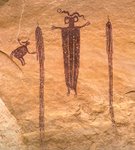
Mysteries
Pictograph From San Rafael Swell, Utah
Endangered Peninsular Bighorn Sheep
Bighorns in Anza Borrego State Park, CA, 1998
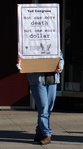
Not One More Death, Not One More Dollar
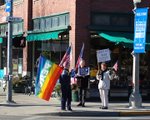
Message On Main Street to End the War
Peace On Main Street
Need money For Schools?
Winnie Moves to New Meadows, Idaho
In 1944 Winnie's house at the logging camp was moved on the back of a truck. In those days, logger's homes were often moved from camp to camp on R.R.flatcars or trucks.
Showing posts with label Occupy Wall Street. Show all posts
Showing posts with label Occupy Wall Street. Show all posts
After a holiday of satiation, frenzied shoppers, and hopefully thanks, readers might be interested in the following article I ran across this morning while pursuing a link on the "America 2 Point 0" mailing list at Yahoo. For myself at least, it has always been too tempting and too easy to slip back under the spell of the cornucopian eternal consumption and growth delusions created and marketed by the dominant global business class. This despite having realized for at least two or three decades that a growing population size of a country or world coupled with consumer growth culture, is on an unsustainable resource ravaging road that leads to social and ecological collapse. When looking at social phenomena, like Occupy Wall Street, I've tended to pop right back into the old endless growth paradigm instead of viewing them through the lens of sustainability. This article by Jan Lundberg of Culture Change helps to bring the Occupy movement into proper perspective and focus when viewed through a sustainability lens. _____
. . . . What folks in "poor" countries have always understood is that their power and survival lie in possessing their own land. Land reform in many parts of our increasingly crowded world is a burning issue. Many people live and die for the struggle for their right to live on their ancestral lands. A movement in the U.S. for the masses to take back the land from the few is inevitable.
Better late than never; many decades have passed during which the importance for consumers of being close to the land was greatly diminished. Real wealth, the land, was given up for wages and cheap petroleum's technology explosion. Population growth has happened so fast that a new generation didn't know it was inheriting a world less and less free and no longer abundant in life-giving resources ("ecological services").
But as the sun sets on the system of vast, false monetary wealth and on the oppression it has wielded, nature may first wake us up rudely, before people in the U.S. can go about land reform. If so, after societal and possibly ecological collapse, there may be quite a bit of land available and to share after the population has diminished sufficiently in size. This was the case in Europe after the 14th century plagues took their toll. However, in no way should such drastic "solutions" be pursued.
"Occupying" the heart of cities today does mean something in today's world of artificial environments, material culture, and middle class values. But instead of occupying the cities, the movement should be about running away from cities. Instead of occupying Wall Street, run away from it: abandon it, abandon the system, abandon consuming, and embrace simple living on the land. This ought to be the prime goal, rather than a stampede today or tomorrow. . . . .
In This Edition: - Former Seattle Police Chief Norm Stamper on Lessons Not Learned - Glenn Greenwald on the Pacifying Effects of Militarized Police Power (must read) - A Compendium of Police Violence Against Occupy Protestors - "You Can Crush the Flowers, But You Can’t Stop the Spring" _____
Back on October 26, 2011, in a short lead-in to news about the police riot in Oakland, I mentioned the militarization of American police forces over the last 20, more realistically, 30, years. This month I've seen a few articles that address the issue much more effectively than I can, so I'm posting them here tonight.
Police Pepper Spraying UC Davis (YouTube capture)
The first one is by former Seattle police chief Norm Stamper, who was in charge during the WTO protests, aka, the Battle in Seattle almost 10 years ago this month.
Writes Stamper:
More than a decade later, the police response to the Occupy movement, most disturbingly visible in Oakland—where scenes resembled a war zone and where a marine [protester] remains in serious condition from a police projectile—brings into sharp relief the acute and chronic problems of American law enforcement. Seattle might have served as a cautionary tale, but instead, US police forces have become increasingly militarized, and it’s showing in cities everywhere: the NYPD “white shirt” coating innocent people with pepper spray, the arrests of two student journalists at Occupy Atlanta, the declaration of public property as off-limits and the arrests of protesters for “trespassing.”
The paramilitary bureaucracy and the culture it engenders—a black-and-white world in which police unions serve above all to protect the brotherhood—is worse today than it was in the 1990s. Such agencies inevitably view protesters as the enemy. And young people, poor people and people of color will forever experience the institution as an abusive, militaristic force—not just during demonstrations but every day, in neighborhoods across the country.
A second article, by Glenn Greenwald, is a most thoughtful summary of the meaning and dangers of police force and state violence in America, as seen today and in the past. It is simply the best piece I remember reading on the subject over the years. (But then. . . there is the problem of my memory! ;-)) If you don't read anything else on this blog, please read the excerpts below.:
Police pepper spraying and arresting students at UC Davis As Chief Stamper would now say--"Why?"
. . . . Despite all the rights of free speech and assembly flamboyantly guaranteed by the U.S. Constitution, the reality is that punishing the exercise of those rights with police force and state violence has been the reflexive response in America for quite some time. . . . .
The intent and effect of such abuse is that it renders those guaranteed freedoms meaningless. If a population becomes bullied or intimidated out of exercising rights offered on paper, those rights effectively cease to exist. Every time the citizenry watches peaceful protesters getting pepper-sprayed — or hears that an Occupy protester suffered brain damage and almost died after being shot in the skull with a rubber bullet — many become increasingly fearful of participating in this citizen movement, and also become fearful in general of exercising their rights in a way that is bothersome or threatening to those in power. That’s a natural response, and it’s exactly what the climate of fear imposed by all abusive police state actions is intended to achieve: to coerce citizens to “decide” on their own to be passive and compliant — to refrain from exercising their rights — out of fear of what will happen if they don’t.
The genius of this approach is how insidious its effects are: because the rights continue to be offered on paper, the citizenry continues to believe it is free. . . . .
Although excessive police force has long been a reflexive response to American political protests, two developments in the post-9/11 world have exacerbated this. The first is that the U.S. Government — in the name of Terrorism — has aggressively para-militarized the nation’s domestic police forces by lavishing them with countless military-style weapons and other war-like technologies, training them in war-zone military tactics, and generally imposing a war mentality on them. Arming domestic police forces with para-military weaponry will ensure their systematic use even in the absence of a Terrorist attack on U.S. soil; they will simply find other, increasingly permissive uses for those weapons. Responding to peaceful protests and other expressions of growing citizenry unrest with brute force is a direct by-product of what we’ve allowed to be done to America’s domestic police forces in the name of the War on Terror (and, before that, in the name of the War on Drugs).
The second exacerbating development is more subtle but more important: the authoritarian mentality that has been nourished in the name of Terrorism. It’s a very small step to go from supporting the abuse of defenseless detainees (including one’s fellow citizens) to supporting the pepper-spraying and tasering of non-violent political protesters. It’s an even smaller step to go from supporting the power of the President to imprison or kill anyone he wants (including one’s fellow citizens and even their teenaged children) with no transparency, checks or due process to supporting the power of the police and the authorities who command them to punish with force anyone who commits the “crime” of non-compliance. At the root of all of those views is the classic authoritarian mindset: reflexive support for authority, contempt for those who challenge them, and a blind faith in their unilateral, unchecked decisions regarding who is Bad and deserves state-issued punishment. . . . .
The third article is a collection of visuals, primarily YouTube videos, highlighting some of the more offensive actions towards Occupy protesters by various police departments across this country over the last month.
The fourth article is an essay in defense of Occupy Wall Street from Tom Dispatch, with the following prologue to Rebecca Solnit's article just below it:
. . . . The police, up-armored in full riot gear, with the sort of surveillance paraphernalia, helicopters, and high-tech cameras that were a far more minimal aspect of domestic policing before 9/11, were clearly thinking counter-terrorism.
They were the representatives not just of New York’s billionaire mayor and the bankers and brokers who had previously made the area their own, but of the ever more militarized national security state that had blossomed like some errant set of weeds in the ruins of the World Trade Center towers. They were domestic grunts for a new order in Washington as well as New York that has, by now, lost the ability to imagine solving problems in a civil and civilian fashion.
They represent those who have ruled this country since 9/11 in the name of our safety and security, while they made themselves, and no one else, safe and secure. It is an order that has based itself on kidnapping, torture, secret prisons, illegal surveillance, assassination, permanent war, militarized solutions to every problem under the sun, its own set of failed occupations in Iraq and Afghanistan, and the closest of relations with a series of crony capitalist corporations intent on making money off anyone’s suffering as long as the going is good.
Behind the police, directly or indirectly, stands that bureaucratic monster of post-9/11 domestic "safety," the Department of Homeland Security. And behind both of them, without a doubt, that giant tangle of agencies -- 17 in all -- with an $80 billion-plus budget that go under the rubric of “intelligence” and dwarf the intelligence bureaucracy of the Cold War era, when the U.S. actually had an enemy worth speaking of. . . . .
. . . . Alexander Dubcek, the government official turned hero of the Prague Spring uprising of 1968, once said, “You can crush the flowers, but you can’t stop the spring.” . . . .
It’s as if the best of the spirit of the Obama presidential campaign of 2008 was back -- without the foolish belief that one man could do it all for civil society. In other words, this is a revolt, among other things, against the confinement of decision-making to a thoroughly corrupted and corporate-money-laced electoral sphere and against the pitfalls of leaders. And it represents the return in a new form of the best of the post-9/11 moment.
As for the worst after 9/11 -- you already know the worst. You’ve lived it. The worst was two treasury-draining wars that helped cave in the American dream, a loss of civil liberties, privacy, and governmental accountability. The worst was the rise of a national security state to almost unimaginable proportions, a rogue state that is our own government, and that doesn’t hesitate to violate with impunity the Geneva Convention, the Bill of Rights, and anything else it cares to trash in the name of American "safety" and "security." The worst was blind fealty to an administration that finished off making this into a country that serves the 1% at the expense, or even the survival, of significant parts of the 99%. More recently, it has returned as another kind of worst: police brutality (speaking of blind fealty to the 1%). . . . .
In the meantime, a domestic-violence-prone government is squandering a fortune on a little-mentioned extravagance in financially strapped American cities: police brutality, wrongful arrest, and lawsuits over civil-rights violations. New York City -- recall those pepper-sprayed captive young women, that legal observer with a police scooter parked on top of him, and all the rest -- you’re going to have a giant bill due in court, just as you did after the 2004 Republican convention fiasco: New York has spent almost a billion dollars paying for the collateral damage already done by its police force over the past dozen years. The desperately impoverished city of Oakland paid out more than $2 million in recompense for the behavior of the Oakland Police at a nonviolent blockade at the Oakland Docks after the invasion of Iraq broke out in 2003, but seems to have learned nothing from it. Surely payouts in similar or larger quantities are due to be handed out again, money that could have gone to schools, community clinics, parks, libraries, to civilization instead of brutalization. . . . .
Tonight, I'm just passing on some information that folks have sent to me, and some info I've come across--all well worth watching or reading. Thanks to those who forwarded the information. [Edited 11/2-3/11]
In This Edition:
- Occupy Wall Street Videos and reminders of why Occupy is important
- Oregon Wolf News--“OR-7” Makes it into the Cascades!
- Rick Perry's Tax Plan
- What's With the Deficit SuperCommittee? __________
Occupy Wall Street Videos and reminders of why Occupy is important __
This is a 36-minute video of Michael Moore speaking at Occupy Oakland last Friday, with transcript, from Truthout. __
Back in March, I published info about the documentary, "Inside Job," narrated by Matt Damon.
If you have a memory like mine, this longer video will re-focus the mind on the reasons for Occupy Wall Street. I just watched it again recently, and was amazed (and outraged again) at the events I had forgotten. Now, for those with DSL broadband, you can watch it for free at "Inside Job. The documentary. Online. For free."
The DVD is also available (may have to sign-up for it) at the Baker County Public Library, and I think it also available from NetFlix and the sources mentioned on the previous blog, or for purchase at Amazon and probably from Betty's Books.
Please take the time to watch it! _____
Oregon Wolf News--“OR-7” Makes it into the Cascades!
Oregon conservationists and wildlife-lovers are celebrating the news today that the radio collar of “OR-7”, a two year old male wolf originally from Northeast Oregon, has been located in the Cascade Mountains east of Roseburg. This is the latest stop in a spectacular, 500 mile journey that has taken the young wolf across some of Oregon’s most rugged and remote mountains, deserts, and forests.
OR7’s odyssey has taken him across at least 9 Oregon Counties. Prior to the discovery of his tracking collar signal in the upper Umpqua River watershed this week, his most recent known location was in Lake County, over 100 miles away. Whether he will winter in the South Cascades, or continue his journey elsewhere, is unknown.
OR7’s arrival in the upper Umpqua is another major milestone in one of Oregon’s, and America’s, greatest wildlife conservation success stories. Gray wolves were hunted to extinction in Oregon under a misguided policy of extermination that was driven by irrational fear and misinformation. The last bounty paid for the killing of a wild wolf in Oregon was in 1947, for a wolf shot and killed in the Rogue-Umpqua Divide. Ironically, OR7’s latest known location is very near the Divide. . . . .
Migrating wolf enters southwest Oregon Medford Mail Tribune 11/1 A young wolf migrating out of a northeast Oregon pack this fall has reached northeastern Douglas County, becoming the first confirmed wolf in Western Oregon in 65 years. __
With the shrinkage of the state's oldest and biggest pack of gray wolves to four -- and a potential kill order looming over two of the pack's remaining wolves for preying on livestock -- Oregon's fledgling wolf population looked like it was in trouble...the Department of Justice is adopting a paradoxical stand that to save wolves, they must be killed. __
The state argues that killing two wolves "will not cause irreparable harm to the gray wolf population in Oregon, and, in fact, will aid in the recovery of the species...,"... Noah Greenwald: "There's really no evidence that killing wolves increases tolerance. In fact, there are studies that show it doesn't increase tolerance, he said "The wolf population is too small to take these kinds of killings." . . . .
. . . . "FWP wolf biologists routinely come upon pup rearing areas or other loafing areas where a pack is spread out and bedded down," he said. "Anyone out enjoying the outdoors could similarly surprise multiple wolves by coming upon them at rest."
"If you surprise resting wolves at close range they might quickly rise to their feet around you," McDonald said. "It can be unnerving, it might heighten your heart rate."
Hunters are most likely to have this experience as they advance stealthily during a hunt.
Some of the wolves scattered across the landscape may see the intruder, while others will not. A few might lope off quietly, others may bark at the intruder, howl to locate the other wolves, or cautiously approach to get a better look at the intruder. McDonald said once wolves have identified what the disturbance is, they generally leave the area. Or, the vocalizing and movements could go on for awhile as wolves regroup out of sight and pull back from the situation.
"It is easy to read aggression into this, but that is rarely the case," McDonald said. "The few unfortunate incidents between wolves and humans have occurred where wolves were habituated to humans, were fed human foods, provoked or otherwise engaged in ways that caused them to lose their fear of humans. . . . .
The amazing disappearing, reappearing wolves of Oregon
Newly released map of wolf groups in Oregon
Wolf numbers in Oregon have fluctuated quite a bit this year, but according to a new map, state wildlife managers now believe at least five distinct groups of wolves comprising four different packs exist today. Oregon Department of Fish and Wildlife (ODFW) announced this week that a new pack has been identified along the border with Idaho in the northeast corner of the state. That brings the total number of known wolves in Oregon to at least 23: four in the Imnaha pack, six in the Walla Walla pack, five in the Snake River pack, four in the Wenaha pack, two wolves in northern Umatilla county, and two have dispersed from the Imnaha pack to central Oregon.
The official count, however, won’t be determined until the end of the year when ODFW does their survey for the 2011 Northern Rockies annual report. Only packs with at least two adults (one male, one female) and two or more pups are considered “breeding pairs.” The state’s initial goal as outlined in the Oregon wolf management plan is to have four breeding pairs on either side of the Cascade Mountains. If Oregon’s wolves continue to move about the way they have this year, the state may reach their goal sooner rather than later. . . . .
Individuals making more than $1 million a year could see an average tax cut of more than $500,000 under Republican presidential candidate Rick Perry's complicated tax proposal, while some taxpayers at the other end of the income spectrum would see a tax hike compared to the current tax rates, according to an analysis released Monday.
Perry's plan would also reduce federal tax revenues by hundreds of billions of dollars, forcing the government to make dramatic spending cuts -- long a goal of many conservatives pushing for a smaller federal footprint. . . . .
. . . . While the supercommittee has plenty of time to think of ways to make life more miserable for seniors, it won't even countenance the idea of taxing Wall Street speculation. In spite of the repeated pledges that everything is on the table, taxing Wall Street speculation is absolutely off the table.
In order for a tax bill to be considered by Congress, it must be scored by the Joint Tax Committee (JTC). While many members, including some very senior members from both houses, have requested a score from the JTC of a bill taxing financial speculation, the supercommittee has the JTC completely tied up meeting its requests. By refusing to include a financial speculation tax (FST) in its scoring request, the supercommittee is preventing this idea from even being included in the discussion.
Given the role of Wall Street in both creating the conditions for the crash and prospering at the expense of the other 99 percent, it might seem reasonable to include a tax on speculation in the mix of items to consider. This is not a radical proposal. The European Commission is currently on the edge of approving a FST. Its leading proponents are the conservative leaders of Germany and France. . . . .
Every activist knows that to influence legislation you have to get involved at the earliest stage in the legislative process you possibly can.
Congress knows this too, and itʼs why the created the supercommittee — to prevent the public from having influence in discussions on long-term budget, spending and tax issues. The supercommittee process shuts the public out until the very last step by concentrating power in just 12 lawmakers and establishing special fast-track rules that make any engagement beyond “yes” or “no” impossible. But itʼs not shutting out the corporations and special interests that have been able to engage with the committee through expensive access lobbyists. Transparency wouldnʼt fix all the problems with the supercommittee — its structure is anti-democratic and its mission is flawed — but it would at least level the playing field a bit.
Just a "few" bits and pieces on domestic American politics tonight.
In This Edition: [Edited 10/29/11]
- Dennis Kucinich on Occupy Wall Street & National Emergency Employment Defense (NEED) Act - Recent Occupy Wall Street Polls (oldest first) - Study Confirms Wealth Distribution in United States is Most Unequal Among Industrialized Nations - CBO Study Shows Growing Inequality - Noam Chomsky at Occupy Boston--Three Part Video - Joint Select Committee on Deficit Reduction (Bad) News - Article on Rick Perry "Flat Tax" - Bob Dylan--High Water [For Charley Patton] _____
Dear Friends, An Iraq War veteran who survived two tours of duty gets his skull fractured in ... Oakland! 53 activists arrested in Atlanta. SWAT teams deployed to boot out peaceful protesters. Recent actions against Occupy protesters are irresponsible and tragic. They're an assault on our democracy. These protesters are bravely exercising their right to freedom of expression, to bring attention to a political and economic system that's rigged against most Americans. I stand with them; and, all Americans -- left and right -- should join me in protecting their freedom to non-violently create change.
This isn't a Democratic or Republican movement. It's not about one party or one policy. It's about standing up to a financial system that's completely backwards. Wall Street banks get billions in bailouts and emerge with massive profits. Most Americans see a program of austerity in a painful economic climate -- benefit cuts, high unemployment, declining wages, and crumbling infrastructure. Congress moved swiftly to "save" banks (something I strongly opposed), and now Congress is paralyzed, unable to create jobs and to save our middle class.
It's no surprise Americans are standing up. Our country's economic policies have consolidated and accelerated wealth to the top. One percent of Americans now control 42% of our wealth. It's not radical to think this is out of balance or to demand a government that is of the people and for the people. I've been to these protests, and I can tell you they're filled with honest, hard working Americans who are concerned with the direction of our country and our economic future.
I am deeply concerned. I'm concerned about an economic system which tethers job creation to China and big banks. We shouldn't have to borrow money from China -- or Japan or South Korea -- to get out of this ditch. We should stop the Fed from giving billions to the big banks. We have to take back the power to manage our own economy, to regain control over our monetary system, consistent with the U.S. Constitution. That's why, one month ago, I introduced the National Emergency Employment Defense (NEED) Act. The legislation would put the Federal Reserve under the Department of the Treasury, and it would help us recapture control of our financial system. As part of the NEED Act, Congress would use its constitutional power to invest in America, creating millions of jobs by putting billions of dollars directly into circulation. And since this money is adding real, tangible value to our national wealth, it will not generate inflation.
We need a financial system that is of the people and for the people. We need to take it back from the big banks. We need economic and social justice. I will continue to support the Occupy movement. I will continue to fight for legislation, including the NEED Act, that sets America on a path of jobs for all, health care for all, education for all, retirement security for all, and peace.
Let's keep this movement alive. Let's keep fighting for economic and social justice. Keep occupying Wall Street. And, with your help, I'll keep occupying Congress. With respect, Dennis Kucinich P.S. Please forward this email to your friends and family, and share it on Facebook and Twitter. Let's spread this movement, and continue to support the Occupy protests. __
After over a month of demonstrations, numerous dismissals, and thousands of arrests, Occupy Wall Street is gaining momentum. Over the last two weeks, polls have poured in revealing that Americans familiar with the protests largely support them. And since that familiarity will continue to increase, we can only conclude that the country's support for the movement will keep on growing. When you've got NYT pundit Charles Blow unfurling his hipster flag comparing OWS to legendary 90s band Nirvana, you know a tipping point has been reached!
Recent polls prove that when Americans hear this band, they dig it. Here’s a round-up:
Oct. 9-10 Time Magazine/Abt SRBI: This poll showed a 54 percent favorable rating of OWS, compared to a mere 27 percent thumbs up for the Tea Party. . . . .
Oct. 13-16 United Technologies/National Journal Congressional Connection Poll: Here, a majority of those polled – fully 59 percent – said that they backed the goals of the protests from what they "know about the demonstrations." And 68 percent supported the Democratic surtax on millionaires to pay for the cost of their jobs plan, a policy cited by OWS protesters in a recent Millionaire's March in New York City.
Oct. 17 Quinnipiac poll: This survey of New York City voters revealed that the Big Apple is on board with OWS. 67 percent agreed with the views of the Wall Street protesters and a whopping 87 percent believed it's okay that they are protesting. . . . .
Bottom line: If this thing continues to grow – and there is every indication that it will – the Occupy Wall Street could become the definitive movement for an entire generation. On Sunday, Noam Chomsky addressed Occupy Boston and called the movement "unprecedented." "There's never been anything like it," said Chomsky. "If the bonds and associations that are being established at these remarkable events can be sustained through a long, hard period ahead – because victories don’t come quickly – it could turn out to be a real historic, a very significant moment in American history." _
Forty-three percent of Americans agree with the views of the "Occupy Wall Street" movement, according to a new CBS News/New York Times poll that found a widespread belief that money and wealth should be distributed more evenly in America.
Twenty-seven percent of Americans said they disagree with the movement, which began more than a month ago in lower Manhattan and has since spread across the country and around the world. Thirty percent said they were unsure. . . . . __
A new study released Thursday has found the distribution of wealth in the United States is among the most unequal among industrialized nations. The United States ranked in the bottom five on a combination of issues including poverty prevention, health and access to education—ahead of only Greece, Chile, Mexico and Turkey. The study was done by the German-based Bertelsmann Foundation. Meanwhile, a new study here in the United States has found New York State has the highest income inequality of all 50 states and that the New York City metropolitan region has the highest income inequality of any large metro area. __
By Robert Greenstein, Richard Kogan and Paul N. Van de Water Revised October 28, 2011
The new deficit-reduction plan from a majority of Democrats on the congressional Joint Select Committee on Deficit Reduction (the "supercommittee") marks a dramatic departure from traditional Democratic positions — and actually stands well to the right of plans by the co-chairs of the bipartisan Bowles-Simpson commission and the Senate's "Gang of Six," and even further to the right of the plan by the bipartisan Rivlin-Domenici commission. The Democratic plan contains substantially smaller revenue increases than those bipartisan proposals while, for example, containing significantly deeper cuts in Medicare and Medicaid than the Bowles-Simpson plan. The Democratic plan features a substantially higher ratio of spending cuts to revenue increases than any of the bipartisan plans.
Although the new plan thus moves considerably closer to Republican positions than any of the bipartisan plans, Republicans have been quick to reject it. . . . .
The flat tax is such a popular idea in conservative circles that Texas Governor Rick Perry is trying to revive his presidential primary campaign by proposing one.
Except for the flat tax part.
It turns out Perry’s plan isn’t flat, doesn’t eliminate the current tax code, as many conservative elites claim to want, and would likely blow a huge hole in the federal budget.
Perry’s plan doesn’t scrap existing tax law altogether, but rather creates a new, parallel tax code that taxes individual and corporate income at 20 percent. Investment income would go untaxed. Every tax payer would have a choice between staying in the current system, or transferring over to the new one. But as Michael Linden, a tax expert at the liberal Center for American Progress, points out, the new, simpler, alternative code would constitute a tax increase for most Americans and a huge tax cut for wealthy Americans, creating incentives for a small well-to-do sliver of the country to make the switch, and for everyone else to stay put.
. . . .
“For most people who don’t have big capital gains and dividend income, they’re going to stay in the current system,” Linden explained. “It’s not a flat tax.”
. . . .
“For very wealthy people who do have big capital gains and dividends — they’ll take the new one, but even that’s not really a flat tax. It’s 20 percent on ordinary income and zero percent on investment income.”
. . . .
“The wealthy will end up benefitting from a very simple tax code, and they’re going to end up paying really low rates,” Linden said. “Of the richest 400 taxpayers, fully 66 percent of their total adjusted gross income came from capital gains and another seven percent came from dividends. So basically for the very wealthy you’re going to save nearly 75 percent of income from taxation. It’s just a massive tax cut for very wealthy.” . . . . __
When, as an adult, I was able to explore the rural west, I was struck by its conservatism, as represented by the large majorities of registered Republicans and voting patterns in western rural counties. Millard County, Utah, where I once owned property and spent several months of each year, was a real shock, given that votes for Republican Presidential candidates hovered around 90%. When I moved to Grant, and then Baker County here in Oregon, similar feelings of minority political status surfaced, even though the political distribution was less lopsided and extreme than was the case in rural Utah. Only in these rural western counties had I experienced small town businesses putting pressure on local papers to tow a particular political line, and, at least in one case where the local businesses publicly spoke about removing their advertising, and thus the life-supporting revenue needed by the paper, if editorials or op-ed appeared with which they disagreed.
In the case of the small town commercial media, dependent on subscribers, and most importantly, on advertising revenue, one may reasonably suspect that when the opinions rendered by the local paper most often reflect the political makeup of the community, that it is the the local politics, especially those of the business interests that provide advertising revenue, that drives the opinions and articles rendered. On the other hand, one might also reasonably assume that people who pass the hiring filter at the local paper may reflect the political opinions of the publisher or owners who reflect the major political forces in the community. (After all, it is unlikely that a news outlet in business to make money is going to hire a howling progressive to run a paper in a conservative community.) Either way, it works out well for the commercial interest of the media outlet, with the only problem being that media likes to present themselves as the great objective voice that readers and viewers can trust, fair and balanced, as they say.
If anyone is aware of the local political demography here in Baker County, besides the County Clerk and political party heads, it is Jason Jacoby, editor of the Baker City Herald. He wrote a delightfully detailed article a while back (The urban-rural divide in Baker County; and eating crow on Dudley) that carefully described those demographics. His investigation revealed that:
- 46 percent of of all Baker County voters are registered Republicans. - 28 percent of all Baker County voters are registered Democrats - the rest, about 26 percent, are not affiliated with either party - Within Baker City, "41.9 percent are registered Republicans, and 30.5 percent Democrats."
More telling perhaps, is, as Jayson says:
"Voter registration isn’t a foolproof way to gauge the political preferences of a populace, of course.
In the 2008 presidential election, for instance, Baker County voters went for Republican John McCain in a relatively big way — 64 percent."
So it is a bit complicated, but none-the-less, quite "conservative." Nothing, however, like rural Utah.
My take on all of this is that there isn't much difference between Republicans and Democrats in Baker County. Both parties here are really rather conservative, as they are nationwide. That's why some call them the two wings of the business party (or is that the war party?)
(I must admit, that I am particularly alone as a member of the Progressive Party aligned with the likes of Ralph Nader--do they still exist? Haven't heard much from them lately.)
Trust of media, of course, as opposed to trust of partisan bloggers like myself, depends on objective journalists, who try to stick to the facts, and check on whether those "facts" are actually facts. Otherwise, we would be left with demagogues, who report any notion, or recent email, as fact, and twist their falsehoods as they want, in order to please themselves and the political persuasion of their audience. Worse than self-admitted partisan bloggers perhaps.
Recall that Dan Rather, long-time anchor of CBS News was fired for reporting "facts" that may have actually been true:
"The documents [presented by 60 minutes in early 2009] suggested that Mr. Bush disobeyed an order to appear for a physical exam, and that friends of the Bush family tried to "sugar coat" his Guard service.
After a stubborn 12-day defense of the story, CBS News conceded that it could not confirm the authenticity of the documents and asked former Attorney General Dick Thornburgh and former Associated Press President Louis Boccardi to conduct an independent investigation into the matter.
Their findings were contained in a 224-page report made public on Monday. While the panel said it was not prepared to brand the Killian documents as an outright forgery, it raised serious questions about their authenticity and the way CBS News handled them."
Was Dan Rather fired for reporting the "facts" or for reporting questionable facts? Apparently there is at least a selective standard applied to the "facts" that commercial media journalists report, as opposed to those reported by "crazy" bloggers ("crazy blogger"--Dave Miller-"Think Out Loud"/OPB/NPR).
In a county as conservative and ours, I have no doubt that it was well received by most.
About the Occupy Wall Street protests, Jayson, in his admirably sarcastic and flowery prose, says:
"Well, I kind of understand. The economy stinks.
And Wall Street is the symbolic, and malodorous, heart of the putrefying American financial system."
and that:
"(. . . the presence of sign-waving hordes is as predictable as autumn rain puddles.)
What’s not clear to me, though, is which actions we’re supposed to take against the omnipotent cabal that controls America — the so-called 1-percenters — that will confer any tangible benefit on everyone else.
And by “we” I mean the voters.
Forgive my childlike innocence, but I still believe the best way to fix any mess in the halls of power is with the ballot, generally speaking a more potent slip of paper than the most cleverly phrased protest sign."
"Childlike innocence" indeed, and from such a bright guy! This full half page (The Herald will give you 350 word to express your opinion.) of mocking misrepresentations, with its barely veiled contempt for Americans practicing their rights to protest policies that have left them in dire straits, was printed on the Friday (10/14/11) before last weekend's unprecedented worldwide protests against the prevailing global financial system involving "1,500 cities, including 100 cities in the United States—all in solidarity with the Occupy Wall Street movement that launched one month ago in New York City." See Democracy Now!
I understand why, after the outrageous Obama fraud, and many fruitless protests over the years, one might question whether these protests will go anywhere, but given their depth and breadth across this nation and the world, I wouldn't characterize them to be exactly "as predictable as autumn rain puddles."
What actions are we, Jayson says, "supposed to take?"
Hint--Something more than badgering cynicism and demagoguery.
Something more than inferring that the most important social movement in recent American history is insignificant.
Something more than saying that one is worried about their 401(k), which Wall Street no doubt trashed a few years ago anyway, along with the 401(k) s of millions of other Americans.
"(CBS) The effects of the current economic crisis have touched everyone. Even if you still have a good job and a paid up mortgage, chances are your monthly 401(k) statement will remind you that you've lost a good chunk of your savings.
Trillions of dollars have evaporated from those accounts that have become the prime source of retirement funds for a majority of American workers, affecting their psyche and their future. If you are still young enough, there's time to rebuild and recover, but if you are in your 50s, 60s or beyond the consequences can be dire, and its drawing attention to the shortcomings of a retirement system that has jeopardized the financial security of tens of millions of people."
Something more than the cynical or naive true believer notion that "'we' ,,, "the voters" can fix the problem with a vote" in a system controlled by big money and the political elite.
Something more than blind faith in a system that in recent decades has failed the majority of Americans time and time again--from the union busting, consequent wage depression, and deregulation of the Reagan administration, to the long-term flooding of the labor market via mass immigration policies, to the savings and loan fiasco, to the high-tech bubble, and on to the really monstrous and predictable collapse of the housing bubble. Boom and bust, over and over. It is a system that burns up decent hard-working Americans in one crisis and phony war after another, and then largely ignores them. Looks like the people are getting a little tired of it and are willing to start doing something about it, which of course scares the bejesus out of the comfortable, who came through these upheavals unscathed for the most part.
"If you lived with a [loved one] who was as unstable as Capitalism, you would long ago have moved out, or demanded that [the] other person get some professional help! But you live in an economic system that is unspeakably unstable, and you accept it."
The Herald Op-Ed speaks about the 1 percent, but doesn't tell us much about them. The one percent are but a symbol, used by #Occupy Wall Street, to represent the social and economic inequality in this country. The inequality in wealth and opportunity between the top one percent and those in the middle and below is so enormous that, once understood, crystallizes in general discontent, now represented by a movement that is about much more than the one percent.
"The richest 1 percent in the 1970s only took in about "8-9 percent of American total annual income," whereas today they take in 23.5 percent.(9) Furthermore, as University of California-Berkeley Professor Emmanuel Saez states in his study of inequality, 10 percent of Americans as of 2007 have taken in 49.7 percent of all wages, "higher than any other year since 1917."(10)"
No big deal to the presently comfortable I guess.
The Herald piece goes on to say that:
"Even if we seize a significant portion of the 1 percent’s allegedly ill-gotten gains, I don’t see how, if we spread this considerable sum among the 99 percent in anything resembling an equal formula, that anybody’s going to end up with much more than a couple payments on the mortgage."
Perhaps, but the claim is really just a straw man distraction from the real motivations and intent of the #Occupy Wall Street movement, which is not simply about taking the money of the 1 percent and sending checks to the 99%.
Right now I don't have those figures, and the article doesn't provide a citation for them either, just some speculation. What is missing from the Op-Ed's analysis, is any understanding that Occupy Wall Street's 1% is simply symbolic of our country's gross inequality in income distribution, and all that it entails. Inferring that Occupy Wall Street is busy devising a scheme to seize and divvy up the 1 percent’s booty so as to send out checks to the 99% is a gross mischaracterization and distraction from what they are really about, which in part is to create a more participatory and meaningful democracy where greed, fraud, and inequality are minimized, starting with Wall Street.
For the sake of argument though, here is a figure from Dean Baker, Center for Economic and Policy Research, concerning the effects on the typical family of the upward income distribution to the top 5%:
Robert Samuelson warns that our children may not do better than us. His warning is based on rising health care costs, aging of the population and the resulting rise in Social Security and Medicare expenses, and the risk of an end to productivity growth. Remarkably the upward redistribution of income doesn't feature in his story.
This is striking since upward redistribution is such a huge part of the picture. His example of workers not gaining is taken from a Health Affairs article that reported that 95 percent of compensation growth from 1999 to 2009 for a median four person family was eaten up by inflation and health care costs. However, if there had not been an upward redistribution of income over this period, compensation for a typical family would be about 10 percent higher (@$10,000 in today's dollars).
What about $10,000 per family, or at least a 10% increase in family income that was instead accrued by the top 5%? Is that enough money to pay the mortgage on foreclosed property owners for enough months to please the nervously comfortable?
It’s no use pretending that what has obviously happened has not in fact happened. The upper 1 percent of Americans are now taking in nearly a quarter of the nation’s income every year. In terms of wealth rather than income, the top 1 percent control 40 percent. Their lot in life has improved considerably. Twenty-five years ago, the corresponding figures were 12 percent and 33 percent.
One response might be to celebrate the ingenuity and drive that brought good fortune to these people, and to contend that a rising tide lifts all boats. That response would be misguided. While the top 1 percent have seen their incomes rise 18 percent over the past decade, those in the middle have actually seen their incomes fall. For men with only high-school degrees, the decline has been precipitous—12 percent in the last quarter-century alone. All the growth in recent decades—and more—has gone to those at the top.
In terms of income equality, America lags behind any country in the old, ossified Europe that President George W. Bush used to deride. Among our closest counterparts are Russia with its oligarchs and Iran. While many of the old centers of inequality in Latin America, such as Brazil, have been striving in recent years, rather successfully, to improve the plight of the poor and reduce gaps in income, America has allowed inequality to grow.
Economists long ago tried to justify the vast inequalities that seemed so troubling in the mid-19th century—inequalities that are but a pale shadow of what we are seeing in America today.
The justification they came up with was called “marginal-productivity theory.” In a nutshell, this theory associated higher incomes with higher productivity and a greater contribution to society. It is a theory that has always been cherished by the rich. Evidence for its validity, however, remains thin. The corporate executives who helped bring on the recession of the past three years—whose contribution to our society, and to their own companies, has been massively negative—went on to receive large bonuses. In some cases, companies were so embarrassed about calling such rewards “performance bonuses” that they felt compelled to change the name to “retention bonuses” (even if the only thing being retained was bad performance). Those who have contributed great positive innovations to our society, from the pioneers of genetic understanding to the pioneers of the Information Age, have received a pittance compared with those responsible for the financial innovations that brought our global economy to the brink of ruin.
Some people look at income inequality and shrug their shoulders. So what if this person gains and that person loses? What matters, they argue, is not how the pie is divided but the size of the pie. That argument is fundamentally wrong. An economy in which most citizens are doing worse year after year—an economy like America’s—is not likely to do well over the long haul. There are several reasons for this.
First, growing inequality is the flip side of something else: shrinking opportunity. Whenever we diminish equality of opportunity, it means that we are not using some of our most valuable assets—our people—in the most productive way possible.
Second, many of the distortions that lead to inequality—such as those associated with monopoly power and preferential tax treatment for special interests—undermine the efficiency of the economy. This new inequality goes on to create new distortions, undermining efficiency even further. To give just one example, far too many of our most talented young people, seeing the astronomical rewards, have gone into finance rather than into fields that would lead to a more productive and healthy economy.
Third, and perhaps most important, a modern economy requires “collective action”—it needs government to invest in infrastructure, education, and technology. The United States and the world have benefited greatly from government-sponsored research that led to the Internet, to advances in public health, and so on. But America has long suffered from an under-investment in infrastructure (look at the condition of our highways and bridges, our railroads and airports), in basic research, and in education at all levels. Further cutbacks in these areas lie ahead.
None of this should come as a surprise—it is simply what happens when a society’s wealth distribution becomes lopsided. The more divided a society becomes in terms of wealth, the more reluctant the wealthy become to spend money on common needs. The rich don’t need to rely on government for parks or education or medical care or personal security—they can buy all these things for themselves. In the process, they become more distant from ordinary people, losing whatever empathy they may once have had. They also worry about strong government—one that could use its powers to adjust the balance, take some of their wealth, and invest it for the common good. The top 1 percent may complain about the kind of government we have in America, but in truth they like it just fine: too gridlocked to re-distribute, too divided to do anything but lower taxes. . . . .
Alexis de Tocqueville once described what he saw as a chief part of the peculiar genius of American society—something he called “self-interest properly understood.” The last two words were the key. Everyone possesses self-interest in a narrow sense: I want what’s good for me right now! Self-interest “properly understood” is different. It means appreciating that paying attention to everyone else’s self-interest—in other words, the common welfare—is in fact a precondition for one’s own ultimate well-being. Tocqueville was not suggesting that there was anything noble or idealistic about this outlook—in fact, he was suggesting the opposite. It was a mark of American pragmatism. Those canny Americans understood a basic fact: looking out for the other guy isn’t just good for the soul—it’s good for business.
The top 1 percent have the best houses, the best educations, the best doctors, and the best lifestyles, but there is one thing that money doesn’t seem to have bought: an understanding that their fate is bound up with how the other 99 percent live. Throughout history, this is something that the top 1 percent eventually do learn. Too late."
Next comes the suggestion that we would be shooting ourselves in the foot if we redistributed wealth:
"Besides which, if we take all that money then who’s going to pay the taxes that keep Medicare and Medicaid and all those social programs afloat?"
This question implies that the rich are paying so much money in taxes that we are fortunate that things are arranged the way they are.
Thing is, as Warren Buffet recently explained (see "Stop Coddling the Super-Rich", the very rich folks like himself are paying a much smaller percentage of their income in taxes than do the middle class workers he employs. Buffett explains:
"If you make money with money, as some of my super-rich friends do, your percentage [in taxes] may be a bit lower than mine. But if you earn money from a job, your percentage will surely exceed mine — most likely by a lot. To understand why, you need to examine the sources of government revenue. Last year about 80 percent of these revenues came from personal income taxes and payroll taxes. The mega-rich pay income taxes at a rate of 15 percent on most of their earnings but pay practically nothing in payroll taxes. It’s a different story for the middle class: typically, they fall into the 15 percent and 25 percent income tax brackets, and then are hit with heavy payroll taxes to boot. Back in the 1980s and 1990s, tax rates for the rich were far higher [Higher still, like around 90% for top brackets, if you go back to the 1940's--Chris], and my percentage rate was in the middle of the pack. According to a theory I sometimes hear, I should have thrown a fit and refused to invest because of the elevated tax rates on capital gains and dividends. . . . . I would leave rates for 99.7 percent of taxpayers unchanged and continue the current 2-percentage-point reduction in the employee contribution to the payroll tax. This cut helps the poor and the middle class, who need every break they can get. But for those making more than $1 million — there were 236,883 such households in 2009 — I would raise rates immediately on taxable income in excess of $1 million, including, of course, dividends and capital gains. And for those who make $10 million or more — there were 8,274 in 2009 — I would suggest an additional increase in rate. My friends and I have been coddled long enough by a billionaire-friendly Congress. It’s time for our government to get serious about shared sacrifice."
"In a recent newspaper interview, I mentioned my absurdly low tax rate to illustrate the extent to which the tax system is biased in favor of the wealthy (my income varies widely from year to year, but is typically north of half a million dollars). My point was that with our country facing frightening budget deficits amid an ever-widening income gap between the rich and everybody else, I consider it both unwise and unfair that a former investment banker like myself pays less in taxes than working Americans with far lower incomes.
Among the dozens of emails I received in response were many from people who assumed that rich people avoid taxes through complicated strategies devised by an army of expensive advisors (many correspondents asked for the name of my accountant). But under our current tax system, the rich don't need high-priced lawyers who exploit obscure loopholes; I wasn't even trying to minimize my taxes (and, in fact, could have paid zero tax if I was). Warren Buffett has observed that if there's class warfare in this country, the rich are winning. I offer my 2009 tax return, then, as a flare to illuminate the battlefield.
Americans are understandably angry over the government's multi-billion-dollar bailouts of reckless bankers. But low tax rates on investment income have put far more money into Wall Street's pockets than the TARP bill did. Even President Obama's proposal to let the Bush tax cuts lapse for the richest Americans would leave a top marginal rate on capital gains and qualified dividends of just 20% -- half the proposed rate on labor income.
This difference creates a loophole you can drive a Rolls Royce through. . . . ."
My take is that if the wealth were redistributed downward, more revenue would be raised, because the lower brackets seem to always pay a higher percentage of their income in taxes. If, in addition, tax rates on the very rich were raised back towards what they used to be, assuming reasonable fiscal responsibility in Congress, our budget problems would be over.
But who cares about concentration of wealth in America, because, after all, Jayson says:
". . . such abominations [should not be used] as a pretext for, in essence, busting up an entire economic system. For all its faults, that system has contributed to a society in which even those in the lower tier of the 99 percent, were they to consider the matter soberly and honestly, must admit they’ve made out pretty well over the decades.
(Sure there are exceptions. But how many bloated-belly toddlers have you seen recently? And Africa doesn’t count.) [Apparently, belly size is supposed to be the new standard for health and a satisfying and productive life. -Chris]
Yet dismantling the Wall Street oligarchy seems to be a theme among this budding protest movement.
This might sound satisfying when you’re striding down the street, aglow with populist solidarity, your critical thinking skills subsumed by the crude power of the crowd."
Whoa--wait a minute--"busting up an entire economic system?" "dismantling the Wall Street oligarchy?"
My take is that people participating in the protests want to see Wall Street and the financial system regulated in an effective manner (yes, they used to be) which prevents the sort of greed, fraud, bubble creation, and Too-Big-to-Fail behavior that has brought financial disaster, home foreclosures, and personal insecurity to many millions of Americans.
And given the thought and facts that went into the Op-Ed, don't get me started on "critical thinking skills."
Jayson Jacoby, the editor of the Herald then states:
"I haven’t filched any of my meager dollars from some oppressed minority of laborers, either. I just show up for work when I’m supposed to.
There are tens of millions of Americans who do the same (although not as many as a few years ago). We’re all part of that mistreated middle class the protesters purport to represent, and as I said, many of us are equally disgusted by the more egregious abuses of crony capitalism."
Great Jayson, so glad you have a job you can show up to, with the family and all, but many millions of Americans who want one, with families and all, don't have one. But then maybe they can't produce mindless Op-Eds that cater to the well off and conservative patrons.
"Equally disgusted?" I'm thinking maybe they are not equally disgusted, but in fact much more disgusted, given that they don't have a paycheck and the security you now have. They might be disgusted because the homes they live in, or used used to live in, and had invested in, are now underwater or foreclosed upon. Maybe many of them, our younger generation, are wondering how they are ever going to pay off their gargantuan student loans in a system that has provided no jobs for them. They might even be wondering why their government doesn't provide free or subsidized higher education, as some other successful countries do. Maybe they don't have the national heath insurance for all that other western industrial nations provide. Perhaps an unforeseen health issue has caused them to go bankrupt. Perhaps it was not because they didn't want to "show up for work," but because the system controlled by the greed and criminal behavior of Wall street speculators, bought off politicians, and corporations, not to mention simple discrimination, caused the current economic disruption they are victims of.
The Op-Ed goes on to toss out yet another straw man:
"But I’d also wager that most of us would appreciate it if the marchers avoid trampling our 401(k)s while they’re clambering up to the penthouse to get their hands on those conniving 1-percenters."
Interesting imagery considering that the protests have thus far been pretty peaceful, aside from some bad behavior by the gendarmes.
"But speaking as a member of the people, I don’t want to spend my golden years eating ramen three times a day (or scraps of poster board) because one of the consequences of my power grab is that the market gobbled my retirement and excreted a few pellets of Social Security.
One suspects that some true believers still don't understand the game.
While I understand people's nervousness, given the mainstream media's constant propaganda about the coming end of Social Security, the reference to the collapse of Social Security is not supported by the facts and only serves as a self fulfilling prophesy. As more people, young people in particular, are led to believe that Social Security won't be there for them, these claims provide political support for it's dismantling. Then all people will have is their winnings or losses gambled on 401(k)s, if they are wealthy enough to have one.
"it would take just 5 percent of the projected wage growth over the next 30 years to make the Social Security trust fund fully solvent for the rest of the century."
So there are some problems with the Op-Ed from my perspective. But then we get to the part that I found even more troublesome--the most flimsy "straw man" allegation of them all perhaps:
"But after perusing some of the material allegedly associated with their campaign, including a 13-point manifesto, I see little reason to trust my financial future to their judgment."
And
"I hate to be cynical but it may well be that the protesters aren’t motivated mainly, or even largely, by a beneficent concern for the well-being of ordinary, politically obtuse Americans like me.
Consider, for instance, demand number three on that manifesto I mentioned: 'A guaranteed living wage income regardless of employment.'
I have no idea if most, or even many, of the people participating in the various protests consider this a reasonable demand. But I hope not."
These concerns are apparently in reference to a bogus manifesto that was circulating on the internet as early as October 9, 2011. But it was false.
The disclaimer is prominent at the top of the list:
Admin note: This is not an official list of demands. This is a forum post submitted by a single user and hyped by irresponsible news/commentary agencies like Fox News and Mises.org. This content was not published by the OccupyWallSt.org collective, nor was it ever proposed or agreed to on a consensus basis with the NYC General Assembly. There is NO official list of demands.
"We are daring to imagine a new socio-political and economic alternative that offers greater possibility of equality. We are consolidating the other proposed principles of solidarity, after which demands will follow."
"No list of demands" We are speaking to each other, and listening. This occupation is first about participation." [The No list of demands statement was repeated in issue #2. ]
and that:
"Through a direct democratic process, we have come together as individuals and crafted these principles of solidarity, which are points of unity that include, but are not limited to: - Engaging in direct and transparent participatory democracy; - Exercising personal and collective responsibility; - Recognizing individuals’ inherent privilege and the influence it has on all interactions; - Empowering one another against all forms of oppression; - Redefining how labor is valued; - The sanctity of individual privacy; - The belief that education is human right; and - Endeavoring to practice and support wide application of open source."
They also said:
"Even now, three weeks later, the elites and their mouthpieces in the press continue to puzzle over what we want. Where is the list of demands? Why don’t they present us with specific goals? Why can’t they articulate what they need?
The goal to us is very, very clear. It can be articulated in one word — REBELLION. We have not come to work within the system. We are not pleading with the Congress for electoral reform. We know electoral politics is a farce. We have found another way to be heard and exercise power. We have no faith in the political system or the two major political parties. And we know the corporate press will not amplify our voices which is why we have a press of our own. We know the economy serves the oligarchs. We know that to survive this protest we will have to build non-hierarchical communal systems that care for everyone.
These are goals the power elite cannot comprehend. They cannot envision a day when they will not be in charge of our lives. The elites believe, and seek to make us believe, that globalization and unfettered capitalism are natural law, some kind of permanent and eternal dynamic that can never be altered. What the elites fail to realize is that rebellion will not stop until the corporate state is extinguished. It will not stop until the corporate abuse of the poor, the working class, the elderly, the sick, children, those being slaughtered in our imperial wars and tortured in our black sites, stops. It will not stop until foreclosures and bank repossessions stop. It will not stop until students no longer have to go into massive debt to be educated, and families no longer have to plunge into bankruptcy to pay medical bills. It will not stop until the corporate destruction of the ecosystem stops, and our relationships with each other and the planet are radically reconfigured.
And that is why the elites, and the rotted and degenerate system of corporate power they sustain, are in serious trouble. . . . ."
A difficult task, for sure.
What troubles me, more than Jayson printing things he admits may not be true, even as he attacks them (straw men), is that somehow the Occupy Wall Street protestors "aren’t motivated mainly, or even largely, by a beneficent concern for the well-being of ordinary, politically obtuse Americans like me." Why would someone admit they lack political intelligence and sensitivity, and then suspect that the protesters might not be concerned about them? Could it be that protesters may not be concerned and beneficent towards people that are clearly hostile to them? Beats me. I do hope the statement is not yet another version of the "I'm doing OK, so what's wrong with you?--get a job!" mantra that seems so prevalent in conservative circles these days. Seems to me that the Occupy Wall Street folks are trying to create a more fair and democratic system (spare me the rhetoric about a "republic" unless you also want to talk about the "general welfare" mentioned in the preamble to the Constitution!) that benefits everyone, even newspaper editors that disparage them.
That's what it is about folks, from their own journal. It is not about the Straw Men erected by the media so as to discredit and trivialize a promising movement that the media and the comfortable see as threatening. It is in fact a serious movement with the best of intentions and values, backed by action and sacrifice, about real hope and social change--one that could bring something valuable to the whole of society, as well as to the oligarchs and their apologists. _____
We got preachers dealing in politics and diamond mines and their speech is growing increasingly unkind They say they are Christ's disciples but they don't look like Jesus to me and it feels like I am living in the wasteland of the free
We got politicians running races on corporate cash Now don't tell me they don't turn around and kiss them peoples' ass You may call me old-fashioned but that don't fit my picture of a true democracy and it feels like I am living in the wasteland of the free
We got CEO's making two hundred times the workers' pay but they'll fight like hell against raising the minimum wage and If you don't like it, mister, they'll ship your job to some third-world country 'cross the sea and it feels like I am living in the wasteland of the free
Living in the wasteland of the free where the poor have now become the enemy Let's blame our troubles on the weak ones Sounds like some kind of Hitler remedy Living in the wasteland of the free
We got little kids with guns fighting inner city wars So what do we do, we put these little kids behind prison doors and we call ourselves the advanced civilization that sounds like crap to me and it feels like I am living in the wasteland of the free
We got high-school kids running 'round in Calvin Klein and Guess who cannot pass a sixth-grade reading test but if you ask them, they can tell you the name of every crotch on MTV and it feels like I am living in the wasteland of the free
We kill for oil, then we throw a party when we win Some guy refuses to fight, and we call that the sin but he's standing up for what he believes in and that seems pretty damned American to me and it feels like I am living in the wasteland of the free
Living in the wasteland of the free where the poor have now become the enemy Let's blame our troubles on the weak ones Sounds like some kind of Hitler remedy Living in the wasteland of the free
While we sit gloating in our greatness justice is sinking to the bottom of the sea Living in the wasteland of the free Living in the wasteland of the free Living in the wasteland of the free __
"Rolling Stone" - - I've been down to "Occupy Wall Street" twice now, and I love it. The protests building at Liberty Square and spreading over Lower Manhattan are a great thing, the logical answer to the Tea Party and a long-overdue middle finger to the financial elite. The protesters picked the right target and, through their refusal to disband after just one day, the right tactic, showing the public at large that the movement against Wall Street has stamina, resolve and growing popular appeal.
But... there's a but. And for me this is a deeply personal thing, because this issue of how to combat Wall Street corruption has consumed my life for years now, and it's hard for me not to see where Occupy Wall Street could be better and more dangerous. I'm guessing, for instance, that the banks were secretly thrilled in the early going of the protests, sure they'd won round one of the messaging war.
Why? Because after a decade of unparalleled thievery and corruption, with tens of millions entering the ranks of the hungry thanks to artificially inflated commodity prices, and millions more displaced from their homes by corruption in the mortgage markets, the headline from the first week of protests against the financial-services sector was an old cop macing a quartet of college girls.
That, to me, speaks volumes about the primary challenge of opposing the 50-headed hydra of Wall Street corruption, which is that it's extremely difficult to explain the crimes of the modern financial elite in a simple visual. The essence of this particular sort of oligarchic power is its complexity and day-to-day invisibility: Its worst crimes, from bribery and insider trading and market manipulation, to backroom dominance of government and the usurping of the regulatory structure from within, simply can't be seen by the public or put on TV. There just isn't going to be an iconic "Running Girl" photo with Goldman Sachs, Citigroup or Bank of America – just 62 million Americans with zero or negative net worth, scratching their heads and wondering where the hell all their money went and why their votes seem to count less and less each and every year.
No matter what, I'll be supporting Occupy Wall Street. And I think the movement's basic strategy – to build numbers and stay in the fight, rather than tying itself to any particular set of principles – makes a lot of sense early on. But the time is rapidly approaching when the movement is going to have to offer concrete solutions to the problems posed by Wall Street. To do that, it will need a short but powerful list of demands. There are thousands one could make, but I'd suggest focusing on five:
1. Break up the monopolies. The so-called "Too Big to Fail" financial companies – now sometimes called by the more accurate term "Systemically Dangerous Institutions" – are a direct threat to national security. They are above the law and above market consequence, making them more dangerous and unaccountable than a thousand mafias combined. There are about 20 such firms in America, and they need to be dismantled; a good start would be to repeal the Gramm-Leach-Bliley Act and mandate the separation of insurance companies, investment banks and commercial banks.
2. Pay for your own bailouts. A tax of 0.1 percent on all trades of stocks and bonds and a 0.01 percent tax on all trades of derivatives would generate enough revenue to pay us back for the bailouts, and still have plenty left over to fight the deficits the banks claim to be so worried about. It would also deter the endless chase for instant profits through computerized insider-trading schemes like High Frequency Trading, and force Wall Street to go back to the job it's supposed to be doing, i.e., making sober investments in job-creating businesses and watching them grow.
3. No public money for private lobbying. A company that receives a public bailout should not be allowed to use the taxpayer's own money to lobby against him. You can either suck on the public teat or influence the next presidential race, but you can't do both. Butt out for once and let the people choose the next president and Congress.
4. Tax hedge-fund gamblers. For starters, we need an immediate repeal of the preposterous and indefensible carried-interest tax break, which allows hedge-fund titans like Stevie Cohen and John Paulson to pay taxes of only 15 percent on their billions in gambling income, while ordinary Americans pay twice that for teaching kids and putting out fires. I defy any politician to stand up and defend that loophole during an election year.
5. Change the way bankers get paid. We need new laws preventing Wall Street executives from getting bonuses upfront for deals that might blow up in all of our faces later. It should be: You make a deal today, you get company stock you can redeem two or three years from now. That forces everyone to be invested in his own company's long-term health – no more Joe Cassanos pocketing multimillion-dollar bonuses for destroying the AIGs of the world.
To quote the immortal political philosopher Matt Damon from Rounders, "The key to No Limit poker is to put a man to a decision for all his chips." The only reason the Lloyd Blankfeins and Jamie Dimons of the world survive is that they're never forced, by the media or anyone else, to put all their cards on the table. If Occupy Wall Street can do that – if it can speak to the millions of people the banks have driven into foreclosure and joblessness – it has a chance to build a massive grassroots movement. All it has to do is light a match in the right place, and the overwhelming public support for real reform – not later, but right now – will be there in an instant.
Republican presidential candidate Herman Cain wants to increase your taxes so that the very rich pay less.
If you were trying to formulate a tax proposal to enrage and energize the Occupy Wall Street movement, it would be hard to improve on Herman Cain's 9-9-9 plan.
The Republican frontrunner is proposing a 9 percent tax on wages, a 9 percent tax on business income and a new 9 percent federal sales tax. This cleverly marketed flat-tax plan would "drastically increase taxes on the working poor and middle class, and reduce taxes going forward on the rich, " Edward Kleinbard, a professor of tax law at USC, writes for Tax Notes.
Kleinbard estimates that 90 percent of tax payers would end up with a "vastly increased tax bill," under the 9-9-9 plan. That's because the "business flat tax" is effectively structured as a payroll tax, so with each 9 in Cain's plan, workers take the hit. "The combination of the three actually operates as the economic equivalent of a 27 percent uncapped payroll tax," writes Kleinbard. A middle class family of four with an income of $50,000, he tells Rolling Stone, would see its tax burden soar by nearly $5,000 a year to $13,500. "Its staggering!" For a family just to break even under Cain's scheme, it would need to take home in excess of $120,000 a year.
If Cain were being honest, he would sell his tax scheme as the 9-0-9-0-9 plan. That's because two taxes vital to the fairness of the current tax code simply disappear: Taxes on capital gains and inheritance. That is to say, taxes on the rich.
Who earns capital gains? The top 0.3 percent of tax payers take home more than 60 percent of America's investment income. Perversely, the Cain plan would liberate more than 23,000 millionaires from federal income taxes altogether. Those who make money soley from investing wouldn't pay nine percent – they'd pay a zero percent. That's an average annual tax cut of nearly half a million dollars for some of the fattest cats in the land.
Repealing the estate tax, currently up to 35 percent for estates in excess of $5 million, would create another trillion-dollar windfall for the richest of the rich. The two tax breaks dovetail nicely. Under Cain's plan, a billionaire hedge fund manager could pay nothing in income tax and then pass that wealth on to his heirs completely tax free.
The net effect of the Cain plan, says Kleinbard, would be to shift the tax burden from capital to labor, and — within labor income — to shift the burden of taxes down the ladder from the CEO class to workers struggling to make ends meet. Worse, Cain's plan would not raise any more revenue than the current system. Cain would destroy the fairness of the tax code and still leave America's fiscal house, Kleinbard says, "in exactly the same mess we're in now."
WASHINGTON, Oct 13 (IPS) - While the administration of Barack Obama vows to hold the Iranian government "accountable" for the alleged plot to assassinate the Saudi ambassador in Washington, the legal document describing evidence in the case provides multiple indications that it was mainly the result of an FBI "sting" operation.
Although the legal document, called an amended criminal complaint, implicates Iranian-American Manssor Arbabsiar and his cousin Ali Gholam Shakuri, an officer in the Iranian Quds Force, in a plan to assassinate Saudi Arabian Ambassador Adel al-Jubeir, it also suggests that the idea originated with and was strongly pushed by a undercover DEA informant, at the direction of the FBI.
On May 24, when Arbabsiar first met with the DEA informant he thought was part of a Mexican drug cartel, it was not to hire a hit squad to kill the ambassador. Rather, there is reason to believe that the main purpose was to arrange a deal to sell large amounts of opium from Afghanistan.
In the complaint, the closest to a semblance of evidence that Arbabsiar sought help during that first meeting to assassinate the Saudi ambassador is the allegation, attributed to the DEA informant, that Arbabsiar said he was "interested in, among other things, attacking an embassy of Saudi Arabia".
Among the "other things" was almost certainly a deal on heroin controlled by officers in the Islamic Revolutionary Guard Corps (IRGC). Three Bloomberg reporters, citing a "federal law enforcement official", wrote that Arbabsiar told the DEA informant he represented Iranians who "controlled drug smuggling and could provide tons of opium".
Because of opium entering Iran from Afghanistan, Iranian authorities hold 85 percent of the world's opium seizures, according to Iran's Fars News Agency. Iranian security personnel, including those in the IRGC and its Quds Force, then have the opportunity to sell the opium to traffickers in the Middle East, Europe and now Mexico.
Mexican drug cartels have begun connecting with Middle Eastern drug traffickers, in many cases stationing operatives in Middle East locations to facilitate heroin production and sales, according to a report last January in Borderland Beat.
But the FBI account of the contacts between Arbabsiar and the DEA informant does not reference any discussions of drugs. . . . .
Washington Post columnist David Ignatius, in his accustomed role as unofficial surrogate CIA spokesman, has thrown light on how the CIA under its new director, David Petraeus, helped craft the screenplay for this week’s White House spy feature: the Iranian-American-used-car-salesman-Mexican-drug-cartel plot to assassinate the Saudi ambassador to the U.S.
In Thursday’s column, Ignatius notes that, initially, White House and Justice Department officials found the story "implausible." It was. But the Petraeus team soon leapt to the rescue, reflecting the four-star-general-turned-intelligence-chief’s deep-seated animus toward Iran.
Before Ignatius’s article, I had seen no one allude to the fact that much about this crime-stopper tale had come from the CIA. In public, the FBI had taken the lead role, presumably because the key informant inside a Mexican drug cartel worked for U.S. law enforcement via the Drug Enforcement Administration.
However, according to Ignatius, "One big reason [top U.S. officials became convinced the plot was real] is that CIA and other intelligence agencies gathered information corroborating the informant’s juicy allegations and showing that the plot had support from the top leadership of the elite Quds Force of the Iranian Revolutionary Guard Corps, the covert action arm of the Iranian government."
Ignatius adds that, "It was this intelligence collected in Iran" that swung the balance, but he offers no example of what that intelligence was. He only mentions a recorded telephone call on Oct. 4 between Iranian-American cars salesman Mansour Arbabsiar and his supposed contact in Iran, Gholam Shakuri, allegedly an official in Iran’s Quds spy agency.
The call is recounted in the FBI affidavit submitted in support of the criminal charges against Arbabsiar, who is now in U.S. custody, and Shakuri, who is not. But the snippets of that conversation are unclear, discussing what on the surface appears to be a "Chevrolet" car purchase, but which the FBI asserts is code for killing the Saudi ambassador.
Without explaining what other evidence the CIA might have, Ignatius tries to further strengthen the case by knocking down some of the obvious problems with the allegations, such as "why the Iranians would undertake such a risky operation, and with such embarrassingly poor tradecraft."
"But why the use of Mexican drug cartels?" asks Ignatius rhetorically, before adding dutifully: "U.S. officials say that isn’t as implausible as it sounds."
But it IS as implausible as it sounds, says every professional intelligence officer I have talked with since the "plot" was somberly announced on Tuesday.
INSTITUTE FOR SECURITY STUDIES Published 14 Oct 2011
The mainstream media’s conspicuous silence about the racially motivated human rights abuses perpetrated against black Libyans and immigrants, by the NATO-backed Transitional National Council (TNC) forces in Libya, is disturbing. Similarly, the high civilian casualties of the current intense fighting in the city of Sirte seems, to a large extent, to be underplayed. Yet organisations such as Human Rights Watch have acknowledged that civilian abuses have continued and called on forces on both sides that are fighting in Sirte to minimize harm to civilians and treat all prisoners humanely.
This biased media coverage raises questions about the credibility of media organisations and their agenda. Is it because the presence of widespread evidence of racially motivated human rights abuses committed by the TNC forces raises moral and ethical questions that challenge the validity of the notion of a “humanitarian war”? The responsibility assumed by NATO and the TNC forces to protect civilian lives from abuse by Gaddafi forces is also questionable, as it appears this mandate does not seem to extend to the protection of black Libyans and African immigrants. . . . . It in interesting to note that despite widespread evidence of such racial abuses perpetrated by the TNC forces, it appears mainstream media organisations have not been willing to represent a narrative that does not conform to its set ideological position and agenda. What has become evident where the reports of racial abuses have reached mainstream media is the framing of a narrative that portrays the victims as “African mercenaries,” despite the availability of adequate evidence to prove that many of the victims were not mercenaries. Amnesty International reports that, “the allegations about the use of mercenaries proved to be largely unfounded” but this has remained an unknown fact to the public. This revelation demonstrates the media’s complicity in the human rights violations. Therefore, mainstream media organisations have concealed gross abuses that could have been exposed and stopped by not representing and speaking against such human rights violations.
The lack of adequate exposure and coverage of the rebels’ racial violations by mainstream media corroborate the assertion that the media is not serving the public but it is serving power and in the process it has abandoned professional media ethics and standards.