This site may contain copyrighted material the use of which has not always been specifically authorized by the copyright owner. I am making such material available in an effort to advance understanding of environmental, political, human rights, economic, democracy, scientific, and social justice issues, etc. I believe this constitutes a ‘fair use’ of any such copyrighted material as provided for in section 107 of the US Copyright Law.
In accordance with Title 17 U.S.C. Section 107, the material on this site is distributed without profit.
"Fascism should rightly be called Corporatism as it is a merger of state and corporate power": Benito Mussolini
Voltaire on Freedom
"...So long as the people do not care to exercise their freedom, those who wish to tyrannize will do so; for tyrants are active and ardent, and will devote themselves in the name of any number of gods, religious and otherwise, to put shackles upon sleeping men." Voltaire, François Marie Arouet (1694-1778), Philosophical Dictionary, 1764
Darwin on Effect of Early Brainwashing
"It is worthy of remark that a belief constantly inculcated during the early years of life, whilst the brain is impressible, appears to acquire almost the nature of an instinct; and the very essence of an instinct is that it is followed independently of reason." - Charles Darwin, The Descent of Man, 1871
It was impossible to save the Great Republic
"But it was impossible to save the Great Republic. She was rotten to the heart. Lust of conquest had long ago done its work; trampling upon the helpless abroad had taught her, by a natural process, to endure with apathy the like at home; multitudes who had applauded the crushing of other people's liberties, lived to suffer for their mistake in their own persons. The government was irrevocably in the hands of the prodigiously rich and their hangers-on; the suffrage was become a mere machine, which they used as they chose. There was no principle but commercialism, no patriotism but of the pocket."
Mark Twain
E.O. Wilson on population growth and sustainability
"The raging monster upon the land is population growth. In its presence, sustainability is but a fragile theoretical construct." - E.O. Wilson
Jefferson on Corporations
“I hope we shall... crush in its birth the aristocracy of our moneyed corporations, which dare already to challenge our government to a trial of strength and to bid defiance to the laws of our country.”
~ Thomas Jefferson, letter to George Logan. November 12, 1816
How despicable and ignoble war is
Heroism at command, senseless brutality, deplorable love-of-country stance, how violently I hate all this, how despicable and ignoble war is; I would rather be torn to shreds than be a part of so base an action! - Albert Einstein
Do not despair due to hostility or exclusion
Do not despair due to hostility or exclusion by popular, small minded, or greedy men and women, simply because they reject or cannot understand your truths. Stand up and declare your reality, in defiance of their ignorance and self-serving falsehoods. -- Chris
Anger Looks to the Good of Justice
"He who is not angry when there is just cause for anger is immoral. Why? Because anger looks to the good of justice. And if you can live amid injustice without anger, you are immoral as well as unjust." -- St. Thomas Aquinas (1225-1274)
Aside from the fact that Thomas thought heretics should be put to death ;-) he really has hit on something here!
"In those wretched countries where a man cannot call his tongue his own, he can scarce call anything his own. Whoever would overthrow the liberty of a nation must begin by subduing the freeness of speech." -- Benjamin Franklin (1706-1790) US Founding Father - Source: Dogwood Papers
"There will be, in the next generation or so, a pharmacological method of making people love their servitude, and producing dictatorship without tears, so to speak, producing a kind of painless concentration camp for entire societies, so that people will in fact have their liberties taken away from them, but will rather enjoy it, because they will be distracted from any desire to rebel by propaganda or brainwashing, or brainwashing enhanced by pharmacological methods. And this seems to be the final revolution." - Aldous Huxley, Tavistock Group, California Medical School, 1961
The weak do what they must. . .
"The strong do what they will, and the weak do what they must." - Thucydides (c. 460 B.C. - c. 395 B.C.)
Sustainability and Population Growth
"A sincere concern for the future is certainly the factor that motivates many who make frequent use of the word, "sustainable." But there are cases where one suspects that the word is used carelessly, perhaps as though the belief exists that the frequent use of the adjective "sustainable" is all that is needed to create a sustainable society."
"Can you think of any problem in any area of human endeavor on any scale, from microscopic to global, whose long-term solution is in any demonstrable way aided, assisted, or advanced by further increases in population, locally, nationally, or globally?"
The Primary Political Question: "Who benefits? Who pays?"
To cut through the cant of "responsibility," we must ask the double question "Who benefits? Who pays?" This is the first question to ask when a politico-economic system of distribution is proposed. It focuses our attention on operations and their consequences rather than on words. The answer to this double question largely defines the properties of a system. We take it as axiomatic that every social action entails both gain (profit) and cost (loss). We can indicate the way profit and loss are distributed by three alternative verbs: privatize, commonize and socialize. -Garrett Hardin 1985
Thomas Paine on the Defense of Custom
Perhaps the sentiments contained in the following pages, are not yet sufficiently fashionable to procure them general favor; a long habit of not thinking a thing wrong, gives it a superficial appearance of being right, and raises at first a formidable outcry in defense of custom. But tumult soon subsides. Time makes more converts than reason.
From the Introduction to Common Sense, January 10, 1776
Taking A Position Because It Is Right
Cowardice asks the question - is it safe? Expediency asks the question - is it politic? Vanity asks the question - is it popular? But conscience asks the question - is it right? And there comes a time when one must take a position that is neither safe, nor politic, nor popular; but one must take it because it is right. Dr. Martin Luther King, Jr.
Galbraith on Respectability
“Political conservatism benefits from the deep desire of politicians, Democrats in particular, for respectability -their need to show that they are individuals of sound, confidence inspiring judgment. And what is the test of respectability? It is broadly whether speech and action are consistent with the comfort and well-being of the people of property and position. A radical is anyone who causes discomfort or otherwise offends such interests. Thus in our politics, we test even liberals by their conservatism.” - John Kenneth Galbraith
They love the liars and hate the truth, Mencken
"The men the American people admire most extravagantly are the greatest liars: the men they detest most violently are those who try to tell them the truth." - - H. L. Mencken - (1880-1956) American Journalist, Editor, Essayist
a lie so subtle
"Observance of customs and laws can very easily be a cloak for a lie so subtle that our fellow human beings are unable to detect it. It may help us to escape all criticism, we may even be able to deceive ourselves in the belief of our obvious righteousness. But deep down, below the surface of the average man's conscience, he hears a voice whispering, 'There is something not right,' no matter how much his rightness is supported by public opinion or by the moral code." - Carl Gustav Jung
Repression works only to strengthen and knit the repressed,
"And the great owners, who must lose their land in an upheaval, the great owners with access to history, with eyes to read history and to know the great fact: when property accumulates in too few hands it is taken away. And that companion fact: when a majority of the people are hungry and cold they will take by force what they need. And the little screaming fact that sounds through all history: repression works only to strengthen and knit the repressed." -John Steinbeck - Grapes of Wrath
Need to write an Oregon Public Records request?
Click on this link and they will write a request for you:
“Its hard to give, Its hard to get, But everybody needs a little forgiveness.” Patty Griffin - from "Forgiveness"
American “Democracy” and Responsibility
"we also have to be precise about the roadblocks that keep people from acting responsibly: A nominally democratic political system dominated by elites who serve primarily the wealthy in a predatory corporate capitalist system; which utilizes sophisticated propaganda techniques that have been effective in undermining real democracy; aided by mass-media industries dedicated to selling diversions to consumers more than to helping inform citizens in ways that encourage meaningful political action."
- Robert Jensen, Professor of journalism, University of Texas at Austin. From Op-Ed, July 8, 2008
OUR UNDISPUTED OVERLORDS
“Big money and big business, corporations and commerce, are again the undisputed overlords of politics and government. The White House, the Congress and, increasingly, the judiciary, reflect their interests. We appear to have a government run by remote control from the U.S. Chamber of Commerce, the National Association of Manufacturers and the American Petroleum Institute. To hell with everyone else.” - Bill Moyers - PBS Commentator
The Politics of Anti-Semitism
The Politics of Anti-Semitism, edited by Alexander Cockburn and Jeffrey St. Clair, confronts how the slur of "anti-semite" has been used to intimidate critics of Israel's abuse of Palestinians. It includes essays by Uri Avnery, Edward Said, Michael Neumann and Bill and Kathy Christison and more.
"If a nation values anything more than freedom, it will lose its freedom"
"If a nation values anything more than freedom, it will lose its freedom; and the irony of it is that if it is comfort or money that it values more, it will lose that too." -- Somerset Maugham
Human Insensitivity, Arrogance, Ignorance, Greed and Folly
There is perhaps no more certain sign of human insensitivity, arrogance, ignorance, greed and folly than the constant growth and destructive expansion of human populations across the globe—a self-worshiping, voracious cancer that continues to plunder and trash our planet and its creatures while almost imperceptibly picking away at the very support systems of life as we know it. - Me (and many others before)
I am a nature photographer specializing in wildflowers, birds, and other criters.
Some of my wildflower and other photos can be found at:
http://www.flickr.com/photos/christopherchristie/sets/
And
http://calphotos.berkeley.edu/cgi/img_query?where-photographer=Christopher+Christie
These photos can be downloaded without charge for personal use and are used for educational purposes in the publications of many organizations, most often for free.
My professional training is in microbiology (BS Microbiology, Honors / Distinction in) and medical technology. I have worked as a microbiologist, medical technologist and Greyhound bus driver. In the late 1980's I grew over 100 native species in a small nursery. Besides identifying, photographing and growing native plants, I enjoy birdwatching, gardening and hiking in the Great Basin and local mountains. In the fall and winter, I used to do raptor counts along the Burnt River in the Hereford area for the East Cascade Bird Conservancy.
“We are swimming with the snakes at the bottom of the well - So silent and peaceful in the darkness where we fell - But we are not snakes and what's more we never will be And if we stay swimming here forever we will never be free” Patty Griffin - from "Forgiveness"
Mysteries
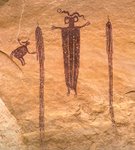
Pictograph From San Rafael Swell, Utah
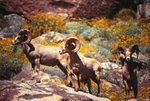
Endangered Peninsular Bighorn Sheep
Bighorns in Anza Borrego State Park, CA, 1998
Not One More Death, Not One More Dollar
Message On Main Street to End the War
Peace On Main Street
Need money For Schools?
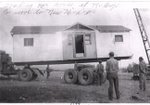
Winnie Moves to New Meadows, Idaho
In 1944 Winnie's house at the logging camp was moved on the back of a truck. In those days, logger's homes were often moved from camp to camp on R.R.flatcars or trucks.
[Edited & Updated, links added; 2/21/12] The Oregon House passed a bill, HB 4158 (Sponsored by Rep. Cliff Bentz, District 60, from cow oriented Malheur, Baker, Harney, and Grant Counties) on Friday, February 17, 2012, that would allow another legislative end run against an endangered species act, this time Oregon's. HB 4158 still must be passed by the Senate, and Democrats outnumber Republicans there by 16-14. The intent is to relieve Oregon ranchers from the responsibility to protect their livestock from wolves by using non-lethal measures, and allow the killing of wolves who prey on livestock, regardless of the circumstances, before recovery has been achieved. In other words, the ranchers, and their legislative sponsors, don't want to change the way ranchers do their destructive business on the lands of Oregon: Ranchers, thinking only of their profits after having grown accustomed to the wolf-free environment they and the government created by killing off the wolves many years ago, refuse to spend the money necessary to protect their livestock. See also: "Keeping Wolves Out of Harm's Way."
Representatives BENTZ, R District: 60 SMITH; R District: 57 Union, Wallowa, Umatilla, Morrow Counties ESQUIVEL, R-Medford District 6 GARRARD, R District: 56 Klamath Falls JENSON, R District: 58 Pendleton JOHNSON, R District: 52 Hood River KRIEGER, R District: 1 Gold Beach SCHAUFLER, D District: 48 Happy Valley WHISNANT, R District: 53 Sunriver
Senators BOQUIST, R District: 12 Dallas FERRIOLI, R District: 30 John Day GEORGE, R District: 13 Sherwood GIROD, R District: 9 portions of Clackamas, Linn and Marion KRUSE, R District: 1 Roseburg NELSON, R District: 29 Pendleton TELFER, R District: 27 Bend THOMSEN, R District: 26 Hood River WHITSETT R District: 28 Klamath Falls
There is a lot of bad news coming out of Salem and the state legislature on the environment these days. One deeply cynical ploy—taking health care in Oregon hostage to try and force more clear-cutting on state lands—has generated headlines and public outrage, but it isn’t the only attack on the environment this session. The worst may be HB 4158, a measure that would declare a “state of emergency” in Oregon in order to immediately exempt our state’s 29 wild gray wolves from state Endangered Species Act protections so they can be shot.
After exterminating wolves from Oregon in 1947 to pave the way for a more lucrative livestock industry, the Beaver State is now home to only 4 known packs.
In a state that prides ourselves on our conservation ethic and connection to the outdoors, the elimination of wolves in the last century is an environmental tragedy. Their recovery has the potential to be one of our greatest conservation success stories. But that won’t happen if the Oregon Cattlemen’s Association (OCA) and their allies in Salem have their way.
In what’s become an annual affair, the OCA and the legislators who promote their agenda have introduced a wolf-kill bill and more tax breaks for their already heavily subsidized industry. In previous years, we’ve seen bills that would make poaching laws unenforceable or allow them to be killed if they get too near a structure. This year, rather than the Three Little Pigs bill, they’ve introduced the Chicken Little Bill.
HB 4158 is a hysterical piece of legislation, but not in a funny way. Not only does the bill threaten Oregon’s fragile wolf recovery, it sets a dangerous precedent for all wildlife. HB 4158 declares that the 29 wolves now residing in Oregon constitutes a “state of emergency”, and as a result immediately strips them of state Endangered Species Act protection. This would pave the way for members of the Imnaha Pack (or any other wolf pack in the state) to be shot despite their endangered status. In a bit of Orwellian double-speak, the original text of the bill declared that shooting wolves is the same as conserving them.
If passed, HB 4158 would set an awful precedent and open a Pandora’s box of copy-cat measures exempting other inconvenient species. Endangered salmon getting in the way of a plan to clear-cut forests? Declare a state of emergency! Protection for humpback whales restricting energy development on the coast? Emergency! Want to pave over an old-growth forest that contains spotted owls? Go to the legislature and declare an emergency! . . . . Feb. 17, 2012 | | 9 comments
We, the undersigned, urge you to oppose HB 4158, a bill proposed by the Oregon Cattlemen's Association, which allows killing of wolves to address livestock depredation and declares a "state of emergency." With less than 30 wolves in the entire state, we find this declaration absurd. We, and most Oregonians, highly value our wildlife and strongly support endangered species protection and the return of wolves to Oregon, and their strong recovery.
Oregon has less than 30 confirmed wolves in the entire state and approximately 1.3 million cows. We feel that a Bill establishing a “state of emergency” over the presence of a tentatively recovering endangered wolf population is an attempt to bypass the Oregon Endangered Species Act and would set a dangerous precedent which could be used to circumvent protections of other endangered species at the behest of special interests. Furthermore, we believe it is an effort to short-circuit current litigation which aims to clarify the relationship of the state Endangered Species Act with the Oregon Wolf Plan.
Statements by Oregon Cattlemen's Association members and officers constantly stress the aim of lethal removal over the use of non-lethal measures and tools, which they routinely disparage. As quoted in the Lewiston Tribune Online, 7/2/11, OCA Wolf committee Chair Rod Childers said, “To be able to move to lethal control we as producers have to show we tried nonlethal actions. I can't say if it works or not, it is just things we have been told we have to do, and the whole key to me is getting them to move to lethal control,...” With this in mind, we believe HB 4158 to be an attempt to weaken the commitment to non-lethal measures.
With so many critical issues before this short session of the legislature, devoting precious time to this controversial and unnecessary Bill is a mistake.
Please oppose HB 4158.
Thank you. [Your name] [Emphasis Added] _
Why This Is Important Oregon has less than 30 confirmed wolves in the entire state. While a majority of Oregonians support wolf recovery, the livestock industry and hunting organizations have been fighting tooth and nail against protection of the Oregon Endangered Species Act and the Oregon Wolf Plan. The proposed bill HB 4158 declares a "state of emergency" and allows for the killing of wolves to address livestock depredation. We vehemently oppose the slaughtering of endangered native wolves to appease the cattle industry, and we find the declaration of a "state of emergency" absolutely absurd. Please join us in urging our Governor, Senators and House Representatives to oppose this offensive bill. Thank you.
My Comment:
"The only "emergency" needing to be addressed is to have Oregon ranchers begin using all the non-lethal measures that are available for them to avoid conflicts with wolves. The majority of Oregonians and Americans support wolf recovery for the ecological/environmental benefits they provide. Ranchers, thinking only of their profits after having grown accustomed to the wolf-free environment they and the government created by killing off the wolves many years ago, refuse to spend the money necessary to protect their livestock. It is time to stand up and confront the damage caused to our lands by livestock grazing. One might call it an "emergency." "Fladry" ODFWPhoto
GOVERNOR KITZHABER HAS INFORMED REP. SPRENGER, THE SPONSOR OF THE BILL HB 4119 TO REPEAL MEASURE 18 AND BRING HOUND HUNTING OF COUGARS BACK, THAT HE HAS NO INTENTION OF SIGNING IT!
PLEASE CONTACT THE GOVERNOR AND THANK HIM FOR STEPPING UP TO THE PLATE FOR OREGON VOTERS AND COUGARS.
- Letters to the Editor in Oregonian & OP-EDS--RE: Ferrioli & Wolves _________
__
Billboard Keeps the Heat on Wolf Poacher
FOR IMMEDIATE RELEASE February 14, 2011
Contact: Wally Sykes, Northeast Oregon Ecosystems, wally_sykes2000@yahoo.com (Phone number available upon request) Suzanne Stone, Defenders of Wildlife, 208.424.9385, sstone@defenders.org Greg Dyson, Hells Canyon Preservation Council, 541.963.3950 x22, greg@hellscanyon.org Rob Klavins, Oregon Wild, 503.283.6343 ext 210, rk@oregonwild.org
Billboard Keeps the Heat on Wolf Poacher Groups advertise $10,000 reward in hopes of catching wolf killer
La Grande, Ore—Local citizens and conservation groups today announced a new effort to bring the poacher who illegally shot an endangered wolf in Oregon to justice. Starting tomorrow, drivers traveling East on Hwy. 82 from La Grande will see a billboard with the image of the young wolf killed in September and the phone number to call with information about its death. The advertisement highlights a $10,000 reward being offered or information about the poaching and the statement “whatever you think of wolves…poaching is wrong!”
Wally Sykes of Joseph, Oregon is a founder of the community group Northeast Oregon Ecosystems which spearheaded the effort to raise funds from neighbors, friends, community members, and wildlife advocates in Wallowa County upset by the illegal killing. The group has also funded predator management presentations for ranchers and the range rider program implemented by Defenders of Wildlife in partnership with local ranchers.
“Tourism is vital to this area.” said Sykes. “People come to see spectacular wild landscapes and wildlife. Just like in Yellowstone, the return of wolves to Oregon has the potential to draw visitors from all over the country. Anti-wildlife attitudes and rhetoric that result in the illegal killing of endangered species are counterproductive and give our community a black eye.”
The wolf killed in September was collared by biologists in early August in an effort to track the Wenaha pack – one of only two known packs in Oregon. In a monthly wolf update, ODFW claimed the collaring effort began in 2007 and represented the agency’s single largest wolf collaring effort. Photos of the silver male were circulated widely. The wolf was found dead on September 30th by wildlife agents and represents the third illegal wolf killing since the species first returned to Oregon after being exterminated over 60 years ago. Oregon’s confirmed wolf population now stands at 24 wolves in 2 packs.
In response, local citizens, conservation groups, and the U.S. Fish & Wildlife Service have offered a combined reward of $10,000. High profile wolf poachings have also recently occurred in Washington.
“There is room in the West for both wildlife and people. Old attitudes of intolerance and fear don’t get us anywhere,” said Sykes. “Wolves were shot on sight until they were all gone. Living with wolves is going to require some adjustments, but it’s the right thing to do in a state that prides itself on its conservation values.”
A press release about the reward can be found at http://tinyurl.com/ORwolfreward. Anyone with information about this wolf poaching should contact Special Agent Cindi Bockstadter at 503.682.6131 ### __
Congressional Bill Concerning Endangered Wolves
SENATE BILLS S 249 – The Orrin Hatch Bill would remove gray wolves from the Endangered Species Act forever nationwide.
S 321 - The Baucus/Tester (D, Mont.) bill would make the 2009 delisting rule law in Idaho and Montana, but would additionally allow Idaho to reduce their wolf population to 100 animals as directed by the Idaho legislature. Montana's plan calls for at least 342 wolves. It makes no mention of state management plans conforming to any prior delisting agreement between the states and the USFWS, which was part of the 2009 delisting agreement since overturned by Judge Malloy.
HOUSE BILLS HR 509 – One of two Rehberg (R, Mont.) bills, it would delist all wolves nationwide and prevent them from ever receiving protection under the Endangered Species Act.
HR 510 – The second Rehberg (R, Mont.) bill would delist wolves only in Montana and Idaho but would not require the states to follow their own management plans, leaving the door open for wolf eradication if directed by the legislatures of each state.
Note: Idaho Republican Rep. Mike Simpson said he will add a provision to the continuing budget resolution necessary for the government to continue that would reinstate the 2009 decision by the U.S. Fish and Wildlife Service to delist the gray wolf in Idaho and Montana. This would also include recovering wolf populations in eastern Oregon and Washington.
Text of the Provision: SEC. 1713. Before the end of the 60-day period beginning on the date of enactment of this division, the Secretary of the Interior shall reissue the final rule published on April 2, 2009 (74 Fed. Reg. 15123 et seq.) without regard to any other provision of statute or regulation that applies to issuance of such rule. Such re-issuance (including this section) shall not be subject to judicial review. __
Howling over wolves Regarding "Wolf input from EU gets Oregon hackles up" (Feb. 10): State Sen. Ted Ferrioli is a throwback to frontier days, when the land existed solely for exploitation by resource extractors, and hang anyone who stood in their way. If the people he represents cheer his swagger and applaud his bare-knuckle arrogance, clearly it is Grant County, not Greece, that has become a "haven for morons."
He will no doubt bristle at this suggestion and redirect his vitriol to "outsiders" from western Oregon. But before he defends his knee-jerk reaction to world opinion, perhaps he would be wise to learn about the remarkable ecological recovery wolf reintroduction has brought to the rivers and valleys of Yellowstone National Park.
Perhaps then he would tone down his rhetoric. Perhaps he would work for the balanced approach we need if we hope to avoid joining the long list of endangered species we are driving to extinction.
DAVID HEDGES West Linn *****
The incivility and immaturity shown by state Sen. Ted Ferrioli in response to the letter from the out-of-state (and out-of-country) wolf advocate boggles my mind. It was the adult equivalent of a 6-year-old folding his arms, stamping his foot and saying, "You're not the boss of me!" I certainly hope the only way this person represents the denizens of John Day is by his presence in the Legislature. KAREN MAYFIELD Southeast Portland __
Add Ted Ferrioli, the state Senate minority leader, to the victims of impulsive e-mailing. That’s the ailment that causes people to answer an annoying e-mail with a snarky remark and hit the send button before they’ve cooled down. [Hey Ted, I do that too!]
There’s a bill pending in the legislature removing wolves from the state’s endangered species list. Somebody from Europe, a singer living in Greece, e-mailed Ferrioli urging him to oppose the bill.
Ferrioli could have ignored the message. He could have thanked the singer for her concern even though she’s as far removed from the facts as she is from the location of the issue.
Instead, he snapped that input from residents of the European Union made no difference to him on this or presumably any other issue. And by way of illustration or example, he added that maybe he should write to the EU and recommend that it no longer subsidize Greece since it had become a “haven for morons.” [See link above for more. ...] __
A heated e-mail from Sen. Ted Ferrioli (R-John Day) to a wolf advocate in Greece last week sparked howls of protest and eventually elicited an apology from the senator to people of Greek descent, wherever they reside.
It also made it pretty clear that this county should never appoint Ferrioli to be its Minister of Tourism.
The uproar began after the senator got an e-mail from a woman in Greece, urging him to oppose an Oregon Senate bill that would remove wolves from the state’s endangered species list. Ferrioli shot back that he supports the bill, but added that “perhaps I should be writing to EU ministers to stop bailing out Greece. Clearly, it has become a haven for morons. Go away!” . . . . The senator may have shot himself in the foot, but we’re catching the ricochet. Maybe he should apologize not just to Greeks, but to this community. And perhaps next time, rather than telling foreign correspondents to “go away,” he should be inviting them to visit Grant County and see rural life for themselves. Our county leaders and Extension agents took that approach few years with their urban-rural exchange, an award-winning program that arose out of verbal clashes over – what else? – wolves. . . . . [See link above for more. ...]
When singer and Greek resident Louise du Toit wrote to Oregon Senate Minority Leader Ted Ferrioli (R-John Day) urging him to oppose a GOP-sponsored bill that would weaken environmental protections in the state, she probably didn’t expect her voice to carry much weight overseas.
But she certainly didn’t expect the sheer boorishness of Sen. Ferrioli’s answer:
"Are you kidding? Why do you expect that input from [European Union] residents make any difference at all to me? I'll be supporting Dr. Whitsett's bill (he is a VETERINARIAN). By the way, perhaps I should be writing to EU ministers to stop bailing out Greece. Clearly it has become a haven for morons.
There’s not a lot of love for wolves or wildlife on Capitol Hill today. In fact, some in Congress are trying to use a must-pass spending bill to eliminate lifesaving protections for gray wolves across the U.S., opening the door to widespread trapping and poisoning of wolves in the Northern Rockies and Greater Yellowstone.
The spending bill, called a continuing resolution, is designed to ensure that military and government workers continued to get paid, that social security recipients receive their checks and that the government continues to function.
Unfortunately, some in Congress are using this legislation as a vehicle to attack protections for wolves and enact some of the deepest cuts in recent memory for the agencies that protect our wildlife and environment – a move that would have dire consequences across the country for your wildlife and for the quality of your environment .
Some of the crucial programs that will be slashed include those that protect imperiled species, acquire key habitat around the country, including for our national wildlife, refuges, parks, forests and other public lands, help state protect wildlife before they decline to the point where they are endangered, and assist wildlife in surviving climate change.
It’s up to caring wildlife supporters like you to stop this assault on the precious natural treasures we all love. Please take action now. The U.S. House of Representatives will consider the continuing resolution this week, and we need to make a strong showing against this assault on our wolves, wildlife and environment. Help us send 65,000 messages to Capitol Hill by Wednesday. Please take action, forward this email and share our message on Facebook. We can protect our wolves, wildlife and environment, but only if we work together. Will you take just a few moments to help today? For the Wild Ones,
Rodger Schlickeisen President Defenders of Wildlife
----- Another Step Forward for Threatened Steelhead on the Malheur National Forest ----- Hell's Canyon Preservation Council Files Suit Asking Forest Service to Comply With the Law ----- ODFW Wolf Report ----- Krugman--A Tale of Two Moralities [Edited 1/14-15 & 17/11] _________
More time was taken with this post on livestock gazing, compared with others (:-)), simply because this is a subject that has been close to my heart and action for a long while, as is explained to some degree below.
Understanding the effects of livestock grazing is not really fully realized by reading a book--one has to go out over a period of time and look around, experience and get to know grazed and un-grazed environments--sit still, walk slowly, study, and soak up what is happening to living things in both situations. Looking at sometimes subtle (and often not so subtle) differences, such as in plant and animal diversity, the number of breeding birds or fish spawning locations (redds) found, stream morphology measurements such as width and depth, stream bank characteristics (overhanging or bare and laid back), the kinds, quantity and condition of riparian plants present, and much more, helps people understand the effects of livestock grazing on riparian/stream systems. The literature is rich with observations and conclusions, some of which have come from the scientists within the land management agencies (Forest Service, Bureau of Land Management, Fish and Wildlife Service, state wildlife agencies, and etc.) themselves.
The effects of livestock grazing are well know to many in addition to university professors, including in particular, the scientists in the federal and state agencies that manage our public lands. Conscientious and courageous agency biologists like Bill Platts, a now retired fisheries biologist in the Forest service pointed out some of the adverse effects many years ago. Most of the agencies own scientists today are well aware of these effects and more, but others in powerful and not so powerful positions, while under enormous political pressure to promote the grazing status quo, may bend to that pressure. Others, including even some with scientific training, eagerly enable bad grazing practices to continue, going so far as to ignore or defend them. Enormous amounts of taxpayer dollars are siphoned off and wasted so as to needlessly defend against lawsuits that properly target indefensible and destructive grazing practices, when taxpayer money should be aimed at monitoring the grazing activity and managing conditions on the ground--the public's ground. (I won't even be touching on the fact that public lands ranchers receive what amounts to a very large subsidy from US taxpayers--beginning with the woefully inadequate $1.35 monthly grazing fee for each cow and calf--so that ranchers can continue to have their way with the public lands.)
Here is one guarded example of many agency statements about the effects of livestock on riparian/stream systems:
Within the western U.S., livestock grazing likely will continue as a primary use of much of the land area of the Columbia Basin (Kindschy 1994). Cattle are the principal type of livestock that now graze rangelands of the Columbia Basin. Riparian areas constitute only a small percentage of these rangelands (Bedell ed. 1993), yet livestock (especially cattle) activity is disproportionately concentrated within riparian areas (Marlow and Pogacnik 1986, Kovalchik and Elmore 1991) compared with upland areas of watersheds. Excessive herbage removal and physical damage by trampling are visual effects of improper grazing in riparian areas resulting from this concentration of activity. Less noticeable are effects on water quality.
Ramifications of excessive herbage removal and physical damage can include reduced dissipation of stream energy, increased bare soil and soil loss through accelerated erosion, stream channel degradation resulting in reduced floodplain recharge and/or lowered water table and subsequently reduced riparian community size. Erosion and stream channel degradation also affect water quality by increasing suspended sediments and, in conjunction with absence of vegetation shading, water temperature. Simplification of structural layering of vegetation, and presence of early successional stages result in less diverse and often less productive floral and faunal assemblages. Direct influences of livestock concentrations in riparian areas on water quality also include bacterial and protozoal parasite contamination and nutrient enrichment from fecal material in and near surface waters (Larsen in press).
To put that more simply, in lay people's terms: Poorly managed livestock grazing can easily trash riparian/stream systems (not to mention the uplands) on public lands, which are a natural heritage belonging to all the people of our sometimes United States.
Examples of grazing's effects on riparian/stream systems used by endangered fish like steelhead or bull trout.
Summit Creek Exclosure-- Summit Creek on the Sagehen unit, Prairie City Ranger District. Photo shows example of healthy riparian and good fish habitat inside the exclosure. Note deep and narrow stream channel with ample bank stabilizing vegetation. The exclosure excludes cattle but not other native herbivores. I have personally witnessed elk jumping over the west fence into the exclosure to feed. The graminoids along the greenline were about 12 to 14 inches when this photo was taken on 10/08/06.
Summit Creek, just a hundred feet or so outside exclosure. Contrast this photo of this grazed portion of the creek with the previous photo showing conditions just upstream where cattle are excluded. ONDA folks listening to Tim Burton at Multiple Indicator Monitoring (MIM) field trip are Ken Stolz (rt.), Jefferson Jacobs (crouched, 2nd from end) and Mike Ogle (this side of Jefferson).
Note wide, shallower, unshaded stream, little bank stabilizing vegetation, and accelerated erosion from cattle shearing the overhanging bank on the right in photo above. Ex-Forest Service employee, now "consultant," Tim Burton (in the creek), who was conducting the seminar, had little to say about the cattle damage to the overhanging bank on the right. Of course it is hard to know exactly what the instructors said, as they told me to turn my video camera off before their educational program even got started. I was happy to help them find or identify some of the plants along this creek, as I have become quite familiar with this area over the years. Malheur NF, Grant Co. OR, July 15, 2009
Tim Burton-Erv Cowley Shut Down Filming of their Malheur National Forest MIM Field Trip
Tim Burton, career retired government employee and fisheries biologist for the Forest Service and Bureau of Land Management (BLM), and Erv Cowley, retired career employee at the BLM, shut down filming of the field trip where they try explain their idea of Multiple Indicator Monitoring (MIM) to Malheur National Forest Service employees, ranchers, and other interested parties who are responsible for protecting streams from cattle grazing.
I guess they didn't want their methodologies under scrutiny, as Tim Burton was at the time helping the Forest Service defend themselves against a law suit by environmental groups who were trying to improve grazing management on the Malheur National Forest. Both Mr. Burton, and Mr. Cowley took their many years experience in the land management agencies, the kind of careers during which some employees get in bed with the ranchers, or at a minimum become totally inured to the damaging effects of livestock grazing, to propel themselves into their new job as monitoring "consultants."
While MIM monitoring is certainly a big step forward from what has been near total neglect, because the agencies will be unable to afford its implementation, it really just ends up providing a very thin veneer of professionalism and science over a failed grazing program.
Mr. Burton is leaning against the tailgate of the pick-up and Mr. Cowley is the one who came over to tell me to stop filming. Another individual in black cap and blue denim jeans, probably from the Forest service, came over to say something to them just before Cowley delivered his message to me. Here's your video Tim and Irv. You can watch it anytime you want on YouTube! __
Brent Fenty, ONDA, (541) 330-2638 Noah Greenwald, Center for Biological Diversity, (503) 484-7495 Jon Marvel, Western Watersheds Project, (208) 788-2290
Grazing Halted to Protect Steelhead Trout on a Quarter-million Acres of Malheur National Forest
PORTLAND, Ore.— A federal judge today barred livestock grazing harmful to endangered steelhead trout on more than a quarter-million acres of public land on the Malheur National Forest in eastern Oregon. District Judge Ancer Haggerty ordered the U.S. Forest Service and National Marine Fisheries Service to reconsider the effects of the federal agencies’ grazing plan on native steelhead streams before grazing can resume.
According to Judge Haggerty, grazing has harmed steelhead by damaging the streams they depend on. The court’s order prohibits the Forest Service from allowing grazing on a vast area, including nearly 200 miles of critical steelhead habitat, until the agency complies with the Endangered Species Act. Along another 100 miles of steelhead streams, the court ordered the Forest Service to continue to carry out protective measures it approved during the last two years. The judge also ordered the Forest Service to comply with its steelhead habitat monitoring obligations under the National Forest Management Act and the Malheur Forest Plan before resuming grazing.
Today’s court order is the result of long-running challenges to Forest Service grazing by the Oregon Natural Desert Association, Center for Biological Diversity and Western Watersheds Project that began in 2003. It follows Judge Haggerty’s June 2010 ruling that the Forest Service’s grazing plan violated the Endangered Species Act and National Forest Management Act along more than 300 miles of steelhead streams in the John Day River Basin.
“Today’s decision puts the responsibility for protecting steelhead squarely on the agencies,” said Brent Fenty, ONDA’s executive director. “The court makes clear that the agencies have to make steelhead protection their highest priority, and that they cannot let riparian grazing continue until the agencies create a plan that complies with the law.”
In his ruling earlier this year, Judge Haggerty noted evidence that streamside grazing failed to meet ecological standards designed to conserve steelhead. The standards, established by the Forest Service and Fisheries Service, are meant to protect the key elements of healthy fish streams: stable stream banks and overhanging vegetation that keep streams clear and cold. The Forest Service’s grazing program has damaged stream banks much more severely than is allowed under federal standards.
“This decision insures that the Forest Service must give up its business-as-usual grazing management,” said Jon Marvel, executive director of Western Watersheds Project. “There will be no grazing on hundreds of miles of important fish streams until the Forest Service and NMFS can guarantee that grazing will not harm steelhead.”
Judge Haggerty’s order is the latest in a series of decisions that have resulted in significant protections for threatened steelhead. The judge issued a preliminary ruling in 2008 barring grazing on two allotments, which protected more than 90 miles of steelhead streams. In 2009, the court imposed strong conditions to restrict grazing and limit damage to streams. In the places where the court’s orders have prevented grazing during the past two years, even a single year of rest has allowed for significant initial recovery of riparian plant communities, stream channels and fish habitat.
“Suspending grazing on more than 200 miles of stream on the Malheur National Forest will not just benefit endangered steelhead, but numerous other wildlife species dependent on healthy rivers for their survival,” said Noah Greenwald, endangered species director at the Center for Biological Diversity. “It will also benefit the public by improving water quality and recreational opportunities, such as fishing, bird-watching and boating. Numerous studies have conclusively demonstrated that there is no compatible use of riparian areas by livestock.”
The Malheur National Forest is located in eastern Oregon’s Blue Mountains. It includes portions of the Upper John Day, Middle Fork John Day, North Fork John Day and Malheur rivers. The 281-mile long John Day River is the second longest undammed river in the continental United States. The river and its hundreds of miles of tributary streams on the Malheur National Forest provide spawning, rearing and migratory habitat for the largest naturally spawning, native stock of wild steelhead remaining in the Columbia River basin.
Rumor has it that the defendants may have filed for a "Reconsideration" of Judge Haggerty"s opinion in this case. __ Beaver Dam Creek in 2007--Grazed condition Murderer's Creek Allotment, Dan's Creek unit, Beaver Dam Creek and wet meadow. Photo shows low stubble and massive bank alteration. Cows had been on the unit for a while. Photo was taken on September 28, 2007.
Beaver Dam Creek in 2008--Essentially ungrazed condition Murderer's Creek Allotment, Dan's Creek unit, Beaver Dam Creek and wet meadow. Photo shows high grass and sedge with little in the way of bank alteration. Cows were allegedly not here this year--just wild ungulates and feral horses. Photo was taken in September, 2008. __
This case began in 2007, and was filed by the Oregon Natural Desert Association (ONDA), and their lawyers, Peter M. (Mac) Lacy (ONDA), Stephanie Parent (Pacific Environmental Advocacy Center, now also in private practice), and Kristin Ruether (Advocates for the West). It was subsequently led by David Becker (davebeckerlaw@gmail.com) who really brought success through his arduous effort which was well beyond the call of duty.
Earlier attempts to improve grazing practices on the Malheur National Forest began under the direction of one of ONDA's founders and leading lights, Bill Marlett (along with Don Tryon and Alice Elshoff & others), when ONDA filed their first grazing lawsuit on the Malheur N.F. in the John Day/Camp Creek case back in 1994. Denzel and Nancy Ferguson were also early supporters, see: Sacred cows at the public trough and Amazon.
My own involvement in documenting livestock grazing damage on the Malheur began with feeble photographic attempts in 1999, when I first moved to Oregon. I had grown up in an area where the portions of the national forests I visited were not impacted by public lands livestock grazing. The streams that my father took me to for fishing and hiking were as natural as could be expected, with plenty of stream-shading shrubs to deal with, overhanging banks, and numerous pools where I could find some nice fish for dinner. Beginning in the early 1980's, during my jaunts to Utah, I began to notice that the streams, lakesides, and springs were being trashed by livestock grazing, with some areas taking on characteristics that resembled a stockyard. It was obvious that "Ecosystem management" had not yet become popular buzzwords within the land management agencies. In the mid-1980s western ecosystems and native plants became an interest, so I completed a field botany course in 1989, and began identifying and photographing native plants. Since the late 1980s I have observed and been deeply concerned about the destruction, including in some cases the permanent impairment and alteration, of western public ecosystems by livestock grazing.
I was, at least I like to think, a thorn in the side of the Forest Service and BLM, concerning their grazing practices, from the late 1980's on. The victories were almost non-existant, given that I had no lawyer and the BLM (Originally called the "Grazing Service" and "General Land Office"), as well as the Forest Service at that time, were actually at the beck and call of local ranching communities. In the rural ranching areas, both agencies did for all intents and purposes, function as a grazing service, protecting some ranchers' privileges to expropriate public land for use as an over-stocked private cow pasture. I used to go into the BLM district office in Fillmore, Utah, and find that the assistant district manager had articles from Range magazine on her office wall. The district manager was responsible for one allotment that was named for a relative, who bore his own last name. Similar agency kowtowing (or is that cowtowing?) and deplorable conditions were observed in California, Nevada and Arizona. Portions of the public lands in many areas of the rural west had clearly taken on the character of a stockyard.
Stockyard? Bluebucket Allotment/Lake Camp Unit, Malheur National Forest. UTM 11T 0376580E 4883943N Black Canyon at end of trail from 460 road leading to spring & exclosure. Photo shows bare ground and erosion created by cattle trails and heavy use in the canyon around the exclosure. Sediments from sources like these will easily find their way downstream to seasonally used, threatened bull trout habitat, on the main stem of the Malheur River. Photo was taken on October 8, 2006.
Given my experiences, it was natural therefore to notice similar conditions on the Malheur National Forest when I moved to Prairie City, Oregon in 1999. My interest in monitoring public land grazing activities was well developed prior to my moving to Grant County in 1999, and so I immediately involved myself in continuing that activity. I attended agency-organized field tours, when allowed (they didn't always allow me to attend their "tours."), and reported incidents of cattle trespassing, violation of grazing standards, and areas of chronic damage caused by cattle grazing to the Forest Service. I also donated fencing material to the Prairie City district of the Malheur National Forest to help protect declining aspen stands from cattle grazing.
In 2000-2001, I teamed up with the Oregon Natural Desert Association, who had taken an interest in grazing activities on the Malheur not long after their founding in 1987. Jon Rhodes, Hydrologist at Planeto Azul Hydrology had already been on the case for some years, and soon, Dr. Bob Beschta, Professor Emeritus at Oregon State Universuity, who Jon has described as "perhaps the world's greatest living wildland hydrologist," along with renowned riparian ecologist, Dr. Boone Kauffman, and Grant County residents whose identity I should probably protect (unless given permission), were on the case. With that expertise, ONDA's lawyers, and my monitoring, we began an association aimed at getting the Malheur National Forest and their public land grazing permittees to begin following the law and to show the land a little respect in the John Day and Malheur River basins.
The first of a series of ONDA lawsuits that I was a party to began in 2003, with the most recent being the one that Judge Haggerty just rendered a decision in (2007). ONDA's legal efforts, along with court action, are beginning to improve livestock grazing management in both of these river systems. ONDA's actions, with the tremendous help of The Center For Biological Diversity, Western Watersheds, and Advocates For The West, have begun to see results, despite the enormous financial power arrayed against them, in protecting riparian corridors along the rivers and streams of these systems. As these riparian corridors begin to heal, the critters that inhabit them, including steelhead and breeding birds, among others, should begin to flourish and increase their numbers to a healthy sustainable level.
Grazed Condition in 2007 Murderer's Creek Allotment/John Young Meadows Unit; S. Fk. Murderers Creek as it flows through John Young Meadows. Photo shows more massive trampling and mowed-down graminoids as poor conditions continue upstream from transectt south end of transect toward the horse pasture/exclosure and cow camp. Photo was taken on October 22, 2007.
Un-grazed Condition in 2008 Murderer's Creek Allotment/John Young Meadows Unit; S. Fk. Murderers Creek as it flows through John Young Meadows. Photo shows the effects of no cattle grazing, although feral horses and elk used the area. Bank alteration on transect measured was essentially non existant. Grazing permittee and ODFW employee are watching and photographing me from the road in upper right. Photo was taken in late October, 2008. ______
Hell's Canyon Preservation Council Files Suit Asking Forest Service to Comply With the Law USFS Feedlot-Juniper Flat, Juniper Flat pasture, Alder Springs allotment on the Whitman Ranger District, Wallowa-Whitman National Forest, Baker County, OR, (this allotment was among those categorically excluded from thorough environmental review and challenged in the lawsuit described in press release below). Photo by Christopher Christie, October 9, 2008
The Hells Canyon Preservation Council and the Oregon Natural Desert Association filed a lawsuit in federal court challenging several Forest Service livestock grazing permit renewals on three National Forests in eastern Oregon. The Wallowa-Whitman, Umatilla and Malheur National Forests have together reauthorized livestock grazing on well over a quarter million acres of our public lands without thoroughly assessing or disclosing to the public the impacts of these actions on the region's natural resources.
Instead, the Forest Service has elected to forego any thorough environmental assessments or meaningful public participation, issuing numerous "categorical exclusions" across eastern Oregon and throughout the entire American West. An appropriations “rider” passed by Congress in 2005 and extended in 2008, allowed the Forest Service to categorically exclude grazing reauthorizations in fiscal years 2005 through 2008 from documentation under the National Environmental Policy Act (NEPA), if the agency was able to demonstrate with monitoring data that current grazing management is meeting resource standards (standards designed to ensure ecosystem health, protect native species, and prevent overgrazing). Categorical exclusions are also disallowed if grazing might negatively affect certain special resources like threatened and endangered species; flood plains, wetlands, or municipal watersheds; congressionally designated areas, such as wilderness or national recreation areas; and cultural or archeological sites.
The Forest Service has repeatedly misapplied this grazing rider across these three forests. Although grazing has occurred on these public lands allotments for decades, in most cases the Forest Service has never prepared any environmental analyses under NEPA, despite the presence of imperiled plants, threatened salmon and steelhead, degraded streams, sensitive and unique habitats, cultural and archeological sites, and areas designated by Congress for special resource protection, such as the Hells Canyon National Recreation Area and the Imnaha and John Day Wild & Scenic Rivers. Because the agency has failed to adequately monitor these areas and the resources they contain, it cannot show that protective standards are being met and that grazing does not pose any serious threats.
When inappropriately managed, livestock grazing adversely impacts ecological communities, particularly sensitive streamside areas, meadows, sagebrush ecosystems, aspen stands, and native grasses and forbs, all of which are critically important habitat for fish and wildlife. Livestock can trample and eat vegetation, spread noxious weeds, compact soils, erode streambanks and impair water quality. When livestock are allowed to degrade this habitat, it threatens the ecological functioning or survival of many fish, wildlife and plant species.
This action aims to ensure the Forest Service takes a hard look at the impacts of grazing on thousands of acres of public lands and waters, imperiled species, and countless other natural resources of eastern Oregon and gives the public a meaningful opportunity to participate in the decisions affecting our natural heritage.
On Wednesday, President Obama called on Americans to “expand our moral imaginations, to listen to each other more carefully, to sharpen our instincts for empathy, and remind ourselves of all the ways our hopes and dreams are bound together.” Those were beautiful words; they spoke to our desire for reconciliation.
But the truth is that we are a deeply divided nation and are likely to remain one for a long time. . . . . What are the differences I’m talking about?
One side of American politics considers the modern welfare state — a private-enterprise economy, but one in which society’s winners are taxed to pay for a social safety net — morally superior to the capitalism red in tooth and claw we had before the New Deal. It’s only right, this side believes, for the affluent to help the less fortunate.
The other side believes that people have a right to keep what they earn, and that taxing them to support others, no matter how needy, amounts to theft.
That’s what lies behind the modern right’s fondness for violent rhetoric: many activists on the right really do see taxes and regulation as tyrannical impositions on their liberty.
There’s no middle ground between these views. One side saw health reform, with its subsidized extension of coverage to the uninsured, as fulfilling a moral imperative: wealthy nations, it believed, have an obligation to provide all their citizens with essential care. The other side saw the same reform as a moral outrage, an assault on the right of Americans to spend their money as they choose. . . . .
It’s not enough to appeal to the better angels of our nature. We need to have leaders of both parties — or Mr. Obama alone if necessary — declare that both violence and any language hinting at the acceptability of violence are out of bounds. We all want reconciliation, but the road to that goal begins with an agreement that our differences will be settled by the rule of law.
My Edited Response:
The so-called "conservatives" (certainly not my conservative side) think their breaks in life make them superior, and entitle them to be actually haughty and vicious--to rationalize that the needy are simply "bad" people. It appears that they have no understanding of a simple truth: "There but for fortune go you and I."
As far as empathy, violence, the rule of law, and reconciliation goes, perhaps the first step is for America (and Obama) to set an example, by ending the state terrorism we afflict on others in illegal, useless, wasteful, counter-productive and destructive wars, and, most importantly, the infliction of tragic violence and murder on innocent people around the globe. All talk about violence being inappropriate seems a little hypocritical and inconsistent in the face of our own country's very violent ways.
- Wallowa Wildflowers Part 2 - What’s with Baker City Gas Prices? - Federal judge rules gray wolves in Oregon were illegally removed from the protections of ESA [Edited 8/22/10; segment deleted for personal reasons] ________________
Wallowa Wildflowers Part 2
Helianthella uniflora
This is the second installment of an article displaying some of the common wildflowers that can be found near the 66 Forest Service Road between Halfway and Twin Lakes (and beyond) in the Wallowa Mountains, Baker County, Oregon.
This 2nd portion of the article begins where the 1st part (July 28th) left off, to the east of Trinity Creek, at about 6300 feet in elevation. There is a short spur road there leading to a rocky outcrop and a sometimes used campsite, where a few of the previously listed wildflowers occur, as well as the first following.
One-flower Helianthella (Helianthella uniflora), is a rather tall perennial with several to many long rangy stems from the base, each one with normally only one large yellow flower at the end. Our usual variety is Douglas' helianthella (Helianthella uniflora var. douglasii). Frankly, I can scarcely tell the difference between the two varieties most of the time, but this one appears to be douglassii. It can be found along the upper 66 Road and on the Hells Canyon Rim, among other areas, often on rocky slopes.
Helianthella was used by the “First Nations.” AKA Native Americans, for an analgesic, usually as a poultice of ground roots, to treat sprains, swelling, and rheumatism.
Helianthella uniflora
In this same area can be found Blue Stickseed (Hackelia micrantha), also known as Jessica sticktight and wild forget-me-not, a widespread and common species in the Blue Mountains of Oregon. It appears in the lower elevations but is prominent in meadows and openings of the middle and higher elevations.
Blue Stickseed (Hackelia micrantha)
According to Wallowa-Whitman National Forest herbarium records, blue stickseed increases in overgrazed areas. “Increasers” in a grazed situation are those plants that increase due to their degree of distaste by livestock, either because they have poisonous properties or due to other factors, such as coarseness and aggravating seeds, or the effects of grazing on the ecosystem itself through disturbance, etc.. Three obvious increasers to look for in the Wallowas and elsewhere, out of the many to choose from, are Hackelia, lupine, and false hellebore (to be described later, aka, skunk cabbage). When pondering a portion of the forest that has been grazed for many decades, you can bet that the plant community you are looking at is quite a bit different from what it was before cattle and sheep were allowed to have at it. Some species of plants and the insects and other species that depend upon them, may be greatly diminished (eg. bunch grasses), or may have disappeared all-together.
Blue Stickseed
Stickseed grows in abundance in more open disturbed areas, whether caused by grazing, fire, campers, timber extraction, or firewood seekers. The seeds, nutlets, have prickly stiff hairs that have small barbs around the tip, as in the photograph above. This characteristic allows the seeds to cling to passing wild animals, livestock, hikers, and their dogs, thus helping to disperse the seeds over a much wider area. You may remember pulling them off your clothing or combing them out of your pet’s fur—great fun! Despite their aggressive seed dispersal “strategy,” most generally appreciate them due to the delicate and attractive flowers.
Although some species of Hackelia were used by some First Nations, for uses such as serious wound injuries and cancer (????) treatment, accounts of use by North West tribes are hard to come by.
Blue Stickseed
Another interesting and attractive, mostly sub-alpine, plant in the area is found close to creeks, from at least as low as Trinity Creek, on up in elevation to Lake Fork Creek, Big Elk Creek, and beyond, and is called Cusick's fumewort (Corydalis caseana Gray ssp. Cusickii), AKA “Fitweed.“ It is consumed by cattle and sheep but is non-the-less somewhat toxic. It apparently gives them fits and may cause losses.
It is from a fairly unusual family of plants called the Fumeworts or Fumitory family; the Fumaracea. There are only four genera listed for this family in Hitchcock and Cronquist’s “Flora of the Pacific Northwest,” which includes the familiar Bleeding Heart (Dicentra formosa). Cusick's fumewort is named for perhaps the most famous early botanist/plant collector/explorer/rancher in our area, William Cusick. (The map included in the link shows many plant collection points in Union, Baker, and Wallowa Counties, as well as the rest of Oregon.) Several plants and a local mountain are named in his honor. I first encountered plants named after him in northeastern most California some years ago.
Cusick's fumewort
Acetylcholinesterase (AchE) inhibitors, such as those found in the genus Corydalis, and other members of the family, are thought by some to be useful in treating “Alzheimer's disease (AD), senile dementia, ataxia, myasthenia gravis and Parkinson's disease.” [In Acetylcholinesterase inhibitors from plants]
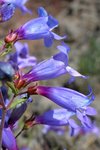
Heartleaf Arnica (Arnica cordifolia)
Another common and widespread wildflower from lower elevations and on into the sub-alpine elevations of the Wallowas, including the Hells Canyon Rim, is Heartleaf Arnica (Arnica cordifolia). This is a very common montane perennial in North America, including much of Canada, a few northern mid-western states, and appears in the west from the Dakotas south to New Mexico and westward to the Pacific coastal states. It is seen roadside in partially shaded areas along the 66 road and was fading when I was there in July, so I have used photos from other locations during previous trips in the Blue Mountains.
Heartleaf Arnica
It is fairly easy to identify due to its large, heart-shaped (chordate), and usually toothed, lower leaves, and the single large yellow “sunflower” atop the flowering stem.
This plant has been reported to have been used for many ailments by the Native Americans, including bruises, cuts and swellings, sore eyes, and as a “love medicine” (hmmm!).
Heartleaf Arnica
When you get to the streamside and bog communities of the sub-alpine zone, a whole new world of plants presents itself. There are a number of interesting and attractive plants in these communities, some threatened by grazing (more to follow in future blogs). Here is one member of this community from Lake Fork Creek below the 66 Road.
Bull elephant's-head, elephanthead lousewort, or simply Elephant Heads (Pedicularis groenlandica)
Elephanthead lousewort is a lousewort of the figwort family of plants (Scrophulariaceae), which also includes such notables as the Penstemons and Paint-brushes. This non-toxic, spring and summer perennial is quite common in wet or boggy meadow environments from all of the western states, including Alaska, and almost all of Canada.
Bull elephant's-head or Elephanthead lousewort
Elephant heads was ingested by some Native American tribes to treat coughs. Some modern folklore lists the genus as having value for use as “tranquilizers, muscle relaxants, powerful aphrodesiacs, and sedatives.” I am just glad it is out there.
Bull elephant's-head or Elephanthead lousewort
That’s all the time I have for Wallowa Wildflowers-- Part 3 later.
_____
What’s with Baker City Gas Prices?
Pricing at Jackson Shell
I can hear readers thinking, please tell me something I didn’t already know, but I thought it was worth documenting our relatively expensive gasoline prices. I think paying more for fuel may not necessarily be a bad thing, but the excess profits should probably go for alternative transportation, renewables, and etc., rather than to, well, you know. Those who have traveled beyond Baker City to places as close as La Grande, Halfway, or Ontario, may have noticed that our prices for unleaded regular are almost always higher here than in these nearby communities (I’m not including restricted “card-lock” stations as it seems to me that due to lower labor costs, they should and often do have lower prices.).
The Baker City gas price issue came to my attention again this year when I made trips to or through the nearby communities mentioned over the last three months, and noticed their low price was sometimes as much as 20 cents or more per gallon lower, excluding Halfway. It would be nice if I had solid answers to the question as to why this is so, but I don’t. The hauling distance to these communities, except perhaps Halfway, are not so much higher that the distance alone could account for the differences. In fact, if hauling distance were a large factor, one must wonder why the price in Halfway was a penny lower than Baker City’s lowest price during July and into August. I’m guessing some of you have reached a conclusion of your own, with the initials PG. (Hint—the G stands for gouging.) Another related explanation may be a sort of non-conspiratorial sort of price fixing, where the owners gauge their pricing by comparison to other prices at stations in their captive driver sphere of influence (such as can be seen in many small towns). I hope there is a more agreeable explanation, and if you have one, please send it to me at refugee2000@gmail.com, or simply use the comment facility at the bottom of the blog.
Before I get to far along, here is a graph of the recent historical price in Oregon via GasBuddy.Com, which can be found at oregongasprices.com.
Oregon Gas Price Chart Showing Average Retail Price in Oregon from May 5th to August 5, 2010.
Price for unleaded regular at Oregon Trails RV Park (Oregon Trails West)
During that period, the low price for unleaded regular in Baker City, up at the Oregon Trail RV Park, ranged from around $3.18.9 on May 12th, when the average Oregon price was about $2.95.9, to $303.9 over much of June, July, and into August, when the average Oregon price ranged from $2.83.9 to roughly $3.00. By contrast, the price at the Pilot station at the main freeway interchange in Ontario, hung persistently at $2.95.9, and the price at Safeway in La Grande varied from $2.96.9 to (just recently), $2.99.9 (three cents lower if you have a Safeway card). Baker City gas stations are consistently 3 to around 6 cents per gallon higher than Oregon Trail RV Park. If you were to chart our prices over the same period using the graph above, our prices would be off the chart in a nearly straight line. So far, while the state-wide average has climbed rapidly over the last two weeks, our prices have held steady, but tomorrow is a new day.
Pricing at Gas & Snack on 10th Street
Current Regular Unleaded Gas Prices for Oregon (Average), Baker City, and nearby communities (all from August 4th, except for Gas & Snack, Halfway, Safeway La Grande, and Ontario Pilot, which are from today.). Some prices from August 4th may have increased today.
Current Oregon average unleaded gas price $3.00.9 Shell Station at Highway 7 and David Eccles Road (no gas yesterday). $3.09.9 Jackson Shell just west of the freeway on Broadway $3.09.9 Chevron, just east of the freeway on Broadway $3.09.9 Chevron at Auburn & Main $3.08.9 Truck Corral, just east of the freeway on Broadway $3.07.9 Sinclair Station at Broadway & Cedar $3.07.9 Albertsons Express on Broadway $3.06.9 Gas & Snack on 10th and Church $3.06.9 Oegon Trail RV Park on Cedar/Hwy 86 near the north interchange $3.03.9
Richland Feed & Seed in Halfway $3.02.9 Safeway in La Grande (3 cents less with Safeway card) $2.99.9 Pilot at the freeway in Ontario $2.95.9 _____
On the heels of the Payette's decision to protect Bighorn Sheep on the Idaho side of Hells Canyon, we are celebrating another big success for wildlife here at HCPC! Today, a federal judge ruled that gray wolves in Oregon were illegally removed from the protections of the Endangered Species Act. The Gray Wolves are now back on the Endangered Species List and will be guaranteed the guardianship they need to thrive in Oregon.
HCPC and other groups have worked diligently to assure the Gray Wolf remains protected under the Endangered Species Act, and with your support it has paid off!
Here are some of the decisions :
The Endangered Species Act does not allow the U.S. Fish & Wildlife Service to list only part of a "species" as endangered, or to protect a listed distinct population segment only in part as the Final Rule here does; and
The legislative history of the Endangered Species Act does not support the Service's new interpretation of the phrase "significant portion of its range." To the contrary it supports the historical view that the Service has always held, the Endangered Species Act does not allow a distinct population segment to be subdivided.
We’re excited about the decision. It allows us to step away from the current controversy and gives us a fresh opportunity to bring all parties together to work on a true science-based recovery plan for wolves. This also gives us time to work on updating the Oregon Wolf Plan without the added pressure of having to simultaneously implement it.





 ODFW Photo
 "Fladry" ODFWPhoto