






In This Edition:
- Why is the Government Driving Folks off Their Land? Classism Gone Wild!
__
Why is the Government Driving Folks off Their Land?
http://youtu.be/yw3RiMdS7sE
L.A. County's War on Desert Rats
-
LA Weekly Articles:
"The crackdown, and the denial by some that a crackdown is under way, have fueled speculation as to Antonovich's, Cooley's and the NAT teams' motives. Residents suggest "they need to justify their jobs — and fill their budget." Others fear a land grab for future development plans. Bell calls that an "absurd" idea that he won't "validate" with a response."
"L.A. Weekly found in a six-week investigation that county inspectors and armed DA investigators also are pursuing victimless misdemeanors and code violations, with sometimes tragic results."
"Los Angeles County has left some residents, who appeared to be doing no harm, homeless."
"Until the county enforcers came calling, Gallo led a stable life. He wasn't in any danger of becoming homeless."
"Interestingly, county officials appear to understand what they are forcing Gallo into: A recent NAT visit was from "a lady at the gate," he says angrily, who handed him a flier for Stand Down, a program for homeless vets."
"Before NAT came around, Sterner had two valuable, sturdy cargo containers — and no neighbor gave a damn. "
"Fahey points out that those who purportedly "hate" his buildings remain anonymous. "They said it was A. Nonymous," he jokes."
"Robert McNamara is an attorney at the Institute for Justice, which litigates nationwide on behalf of individuals whose rights are violated by the government. Property rights is a key area in which "the courts are completely deferent to government, and have stopped acting as a check on government," he says."
"Tim Cavanaugh, senior editor of Reason, a libertarian magazine, says Los Angeles County has "started going after the lifestyle that has existed forever in the Antelope Valley." And such campaigns, Cavanaugh says, can escalate."
"city people are moving to the desert and they expect a higher level of cleanliness and conformity."
"They're not talking about setting up whorehouses," Rajkovacz says. "They live in the high desert, a lot in Antelope Valley. There's a reason they live in rural, downtrodden areas — because that's all they can afford."
"Cavanaugh suggests what is under way in the high desert is an intolerance toward working-class and poor people who are 'different.' 'Thank God they don't have resources to go around enforcing everything,' he says. 'It may not be your cup of tea, but that's the way people live.' "
L.A. County's Private Property War
By Mars Melnicoff
published: June 23, 2011
Defending Desert Rats
By L.A. Weekly readers
published: June 30, 2011
__
See Also:
SUNDAY, MAY 17, 2009
Property Maintenance Jihad Targets Disabled Life-long Baker City Resident
FRIDAY, JUNE 5, 2009
Democracy In Baker City, Plus Calder Update (YouTube)
War on the Poor Escalates--City Ordinance Would Add Restrictions to Burn Barrels (There is a New Burn Fee Too!)
(The City relented on the burning permit fee later, and relaxed some of the restrictions, but no campfires for the relatives when they visit, and no burning after normal working hours.)
Showing posts with label Burning Ordinance. Show all posts
Showing posts with label Burning Ordinance. Show all posts
Saturday, August 27, 2011


Wednesday, June 8, 2011
Bobolinks, Bitterroots & Burn Barrels
In This Edition:
[Edited 6/9/11, 5 PM]
- A Seldom Noticed but Locally Somewhat Common Bird--Bobolinks in Richland (Includes short video)
- One of Baker County's Most Interesting and Beautiful Wildflowers--The Oregon Bitterroot
-Burn Barrels Revisited
- Late Addition: Hells Canyon Preservation Council Wolf Action Alert
_____
Bobolinks in Richland

In Baker County, the Bobolink, Dolichonyx oryzivorus (Linnaeus, 1758), is a locally common, but for the most part rare, member of the Blackbird and Oriole family. We live on the western edge of its summer range. It breeds and attempts to raise its young in the taller grasslands and meadows of eastern Oregon, but spends the winter as far south as Argentina, Bolivia and Paraguay, flying up to 12,000 miles in a single year. You'd never know from watching them in their northern breeding grounds that they were strong flyers, as they seem to flutter a bit in a tentative flight. Their song has been described as "a bubbling delirium of ecstatic music. . . ." which you can listen to in the video below.
The bird in the video was one of perhaps three males hopefully breeding in a Timothy hay field at Richland, OR, on June 3rd, 2011. According to ODFW (Oregon Dept. of Fish & Wildlife), "due to land use change and other factors, this grassland bird species is declining in Oregon." One problem it faces is early haying on its chosen nesting grassland. I can tell you that it is not very often seen in any event, but it is also sometimes observed here in the Baker and Bowen Valleys.
Bobolink-Richland, OR-06/03/11

__
The Oregon Bitterroot
 Bitterroot along the Snake River Road
Even though Oregon bitterroot (aka bitter root, bitterroot and Lewisia rediviva) is the Montana state flower, and was "discovered" by Lewis and Clark in the Bitterroot Mountains there, one of its currently accepted common names is none-the-less, Oregon Bitterroot. From my first encounter with this white to pink petaled little treasure in Utah some years ago, it has remained one of my favorite spring wildflowers. It is a member of the Purslane Family (Portulacaceae), like, oddly enough, the common annual garden flower, Portulaca, and the weedy small yellow flowered succulent, common purslane.
Yes, the root is said to be bitter, but is rendered palatable by cooking and mixing with meat and/or berries, and some native American tribes treated it as a delicacy. One story alleges that the upper red portion of the root is effective in warding off bears, but you might want to have a back-up plan just in case.
The leaves are long, fleshy and finger-like, and they often wither back into the root by flowering. This is the case in the photo above, but not in the plant just below.
 Bitterroot flowering with leaves still present near Seismograph Road.
You may find it growing in sandy terrain in Utah, but most commonly, as here in eastern Oregon, I find it in rocky areas with clay soils. Right now it is blooming on the Snake River Road south east of Richland, near Seismograph Road east south east of Sparta, and there are a few on the rocky clay hills above Forshey Creek along the East Eagle (70) Road. [6/9/11--The Forest Service just allowed the privately owned cows (see below) out on the meadow today, so God help all the wildflowers there!]
 Leafless Bitterroot blooming along the Snake River Road
[Added 6/9/11 6 PM]
I was up photographing wildflowers on Forshey Meadows (70 Road to Lily White and East Eagle) today. Blooming flowers included Camas, Swamp onion, White Mules Ears and their crosses with yellow Mules ears, Big-head Clover, Orobanche uniflora, Rock Cresses, Peonies and others. The very few Bitterroot plants that remain were getting ready to bloom at any moment. As I travelled up the Sparta Road to the 70 Road, I passed through cows being herded up onto the public forest land at Forshey Meadows, and when I came back to the meadows after photographing several wildflowers there, some in bloom, some with seed, I found that the cows had arrived to trample and munch the meadow life into oblivion in our late Spring.
 Cows trampling and munching the meadow life into oblivion
 Privately owned cow having its way on the public's land
Too bad the Forest Service didn't let the wildflowers seed before the cows trampled them and munched the up for someone's private gain.
__
Burn Barrels Revisited
 Ann Mehaffy's nicely done and possibly legal burn barrel, May 26, 2011 (Ann Mehaffy is Program Director, Historic Baker City)
When I was growing up in Southern California in the 50s and 60's, that portion of the state was still truly "the land of milk and honey." The landscape just outside of town was covered with citrus groves and even a few vineyards. We even had burn barrels and a few had other others brick structures for burning in the back yards. These were most often referred to as incinerators, which the neighborhoods used to burn trash and yard waste. By the late 60s, the hordes had moved in from the east and were beginning to move in from south of the border. When I flew in on an extra seat on an air force flight in the late 60s, I noticed the smog beginning to envelope a valley that had before been clear. Most of this smog had blown in from points west, like Los Angeles, only to be captured and contained in our valley by the surrounding mountain ranges. Sometime around then, due to deteriorating air quality, the burn barrels and other incinerators were eliminated. The population was just over 63,000 in 1950, but was about 107,000 in 1970. In the late 80s and during he 1990s, I lived part-time in a small rural town in western Utah. Burn barrels and more commonly, open burning, were common sights there. When I moved to mostly unpopulated and rural eastern Oregon, in 1999, I found that people still used burn barrels, and where they had sufficient land, practiced open burning of yard waste and leaves. When I arrived in Baker City in 2004, my neighbors did the same, and it didn't bother me one bit. I didn't see it as "inconsiderate," I saw it as an opportunity in an area of low population density and where the air was still clean enough to do so without causing any lasting harm. If you look carefully, you will still see many burn barrels tucked away on the west side of town, but also in many other neighborhoods as well. Many of my neighbors use burn barrels and/or practice open burning, but most of them did not know about the proposed ordinance until I informed them, and they were against it.
The population in Baker City is now even lower (a bit over 9,800) than when I moved here, and our good air quality, according to DEQ measurements, is actually getting better. Unfortunately, an apparently power hungry and somewhat ill-informed Council, eager to please certain interests, have produced a non-sensical burning ordinance that would make burn barrels useless except for the burning of dioxin polluting paper. The Councilors apparently feel this shows they are "doing something" for the comfortable city dwellers who have moved here from the more urban areas that have been ruined, and for the well-off locals who look down their noses at people who struggle or who simply like to burn their yard waste.
To justify the need for the ordinance, some people I communicate with, especially those on the Council (when I can even get them to acknowledge my existence and e-mails), want to focus on the importance of stopping the burning of household garbage and plastics, which are already banned. The main problem with that argument, obviously, is that the burning of most household garbage is already illegal. Instead of focusing on making the current ordinance enforceable, they have actually produced an ordinance that outlaws the periodic burning of much less harmful yard waste in burn barrels, in favor of the burning of paper, which releases a known carcinogen (among other things), i.e., dioxin.
To be clear about my own preferences, I don't see any public good in allowing the burning of toxics, like large quantities of dioxin producing paper and plastic coated paper, or plastics of any sort, or many other materials found in common household garbage. The EPA has made a good case for not allowing that, and the current ordinance already recognizes those facts (except for paper). What I do have a problem with is an ill thought out, over-reaching, heavy-handed and draconian ordinance which bans less problematic substances being burned in burn barrels, while at the same time promoting the burning of dioxin polluting paper, when there has been almost no attempt to educate people about proper burn barrel construction and ventilation for better burning burn barrels, and other alternatives for disposal of trash (which I have touched on in previous blogs, i.e. recycling and container sharing, etc.).
Here is a summary of the objection to the ordinance (in no particular order):
- The city has provided little low cost locally specific data to justify the ordinance, and the Council has not made much more than personal anecdotes available, even though they should be able to provide more specific information.
- Our air is clean, and has been getting cleaner. Other than enforcement issues with the current ordinance, the proposed ordinance is a solution looking for a problem.
- Most people use their barrels for burning yard debris, not household garbage and trash. The latter is already banned. See current permit:
- It seems like the ordinance will punish responsible burners for the crimes of a few. Rather that using the draconian measure of banning the most common, and least problematic use of burn barrels, i,e., burning wood and yard debris, a few measures can be taken first:
a. Enforce current law with an ordinance that provides for that enforcement.
b. Make a concerted effort to educate people as to how to construct a burn barrel so that it has the proper ventilation to create a hot and efficient fire, and on the health hazards associated with burning household garbage, including plastics and paper. Also, make sure people understand that they have the legal and very inexpensive option of taking plastics, oil, paper, and many other recyclables to the recycle center, and that they can use leaves and household vegetable waste for mulch and compost. They can take toxics like paint to Ace, and many others, like batteries and contaminated gasoline to the recycle center on Wednesdays. They can make other arrangements such as garbage pickup sharing with neighbors or friends for any other waste that is illegal to burn, like foodstuffs and some plastics.
- Many people affected don't even know about the ordinance. Only two of several I initially spoke with even knew about it. They don't follow city news in the Herald or Record Courier, and they will not respond to Council in any event, because they feel disenfranchised and marginalized. They know that Council doesn't care about their lives and their problems, and that the Council's priorities are aligned with downtown business interests. They will find ways to do what they think they need to do. Despite Councilor Pope's invitation, most users of burn barrels will not show up at next Tuesday's meeting, as he well knows.
- There are several references to the dioxin problems created by burning paper on state and US EPA sites. Mike Kee sent me some links to sites from densely populated eastern states that he apparently didn't read very thoroughly.
Eg. from a link on one site: http://www.dec.ny.gov/chemical/32060.html
It says:
There are other links available that deal with the paper burning issue.
-Lastly: The Council seems to have an inconsistent standard on toxic pollution. Council defends the 24-7 mercury emissions from Ash Grove (See for example: Ash Grove files suit against EPA’s ruling | Baker City Herald & Ash Grove’s mercury wait continues | Baker City Herald). I understand why they would like to give them time to develop adequate technology to deal with their problem, but the Council then wants to come down hard on residents, many who are low income with few alternatives, without giving them the information and time to adjust their garbage disposal and burning practices.
See: February 8, 2011: Mike Kee & Council Comments on New Proposed Oregon Water Quality Standards.mp4
Here is the description of the video above and some supporting information:
Baker City is a small town of less than 10,000 people in north east Oregon and we are blessed with clean air and clean drinking water. At a time prior to now (May-June 2011), when the Council is supporting an ill-conceived ordinance that would eliminate occasional burning of wood and yard waste in burn barrels, the Council was upset on February 8, 2011, about more stringent proposed water quality rules that would help clean up our waste and agricultural drainage water and which would help protect low income, native, and minority communities dependent on the consumption of fish from those waters.
In his presentation, City Manager Mike Kee misrepresents the rules to an uninformed Council. He states that the old rule was based on "17.5 grams of fish a day that the average Oregonian consumed." According to DEQ, the standard was based on "national consumption data," not Oregon consumption, which was part of the problem. The new rules of 175 grams of fish a day take into account not national, not the "average Oregonian," but Oregon's "susceptible groups", i.e., those mentioned at the end of the last paragraph.
Mayor Dorrah says "They're nuts!" (to much laughter)
Councilor Calder: "Have they heard of catch and release?"
Councilor Bonebrake: "Are they going to require that we eat all this fish?"
Most interestingly, in the case of burn barrels, the Council is supporting an ordinance that bans less harmful burning of wood and yard debris (weeds, and etc.), in favor of allowing ONLY the burning of Dioxin (known carcinogen) producing paper. The fact is that our air quality has been steadily improving for over five years. Council is always very protective of business interests and their pollution, but seemingly deaf to the concerns of low income people who cut their "cost of doing business" through occasional burning of yard waste in burn barrels.
Mercury is a potent neurotoxin. ODFW has issued a MODERATE mercury level alert for the "Snake River including Brownlee Reservoir (Snake River Zone). This means:
Many Baker County (along with out of county and out of state) residents eat fish from Brownlee and the Snake River, along with the Tribes downstream.
According to a report by the Oregon Environmental Council:
Council has been very supportive of Ash Grove in their attempts to lower the mercury emission standard for Ash Grove, but they have no qualms about eliminating the occasional use of burn barrels by primarily lower income residents who burn yard wastes (again, burning most garbage is already illegal). Why they would allow the burning of dioxin emitting paper, while disallowing much less toxic yard waste, (actually not proven to be carcinogenic, unlike dioxin.), is beyond me.
Background info: OPB: DEQ Puts Forward Strict Water Quality Standards
Oregonian: Bills in the Legislature might water down Oregon's tough new limits on toxic water pollution
ODFW: OREGON FISH ADVISORIES
Detailed Oregon DEQ Background, Analysis and Staff Report for Revised Water Quality Rules from June 2, 2011
Changes to the proposed Water Quality Rules in response to lobbying
Previous post on the proposed burn ordinance:
MONDAY, MAY 9, 2011
War on the Poor Escalates--City Ordinance Would Add Restrictions to Burn Barrels (There is a New Burn Fee Too!)
MONDAY, MAY 23, 2011
City Council to Discuss a Revised Burning Ordinance Tomorrow Night
__
HELLS CANYON PRESERVATION COUNCIL WOLF ACTION ALERT
See more of this article at the link above.
[Edited 6/9/11, 5 PM]
- A Seldom Noticed but Locally Somewhat Common Bird--Bobolinks in Richland (Includes short video)
- One of Baker County's Most Interesting and Beautiful Wildflowers--The Oregon Bitterroot
-Burn Barrels Revisited
- Late Addition: Hells Canyon Preservation Council Wolf Action Alert
_____
Bobolinks in Richland

In Baker County, the Bobolink, Dolichonyx oryzivorus (Linnaeus, 1758), is a locally common, but for the most part rare, member of the Blackbird and Oriole family. We live on the western edge of its summer range. It breeds and attempts to raise its young in the taller grasslands and meadows of eastern Oregon, but spends the winter as far south as Argentina, Bolivia and Paraguay, flying up to 12,000 miles in a single year. You'd never know from watching them in their northern breeding grounds that they were strong flyers, as they seem to flutter a bit in a tentative flight. Their song has been described as "a bubbling delirium of ecstatic music. . . ." which you can listen to in the video below.
The bird in the video was one of perhaps three males hopefully breeding in a Timothy hay field at Richland, OR, on June 3rd, 2011. According to ODFW (Oregon Dept. of Fish & Wildlife), "due to land use change and other factors, this grassland bird species is declining in Oregon." One problem it faces is early haying on its chosen nesting grassland. I can tell you that it is not very often seen in any event, but it is also sometimes observed here in the Baker and Bowen Valleys.
Bobolink-Richland, OR-06/03/11

__
The Oregon Bitterroot
 Bitterroot along the Snake River Road
Even though Oregon bitterroot (aka bitter root, bitterroot and Lewisia rediviva) is the Montana state flower, and was "discovered" by Lewis and Clark in the Bitterroot Mountains there, one of its currently accepted common names is none-the-less, Oregon Bitterroot. From my first encounter with this white to pink petaled little treasure in Utah some years ago, it has remained one of my favorite spring wildflowers. It is a member of the Purslane Family (Portulacaceae), like, oddly enough, the common annual garden flower, Portulaca, and the weedy small yellow flowered succulent, common purslane.
Yes, the root is said to be bitter, but is rendered palatable by cooking and mixing with meat and/or berries, and some native American tribes treated it as a delicacy. One story alleges that the upper red portion of the root is effective in warding off bears, but you might want to have a back-up plan just in case.
The leaves are long, fleshy and finger-like, and they often wither back into the root by flowering. This is the case in the photo above, but not in the plant just below.
 Bitterroot flowering with leaves still present near Seismograph Road.
You may find it growing in sandy terrain in Utah, but most commonly, as here in eastern Oregon, I find it in rocky areas with clay soils. Right now it is blooming on the Snake River Road south east of Richland, near Seismograph Road east south east of Sparta, and there are a few on the rocky clay hills above Forshey Creek along the East Eagle (70) Road. [6/9/11--The Forest Service just allowed the privately owned cows (see below) out on the meadow today, so God help all the wildflowers there!]
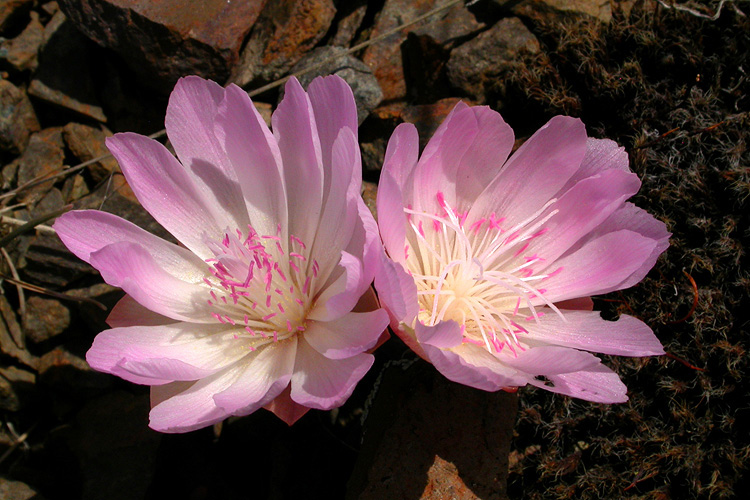 Leafless Bitterroot blooming along the Snake River Road
[Added 6/9/11 6 PM]
I was up photographing wildflowers on Forshey Meadows (70 Road to Lily White and East Eagle) today. Blooming flowers included Camas, Swamp onion, White Mules Ears and their crosses with yellow Mules ears, Big-head Clover, Orobanche uniflora, Rock Cresses, Peonies and others. The very few Bitterroot plants that remain were getting ready to bloom at any moment. As I travelled up the Sparta Road to the 70 Road, I passed through cows being herded up onto the public forest land at Forshey Meadows, and when I came back to the meadows after photographing several wildflowers there, some in bloom, some with seed, I found that the cows had arrived to trample and munch the meadow life into oblivion in our late Spring.
 Cows trampling and munching the meadow life into oblivion
 Privately owned cow having its way on the public's land
Too bad the Forest Service didn't let the wildflowers seed before the cows trampled them and munched the up for someone's private gain.
__
Burn Barrels Revisited
 Ann Mehaffy's nicely done and possibly legal burn barrel, May 26, 2011 (Ann Mehaffy is Program Director, Historic Baker City)
When I was growing up in Southern California in the 50s and 60's, that portion of the state was still truly "the land of milk and honey." The landscape just outside of town was covered with citrus groves and even a few vineyards. We even had burn barrels and a few had other others brick structures for burning in the back yards. These were most often referred to as incinerators, which the neighborhoods used to burn trash and yard waste. By the late 60s, the hordes had moved in from the east and were beginning to move in from south of the border. When I flew in on an extra seat on an air force flight in the late 60s, I noticed the smog beginning to envelope a valley that had before been clear. Most of this smog had blown in from points west, like Los Angeles, only to be captured and contained in our valley by the surrounding mountain ranges. Sometime around then, due to deteriorating air quality, the burn barrels and other incinerators were eliminated. The population was just over 63,000 in 1950, but was about 107,000 in 1970. In the late 80s and during he 1990s, I lived part-time in a small rural town in western Utah. Burn barrels and more commonly, open burning, were common sights there. When I moved to mostly unpopulated and rural eastern Oregon, in 1999, I found that people still used burn barrels, and where they had sufficient land, practiced open burning of yard waste and leaves. When I arrived in Baker City in 2004, my neighbors did the same, and it didn't bother me one bit. I didn't see it as "inconsiderate," I saw it as an opportunity in an area of low population density and where the air was still clean enough to do so without causing any lasting harm. If you look carefully, you will still see many burn barrels tucked away on the west side of town, but also in many other neighborhoods as well. Many of my neighbors use burn barrels and/or practice open burning, but most of them did not know about the proposed ordinance until I informed them, and they were against it.
The population in Baker City is now even lower (a bit over 9,800) than when I moved here, and our good air quality, according to DEQ measurements, is actually getting better. Unfortunately, an apparently power hungry and somewhat ill-informed Council, eager to please certain interests, have produced a non-sensical burning ordinance that would make burn barrels useless except for the burning of dioxin polluting paper. The Councilors apparently feel this shows they are "doing something" for the comfortable city dwellers who have moved here from the more urban areas that have been ruined, and for the well-off locals who look down their noses at people who struggle or who simply like to burn their yard waste.
To justify the need for the ordinance, some people I communicate with, especially those on the Council (when I can even get them to acknowledge my existence and e-mails), want to focus on the importance of stopping the burning of household garbage and plastics, which are already banned. The main problem with that argument, obviously, is that the burning of most household garbage is already illegal. Instead of focusing on making the current ordinance enforceable, they have actually produced an ordinance that outlaws the periodic burning of much less harmful yard waste in burn barrels, in favor of the burning of paper, which releases a known carcinogen (among other things), i.e., dioxin.
To be clear about my own preferences, I don't see any public good in allowing the burning of toxics, like large quantities of dioxin producing paper and plastic coated paper, or plastics of any sort, or many other materials found in common household garbage. The EPA has made a good case for not allowing that, and the current ordinance already recognizes those facts (except for paper). What I do have a problem with is an ill thought out, over-reaching, heavy-handed and draconian ordinance which bans less problematic substances being burned in burn barrels, while at the same time promoting the burning of dioxin polluting paper, when there has been almost no attempt to educate people about proper burn barrel construction and ventilation for better burning burn barrels, and other alternatives for disposal of trash (which I have touched on in previous blogs, i.e. recycling and container sharing, etc.).
Here is a summary of the objection to the ordinance (in no particular order):
- The city has provided little low cost locally specific data to justify the ordinance, and the Council has not made much more than personal anecdotes available, even though they should be able to provide more specific information.
- Our air is clean, and has been getting cleaner. Other than enforcement issues with the current ordinance, the proposed ordinance is a solution looking for a problem.
- Most people use their barrels for burning yard debris, not household garbage and trash. The latter is already banned. See current permit:
"All Burning:
* ONLY untreated wood, paper products and yard debris are permitted to be burned
* It is NEVER permissible to burn household garbage (foodstuffs, plastic, metal, diapers, etc.)"
- It seems like the ordinance will punish responsible burners for the crimes of a few. Rather that using the draconian measure of banning the most common, and least problematic use of burn barrels, i,e., burning wood and yard debris, a few measures can be taken first:
a. Enforce current law with an ordinance that provides for that enforcement.
b. Make a concerted effort to educate people as to how to construct a burn barrel so that it has the proper ventilation to create a hot and efficient fire, and on the health hazards associated with burning household garbage, including plastics and paper. Also, make sure people understand that they have the legal and very inexpensive option of taking plastics, oil, paper, and many other recyclables to the recycle center, and that they can use leaves and household vegetable waste for mulch and compost. They can take toxics like paint to Ace, and many others, like batteries and contaminated gasoline to the recycle center on Wednesdays. They can make other arrangements such as garbage pickup sharing with neighbors or friends for any other waste that is illegal to burn, like foodstuffs and some plastics.
- Many people affected don't even know about the ordinance. Only two of several I initially spoke with even knew about it. They don't follow city news in the Herald or Record Courier, and they will not respond to Council in any event, because they feel disenfranchised and marginalized. They know that Council doesn't care about their lives and their problems, and that the Council's priorities are aligned with downtown business interests. They will find ways to do what they think they need to do. Despite Councilor Pope's invitation, most users of burn barrels will not show up at next Tuesday's meeting, as he well knows.
- There are several references to the dioxin problems created by burning paper on state and US EPA sites. Mike Kee sent me some links to sites from densely populated eastern states that he apparently didn't read very thoroughly.
Eg. from a link on one site: http://www.dec.ny.gov/chemical/32060.html
It says:
Even burning paper today can release dioxins into the air.
Past generations burned their household trash, but it did not contain plastics, foils, batteries, paper (which is bleached with chlorine) and other materials. Even burning paper today can release dioxins into the air. Burning household trash, whether in an open pit, burn barrel or a wood stove, is illegal, unhealthy, unneighborly and unnecessary.
There are other links available that deal with the paper burning issue.
-Lastly: The Council seems to have an inconsistent standard on toxic pollution. Council defends the 24-7 mercury emissions from Ash Grove (See for example: Ash Grove files suit against EPA’s ruling | Baker City Herald & Ash Grove’s mercury wait continues | Baker City Herald). I understand why they would like to give them time to develop adequate technology to deal with their problem, but the Council then wants to come down hard on residents, many who are low income with few alternatives, without giving them the information and time to adjust their garbage disposal and burning practices.
See: February 8, 2011: Mike Kee & Council Comments on New Proposed Oregon Water Quality Standards.mp4
Here is the description of the video above and some supporting information:
Baker City is a small town of less than 10,000 people in north east Oregon and we are blessed with clean air and clean drinking water. At a time prior to now (May-June 2011), when the Council is supporting an ill-conceived ordinance that would eliminate occasional burning of wood and yard waste in burn barrels, the Council was upset on February 8, 2011, about more stringent proposed water quality rules that would help clean up our waste and agricultural drainage water and which would help protect low income, native, and minority communities dependent on the consumption of fish from those waters.
In his presentation, City Manager Mike Kee misrepresents the rules to an uninformed Council. He states that the old rule was based on "17.5 grams of fish a day that the average Oregonian consumed." According to DEQ, the standard was based on "national consumption data," not Oregon consumption, which was part of the problem. The new rules of 175 grams of fish a day take into account not national, not the "average Oregonian," but Oregon's "susceptible groups", i.e., those mentioned at the end of the last paragraph.
Mayor Dorrah says "They're nuts!" (to much laughter)
Councilor Calder: "Have they heard of catch and release?"
Councilor Bonebrake: "Are they going to require that we eat all this fish?"
Most interestingly, in the case of burn barrels, the Council is supporting an ordinance that bans less harmful burning of wood and yard debris (weeds, and etc.), in favor of allowing ONLY the burning of Dioxin (known carcinogen) producing paper. The fact is that our air quality has been steadily improving for over five years. Council is always very protective of business interests and their pollution, but seemingly deaf to the concerns of low income people who cut their "cost of doing business" through occasional burning of yard waste in burn barrels.
Mercury is a potent neurotoxin. ODFW has issued a MODERATE mercury level alert for the "Snake River including Brownlee Reservoir (Snake River Zone). This means:
MODERATE MERCURY LEVELS
* Children under 6 should eat no more than one 4-ounce serving every month.
* Women of childbearing age should eat no more than one 8-ounce serving every two weeks.
* Healthy adults should eat no more than one 8-ounce serving every week.
Many Baker County (along with out of county and out of state) residents eat fish from Brownlee and the Snake River, along with the Tribes downstream.
According to a report by the Oregon Environmental Council:
In Oregon, the major sources of industrial mercury are mercury-added products (such as thermostats, thermometers and fluorescent lamps), point sources (such as power plants that burn coal, commercial and industrial boilers, steel mills, and cement kilns), and abandoned mercury and gold mines. Additional sources of mercury in Oregon include laboratories, dental offices, health care facilities, global emissions, and erosion of native soils. The total amount of mercury released from human sources to air, water, and land in Oregon is estimated at approximately 4,500 pounds annually.
Oregon's two largest source of mercury emissions are the coal-fired power plant at Boardman, emitting an estimated 165 lbs a year, and the Ash Grove cement kiln in the Eastern Oregon town of Durkee, emitting an estimated 2,500 lbs of mercury a year. In 2004, the Ash Grove Cement plant was the third largest source of airborne mercury in the nation.
Council has been very supportive of Ash Grove in their attempts to lower the mercury emission standard for Ash Grove, but they have no qualms about eliminating the occasional use of burn barrels by primarily lower income residents who burn yard wastes (again, burning most garbage is already illegal). Why they would allow the burning of dioxin emitting paper, while disallowing much less toxic yard waste, (actually not proven to be carcinogenic, unlike dioxin.), is beyond me.
Background info: OPB: DEQ Puts Forward Strict Water Quality Standards
Oregonian: Bills in the Legislature might water down Oregon's tough new limits on toxic water pollution
ODFW: OREGON FISH ADVISORIES
Detailed Oregon DEQ Background, Analysis and Staff Report for Revised Water Quality Rules from June 2, 2011
Changes to the proposed Water Quality Rules in response to lobbying
Previous post on the proposed burn ordinance:
MONDAY, MAY 9, 2011
War on the Poor Escalates--City Ordinance Would Add Restrictions to Burn Barrels (There is a New Burn Fee Too!)
MONDAY, MAY 23, 2011
City Council to Discuss a Revised Burning Ordinance Tomorrow Night
__
HELLS CANYON PRESERVATION COUNCIL WOLF ACTION ALERT
At this time only 17 wolves remain in Oregon.
Over this last year Oregon lost 4 wolves. Two wolves from the Imnaha pack were shot by ODFW (Oregon Dept. of Fish & Wildlife) in response to livestock depredations this spring. Another wolf from the Imnaha pack died after being tranquilized, captured, and radio-collared by ODFW in late winter. A wolf from the Wenaha pack was illegally shot by a poacher last fall.
ODFW confirmed less than a dozen cows lost to wolves since wolves began returning to Oregon. Affected ranchers were financially compensated., yet wildlife officials killed wolves in response to all confirmed livestock losses.
ODFW just announced plans to kill 2 more Imnaha pack wolves.
See more of this article at the link above.
Monday, May 23, 2011
City Council to Discuss a Revised Burning Ordinance Tomorrow Night
City Council will discuss a revised Burning Ordinance at tomorrow's, Tuesday night (7 PM) Council meeting.
Agenda Items (From the Council Packet):
1. Call to Order
2. Pledge of Allegiance/Invocation--(Councilor Bonebrake)
3. Roll Call--B. Fitzpatrick
4. Consent Agenda
a. Minutes of May 10, 2011 Regular Session--B. Fitzpatrick, Motion/Approve
5. Citizens' Participation
(Citizens may address the Council on items not on the Agenda. Council may not be able to provide an immediate answer or response, but will direct staff to follow-up within three days on any question raised. Out of respect to the Council and others in attendance, please limit your comment to three (3) minutes. Please state your name and address for the record.)
6. Proclamation for Poppy Day--Mayor Dorrah, Read
7. Ordinance No. 3302 Bum Permit--J. Price, Motion/Approve
Possible 1st Reading
8. Ordinance No. 3303 Create Parks and Recreation Board--M. Kee, Motion/Approve
Possible 3rd Reading
9. Award of the 2011 Thin Overlay Paving Bid--M. Owen, Motion/Approve
10. Resolution No. 36592010-2011 Budget Changes--J. Dexter, Motion/Approve
11. Rules and Procedures of the Baker City Council--M. Kee, Discussion/
Informational
12. City Manager/Department Head Comments
13. Council Comments
14. Adjourn
__
Burning Ordinance (No. 3302)
The city has made a few changes to the new burning ordinance (No. 3302) they introduced about a month ago. One positive change, from my perspective, is that they changed the hours allowed for burning to between 7 AM and Dusk. The ordinance introduced a month ago had restricted burning to between 7 AM and 4 PM, when many people are working, at least on week days.
You can find the revised burning ordinance in the May 24 Council Packet that was posted this morning.
They are still restricting what can be burned in burn barrels. The new ordinance will change the things that are allowed to be burned in burn barrels by eliminating yard debris and wood, etc., and allowing only paper. There are some problems for citizens with this approach, as discussed below, the main one being that those who don't have the space required for open burning will no longer be able to burn yard debris in their burn barrels. There are other problems as well, and I will point them out in a post following tomorrow night's meeting, as I have very limited time right now.
I sent the following e-mail regarding the revised burning ordinance to the Council and City Manager today:
My previous post on this issue can be found at:
MONDAY, MAY 9, 2011
War on the Poor Escalates--City Ordinance Would Add Restrictions to Burn Barrels (There is a New Burn Fee Too!)
More after tomorrow night's meeting.
__
Agenda Items (From the Council Packet):
1. Call to Order
2. Pledge of Allegiance/Invocation--(Councilor Bonebrake)
3. Roll Call--B. Fitzpatrick
4. Consent Agenda
a. Minutes of May 10, 2011 Regular Session--B. Fitzpatrick, Motion/Approve
5. Citizens' Participation
(Citizens may address the Council on items not on the Agenda. Council may not be able to provide an immediate answer or response, but will direct staff to follow-up within three days on any question raised. Out of respect to the Council and others in attendance, please limit your comment to three (3) minutes. Please state your name and address for the record.)
6. Proclamation for Poppy Day--Mayor Dorrah, Read
7. Ordinance No. 3302 Bum Permit--J. Price, Motion/Approve
Possible 1st Reading
8. Ordinance No. 3303 Create Parks and Recreation Board--M. Kee, Motion/Approve
Possible 3rd Reading
9. Award of the 2011 Thin Overlay Paving Bid--M. Owen, Motion/Approve
10. Resolution No. 36592010-2011 Budget Changes--J. Dexter, Motion/Approve
11. Rules and Procedures of the Baker City Council--M. Kee, Discussion/
Informational
12. City Manager/Department Head Comments
13. Council Comments
14. Adjourn
__
Burning Ordinance (No. 3302)
The city has made a few changes to the new burning ordinance (No. 3302) they introduced about a month ago. One positive change, from my perspective, is that they changed the hours allowed for burning to between 7 AM and Dusk. The ordinance introduced a month ago had restricted burning to between 7 AM and 4 PM, when many people are working, at least on week days.
You can find the revised burning ordinance in the May 24 Council Packet that was posted this morning.
They are still restricting what can be burned in burn barrels. The new ordinance will change the things that are allowed to be burned in burn barrels by eliminating yard debris and wood, etc., and allowing only paper. There are some problems for citizens with this approach, as discussed below, the main one being that those who don't have the space required for open burning will no longer be able to burn yard debris in their burn barrels. There are other problems as well, and I will point them out in a post following tomorrow night's meeting, as I have very limited time right now.
I sent the following e-mail regarding the revised burning ordinance to the Council and City Manager today:
Monday, May 23, 2011
Dear Councilors and City Manager:
Mike posted the Council Packet to the city website this morning (Thanks Mike) and I was just now able to read it over for the first time.
A few questions/comments:
1. The Purpose states that:
This ordinance shall promote the public health, safety and welfare of the citizens of the City of Baker City due to the air pollution and fire hazards caused by residential burning involving burn barrels, open burning and the burning of refuse.
As has been pointed out, air quality in Baker City has been improving for several years. The new ordinance will change the things that are allowed to be burned in burn barrels by eliminating yard debris and wood, etc. While these burnable items are allowed in legal open burning by the ordinance, many residents in Baker City's higher density neighborhoods will no longer be able to burn them due to the 25 foot radius required for open burning. They won't have the room required, so even though they might have the radius allowed for using burn barrels, they will no longer be able to use them for their most common purpose--the burning of yard debris, wood and cuttings.
1a. Is it your unstated purpose to make burn barrels useless for their primary use at many city residences and thus eliminate the burning of yard debris, wood and cuttings at these residences (due to the lack of space for open burning?
1b. Do you have any data from local studies that would indicate periodic "residential burning involving burn barrels, open burning and the burning of refuse" is significantly detrimental to the "public health, safety and welfare of the citizens of the City of Baker City due to the air pollution and fire hazards caused by" this type of burning as it is practiced in Baker City? If there were some objective data available, it could be balanced against the harm that will be caused to the users of burn barrels by this ordinance.
2. When the ordinance refers to "small commercial fire pits and grills," is it referring to items commercially available for consumers at retail outlets, or to pits and grills used at commercial establishments, or both?
3. SECTION 3. GENERAL REQUIREMENTS, states under E., that "Only untreated wood, paper products and yard debris are permitted to be burned."
SECTION 5. OPEN PILE BURNING REQUIREMENTS, states under A., that "Open burn piles shall only contain dry leaves, wood, or paper."
One might assume that instead of just dry leaves, that the ordinance intended to allow the normal practice of allowing other yard debris, such as weeds and plant stems like old raspberry canes as well. Is the latter the correct reading and intent?
That's all for now. Thanks for a reply.
Sincerely,
Chris
My previous post on this issue can be found at:
MONDAY, MAY 9, 2011
War on the Poor Escalates--City Ordinance Would Add Restrictions to Burn Barrels (There is a New Burn Fee Too!)
More after tomorrow night's meeting.
__
Subscribe to:
Posts (Atom)