Showing posts with label Wildflowers. Show all posts

Tuesday, March 9, 2010

Hells Canyon Early Spring Wildflowers (also, Brian Cole Case)

In This Issue:

- Hells Canyon (and Local) Early Spring Wildflowers

- Brian Cole Motion Hearing Date Set (Edited 3/10/10)
_________________

Early Spring Wildflowers

A brief post two days ago celebrated the fact that early spring wildflowers can be found blooming in Hells Canyon now. Photos of Dutchman's Breeches (Dicentra cucullaria) were included in that post, along with the hope that more photos would be posted soon. Here are photos of the Lomatium, Yellow Bells, Sagebrush Bluebells, and Sagebrush Buttercup.

Lomatium, also know as Biscuit Root or Desert Parsley (Lomatium species).

This early spring wildflower was growing on the rock face just a hundred yards or so downstream from Hells Canyon Dam. While they are not considered stunningly attractive by many, they have an interesting history of human use right up to the present. Some Native American tribes would cook, peel, cut-up and dry the roots of this perennial, which were later pounded to produce a flour that was used to make biscuits (thus the name biscuit root). They have been used medicinally by both Native and modern day Americans, and the Washoe Indians of Nevada were said to use the roots to treat influenza. They are common and easy to spot in most of the interior West in spring through summer.

Yellow Fritillary or Yellow Bells (Fritillaria pudica)

Yellow Bells are members of the Lily Family and are considered perennial herbs, because, while they dry up and appear dead by late summer or early fall, their small bulbs persist underground to produce above ground growth in future years. They can be found in the interior West from the sagebrush foothills to the openings of the conifer forests--from near the bottom of Hells Canyon to the Hells Canyon Rim--with the first blooms at the low elevations and the last along the rim. While they were cooked and eaten by Northwestern Native American groups, unless you know how to process them properly, Fritillaries should not be considered edible because they contain poisonous alkaloids.

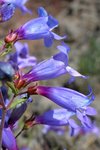
Sagebrush Bluebells (Mertensia longiflora)

I find all the early spring wildflowers very attractive, but the Sagebrush Bluebells are especially so. The flowers at Hells Canyon were not quite open at the tips, so I'm using a photo of a plant taken near a satellite Sage Grouse lek in the south western portion of Baker County a year or two ago. I'm unaware of any Native American uses for this plant, but this little beauty brightens the sagebrush communities in most of the interior west.

Sagebrush Buttercup (Ranunculus glaberrimus)

The bright and cheery Sagebrush Buttercup is the harbinger of Spring for the locals in Baker County. I look forward to seeing them every March along Elk Creek Road, just as I did today. Ours had been blooming for only a few days and most had not opened, while those in Hells Canyon must have begun to open around a little over a week ago. They seem to be about a week early on Elk Creek, which isn't surprising, given the mild winter. Most things have their dark side, and the buttercups are no exception--they are toxic. Ingestion can cause vomiting or diarrhea and they can irritate the skin. Northwest tribes used them for both poison and as poultices.
__________________

Brian Cole Motion Hearing Date Set

[Edited 3/10/10]

According to the good folks at the County Court house, the first open court hearing in the Brian Cole case has been set for March 17th, 2010, at 2:00 PM, in Circuit Court. This could change up to near the last minute if a higher priority case comes along between now and then.

My original understanding was that the trial would begin on March 17th, but what will occur is a "Motion Hearing,", where it is thought that Mr. Cole's attorney, Mr. J. Robert Moon, will make a motion to compel discovery of evidence that has been gathered for the case by the prosecution. This would include any evidence uncovered that might tend to clear Mr. Cole of Blame in the matter (exculpatory evidence). Additionally, if it hasn't already occurred, he will make a motion to return property of Mr. Cole's that had been seized by the State during their investigation. Other open court motions will likely be made in the days, weeks or months leading to trial.

Mr. Cole has been charged by the State with two counts of Furnishing Liquor to a Minor and four counts of Sexual Abuse in the Third Degree.

If you have been down to the courthouse on any of the dates when a matter involving this case was to be addressed, you will have noted the many people of little means having to publicly appear in court, some in chains, for legal problems ranging from name changes and marijuana use, to kidnapping. People are free to sit in court and listen to the give and take. Interestingly, given the charges involved, Brian Cole, to the best of my knowledge, has not had to appear in person even once. Also, to the best of my knowledge, most or all of the proceedings, like Monday's hearing and pretrial conference, were not held in open court. The Grand Jury was conducted in secret as a "secret body." March 17th will theoretically be an opportunity for the public to view a proceeding in the case, but nothing would surprise me and many things are possible.
__________________

Sunday, March 7, 2010

Hells Canyon Springing & Purgatory for Sage Grouse

In This Issue:

- Spring Has Sprung in Hells Canyon

- Obama Administration Sentences Sage Grouse to "Purgatory"

[Edited 3/8/10]
___________________

Hells Canyon:

A Hells Canyon Reflection

Dutchman's Breeches at Hells Canyon


I've been thinking more seriously about spring for the last week, culminating in a five day exploratory trip to the Hells Canyon country between between Oxbow and Hells Canyon Dam. The result is, that I am just now posting some info from environmental organizations and other sources on the "better than nothing. " near purgatory status given to the actually endangered Greater Sage Grouse this last Friday, March 5th. The links and other information about the sage grouse decision can be found immediately below the next photo of Dutchman's Breeches, which is a very early and immensely attractive perennial wildflower related to the native and ornamental Bleeding Hearts found in Baker City back yards. It can be found in the side canyons of the Snake River of Oregon and Idaho, and is also found in Washington state here in the North West. Elsewhere, it is very widely distributed from the mid-west, south to Georgia, but not in our other western states.

Other early spring wildflowers that can be found blooming in Hells Canyon right now are Lomatiums, Yellow Bells, Sagebrush Bluebells, Sagebrush Buttercup, and what I think might be Arabis crucisetosa, a comparatively small and delicate "rock cress." I'll try to post some photos of those plants in a later post.

Dutchman's Breeches at Hells Canyon
___________________

Obama/Salazar Send Sage Grouse to the Old Species Nursing Home, or is that Purgatory?

“warranted but precluded” is sort of the endangered species Newspeak equivalent of an old folks nursing home or hospice, where endangered species lie around without care in a sort of political purgatory. During this period, the powerful interests, like ranchers and energy companies, who have been the largest contributors to the species' decline, continue their destructive and sinful ways with half-hearted, often laughable, "mitigation," all the while praying alternately for the species' improbable survival on small reservations, or for their ultimate demise.

Greater Sage-grouse Warranted…but Precluded from ESA Protection
For immediate release - March 5, 2010


Contact:
Jon Marvel, Executive Director, Western Watersheds Project - 208-788-2290
 
Laird Lucas, Executive Director, Advocates for the West - 208-870-7621
 
Mark Salvo, Director, Sagebrush Sea Campaign - 503-757-4221
 
Katie Fite, Biodiversity Director, Western Watersheds Project - 208-429-1679

Seven years after conservationists petitioned to protect greater sage-grouse under the Endangered Species Act, Secretary of the Interior Ken Salazar announced today that the species is “warranted but precluded” from listing under the Act. The grouse will now join more than 270 imperiled species on the list of “candidate species” under the ESA. The decision marks the agency’s second attempt to assess the species for listing after the Bush Administration published an ecologically flawed, politically tainted decision not to list the grouse in 2005.

“We were right, the Bush Administration was wrong,” said Mark Salvo, Director of the Sagebrush Sea Campaign. “The sage-grouse is in trouble.”

The greater sage-grouse is a charismatic bird that lives in sagebrush steppe in eleven western states. First described by Lewis and Clark in 1805, nineteenth century travelers and settlers reported seeing huge flocks of sage-grouse that darkened the sky as they lifted from valley floors. However, westward expansion and development over the next 200 years eliminated almost half of sagebrush habitat. The total sage-grouse population, estimated between 140,000-500,000 birds, has declined between 69-99 percent from historic levels.

“The action by Secretary Salazar and the U.S. Fish and Wildlife Service comes years too late as hundreds of thousands of acres of sage-grouse habitat have been permanently altered or reduced in value for this charismatic native species since the initial petition for listing,” said Dr. Clait Braun, Director of Grouse, Inc. “Some populations are already at the brink of extirpation in each of the states where this species persists.” Dr. Braun, retired Avian Research Program Manager for the Colorado Division of Wildlife, has been involved with sage-grouse research and management since 1973.

Myriad human activities in the Sagebrush Sea have decimated sage-grouse habitat, including livestock grazing, oil and gas development, agricultural conversion, application of herbicides and pesticides, unnatural fire, urban sprawl, mining, off-road vehicle use, and the placement and construction of utility corridors, roads and fences.

The only way sage-grouse will survive is if large areas of the sagebrush sea are left undeveloped, and chronic disturbances like livestock grazing are removed from those areas,” said Katie Fite, Biodiversity Director for Western Watersheds Project. “This sad delay will make it much more difficult to effectively conserve this magnificent bird.”

The Fish and Wildlife Service’s finding indicates that current conservation efforts are failing to conserve sage-grouse. The grouse’s new status as a candidate species may require agencies such as the Bureau of Land Management to revise their land use plans on public land to improve habitat for sage-grouse and other sagebrush species.

“I look forward to making a careful review of the U.S. Fish and Wildlife Service’s reasons for this decision for sage grouse,” said Jon Marvel, Executive Director of Western Watersheds Project. “That review will determine if further litigation is needed to bring the agency into compliance with the law.”

The Sagebrush Sea Campaign, a program of WildEarth Guardians, was the lead petitioner to list the greater sage-grouse under the Endangered Species Act. Western Watersheds Project, a western conservation organization, successfully litigated a remand of the negative listing decision in 2007. Advocates for the West represented Western Watersheds Project in federal court. More than twenty conservation groups joined the petition to list sage-grouse under the ESA in 2003.
Resources

Video and images of sage-grouse, factsheets on sage-grouse and the Sagebrush Sea, and maps of sage-grouse range and land use in the West are posted at
www.sagebrushsea.org.
--

March 5, 2010
New York Times
No Endangered Status for Plains Bird
By JOHN M. BRODER
WASHINGTON — The Interior Department said Friday that the greater sage grouse, a dweller of the high plains of the American West, was facing extinction but would not be designated an endangered species for now.

Yet the decision in essence reverses a 2004 determination by the Bush administration that the sage grouse did not need protection, a decision that a federal court later ruled was tainted by political tampering with the Interior Department’s scientific conclusions.

Interior Secretary Ken Salazar, a conservative Democrat from a Colorado ranching family, sought to carve a middle course between conservationists who wanted ironclad protections for the ground-hugging bird and industry interests and landowners who sought the ability to locate mines, wells, windmills and power lines in areas where the grouse roam.

Mr. Salazar said that scientists at the United States Fish and Wildlife Service had concluded that the sage grouse deserved inclusion on the endangered species list but that other species were facing more imminent threats, leading the government to assign the bird a status known as “warranted but precluded.”

As a compromise measure, he said, the bird will be placed on the list of “candidate species” for future inclusion on the list and its status will be reviewed yearly.

The middle-ground decision is typical of Mr. Salazar’s stewardship at the Interior Department, where he has tried to mediate between competing energy and environmental interests. Like many previous decisions, including compromises on oil drilling in Utah and habitat protection for the polar bear in the Arctic, Mr. Salazar’s action left both sides somewhat disgruntled.

Residential building and energy development have shrunk the sage grouse habitat over the past several decades, causing its population in 11 Western states to dwindle from an estimated 16 million 100 years ago to 200,000 to 500,000 today.

“The sage grouse’s decline reflects the extent to which open land in the West has been developed in the last century,” Mr. Salazar said in a statement. “This development has provided important benefits, but we must find common-sense ways of protecting, restoring and reconnecting the Western lands that are most important to the species’ survival while responsibly developing much-needed energy resources.”

He said that state resource agencies would be instructed to take stronger steps to preserve the sagebrush where the birds live. Federal wildlife and lands agencies will oversee those efforts.

In 2004, the Bush administration Interior Department decided against listing the sage grouse as endangered or threatened, despite reports from agency scientists that the bird and its habitat were in jeopardy. Three years later, a federal judge ruled that a senior Interior Department political appointee, Julie MacDonald, had intimidated agency scientists and overruled their findings. She later resigned from the department over several similar incidents.

The judge ordered the department to review the sage grouse decision, which led to Friday’s announcement.

A group of lawmakers from Western states had strongly urged Mr. Salazar to keep the sage grouse off the endangered species list, saying that the states had made significant progress in protecting its habitat. They said adding the bird to the list would hurt ranchers and energy producers who need access to sagebrush-covered lands that would be off limits under the listing.

“Today’s unnecessary federal designation is one more on a growing list of examples that this administration places environmental special interests before job creation,” Representative Rob Bishop, Republican of Utah, said Friday.

“Not only is today’s announcement a direct attack on the hundreds of Western communities that depend on access to federal lands for ranching, livestock, mining and energy production, it also could potentially destroy opportunities for development of our renewable resources,” he said.

Representative Jason Chaffetz, another Utah Republican, has been more pungent in his opinion. “The only good place for a sage grouse to be listed is on the menu of a French bistro,” he said recently. “It does not deserve federal protection, period.”

Brian Rutledge, Rocky Mountain regional director for the Audubon Society, said he agreed with Mr. Salazar that other species were facing greater danger. But he said he hoped the decision to make the sage grouse a candidate for endangered species protection would mean that state and federal agencies would act much more aggressively to protect the bird’s threatened habitat.

“We’ve already achieved 50 percent total destruction of the sagebrush ecosystem and a large part of what’s left we’ve seriously compromised,” he said. “We have been told clearly that the science tells us this bird is in trouble. This is an absolute straightforward clarion call for us to pull together to save it.”

As for Mr. Chaffetz’s suggestion, Mr. Rutledge said: “All I can say is he never tasted a sage grouse; they taste horrible. It’s like eating sagebrush.”

Asked how he knew that, Mr. Rutledge responded, “Anecdotally.”

Sunday, March 18, 2007

MORE SIGNS OF SPRING ARRIVE IN BAKER COUNTY


Sagebrush Buttercups

I’m giving many heart-felt thanks that the spring equinox arrives on Tuesday March 20th, at 5:07 PM. You may have noticed the sagebrush buttercups (Ranunculus glaberrimus var. glaberrimus) blooming this week if you’ve taken the time for a stroll in the countryside. They were blooming early in the week around Salt Creek north of highway 203 and later in the week along Elk Creek Road west of Bowen Valley. Healthy looking herds of pronghorn antelope can also be found in both areas. Grass widows (Sisyrinchium douglasii) are said to be blooming in Union County and Allium tolmei, with its white or pink flowers, will be blooming soon as well.

Sisyrinchium douglasii

Allium tolmei

Other signs of life are springing forth in back yards around Baker City. Crocus is blooming here along with the violets, and the tulips won’t be far behind. The 'Tricolor' variety of crocus is a selected clone of a subspecies of a snow crocus Crocus sieberi sublimis, native to mountains of the Peleponnese. Very cold hardy, it is suitable down to zone 3.

Crocus sieberi sublimes

BIRDS

On the bird front, the few sage grouse that have survived the human expropriation and/or ruination of their sagebrush habitat will begin their annual booming and strutting sessions about now.
Sage Grouse

From up in the mountains south of Phillips Reservoir, Jim Lawrence reports that “The birds here are getting really fired up, in the last week many elevational migrants have shown up: White-headed woodpeckers, juncos, solitaires, western bluebirds, Cassins finch were all noticeable. Yesterday I had my first saw-whet owl, and today woke to the sound of 2 male redwing blackbirds and a varied thrush. Pretty exciting stuff!”

Again, we should all be so lucky.

Joanne Britton sends along the following: “Cheyleen Davis reports sandhill cranes at Phillips Lake and mountain bluebirds. Jim Lawrence and I saw three sandhills circling high--found them by sound. We also saw tree swallows, horned larks darting around and sitting on fence posts--a great day for birding. Maybe the best sighting for me was a large flock of white-fronted geese at the Nazarene parking lot (sorry, Wanda R., they flew as we left).

Jim is willing to go on field trips with interested people to help identify birds and work with listening and IDing by sound. Does anyone want to join us? This will depend on his availability, but April, May, and June are good months. Please pass the word to those not on the list. I'd like to hear back from you.” (You can e-mail me your interest at refugee2000@qwest.net and I’ll pass the info on to Joanne and Jim. Also, Cheyleen is looking for native plants for a garden she and her students are putting in behind the old bank vault in Sumpter. If you have anything to offer let me know.)

My raptor count Friday on the Burnt River between Bridgeport and Unity Reservoir wasn’t all that exciting. Diversity was down with lots of red-tail hawks but not much else. The rough-legged hawks have left for their northern breeding areas, and the southern migrants haven’t appeared yet, except that I did get two turkey vultures. Joanne B. had one the same day north west of Baker City. The great horned owl is still nesting on Bridgeport Lane, and I saw only one prairie falcon and no golden eagles or accipiters. There seems to be a mated pair of bald eagles still hanging out as well as one juvenile. Also picked up mountain bluebirds and two northern shrikes. Last year there were about 250 tundra swans on the S. Fork Burnt River arm of Unity Reservoir n the 13th, but by the 16th of this year there were only 74. Did see three separate pairs of sandhill cranes along the route as well as two Say’s phoebes. Also saw four western bluebirds and many horned larks last week in the valley, plus two sandhills flying north over my house. Things are looking up!

STRAIGHT TALK:

From Indy Media: The Pentagon was the focus of a spirited Peace demonstration on March 17, 2007. The crowd in the tens of thousands heard from over 30 riveting speakers. Activist Cindy Sheehan said: “Let’s stop this b... s...These b... s.... wars. It’s for the corporations...to make them rich and line the pockets of the...war criminals.” She added: “We’re the deciders. And we have decided that we want Bush and Cheney impeached...indicted...and imprisoned.”

Thousands line streets in Hollywood

PROTESTS MARK THE FOURTH ANNIVERSARY OF THE WAR IN IRAQ

Iraq war protesters to march on Pentagon after 100 arrested:

Thousands of people are expected to converge on the center of the US capital Saturday and march on the Pentagon to protest the Iraq war, following the arrest of about 100 people during an anti-war vigil the night before.
http://snipurl.com/1dao6

------

Christians Gather in D.C. to Protest War:

Thousands of Christians prayed for peace at an anti-war service Friday night at the Washington National Cathedral, kicking off a weekend of protests around the country to mark the fourth anniversary of the war in Iraq.
http://abcnews.go.com/US/wireStory?id=2958667

------

Ellsberg Joins March 19th Stop Funding the War Protest at Speaker Pelosi's Office

Daniel Ellsberg has agreed to be the lead speaker at The Stop Funding the War http://www.stopfundingthewar.org rally at 12 noon on Monday, March 19, 2007 in front of House Speaker Nancy Pelosi's district office at the San Francisco Federal Building, 450 Golden Gate Avenue.
http://snipurl.com/1dao8

------

True Confessions? The Amazing Tale of Khalid Shaikh Mohammed

By Anthony D'Amato

The sweeping Guantanamo "confessions" of al Qaeda leader Khalid Shaikh Mohammed rival the scope of those made in the Stalinist purge trials of the 1930s, and should equally prompt us to question the legal process in which they were made...
http://www.informationclearinghouse.info/article17340.htm

------

The Confession Backfired
By Paul Craig Roberts

The first confession released by the Bush regime’s Military Tribunals--that of Khalid Sheikh Mohammed--has discredited the entire process. Writing in Jurist, Northwestern University law professor Anthony D’Amato likens Mohammed’s confession to those that emerged in Stalin’s show trials of Bolshevik leaders in the 1930s.
http://www.informationclearinghouse.info/article17336.htm

------

Washington exploits Guantánamo “confession” to justify its crimes
By Bill Van Auken
16 March 2007

What is largely obscured by the media’s approach is that Mohammed’s confession was extracted over the course of four years of detention and torture in secret CIA prisons, and that thousands of others subjected to similar treatment have yet to be accused of, much less tried for, a single crime.
. . . .

As for Mohammed, his confession would be ruled inadmissible in any genuine court. There is no question that he was subjected to forms of extreme torture. He was further intimidated by the CIA’s seizure of his wife and two young children, who were threatened with similar treatment unless he told his interrogators what they wanted to hear.
. . . .

In short, this is an individual who was not an Islamist and whose activities over the course of more than a decade appear to have dovetailed neatly with those of the CIA, directly serving the interests of American foreign policy.

That such an individual is identified as the “mastermind of September 11” only raises once again the essential question surrounding the still unexplained and tragic events of that day: was the US government informed in advance of the 9/11 plot and did it deliberately allow it to take place in order to provide the Bush administration with the pretext that it required to launch its already planned campaign of military aggression and conquest in Central Asia and the Persian Gulf?

It is not only Mohammed’s history as an apparent “asset” of both the CIA and Pakistani intelligence that raises this question. Any serious examination of the information that has emerged about how these attacks were prepared strongly suggests that intelligence officials in the US actively intervened to prevent the plot from being exposed and to protect those who ultimately carried it out.

Those quickly identified as the hijackers after 9/11—Mohammed Atta, Khalid al-Midhar and Nawaf al-Hazmi and others—were well known to US intelligence and had been under surveillance, in some cases for years, by the CIA. Nonetheless, they were allowed to enter and reenter the US, living openly and flying on transcontinental airplanes under their own names. The latter two individuals were even given housing by the FBI’s chief informant on Islamic radicalism in southern California.

Such questions, however, are raised neither by the media nor by the Bush administration’s ostensible political opposition, the Democratic Party. On the contrary, both rallied in support of the essential aim of the administration in releasing the Khalid Sheikh Mohammed transcript: terrorizing the American people and diverting public opinion.

Particularly revealing was the response of Democratic presidential candidate Senator Barak Obama of Illinois.

“Obviously, just from the confession, we see the scope of the planning that was done by al-Qaeda,” he declared on the morning television news program “Today” Thursday. “I think it just redoubles our need to make sure that we are securing the homeland...and that we are aggressive in terms of human intelligence, and really snuffing out these terrorist networks.”

To talk of the need to be “aggressive in terms of human intelligence” in relation to a case in which US intelligence officials acknowledge the use of the most extreme forms of torture, to the extent that the suspect cannot even be presented publicly, has unmistakable significance. Indeed, the entire subtext of the public discussion of Mohammed’s confession—obviously embraced by Obama—was that torture is both legitimate and necessary.

Obama went on to make the case that the Democrats demand for a withdrawal of combat troops—though by no means all troops—from Iraq was predicated on their redeployment... to Afghanistan.

“We have not followed through on the good starts we made in Afghanistan, partly because we took so many resources out and put them in Iraq,” he said. “I think it is very important for us to begin a planned redeployment from Iraq, including targeting Afghanistan.”

What emerges from this reaction to the Mohammed transcript is the bipartisan support for militarism abroad and sweeping attacks on democratic rights at home. Both major big business parties are agreed that the wars and occupations in Iraq and Afghanistan must continue and that the open-ended “war on terror” should be used to justify military aggression internationally. They also both support the use of police state powers and stepped-up spying at home to defend the interests of America’s ruling financial aristocracy. To the extent that there are differences, they are only over how well these methods have been employed and over what constitute the best tactics for accomplishing their shared goals.
http://www.wsws.org/articles/2007/mar2007/ksmo-m16.shtml

------

The Problem with Barack Obama's Israel Pose
http://www.antiwar.com/frank/?articleid=10683

The significance of the World Court ruling on genocide in Bosnia
By Paul Mitchell
16 March 2007

“The aim of the West was to dismantle the state-run economy and restore the economic domination of international capital over Yugoslavia and the entire Balkan region.”

http://www.wsws.org/articles/2007/mar2007/icj-m16.shtml

Yugoslavia was destroyed because it was one of the few remaining viable examples of socialism remaining in the world. Wealthy Capitalists live to crush the Socialist ideal.

Chris